
Pinnasys, an AI consulting and development company serving US mid-market businesses, today published a buyer’s checklist for companies weighing outside AI help. The aim is simple: help operators compare AI consulting firms on evidence rather than pitch decks, and avoid the stalled pilot that has sunk many first AI projects.
Most companies no longer ask whether to use AI; they ask who should build it with them. That second question is where budgets are won or lost, because an outside partner shapes which problem gets solved, how your data is handled, and whether anything reaches production. That is why the question of how to hire an AI consulting company deserves as much attention as the choice of model or platform. This checklist covers what separates a strong AI consultant from a reseller and how readiness and maturity assessments should work. It also explains what to demand on security and governance, how pricing behaves after the first quote, and which questions expose weak answers early.
Why the Right AI Consulting Company Changes Your AI Outcomes
The partner you pick shifts the odds of success more than most buyers expect. Research from MIT’s NANDA initiative, reported by Fortune, found that AI projects built with specialized vendors or partners succeeded about 67% of the time, while internal builds succeeded roughly one-third as often. That gap reflects hard-won experience with integration, data, and user adoption, which a good AI consulting company brings and a weak one only claims. This is why learning how to hire an AI consulting company is a risk decision, not a procurement formality.
What a Strong AI Consultant Does Differently From a Vendor
A vendor starts from its product and looks for a place to install it, while a strong AI consultant starts from your workflow and treats every tool as optional. Picture a distributor struggling with slow quotes: the vendor pitches its chatbot on the first call, whereas the consultant first measures quote volume, error rates, and pricing rules before recommending anything.
The Cost of Hiring the Wrong AI Consulting Firm
The invoice is the smallest part of a bad hire, and the larger loss is a year spent on a project that never ships. Gartner reports that at least half of generative AI projects were abandoned after proof of concept by the end of 2025. A wrong-fit AI consulting firm leaves behind rework, skeptical staff, and a second procurement cycle.
How Do I Choose an AI Consulting Company
Choose on three filters: how a firm diagnoses problems, what it actually delivers, and whether its services map to a measurable business goal. Those filters matter because RAND’s study of why AI projects fail traced the most common root cause of failure to stakeholders misunderstanding the problem AI should solve. By some estimates cited in that report, more than 80% of AI projects fail. Put simply, the first step in how to hire an AI consulting company is testing whether the firm listens before it sells.
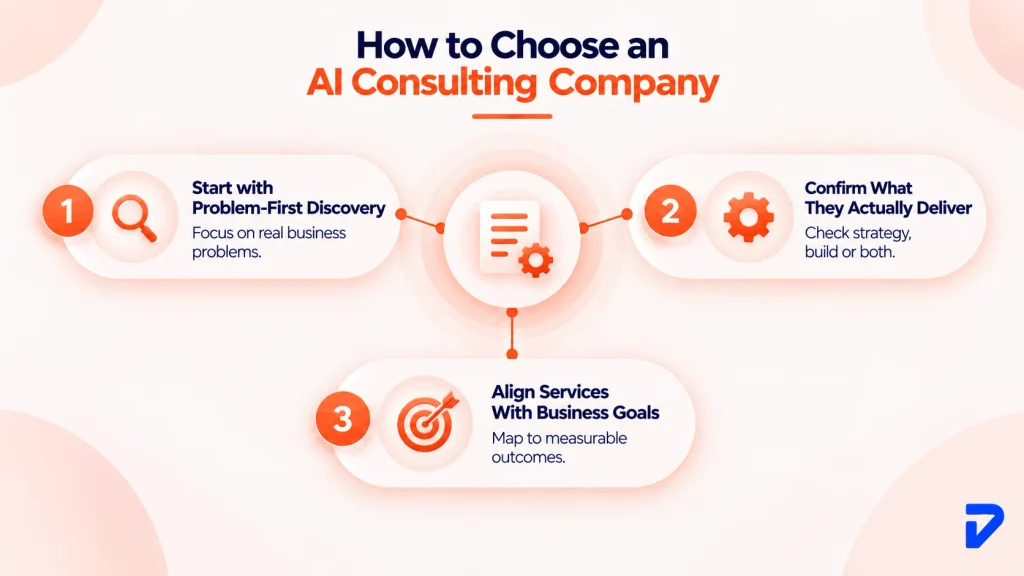
Starting With Problem First Discovery, Not a Pitch
Strong firms open with questions about your operations, not slides about their capabilities. A useful first session maps one workflow end to end: who touches it, how long it takes, where errors appear, and what a fix is worth. The format often resembles a structured AI use case discovery workshop, held before any build is quoted.
Confirming What the Firm Actually Delivers: Strategy Build or Both
Some firms stop at a roadmap, some only write code, and a smaller group owns both strategy and delivery. Ask for a sample deliverable from each phase, such as a prioritized use-case register and a deployed pipeline with monitoring. If a firm sells only AI strategy consulting for the enterprise, budget separately for whoever will build it.
Matching AI Consulting Services to Your Business Goals
Every proposed service should trace back to a number your leadership already tracks, such as days sales outstanding, first-contact resolution, or quote turnaround. Where a proposal lists AI consulting services without naming the metric each one moves, ask for its ideas scored with an impact versus effort prioritization framework. Then drop anything that lacks a baseline.
What Should I Look for When Hiring an AI Consulting Partner
Look for proof in your industry, technical depth that spans strategy and production engineering, and the honesty to say when AI is the wrong tool. The market is crowded with rebranded offerings, so each trait needs a direct test rather than a promise in a proposal.
“Buyers should expect a consultant to measure the workflow before it proposes a model,” said Prakash Saini, Founder and CEO of Pinnasys. “We would rather tell a client that a simpler fix will do than build an AI system that never pays for itself.”
Industry Experience and Relevant Use Cases
Industry context shortens discovery because the consultant already knows your systems, regulations, and data quirks. Consultants who have worked with wholesalers will ask about ERP price tables and EDI orders without prompting, as this look at AI consulting for distribution companies shows. Request two use cases from your sector and one reference from a similar-sized client.
Technical Depth Across AI Strategy Consulting and Delivery
Depth shows up in specifics, such as how the team handles retrieval-augmented generation (a method that fetches your own documents before the model answers), evaluation datasets, observability, and cost controls. Ask who will write the code and whether the firm runs production systems today. Partners offering custom AI development services should answer with examples, not theory.
A Consultant Willing to Recommend Against AI
Integrity shows when a consultant admits that a rules engine or a spreadsheet fix will do the job. Gartner estimates that only about 130 of the thousands of agentic AI vendors are real, and notes that many use cases marketed as agentic do not need that approach. Ask each finalist to name one idea it would refuse to build.
How to Understand AI Readiness Assessment and AI Maturity Model Services
An AI readiness assessment tells you whether your data, systems, people, and controls can support a specific use case. A maturity model, by contrast, places the whole organization on a staged scale so investments land in the right order. Data usually decides the outcome, since Gartner predicts that through 2026, organizations will abandon 60% of AI projects unsupported by AI-ready data.
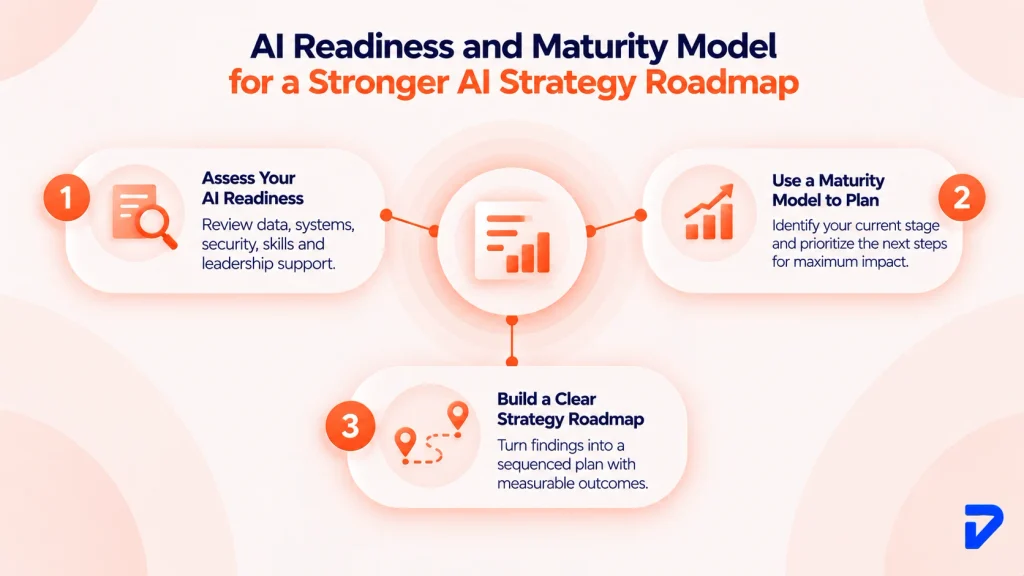
What a Proper AI Readiness Assessment Should Cover
A credible assessment inspects data quality and access, integration points, security posture, skills, and executive sponsorship, then ties each finding to a named use case. The output should be a scored gap list with owners and cost estimates, not a generic survey. This AI readiness assessment guide offers a benchmark for judging proposals.
How an AI Maturity Model Shapes Your AI Strategy Roadmap
Maturity models stop companies from buying advanced tools on top of weak foundations. The MITRE AI Maturity Model scores six pillars, including data and strategy, across five levels from initial to optimized. A good consultant uses a model like it to sequence your AI strategy roadmap, fixing data access before promising autonomous agents.
How to Evaluate an AI Consulting Company Checklist for Delivery Capability
Delivery is where proposals and reality diverge, so this part of your AI consulting company checklist should test technical fit, testing discipline, and handover terms with evidence. A firm that ships production systems will have test reports, runbooks, and dashboards to show, alongside published client case studies naming the problem, the build, and the measured result. Anyone serious about how to hire an AI consulting company should ask to see those artifacts before the second meeting.
Reviewing Generative AI Consulting Services and Technical Fit
Generative AI consulting services fit only if they work inside your stack, respect your data boundaries, and run at a sustainable cost. Request an architecture sketch showing models, data flows, and integration points with systems such as Salesforce, NetSuite, or SAP. Any partner that cannot explain its model choice and fallback plan in plain English is not ready to build.
Checking How the Firm Tests Difficult and Uncertain Cases
Demos succeed on clean inputs, yet production breaks on messy ones. Ask how the firm builds evaluation sets from real edge cases and when a person reviews low-confidence outputs. Then ask how it red-teams, meaning deliberate attacks that expose weaknesses, against the OWASP Top 10 for LLM applications. An invoice agent, for example, should route unreadable scans to staff.
Confirming Ownership and Handover After the Engagement
Ownership terms decide whether you hold an asset or rent a dependency. Your contract should assign code, prompts, fine-tuned weights, and evaluation data to you, and require documentation, runbooks, and training for your team. Ask how the firm moves a system from pilot to production and who holds cloud accounts, API keys, and admin access afterward.
Security Data Practices and AI Governance Framework Requirements
Security and governance belong in the statement of work, not in a policy appendix nobody reads. Any AI consultant touching your data should explain where it is stored, who can reach it, which third-party models process it, and how decisions are logged. The strongest answers map to ISO/IEC 42001, the international management-system standard for AI.
For US buyers, the voluntary NIST AI Risk Management Framework adds a shared vocabulary for mapping, measuring, and managing AI risk. A capable firm will align its controls to it and show you where each one lives in the delivered system.
Data Handling Access Control and Third-Party Model Risk
Ask whether prompts and outputs leave your environment and whether model providers may train on them. Then confirm that access follows least privilege, meaning each user and agent gets only the permissions its task needs. The NIST Generative AI Profile flags data privacy and information security among its core risks, so insist on written answers.
Building an AI Governance Framework Into the Engagement
An AI governance framework, meaning the policies, roles, and controls that decide who approves, monitors, and corrects AI decisions, should be built during the project rather than bolted on later. Expect named decision owners, audit logs, model change approvals, and incident escalation paths. Firms providing AI integration, ops, and governance services should hand these over as working processes.
Unsure which AI consulting proposal will survive production?
Pinnasys scopes one measurable workflow first, then builds, tests, and hands it over with your team owning every line of code.
How Much Does AI Consulting Cost
AI consulting cost depends on scope more than on hourly rates. A readiness assessment is usually a short fixed-fee engagement, a production build is priced by phase, and ongoing support becomes a monthly line. At the far end, Gartner estimates that the most ambitious generative AI deployment approaches cost between $5 million and $20 million. Mid-market buyers working out how to hire an AI consulting company should therefore insist on a scoped first workflow before any large commitment.
What Drives AI Consulting Pricing Beyond the Initial Quote
The quote covers the build, but the real price includes data cleanup, integration, model usage, monitoring, and change requests. A disciplined firm prices in sequence: audit the workflow, set a baseline cost, fix the scope, separate cost buckets, and project ROI. Should a proposal blend one-time and recurring costs, ask for them split, and weigh the build versus buy tradeoffs.
Total Cost of Ownership Versus the Lowest Bid
The cheapest proposal often becomes the most expensive system to run. Model prices keep falling, and the Stanford AI Index reported a 280-fold drop in GPT-3.5-level inference cost between late 2022 and late 2024, so labor, integration upkeep, and rework now dominate spend. Compare three-year costs, including support hours and retraining, rather than day-one fees.
Who Are the Best AI Consulting Companies for Mid-Market Businesses
No single firm is best for every mid-market company, because the right choice depends on budget, industry, and whether you need strategy, delivery, or both. Company size also shapes results: McKinsey found that 29% of companies under $100 million in revenue had begun scaling AI, against nearly half of those above $5 billion. Most options fall into three groups.
| Firm type | Examples | Strengths | Tradeoffs | Best fit |
|---|---|---|---|---|
| Global consultancies | Accenture, Deloitte, IBM Consulting | Breadth, change programs, regulatory depth | Premium rates; senior partners may not staff daily work | Multi-country, board-led transformation |
| Engineering-led firms | Thoughtworks, EPAM Systems, Slalom | Software rigor and platform depth | Minimum project sizes may exceed mid-market budgets | Complex builds on existing platforms |
| Specialist AI boutiques | Pinnasys and similar focused firms | Senior practitioners, fast scoping, outcome focus | Smaller bench and narrower coverage | One or two high-value workflows first |
What Mid-Market AI Buyers Should Prioritize Differently
Mid-market AI buyers rarely have spare engineers, so they need a partner that delivers working systems and trains the people who inherit them. The stakes are rising, since the National Center for the Middle Market reports that nearly a third of middle market companies name AI their primary destination for capital investment. Speed to first value should outrank breadth.
Balancing Enterprise AI Expertise With Mid-Market Budgets
Enterprise AI expertise helps only when it arrives in a form a mid-market budget can absorb. The right firms have senior people who have run large programs yet scope phased work, such as one workflow in the first quarter and a second once results are measured. Also confirm that the people who wrote the proposal will actually staff the project.
What Questions Should I Ask an AI Consulting Vendor
Ask questions that force specifics about how the vendor discovers problems, tests systems, measures value, defines scope, and supports you after launch. Measurement deserves extra weight: Cisco’s AI Readiness Index found that the best-prepared companies, about 13% of organizations, are four times more likely to move AI pilots into production. The two question sets below work as a script for finalist meetings.
Questions About Discovery Testing and Measurement
These questions separate a method from a sales script, and they pair well with a clear view of how to measure AI ROI:
- What baseline will you measure before building?
- How will you build test sets from our edge cases?
- Which metric would prove this project failed?
- Who reviews low-confidence outputs once live?
Questions About Scope Ownership and Long-Term Support
Scope and support questions protect you after signing, when change requests test the relationship. Plan for adoption too, because AI change management decides whether staff use the system:
- What is out of scope, in writing?
- Who owns the code, prompts, and weights?
- What does support cost after month three?
- How will you train our team?
Warning Signs to Look for When Hiring an AI Consultant
The clearest warning signs are premature solutions and evasive answers on risk. Either one suggests the firm is selling something it already built rather than solving the problem you have. The cheapest lesson in how to hire an AI consulting company is to spot both within the first two meetings.
Solutions Proposed Before Discovery Is Complete
A proposal that names a model, platform, or agent framework before anyone has studied your data is a template with your logo on it. Consider a vendor recommending a customer service chatbot after a single call: it has skipped volume analysis, intent mapping, and integration review. Push back and ask what evidence supports the recommendation.
Vague Answers on Security Governance or Ownership
Evasion on risk topics usually means the firm has not done the work. Regulation raises the stakes: the EU AI Act allows fines of up to €35 million or 7% of global annual turnover for the most serious violations. The law reaches US companies serving EU customers too. Treat any “we’ll sort that out later” reply as disqualifying.
Which AI Consulting Company Should I Hire
Hire the firm that proves it understands your problem, can run the solution in production, and will leave you owning the result. Price and polish should break ties rather than decide the outcome, and a structured scorecard keeps a charismatic pitch from outweighing thin delivery proof. It is the last and most consequential step in how to hire an AI consulting company.
A Simple Scorecard for Comparing Final Candidates
Score each finalist from one to five on five weighted criteria, and have at least two people score independently before comparing notes. Disagreements between scorers are useful, because they usually point to a claim nobody verified. Adapt the weights below to your own risk profile, and keep the completed sheet as the baseline for your post-pilot review.
| Criterion | Weight | What a 5 looks like |
|---|---|---|
| Discovery quality | 25% | Measured baseline and a clear problem statement |
| Delivery proof | 25% | Production systems and test reports shown |
| Security and governance | 20% | Written data, access, and audit controls |
| Ownership and handover | 15% | Full IP transfer and trained internal owners |
| Commercial clarity | 15% | One-time and recurring costs split out |
Making the Final Call Beyond Client References Alone
References are curated, so treat them as one input rather than the verdict. Ask each reference what went wrong and how the firm responded, then weigh independent signals such as published technical work and vendor partner programs, like the Claude Service Partner network Pinnasys joined. A short paid pilot remains the strongest test.
A Complete AI Consulting Company Checklist Before You Sign
Use this final list as a sign-off gate, and resolve any unchecked item before the contract is executed. It condenses everything above on how to hire an AI consulting company into three short lists that procurement, IT, and operations leads can review together in one sitting.
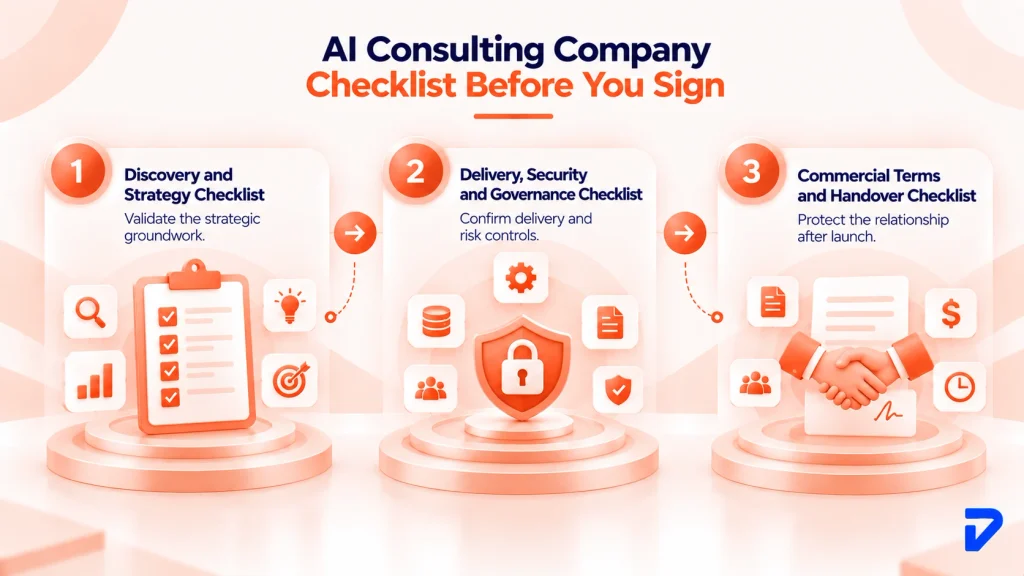
Discovery and Strategy Checklist
Before signing, confirm that the strategic groundwork exists in writing rather than only in meeting notes:
- One workflow selected, with a measured baseline
- A readiness assessment scored against that use case
- An AI strategy roadmap sequenced by maturity stage
- Success and failure metrics agreed by both sides
- A named executive sponsor on your side
Delivery Security and Governance Checklist
Next, check that delivery and risk controls appear as contractual commitments, not verbal assurances:
- Architecture and model choices documented, with fallbacks
- Evaluation sets built from real edge cases
- Human review defined for low-confidence outputs
- Data residency, retention, and access rules in writing
- An AI governance framework with logging and escalation paths
Commercial Terms and Handover Checklist
Finally, protect the relationship after launch with commercial terms that leave nothing to interpretation:
- One-time and recurring costs listed separately
- Code, prompts, weights, and data assigned to you
- Runbooks, documentation, and team training included
- Support hours, response times, and exit terms defined
- A paid pilot with a clear go or no-go decision
The Bottom Line
The answer to how to hire an AI consulting company comes down to evidence at every stage. That means a measured problem before a proposal, production proof before a contract, and written ownership before launch. Firms that pass those tests tend to deliver systems your team can run, while firms that skip them tend to deliver slide decks. Many successful first engagements start small, often with a single workflow and process automation project that proves value within a quarter.
Key Takeaways from this Checklist
- Problem-first discovery, not a polished pitch, predicts which AI projects reach production.
- A credible readiness assessment ties every data gap to one specific use case.
- Contracts should assign code, prompts, model weights, and evaluation data to the buyer.
- Three-year total cost of ownership reveals more than the lowest initial bid ever will.
- Weighted scorecards and short paid pilots outperform reference calls when choosing between finalists.
Frequently Asked Questions on Hiring an AI Consulting Company
How Do I Choose an AI Consulting Company?
Shortlist three to five firms and give each the same written brief describing one workflow and its current baseline. Compare how they diagnose it, since the firm asking the sharpest questions in meeting one usually builds best.
What Should I Look for When Hiring an AI Consulting Partner?
Strong AI consultants can show at least two production systems running for six months or longer. They should also explain their testing method and name the people who will staff your project.
Who Are the Best AI Consulting Companies for Mid-Market Businesses?
The best fit is usually a firm that has delivered for companies with roughly 50 to 1,000 employees and prices work in phases. It should treat mid-market clients as core business, not a side practice.
What Questions Should I Ask an AI Consulting Vendor?
Ask what baseline they will measure, how they test edge cases, who owns the code and weights, and what support costs after launch. A request for written answers within five business days also shows how organized the vendor is.
How Much Does AI Consulting Cost?
Costs vary with scope, so ask every vendor to project three years of maintenance, model usage, and support alongside the build fee. Over a system’s life, those running costs can exceed the original quote.
Which AI Consulting Company Should I Hire?
Hire the firm that scores highest on evidence rather than presentation, ideally after a paid pilot of six to twelve weeks. When you hire an AI consulting firm this way, you limit risk before committing a full budget.