


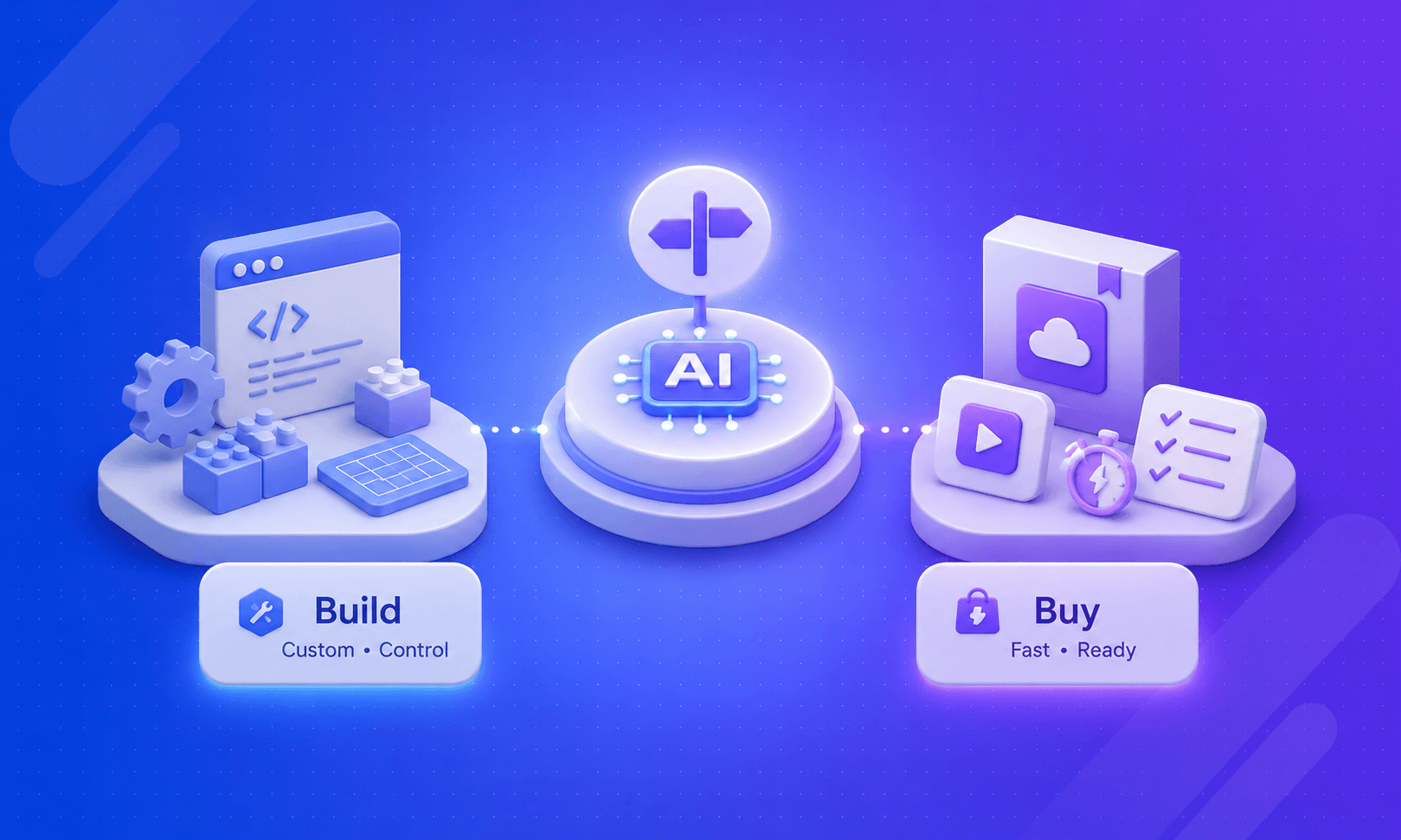
Build vs buy AI comes down to fit, speed, and control. Buy for common, proven use cases and fast results. Build when workflows are unique, or AI is your edge.
AI has moved past being a mere efficiency booster and evolved into a strategic investment that can revolutionize the operations, innovation, and competition of any business enterprise. The dilemma of build vs buy AI happens when regular AI services become incapable of meeting the ever-changing needs of the business, along with its processes and growth.
While the ready-to-use approach brings ease and convenience on one hand, on the other, it does not bring flexibility for all organizations. Here begins the debate of custom AI vs off-the-shelf AI. Both have their own benefits, constraints, and impacts in the long run. In this guide, we will explore the differences between the two approaches.
What Does Build vs Buy AI Mean?
Build vs buy AI is a sourcing choice. You either build a custom AI system or buy a ready-made one. Both put AI to work, but they differ in fit, cost, and control. Building means custom AI development shaped to your exact workflow. Your team or a partner designs, trains, and ships the system, and you own the models, the data, and the roadmap.
Buying means licensing an off-the-shelf tool from a vendor, and it is configurable, not custom. You get proven features fast, but the vendor controls updates and direction. Most companies end up using a mix of both.
Why Businesses Need to Evaluate Build vs Buy AI Carefully?
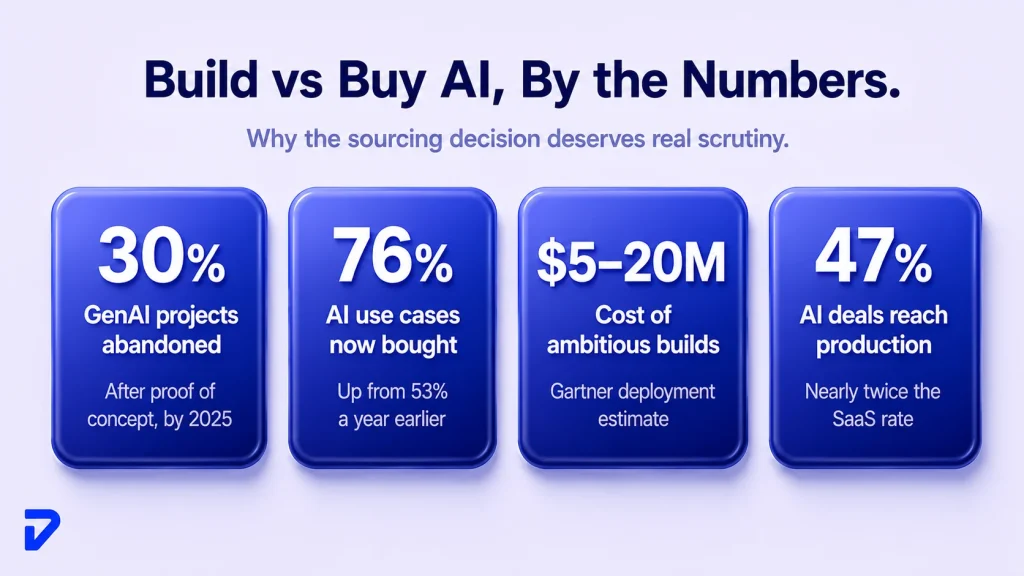
The AI build-or-buy decision shapes cost, speed, and risk for years to come. Rushed choices are what drive that 30% abandonment rate. A rigid tool can trap a unique process, and a custom build can drain budget on a common one.
The market has turned towards the buy side, with Menlo Ventures noting that 76% of AI use cases are bought rather than made, as opposed to 53% a year ago. Out-of-the-box solutions are quicker to implement and generate proof of concept earlier on. But just because something works in a market average doesn’t mean it’s for you. It’s about fit, not fashion.
When Should You Build a Custom AI Solution?
Building an AI product is justified where existing solutions are not flexible enough to cater to the specifics of your business. When faced with these five signs, it becomes clear that building will yield ROI in spite of all the added effort.
Your Business Has Unique Workflows
An off-the-shelf solution assumes certain business processes and therefore makes you do unnatural things, while a tailor-made one models your processes, your business rules, and your data model precisely, without compromises. This exact fit is often crucial in making people adopt AI at all.
AI Is a Strategic Competitive Advantage
When AI sits at the core of how you compete, owning the technology protects your advantage. A licensed tool hands identical capabilities to every rival that signs the same vendor contract. Custom development builds proprietary capability that competitors cannot simply purchase, which justifies the larger investment.
You Require Full Data Ownership
Some data is too sensitive or regulated to route through an external vendor’s cloud infrastructure. Building keeps your models, training data, and inference pipeline entirely inside your own secured environment. You control where information lives, who accesses it, and how long the system retains it.
You Need Highly Customized Features
Vendors build for the widest market, so their roadmaps rarely include the specific logic you need. When your use case demands particular integrations, controls, or decision rules, generic tools fall short. Custom AI lets you shape every feature around the job, rather than bolting on compromises.
Long-Term Value Justifies Higher Investment
Building custom AI demands more money and time upfront, which makes it a serious commitment. The investment pays back when the system runs at scale across many years of operation. Spread over that lifespan, custom AI often undercuts the compounding cost of perpetual subscription fees.
Benefits of Building Custom AI Over an Off-the-Shelf AI Solution
Custom AI development trades speed for depth and control. The technical payoff shows up across the stack.
- Perfect workflow integration: The system learns your logic, corner cases, and data schema, not some template from a vendor.
- Full ownership of data: Your training data, weights, and inference remain within your own ecosystem, which will help with privacy and residency requirements.
- Seamless integration: Custom APIs are used to hook up into your CRM, ERP, and internal databases; no fragile middleware needed here.
- Control over the model: You get to decide on architectures, parameter tuning, and retraining schedules yourself.
- No lock-in: You own the code and pipelines, so you’re not locked in with price increases and roadmaps dictated by a vendor.
- Economies of scale: Once deployed, your marginal cost per additional user remains small despite growing adoption throughout the company.
Challenges of Building Custom AI
Building is powerful, but it carries real weight. Know the friction before you commit.
- High upfront cost: Gartner puts the most ambitious custom generative AI deployments at $5 million to $20 million.
- Scarce talent: You need AI engineers, data scientists, and MLOps skills that are hard to hire and keep.
- Longer timeline: First value can take months, not days, and that delay tests patience and budgets.
- Data burden: Models are only as good as your data, so cleaning and labeling it is slow work.
- Ongoing upkeep: You own monitoring, retraining, and fixes for the life of the system.
When Should You Buy an Off-the-Shelf AI Solution?
Buying works best when speed, reliability, and predictability of costs are more important than custom development. In its report, Menlo Ventures found that 47% of AI investments now make it to production, almost doubling the rate for regular software. These five indicators together give clear guidance to buy an off-the-shelf solution rather than build.
You Need Immediate Results
A vendor tool can go live within days or weeks, while a custom build takes months. When the delivery clock drives the decision, buying gives you working AI almost right away. That early value keeps momentum alive while you plan any larger AI initiatives around it.
Your AI Use Case Is Common
Chatbots, transcription, and document search are mature problems that vendors have solved thousands of times. Their models are refined across many customers, so accuracy and reliability arrive out of the box. For a common workflow, buying easily beats spending months reinventing proven technology from scratch yourself.
Limited Budget or Development Resources
Not all organizations have the funds to pay for an entire build or to find AI engineers and data scientists to work on the project. A recurring subscription makes the costly upfront payment smaller and more periodic. This is the right choice for lean organizations that require tangible outcomes and do not wish to spend significant money.
You Want Proven Technology
A solution with a reputation has proof of performance in terms of customer testimonials, benchmarking, and case studies. A company can try out a technology and assess its accuracy without spending significant upfront funds. This drastically decreases the risks of investing in an untested custom solution.
You’re Testing AI Before Larger Investments
Buying a tool will give you a chance to analyze the true effectiveness of AI in your specific case without investing significantly. You will learn about adoption patterns and gain insights that will help you create a custom solution.
Benefits of Buying Off-the-Shelf AI Solutions
Off-the-shelf tools optimize for speed, reliability, and low overhead. The technical upside is concrete.
- Fast deployment: Prebuilt models and APIs mean you configure, not code, cutting time to value sharply.
- Predictable cost: Subscription pricing replaces a large capital outlay, easing budgeting and approval processes.
- Vendor-managed upkeep: The provider handles hosting, monitoring, retraining, and security patches for you.
- Proven reliability: Models are hardened across many customers, so common edge cases are already handled.
- Automatic upgrades: New features and model versions arrive without an internal engineering effort.
- Lower skill barrier: Business teams can run the tool without a dedicated AI or MLOps function.
Limitations of Off-the-Shelf AI Solutions
Convenience has trade-offs. These limits push some teams back toward building.
- Generic fit: You adapt to the tool, not the other way around. Unusual workflows expose the gaps fast.
- Vendor lock-in: Pricing, data, and roadmap are tied to the provider, so switching later can be painful.
- Shared capability: Rivals can license the same tool, so it rarely becomes a lasting edge.
- Data exposure: Your data flows through vendor systems, which can clash with privacy rules.
- Limited control: You cannot change the model, and features can be retired without your consent.
Custom AI vs Off-the-Shelf AI: A Side-by-Side Comparison
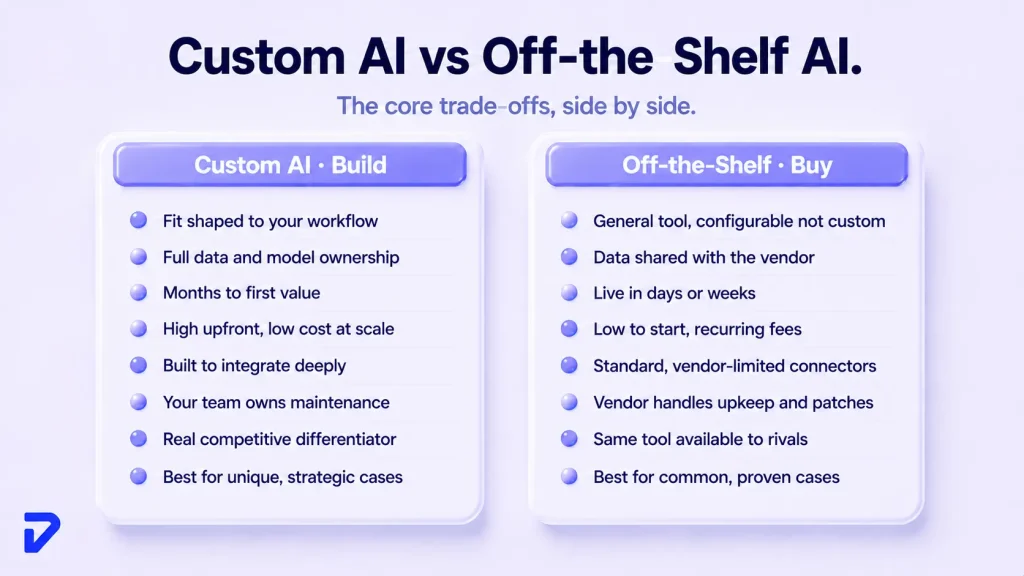
The in-house AI vs SaaS choice ultimately reduces to a handful of concrete practical trade-offs. This side-by-side view maps custom AI vs off-the-shelf across the dimensions that decide most projects. Read each row carefully against your own priorities on cost, control, speed, and long-term fit.
| Factor | Custom AI (Build) | Off-the-Shelf AI (Buy) |
| Fit | Modeled around your exact workflow, rules, and data | General tool you configure, not truly customize |
| Time to value | Months of design and training before first results | Live in days or weeks, value arrives fast |
| Upfront cost | High capital outlay, lower cost per user at scale | Low to start, predictable recurring subscription fees |
| Data ownership | Models and data stay fully inside your environment | Your data flows through the vendor’s systems |
| Control | You own the models, roadmap, and update cycle | Vendor controls features, roadmap, and version changes |
| Integration | Built to fit your CRM, ERP, and existing stack | Standard connectors, limited to what the vendor supports |
| Maintenance | Your team owns monitoring, retraining, and fixes | Vendor handles hosting, upkeep, and security patches |
| Competitive edge | Proprietary capability that rivals cannot simply license | The same tool your competitors can also buy |
| Best for | Unique, strategic, high-stakes use cases | Common, proven, well-understood use cases |
Neither column is automatically correct, because the right answer shifts with the specific job in front of you. Weigh the differentiator value of a build against the speed and lower risk of buying.
Still torn between building AI and buying a tool that never quite fits?
Pinnasys scopes the decision with you, then builds the custom AI system your workflow needs. Real production systems, not another pilot.
Build vs Buy AI: Key Factors to Consider Before Making a Decision
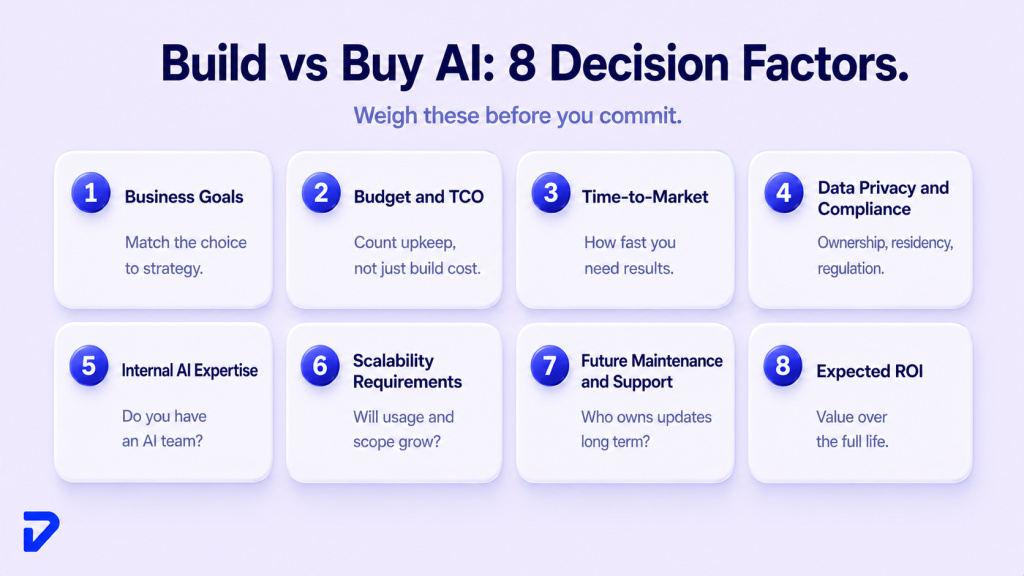
The disciplined approach to building vs buying AI consists of eight separate considerations. Score them objectively, as there is no set combination that will favor one path over another. Each factor’s importance changes depending on your industry, level of maturity, and appetite for risks.
Business Goals
Consider business strategy first and not the technology itself, since the needs of the business are the basis for the decision. When AI helps you compete, it pushes towards building and owning the solution. If the technology is just an aid to some business functions, it is better to purchase it.
Budget and Total Cost of Ownership
Look well beyond the sticker price to the full cost across the entire system lifetime. Building a custom system will be costly upfront, but the marginal cost decreases as its use increases. Subscription models might seem cheaper but have high recurrent costs.
Time-to-Market
Ask honestly how quickly the business actually needs working results from this specific AI initiative. Buying can deliver value in days, while a serious custom build usually takes several months. When speed decides the outcome, a tool bridges the gap as the longer build proceeds.
Data Privacy and Regulatory Compliance
Sensitive or regulated data raises the stakes on where your information is stored and processed. Building keeps that data entirely in-house and fully under your own governance and audit control. Buying routes it through vendor systems, so match the choice to your compliance obligations carefully.
Internal AI Expertise
Building needs engineers, data scientists, and MLOps skills that many mid-market teams simply do not have. Without that in-house bench, an ambitious build often stalls partway and quietly drains the budget. Strong AI integration and governance support can close part of that capability gap either way.
Scalability Requirements
Think carefully about future growth in users, data volume, and the range of use cases. Off-the-shelf tools may cap usage or charge steeply once you scale beyond their comfort zone. A custom system scales on your own terms, so plan for tomorrow’s load, not today’s.
Future Maintenance and Support
AI systems are never finished, since someone must monitor accuracy, retrain models, and fix drift. Vendors quietly absorb that entire ongoing maintenance burden for the tools you buy from them. For custom AI, your own team owns monitoring, retraining, and support across the entire lifespan.
Expected Return on Investment (ROI)
Weigh the value returned across the full lifespan rather than just the initial launch window. Ask directly whether custom AI is worth it, because returns must clear that higher upfront cost. For common and well-served use cases, a proven tool frequently delivers the stronger overall ROI.
Is a Hybrid AI Strategy the Best of Both Worlds?
For many teams, the answer is not build or buy; it is both. A hybrid strategy buys proven tools for common tasks and builds custom AI where it counts. You might buy a support chatbot while building a pricing engine that reflects your unique model. You get speed on the easy wins and an edge on the hard ones. Buying handles the commodity layer. Building handles the differentiator.
Hybrid also lowers risk. You prove value with a tool, then invest in a build once the case is clear. The mix shifts over time as needs mature. Most production AI stacks end up blended, rather than pure. The skill is knowing which jobs deserve a custom system.
Common Mistakes Businesses Make When Choosing AI
The wrong process sinks good intentions. Avoid these frequent errors.
- Chasing hype: Teams build custom AI for common jobs a cheap tool already solves well.
- Ignoring total cost: Buyers forget subscriptions compound, while builders forget years of upkeep.
- Underrating data: Both paths fail on messy data, yet teams skip the cleanup work.
- Skipping the pilot: Big commitments happen with no small test to prove value first.
- Overlooking integration: Connecting AI to existing systems is often the hardest, costliest step.
- Locking in blindly: Buyers sign without checking exit terms, data export, or roadmap risk.
Emerging Trends Influencing the Build vs Buy AI Decision
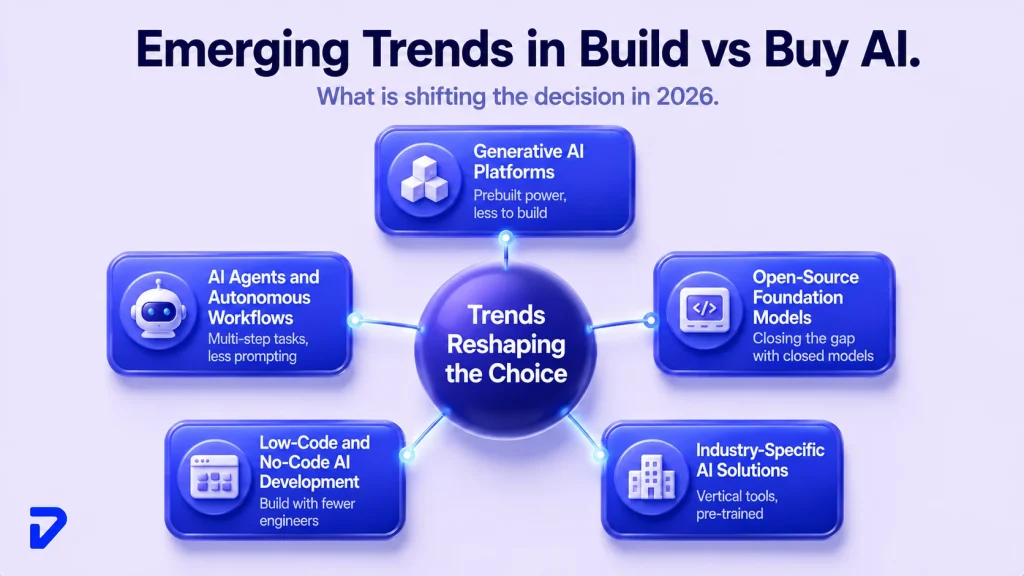
The boundary between building and buying keeps moving as the underlying tools mature very quickly. Five clear trends are actively reshaping the AI vendor selection choice heading right through 2026. Each one lowers the effort or cost of one path, changing where the balance lands.
Generative AI Platforms
Managed generative platforms now bundle prebuilt models, ready-made APIs, and safety guardrails into a single layer. They sharply cut how much you must build from scratch to reach a working system. Teams increasingly assemble full solutions on top of these platforms rather than starting from scratch.
AI Agents and Autonomous Workflows
AI agents now plan and act across long multi-step tasks with far less human prompting. Both major vendors and in-house teams are now racing to ship reliable agentic capabilities fast. Custom AI agents and autonomous workflows can automate complex work that rigid tools simply cannot reach.
Open-Source Foundation Models
Open models now rival closed ones on many practical benchmarks that businesses actually care about. Stanford recently found the performance gap narrowed from 8% to 1.7% within a single year. That shift lowers build costs and meaningfully reduces the vendor lock-in that worries many buyers.
Low-Code and No-Code AI Development
Low-code and no-code platforms enable teams to build useful AI with far fewer specialist engineers. Business users can now assemble working AI workflows visually, without deep coding or model expertise. That falling barrier blurs the old line between simply buying and fully building a solution.
Industry-Specific AI Solutions
Vendors increasingly ship tightly focused tools built and tuned for a single vertical market segment. These products arrive pre-trained on domain data, workflows, and the rules that govern that sector. For a genuinely narrow niche, a specialized solution can outperform a broad, generic custom build.
Build vs Buy AI Decision Checklist
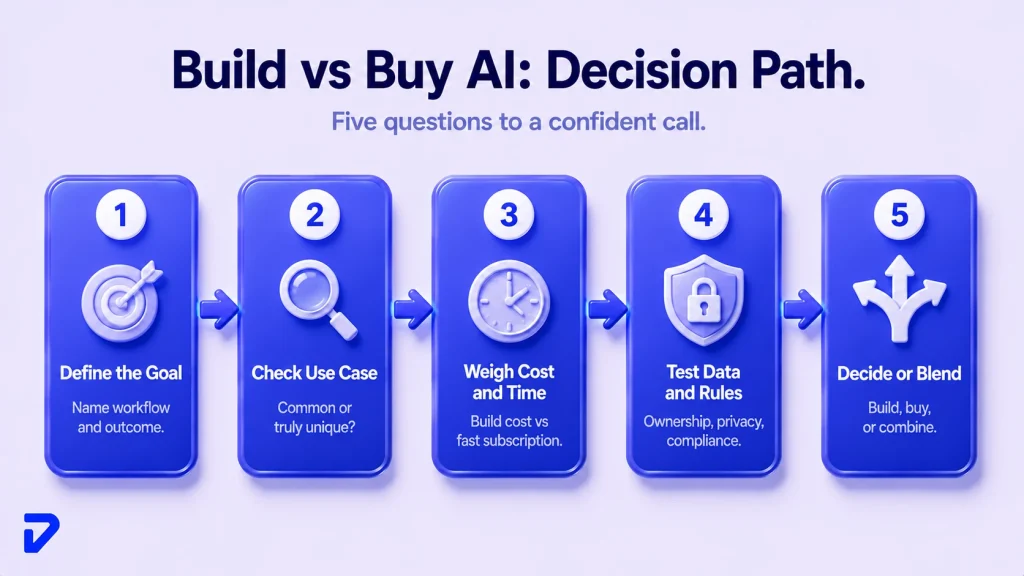
Work through these five questions in order. They lead to a confident call. Falling AI costs help either path. Stanford reports inference prices for GPT-3.5-level output fell more than 280-fold in 18 months.
1. Define the goal: Name the workflow and the outcome you need.
2. Check the use case: Is it common and proven, or truly unique?
3. Weigh cost and time: Can you fund a build, or do you need results now?
4. Test data and rules: What do ownership, privacy, and compliance demand?
5. Decide or blend: Build, buy, or combine both to fit the job.
The Bottom Line
The build vs buy AI decision is rarely all or nothing. Buy proven tools for common jobs. Build custom AI that leverages your workflow or data to give you an edge. Many teams do both, buying for speed and building where it counts. Weigh your goals, budget, data, timeline, and in-house skills before you commit. The wrong pick wastes money, while the right one puts AI to work fast. Pinnasys helps startups and mid-market teams make that call, then ships the system that fits. Whether you buy, build, or blend, aim for AI that reaches production. With a focus on production-ready AI development, our developers can discover, build, and deploy custom AI solutions that work with your existing legacy systems.
Key Takeaways from the Article
- Buy off-the-shelf AI for common, proven use cases and fast, low-risk results.
- Build custom AI when workflows are unique, or AI is your competitive edge.
- Ongoing upkeep, not the initial build, drives most long-term AI cost.
- A hybrid strategy buys speed for common tasks and builds where it counts.
- Enterprises now buy most AI use cases, yet strategic builds still win differentiation.
Frequently Asked Questions
Can a business switch from an off-the-shelf AI solution to a custom AI system later?
Yes, and many teams deliberately start with a tool to prove value before committing to a build. Plan early for clean data export and a documented handoff between the two separate systems. That preparation keeps the eventual migration cheaper, faster, and far less disruptive to daily operations.
How important is data quality when deciding whether to build or buy AI?
Data quality is decisive because poor data undermines both paths, though it hurts custom builds most. Models learn directly from your historical records, so messy inputs quietly cap their real accuracy. Clean, well-labeled data shortens build timelines and lifts real-world performance on either route you choose.
What role does open-source AI play in the build vs buy decision?
Open-source models meaningfully lower build costs and reduce the vendor lock-in that constrains bought tools. They now match closed models on many common tasks that most businesses actually depend on. They suit teams with engineering skills who want real control without training a model from scratch.
How do AI vendor updates affect off-the-shelf solutions?
Vendors push new features, security patches, and model upgrades automatically, which saves your team real effort. However, those same updates can change behavior, shift pricing, or retire a feature you depend on. Read the product roadmap and version terms carefully before you commit to any long contract.
Can custom AI integrate with existing business software?
Yes, custom AI is specifically built to connect with your CRM, ERP, and internal data stores. It communicates through APIs and connectors designed around your existing systems and specific data formats. Clean integration is often the hardest and costliest part, so scope it carefully early in the project.
Should businesses conduct a pilot project before making a long-term AI investment?
Yes, a focused pilot tests real value, data readiness, and workflow fit at relatively low cost. Define clear success metrics up front so the pilot produces an honest, genuinely defensible verdict. Strong results justify scaling confidently, while weak ones save you from a costly long-term commitment.





Prakash C. Saini
Prakash Saini is the Founder & CEO of Pinnasys. With over a decade in digital transformation and building production systems, he grew an engineering team from 2 to 50 people and has led the delivery of 100+ production digital systems. Products built under his leadership have raised millions in funding and generated over $50 million in revenue. He holds an Executive MBA from IIM Kozhikode and today leads the AI engineering team at Pinnasys.