


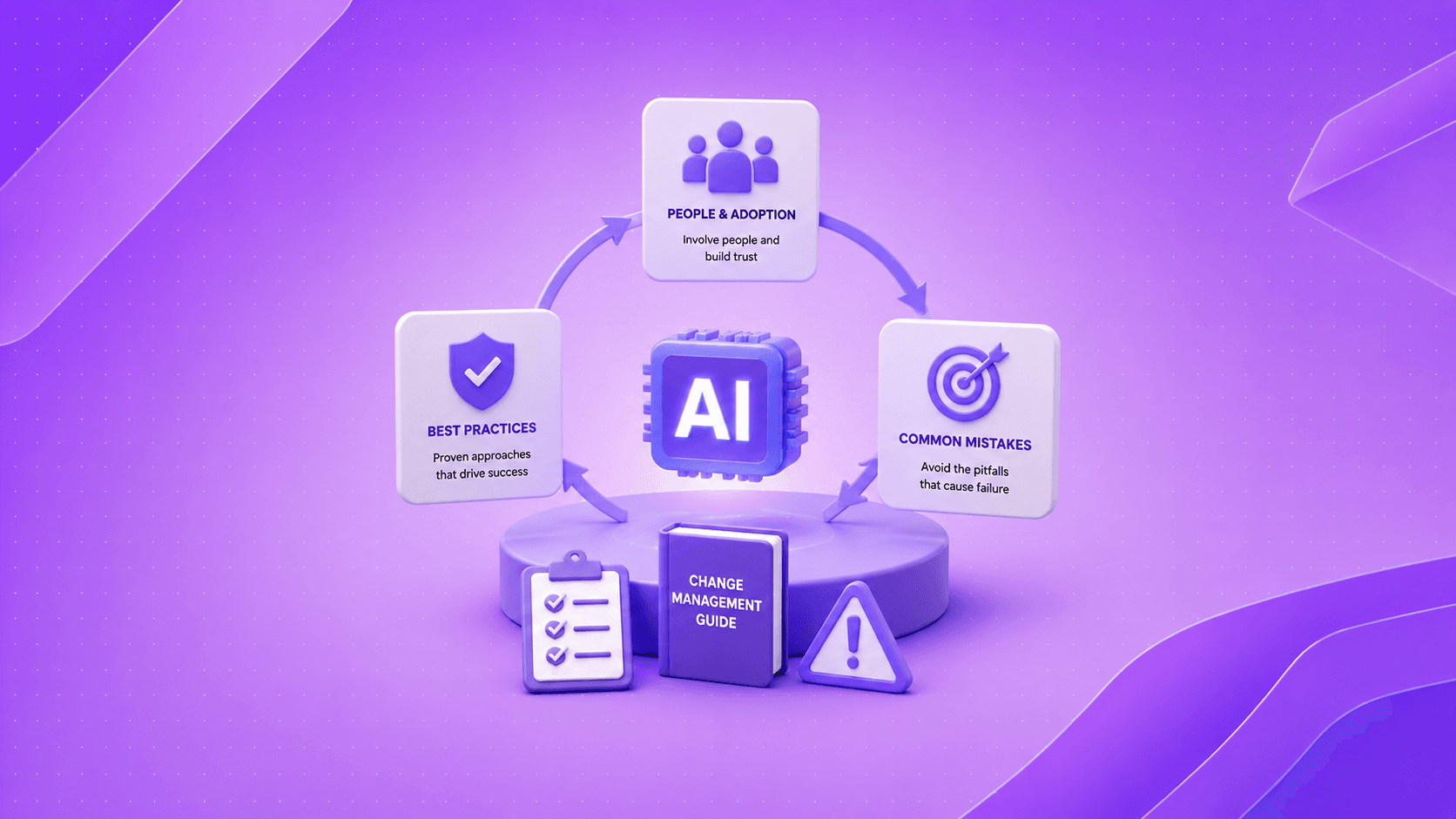
Artificial intelligence can transform business performance, but successful adoption requires more than technology alone. Effective AI change management helps organizations align people, processes, and strategy, overcome resistance, reduce risks, and maximize the long-term value of AI-driven transformation initiatives.
AI isn’t really in the experimentation phase anymore. Companies of every size are using it, or at least trying to, to get more done with less, cut costs, and give customers a better experience. But here’s the part that doesn’t show up in vendor pitch decks! Many organizations pour money into AI and still don’t get much out of it. And it’s rarely the technology’s fault.
Getting AI adopted isn’t just a matter of handing people a new tool and a login. It means preparing the people who’ll actually use it, rethinking the workflows around it, and building an environment where employees feel they can work alongside these tools rather than be replaced by them.
Companies that put real thought into AI change management tend to get far more lasting value from it. In this guide, we explore why AI adoption frequently struggles, the organizational barriers businesses face, and the foundational principles required to support successful organizational AI transformation.
Why AI Adoption Stalls?
Most organizations enter into the world of AI with great excitement. They see an opportunity to automate routine processes, improve decision-making, and stay ahead of the competition. However, it is hard to sustain that excitement as organizations fail to go beyond the experimenting phase. According to research conducted by IBM’s Institute for Business Value, despite ongoing investments in AI, most organizations fail to scale up.
The answer to why it happens lies in the fact that technology develops faster than organizations are able to adopt it. In reality, it always becomes a problem whenever organizations approach this challenge in terms of software, rather than behavior change. There are several things every organization should be clear about before starting this process:
- How will people actually use AI in the work they already do?
- What processes need to change to make room for it?
- How will anyone know if it’s actually succeeding?
- Who’s responsible for governance and oversight?
- What new skills do employees need to pick up?
Skip those questions, and even a technically flawless rollout can produce very little real business value.
Reasons for Failure Behind Poor AI Adoption
Automating a Broken Process
One of the most common mistakes is trying to automate a process that was already broken, instead of fixing it first. AI can speed things up, sure, but it can’t repair a fundamentally flawed system. If a process is loaded with unnecessary approvals, outdated steps, duplicated work, or messy data, throwing AI at it usually makes those problems worse, not better.
Before bringing AI into any workflow, it’s worth actually looking at that workflow first and asking what needs to be simplified, standardized, or cleaned up. AI does its best work on top of operations that are already running well, not as a patch for ones that aren’t.
Mandate AI Without Modeling
Leadership behavior matters a lot here, maybe more than most companies realize. It’s surprisingly common for a company to require employees to use AI, while the executives and managers handing down that requirement barely touch it themselves. That gap between what’s expected and what’s actually modeled doesn’t go unnoticed.
Employees watch what their leaders do, not just what they say. When leaders visibly use AI themselves and talk about how it’s improving their decision-making and productivity, employees start to trust it too. The companies that get this right ensure AI use is visible at every level of leadership, not just announced from the top. That visibility does a lot to build real AI culture change over time.
Training Failure
One of the key elements of successful adoption of any innovation is confidence, which means that companies often fail to realize how much training should be done. Usually, it is just one demo and one session, but there is no proper follow-up to ensure that employees become truly proficient.
Quality AI training is not only about showing someone what buttons should be clicked. However, it is about explaining when the tool is needed, how to check whether the result is correct, and how the overall workflow will change because of AI implementation.
Governance Failures
There are various challenges associated with the use of AI, such as the need to control the security of data, privacy, and ethical aspects of the work done. In many cases, there is no adequate framework that is supposed to address these challenges, which leads to different departments performing different functions and using different tools.
The lack of governance can easily turn into various privacy concerns, incorrect outputs due to the lack of a monitoring system, security risks, and approval processes that are not clear at all. Governance is crucial for scaling operations with the help of AI.
5 Key Organizational Challenges in AI Change Management
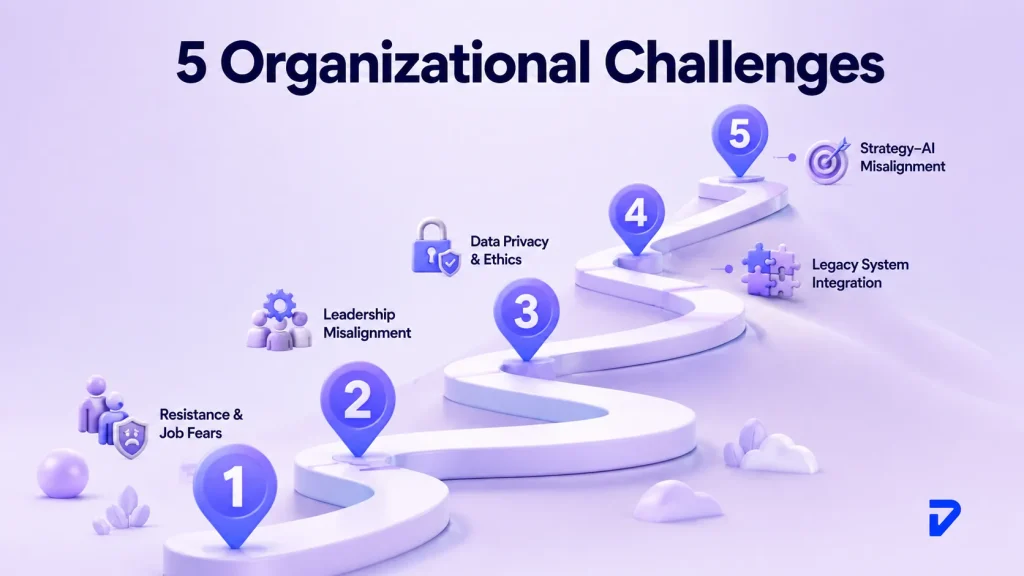
Resistance to Change and Fear of Job Displacement
Fear of job elimination, reduced responsibility scope, and overall decreased importance for a company are reasonable concerns when the process of automation starts to gain momentum. In fact, poor communication exacerbates them even further. The results of the survey conducted by the World Economic Forum show that besides replacing many jobs, AI is projected to create new types of jobs.
Instead of positioning AI as a competitor for humans, leaders should consider explaining the benefits of automating routine actions and liberating employees from the necessity to complete them. The effective handling of the problem presupposes overcoming the barriers to AI adoption and implementation. It presupposes addressing the employees’ concerns, managing expectations appropriately, and engaging them in the process.
Lack of Leadership Alignment
AI initiatives tend to impact multiple departments, including operations, IT, HR, compliance, finance, and others. Thus, the absence of alignment among departmental leaders causes inconsistency in priorities, as each of them aims at solving a specific issue. While one seeks cost savings, another tries to improve customer experience, and yet another seeks operational efficiency. All those goals are important, but not quite the same.
The lack of alignment and consistency in priorities affects the decision-making process and creates uncertainty for other employees. Effective management of AI transformation presupposes consensus among all parties on such aspects as strategic goals, criteria for evaluation, and priority areas in workforce development. The presence of such an alignment helps companies move faster and maintain the same communication strategy in any case.
Data Privacy and Ethical Concerns
When the use of AI becomes more widespread, questions related to data, privacy, and ethics become more prominent. Employees become curious about the ways the company uses their customers’ information, and customers themselves request greater transparency in the use of such technologies.
To get ahead of those challenges, companies need to build robust governance mechanisms and to communicate them effectively. It is not enough to add a few lines about data privacy to the company’s website; it is necessary to develop clear policies on how to collect the data, where it is stored, how it is used, etc. Transparency is the key element that helps establish trust in that case, which may be considered the most crucial one in terms of AI change management.
Integration With Legacy Systems
Many companies continue using legacy software, databases that cannot be integrated properly, and legacy processes. The inability to integrate a new AI solution properly and efficiently limits its effectiveness significantly. Moreover, companies tend to underestimate the difficulties associated with the integration of new solutions into legacy infrastructure.
In order to solve this problem, it is necessary to redesign the processes, modernize the existing system, and facilitate cooperation between teams that usually do not work together. A real organizational AI transformation depends on having a technology environment where AI can actually function alongside what’s already there, not despite it.
Misalignment Between Business Strategy and AI Capabilities
AI isn’t the answer to every business problem, even though it sometimes gets treated that way. Businesses pursue this new trend because the rival does so, or because the company’s leaders want to demonstrate their innovativeness. Such approaches to technology investments lead to very few actual returns on investment. The AI initiatives that actually work start with a clearly defined business problem, not the technology itself.
Instead of asking “where can we use AI,” the better question is which business problems are actually holding growth back and which decisions would genuinely benefit from better insight. That framing keeps AI investment tied to actual strategic priorities and measurable outcomes, rather than becoming a project that exists for its own sake.
Principles of Successful AI Change Management
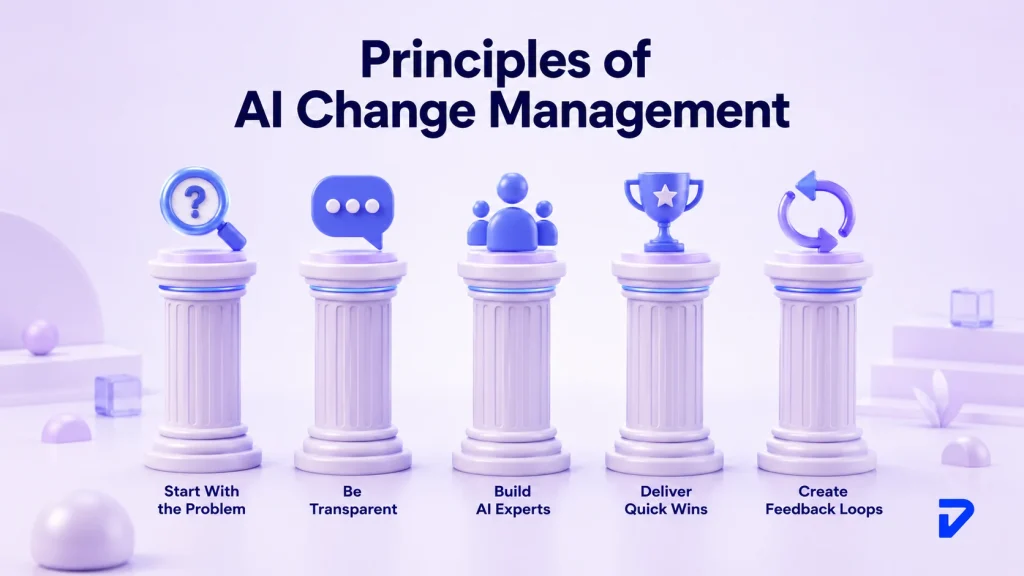
Start with the Problem, Not the Solution
One of the biggest mistakes is adopting AI because others are doing it and not because it solves something critical to your organization. The leadership team attends a conference, listens to several inspiring stories about generative AI, and leaves with a desire to implement it at any cost and somehow. The excitement itself is good, but this attitude often encourages the implementation of technological solutions regardless of the need they address.
Effective AI projects are started with the identification of the issue. Such an approach enhances the whole AI adoption strategy because employees know exactly what challenges have been identified and how AI can solve them. Employees feel that the new technology helps solve their existing issues and do not think that they have to use some new technology that does not provide tangible benefits.
Transparency About What Changes and What Stays
Lack of certainty is the reason for strong resistance to change. Every time people hear “automation”, a certain amount of concern arises: will I still have the job, and if so, will it still involve the same responsibilities? Even those employees who do not worry about being fired want to know how the new technology will impact their daily routine. Leaders constantly underestimate the amount of communication required to address this concern.
AI change management requires transparency about what the technology can deliver and what it cannot do. Employees need truthful answers. Transparency in this case means answering honestly, “we do not know yet”. Being honest always works better than giving some kind of assurance. When leaders talk about risks and uncertainties related to AI along with benefits, trust grows instead of decreasing, and adoption becomes easier.
Create AI Experts, Not Just Users
Many organizations teach their employees how to operate with a new technological solution. It is a good approach to adopt, but it is not enough. An employee trained to operate a new technology may use AI occasionally. The main goal is to create internal AI experts, people who can help their colleagues, share their experience, and see some other possibilities that were not taken into account during the first implementation.
This process requires substantial training programs and cannot be achieved through one afternoon training session. Successful programs usually combine practical, role-specific applications of AI and fundamentals of prompt engineering, governance, and compliance. Training programs teach people how to critically evaluate AI outputs instead of trusting them blindly and provide them with an opportunity to learn continuously.
Deliver Quick Wins And Make Them Visible
Implementation of major transformations can take several months or even years to show any result. The problem is that people become discouraged if they do not see some positive changes in a short period. This is the reason why the best companies implementing this technology give some quick wins at the very beginning of the implementation process. A quick win does not necessarily mean any dramatic change; it is enough to deliver tangible results and to make them visible.
According to Prosci’s research on organizational change, early and visible wins are the key predictors of the success of the change initiative. In the vast majority of cases, they are effective because they reinforce desired behavior among employees. However, such wins are useful only if people can see them.
Build Feedback Loops, Not Just Training Sessions
Plenty of organizations treat training like the last step. Employees sit through a workshop, do a few practice exercises, and, from that point on, they’re expected to figure out the rest on their own. That’s not really how adoption happens in practice. New questions arise after the tool is live, and workflows shift. People stumble onto AI use cases nobody planned for, and problems surface that the original rollout plan never anticipated.
That’s why the organizations that get this right build ongoing ways to actually hear from their people, things like internal AI user communities, discussion forums, usage surveys, and check-ins built into regular performance conversations. Companies that genuinely listen tend to do a much better job of managing AI transformation overall, simply because they keep adjusting based on what’s actually happening rather than running on assumptions made before launch.
AI Change Management Best Practices to Consider During Implementation
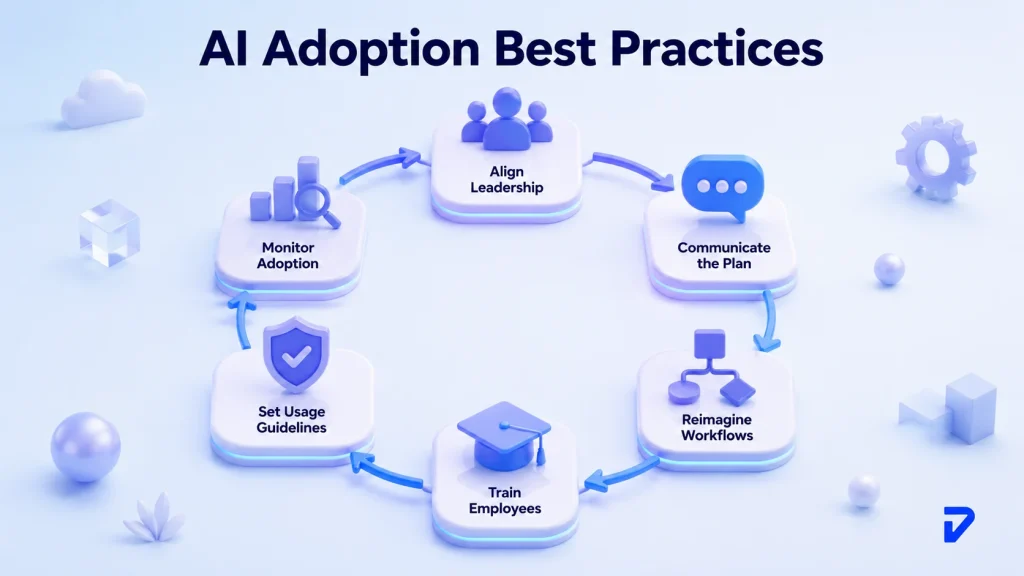
Secure Leadership Alignment
Every AI initiative that actually works starts here. If executives are sending different priorities to different parts of the organization, adoption splinters almost immediately. Leadership needs to land on shared answers: what they’re trying to achieve, how success gets measured, and where workforce development sits on the list of priorities. Getting that agreement in place keeps every department rowing in the same direction.
Employees also pick up on how leaders actually behave, not just what gets said in a memo. When executives are genuinely using AI themselves and talking openly about that experience, it reinforces just how seriously the rest of the company should take it. Strong leadership commitment remains one of the biggest single factors behind whether an organizational AI transformation actually holds up.
Create a Strategy and Communicate a Plan
Companies shouldn’t assume employees automatically understand why AI is showing up in their workday. Left without context, people tend to fill in the blanks themselves, and those assumptions are usually a lot more negative than reality. A real AI adoption strategy needs a communication plan that explains why this is happening, which business goal it’s tied to, how it will affect employees specifically, and how success will be tracked.
That communication has to be consistent and tailored to different audiences, not a single all-hands announcement. Frontline employees usually need practical, day-to-day workflow guidance, while managers need to understand performance metrics, adoption data, and their own role in leading the change. The clearer the communication, the easier it gets to answer the question a lot of leaders keep asking: how do you actually get employees to adopt AI?
Reimagine Workflows
Dropping an AI tool on top of an existing process without rethinking that process tends to produce underwhelming results. A lot of companies just bolt the new tool onto whatever inefficiency was already there. Instead, leaders should sit down and ask which tasks could be automated entirely, where decisions could move faster, and how people could spend more of their time on the work that truly requires human judgment.
The goal here isn’t doing the same work slightly faster. It’s rethinking how the work gets done in the first place. Companies that actually redesign their workflows around AI tend to get more meaningful value from the investment than those that just automate a task here and there without touching anything around it.
Provide AI Skills Training to Employees
A single training session rarely produces lasting adoption. Learning needs to be treated as something ongoing, not a milestone you check off once and move past. Strong training programs combine foundational education with hands-on practice, role-specific guidance, governance instruction, peer learning, and a way for people to continue building skills over time.
That training also has to keep evolving, because the tools themselves keep changing fast. Staying genuinely ready for AI means treating learning as continuous, and companies that keep investing in their people’s development tend to adapt much more smoothly as the technology shifts beneath their feet.
Create Clear Guidelines Around Usage
People need to know exactly how they’re supposed to use AI. Without that clarity, companies end up with inconsistent practices, compliance headaches, and quality problems that nobody saw coming. A real usage policy should cover which tools are approved, how data is handled, what security requirements apply, and where the ethical lines are drawn.
Clear guidelines reduce uncertainty and help people use these tools responsibly. That kind of governance becomes even more important once adoption spreads across multiple departments, where it’s a lot harder to keep everyone on the same page informally.
Monitor Adoption
Getting the tool deployed isn’t the finish line, even though it can feel that way. Companies need to keep an eye on how AI is actually being used and whether it’s delivering what it was supposed to. That usually means tracking things like how often people actually use it, whether productivity is genuinely improving, efficiency gains in the underlying process, and how employees actually feel about the whole thing.
Monitoring is what tells leaders where extra support is needed. It’s also how a company can honestly measure whether its AI change management best practices are working, and adjust course when they’re clearly not.
Change Management Frameworks for AI Adoption
Prosci ADKAR Model
ADKAR (Awareness, Desire, Knowledge, Ability, Reinforcement) focuses on individual-level change and breaks it into five stages. Awareness means employees actually understand why the change needs to happen. Desire means they’re genuinely willing to be part of it, not just compliant. Knowledge covers how to actually operate in the new environment. Ability means putting that knowledge into real, working practice. Reinforcement is what sustains all of it through ongoing support and recognition, rather than letting it quietly fade once the initial push is over. It works particularly well for employee AI adoption because it zeroes in on individual-level behavioral change.
Kotter’s 8-Step Change Model
John Kotter’s model is built around organizational momentum, moving through the stages of creating urgency, building a guiding coalition, and developing a vision. Afterward, communicating that vision clearly, removing obstacles as they arise, generating short-term wins, and sustaining momentum once the early excitement fades. And finally, anchoring the change in the culture so it doesn’t slip back to how things used to be. It tends to fit best for larger, more sprawling AI transformations involving multiple departments and many moving parts.
Lewin’s Change Management Model
One of the oldest frameworks in the field, Lewin’s approach, splits change into three stages. This includes unfreeze, where people prepare for what’s coming; change, where new processes and behaviors are implemented; and refreeze, where those new practices settle in as the new normal rather than a temporary experiment. It’s a simple model, but it still holds up well for companies just starting out on their AI journey and looking for a structured way to approach AI culture change.
McKinsey 7s Framework
This one recognizes that real transformation requires alignment across seven different pieces of an organization: strategy, structure, systems, shared values, skills, style, and staff. AI initiatives tend to touch all seven of these at once. This is exactly why this framework is so useful for leaders seeking a genuinely holistic view of managing AI transformation rather than treating it as a purely technical rollout. Companies that actually get these interconnected pieces aligned tend to see smoother adoption and results that hold up over the long run.
Most Common Mistakes that Derail AI Adoption
Skipping Middle Management
People naturally look to their direct manager for cues on how to feel about something new. If that manager seems unsure, skeptical, or just checked out, that attitude spreads through the team almost without anyone meaning for it to. The fix is fairly straightforward, even if it takes real effort: bring managers into the AI planning conversations early, give them training that’s actually built for their role.
Over-Automating Too Fast
Excitement about AI often pushes companies into aggressive automation before their employees are anywhere near ready for it. Automation genuinely has a lot to offer, but trying to automate too many processes too quickly tends to create confusion, pushback, and operational headaches nobody planned for. People need time to get comfortable with new tools, adjust to how they work, and build real trust in what the AI produces.
Ignoring the Metrics that Matter to People
Companies tend to default to technical or financial measures when judging whether AI is working: cost savings, faster processing, productivity numbers, return on investment, and the extent of automation. Those numbers matter, no question. But they don’t really capture what employees are experiencing day-to-day. If a company only tracks the operational side and ignores how employees actually feel about the change, adoption can stay weak even while the business numbers look great on paper.
Treating Resistance as a Character Flaw
Resistance gets treated way too often like a problem that needs to be stamped out. It’s usually the opposite. People are far more willing to get on board with change when they feel like someone actually heard them. Listening doesn’t mean agreeing with every single concern raised, but it does mean treating that feedback as an opportunity to strengthen the rollout rather than a nuisance to work around. Companies that approach overcoming AI resistance with genuine curiosity rather than frustration tend to achieve stronger engagement overall.
The Bottom Line
A thoughtful approach to AI change management really lays the groundwork for lasting adoption, stronger engagement from the people doing the work, and real business value down the line. Companies that genuinely invest in AI workforce readiness and prioritize getting their people ready tend to be the ones that actually realize what AI can do for them.
At Pinnasys, our AI Integration and AI Automation services help startups, small businesses, and growing organizations work through every stage of adoption. From identifying the highest-value use cases and redesigning workflows to handling implementation and ongoing optimization, we help businesses build AI solutions grounded in their real goals, not just trend-chasing. That’s really what successful AI adoption comes down to.
Frequently Asked Questions About Change Management in AI Adoption
What is AI change management?
It’s the structured work of getting employees, workflows, leadership, and the broader organization ready to actually adopt AI technologies, rather than just installing them and hoping for the best. It covers communication, training, governance, and behavioral change, all aimed at ensuring AI initiatives deliver real, lasting value rather than becoming an expensive tool nobody uses.
How long does AI change management usually take?
It depends largely on the company’s size, complexity, and the ambition of its adoption goals. A smaller rollout might take just a few months, while something enterprise-wide can stretch past a year. The companies that handle this well tend to treat AI adoption as an ongoing journey rather than a project with a finish line.
How is AI change management different from traditional change management?
Traditional change management is mostly about helping people adjust to a new system or process. AI adds extra layers on top of that: algorithmic decision-making, data governance, ethical questions, the impact of automation on roles, and the need for learning that never really stops.
Who should own AI change management inside a company?
Executive leadership sets the strategic direction, while HR, operations, IT, compliance, and the business unit leaders actually affected all need to work together to make it happen. A lot of companies end up forming cross-functional teams to handle adoption, governance, communication, and employee development together rather than leaving it to a single department.
Do small businesses need a formal AI change management plan?
Yes, even if it doesn’t need to look like a big enterprise framework. Small businesses still benefit from clear communication, real training, basic governance guidelines, and objectives that are actually written down. Even a simple AI rollout tends to go much better when there’s a deliberate plan behind it, rather than just hoping people figure it out as they go.





Prakash C. Saini
Prakash Saini is the Founder & CEO of Pinnasys. With over a decade in digital transformation and building production systems, he grew an engineering team from 2 to 50 people and has led the delivery of 100+ production digital systems. Products built under his leadership have raised millions in funding and generated over $50 million in revenue. He holds an Executive MBA from IIM Kozhikode and today leads the AI engineering team at Pinnasys.