


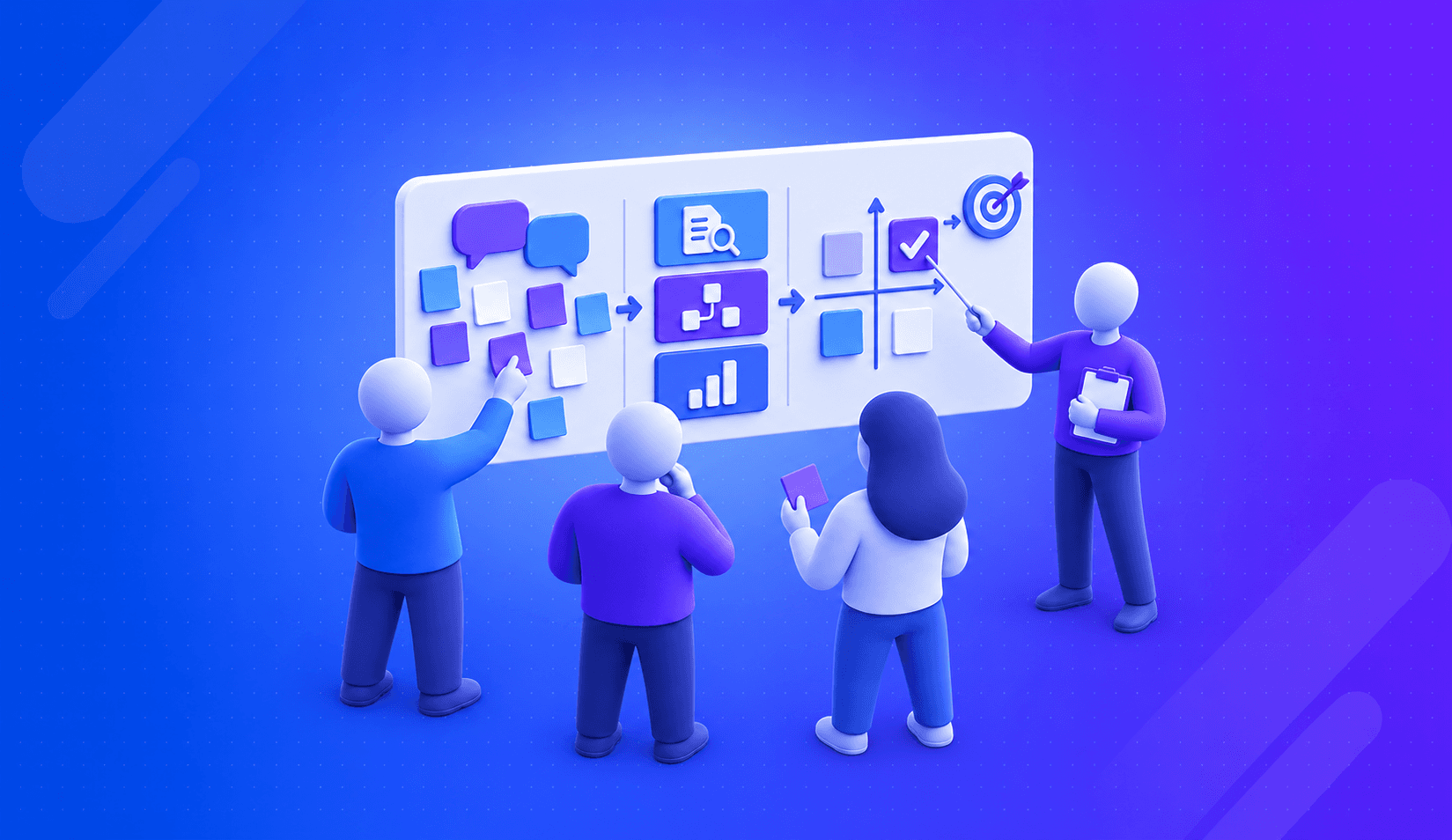
AI use case discovery workshops help organizations identify where AI can create real business value. They bring teams together to explore potential use cases, connect AI opportunities to business goals, and determine which ideas are worth pursuing based on impact, feasibility, and priority.
McKinsey’s 2025 State of AI survey found that 88% of organizations now use AI in at least one business function, but only 7% have fully scaled it across their operations. The gap is not a technology problem. It is a selection and prioritization problem. Most organizations run AI pilots without a structured way to decide which opportunities are worth pursuing. An AI use case discovery workshop fills that gap. It creates a structured, cross-functional process for identifying the right opportunities, validating them against real data and workflows, and turning the best ideas into concrete next steps.
In this blog, we’ll cover how to run an AI use case discovery workshop and prioritize the most valuable opportunities.
What Is an AI Use Case Discovery Workshop?
An AI use case discovery workshop is a structured, facilitated session where business leaders, process owners, and technical teams work together to surface, evaluate, and prioritize AI opportunities within their organization.
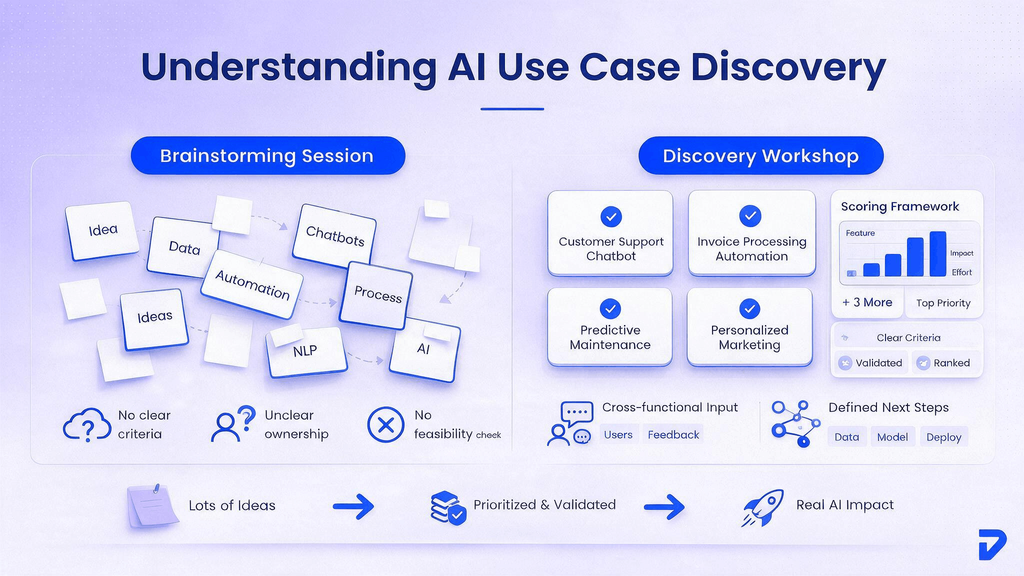
It is distinct from a brainstorming session. Ideas are tested against business value, data availability, and implementation feasibility before they go anywhere. The output is not a long list of AI concepts. It is a short set of validated, prioritized opportunities ready for deeper investigation.
How It Differs from an AI Readiness Assessment
An AI readiness assessment looks at your organization’s overall capacity to adopt AI: your data maturity, infrastructure, talent, and governance. The discovery workshop builds on that foundation. Where the readiness assessment asks “can we do AI?”, the discovery workshop asks “which specific AI opportunities are worth doing and in what order?” Both inform an AI strategy roadmap, but they answer different questions.
When Should Organizations Run One?
Run an AI use case discovery workshop when your team has general AI interest but no agreed-upon list of priorities, when leadership wants to move from experimentation to structured implementation, or when a previous AI pilot ended without a clear next step. It is also a useful reset when an organization has too many ideas and no framework for deciding which ones to act on.
What Makes an AI Use Case Workshop Effective?
A well-run workshop is not simply an ideas session. It is a structured decision-making process that keeps the focus on business problems rather than AI technology. The most effective workshops have five key characteristics:
- Cross-functional participation: Bring together people from operations, IT, finance, and leadership. Different teams understand different problems, workflows, and constraints.
- Evidence-based evaluation: Test each proposed use case against real workflows, available data, and existing systems.
- Clear evaluation criteria: Rank opportunities based on factors such as business impact, feasibility, data readiness, and risk.
- Defined outcomes: The workshop should produce a prioritized list of use cases, initial feasibility assessments, and clear next steps.
- Clear ownership: Each shortlisted use case should have a named sponsor responsible for moving it forward.
According to BCG’s 2025 AI value research, roughly 70% of AI implementation challenges stem from people and process issues, rather than technology or algorithms. A workshop built around real business problems and workflows helps address these challenges from the start.
Who Should Participate in the Workshop?
Getting the right people in the room matters more than the agenda. A workshop with the wrong mix of participants produces either a list of technical experiments or a wishlist with no implementation path.
| Role | Why They Are Needed |
| Executive sponsor | Provides business context, decision authority, and commitment to follow-through |
| Business process owners | Know where workflows break, slow down, or produce errors |
| Operations and subject-matter experts | Understand the daily reality of the work and the data it generates |
| IT and data teams | Assess integration feasibility, data quality, and system constraints |
| Security, compliance, and legal | Flag regulatory and risk considerations early, before use cases are approved |
| AI or technology specialist | Translates business problems into realistic AI capabilities |
IBM’s Global AI Adoption Index found that limited AI skills and expertise affect 33% of organizations deploying or exploring AI, while data complexity is a barrier for 25%. Both problems become visible during a well-structured workshop, which is why having technical and data representatives present from the start is essential.
Aim for 8 to 15 participants. Fewer than eight and you miss key perspectives. More than fifteen and facilitation becomes unwieldy. If a business unit is too large to represent fully, consider separate workshops by function or department.
How to Prepare for an AI Use Case Discovery Workshop
Preparation determines how well the session runs. A workshop with no pre-work produces shallow ideas and slow decisions.
1. Define the Business Objectives
Before scheduling the session, confirm what the organization is trying to achieve. Is the goal to reduce operational costs, improve customer experience, increase throughput, or support revenue growth? These objectives define the lens through which you evaluate every proposed use case.
2. Gather Process and Operational Information
Collect process maps, workflow documentation, and recent operational data. Ask process owners to document where manual effort is highest, where delays are most frequent, and where errors or inconsistencies occur most often. This pre-work surfaces real friction before the session begins.
3. Review Existing Systems and Data
An AI use case is only as good as the data that supports it. Before the workshop, catalog available data sources, note their quality and accessibility, and identify any integration constraints. Legacy systems, siloed databases, and missing data can all affect which use cases are viable.
4. Assess Current AI Readiness
If your organization has completed an AI maturity model assessment, bring those findings into the session. They provide a baseline for what is technically realistic versus aspirational, and they prevent the group from proposing use cases your infrastructure cannot support.
5. Prepare the Workshop Agenda and Materials
Send participants a pre-brief covering the workshop’s scope, expected outputs, and any relevant data. Prepare a simple use-case template that captures: the business problem, the proposed AI capability, users and stakeholders, data sources, expected outcome, and key risks. Prepared participants produce better ideas faster.
Not sure where AI can make the biggest impact?
Pinnasys helps you uncover practical AI opportunities aligned with your business goals.
The AI Use Case Discovery Workshop: Step-by-Step Facilitation Guide
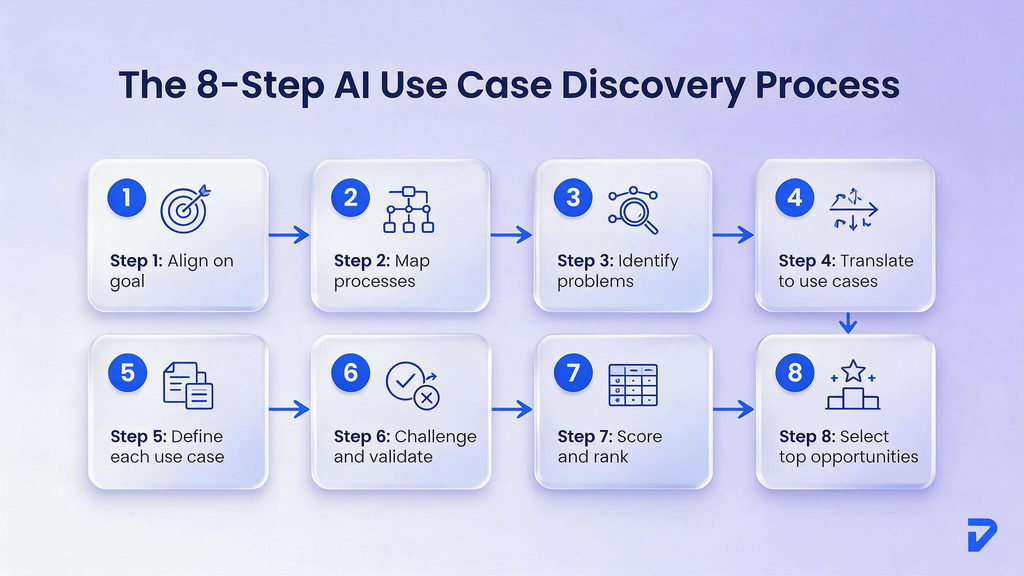
This is the core of the process. Eight steps move a group from orientation to a prioritized, validated list of AI opportunities. The step-by-step structure keeps discussion anchored to business outcomes rather than technology preferences.
Step 1: Align Everyone on the Workshop Goal
Open the session by stating the scope clearly. What business areas are in scope? What outputs will the group produce today? What decisions will not be made in this room? Set ground rules: no solutions before problems, no dismissing ideas before they are evaluated, and no attachment to AI tools or vendors. This alignment prevents the single most common workshop mistake, starting with a specific technology instead of a business need.
Step 2: Map Critical Business Processes
Before identifying AI opportunities, the group needs a shared picture of how work actually flows. Map two to four high-volume, high-impact processes together. Mark where manual effort is highest, where decisions take the longest, and where errors tend to cluster. Process mapping is not about redesigning workflows. It is about creating a shared, honest picture of where friction lives.
Step 3: Identify Business Problems and Opportunities
Move from process maps to pain points. Ask the group: where do employees spend excessive time on tasks that produce no direct value? Where do decisions depend on reviewing large volumes of information? Where do customers experience delays or inconsistency? Where do errors occur repeatedly? Each answer is a potential AI opportunity, but only if the group can articulate the business cost of the problem. Document each one before moving to solutions.
Step 4: Translate Problems Into AI Use Cases
Now match business problems to AI capabilities. This is where the technical specialist earns their place in the room. Common categories include:
- Generative AI use cases: drafting documents, summarizing reports, answering policy questions, generating customer-facing content
- Predictive AI use cases: forecasting demand, predicting equipment failure, scoring credit or claim risk
- Agentic AI and workflow automation: multi-step task execution, automated data collection, approval routing, order processing
- AI-powered decision support: surfacing relevant information at decision points, flagging anomalies, recommending actions
The rule here is one-to-one: each problem maps to one primary AI use case. Avoid stacking multiple AI capabilities on a single use case during the discovery phase.
Step 5: Define Each Use Case
For every candidate use case, the group completes a structured template:
| Field | What to Capture |
| Business problem | The specific operational pain point this addresses |
| Proposed AI capability | The AI method that addresses it (predictive model, generative output, agent, etc.) |
| Users and stakeholders | Who uses the output and who is affected |
| Inputs and data sources | What data the system needs, where it lives, and its current quality |
| Systems involved | ERP, CRM, document management, or other platforms that connect |
| Expected business outcome | The measurable result: hours saved, errors reduced, cycle time shortened |
| Human involvement | What decisions remain with people and why |
| Risks and constraints | Data privacy, regulatory limits, model reliability concerns |
This template creates a consistent basis for comparison during prioritization.
Step 6: Challenge and Validate the Ideas
Before ranking anything, the group stress-tests each use case. Four questions cut through weak proposals quickly: Is AI actually the right solution here, or would a simpler process change achieve the same outcome? Is the required data available at sufficient quality? Can the output integrate into the existing workflow without requiring a full system overhaul? Is the expected value measurable, and who owns the measurement?
Use this step to eliminate use cases that rely on data that does not exist, require regulatory approvals the organization cannot obtain, or depend on integration complexity that would take years to resolve. A structured challenge round prevents the group from prioritizing based on enthusiasm rather than evidence.
Step 7: Prioritize the Use Cases
Score each surviving use case across six dimensions. Use a simple 1 to 5 scale for consistency:
| Dimension | What You Are Measuring |
| Business impact | Revenue uplift, cost reduction, or risk reduction potential |
| Technical feasibility | How straightforward the build is given current infrastructure |
| Data readiness | Quality, availability, and accessibility of required data |
| Implementation complexity | Time, cost, and change management effort required |
| Risk | Regulatory, reputational, and operational exposure |
| Time to value | How quickly the organization would see measurable results |
Total the scores and rank the use cases. This produces a defensible, consistent prioritization that the group can discuss rather than argue about.
Step 8: Prioritize the Highest-Value Opportunities
Once the use cases are ranked, group them into clear priority tiers based on their potential impact, complexity, and implementation timeline:
- Quick wins: High-impact, low-complexity opportunities that can typically reach the pilot stage within three to six months.
- Strategic opportunities: Higher-impact initiatives that require more preparation, with a typical six- to eighteen-month timeline.
- Long-term initiatives: Use cases requiring significant architectural, data, or organizational changes, planned over an eighteen- to thirty-six-month horizon.
- Deferred or rejected: Opportunities that are not currently feasible or valuable enough to pursue. Documenting the reasons helps prevent the same ideas from being reconsidered without new information.
How to Prioritize AI Use Cases: Building a Scoring Framework
Use case prioritization is where most organizations either get it right or get stuck. Without a framework, the loudest voice in the room tends to win. With one, the group can align on the same criteria and reach decisions that hold up under scrutiny.
BCG research shows that only 22% of companies have moved beyond the proof-of-concept stage, and just 4% are creating substantial value. The organizations generating real results are not the ones with the most ideas. They are the ones that chose fewer, better opportunities and executed them with discipline.
The Impact vs. Feasibility Matrix
A two-axis matrix gives the group a visual tool for the initial sort. Plot each use case on impact (low to high) vs. feasibility (low to high). Use cases in the high-impact, high-feasibility quadrant are your immediate priorities. High-impact, low-feasibility use cases are worth planning for but should not be your first project. Low-impact use cases in any quadrant are candidates for deferral.
Scoring Business Value
Business value can be evaluated across three main areas:
- Cost reduction: Consider savings from reduced labor hours, fewer errors, and less rework.
- Revenue impact: Look at opportunities to increase revenue through faster quotes, higher conversion rates, or improved customer retention.
- Risk reduction: Consider how the use case could reduce compliance failures, operational risks, or other business exposure.
Where possible, attach a rough financial estimate to each use case. Quantifiable value makes opportunities easier to compare, fund, and govern.
Evaluating Data Readiness
Data readiness deserves its own scoring dimension because it is the single most common reason AI projects stall after proof of concept. For each use case, assess: does the required data exist, is it accessible, is it sufficiently complete and accurate, and are there any privacy or regulatory constraints on its use? Use cases with serious data gaps belong in a later phase, after the underlying data problems have been addressed.
Why Data and Integration Matter More Than the AI Model
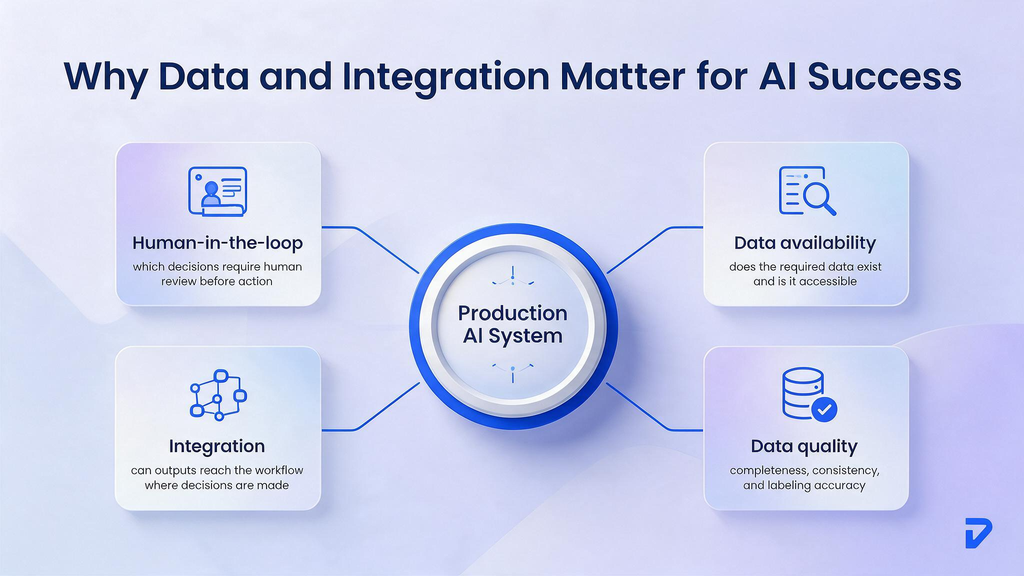
The AI model is rarely the bottleneck. Data quality, integration complexity, and governance readiness are what separate a working AI system from a failed pilot. Most of those problems are detectable during a well-run AI use case discovery workshop, which is precisely why evaluation belongs in the session, not after it.
Data Availability and Quality
High-quality training and inference data is foundational to any production AI system. During the workshop, check whether the data for each use case is structured or unstructured, how frequently it is updated, and whether it is stored in a format your integration layer can access. Incomplete or inconsistently labeled data is not an automatic disqualifier, but it does add time and cost to any project, and the group should factor that into feasibility scoring.
Integration and Legacy Systems
Most mid-market organizations run on a mix of modern SaaS platforms and older systems that were never designed to share data. Before a use case is approved, your IT representative should confirm that the relevant data can be extracted, that the AI output can be delivered back into the right workflow, and that any required APIs or middleware either exist or can be built without significant additional scope. An AI system that cannot connect to where work actually happens will not be used.
Human-in-the-Loop Requirements
Not every AI output should be acted on automatically. For decisions involving significant financial exposure, regulatory compliance, or customer relationships, the AI governance framework should specify where a person reviews the AI recommendation before action is taken. Define this during the discovery phase, not after a model is already deployed.
Building an AI Governance Framework Into Use Case Selection
Governance is not an afterthought. Risk considerations should shape which use cases are approved, how they are designed, and what constraints they operate under from day one.
The KPMG 2026 Global AI Pulse survey found that 75% of executives expressed concern about AI-related risk and security. That concern is appropriate. The response to it, however, should be structured governance, not avoidance.
What Governance Covers in the Discovery Phase
For each prioritized use case, the group should document: what data is processed and whether it includes personal or regulated information, which regulatory frameworks apply (HIPAA, GDPR, SOC 2, industry-specific rules), what level of explainability the business or its regulators require, who has authority to override the AI recommendation, and how the model’s performance will be monitored over time.
Use cases involving customer data, credit or claims decisions, or any output that could be challenged by a regulator need additional scrutiny before moving to implementation. Flagging these early prevents costly redesigns later and ensures that the AI strategy roadmap accounts for the compliance investment each use case requires.
What Should the Workshop Deliver?
By the end of an AI use case discovery workshop, the organization should have a concrete, documented set of outputs, not a slide deck of ideas.
The deliverables include: a prioritized list of AI use cases ranked by the scoring framework, a completed definition template for each shortlisted use case, initial feasibility and data readiness assessments, documented risk considerations and governance requirements, a clear owner for each shortlisted use case, recommended next steps for the top three to five opportunities, and the inputs needed to begin building an AI strategy roadmap.
These outputs differ significantly from what most brainstorming sessions produce. A brainstorming session generates enthusiasm and a long list. An AI use case discovery workshop generates decisions.
Common AI Use Case Discovery Workshop Mistakes to Avoid
A poorly structured workshop can lead to unrealistic ideas, wasted resources, and unclear next steps. Avoid these common mistakes:
- Starting with technology: Begin with business problems and workflow pain points instead of focusing on specific AI tools or models.
- Trying to automate everything: Prioritize a small number of high-value opportunities instead of spreading resources across too many use cases.
- Inviting the wrong stakeholders: Include business, technical, operational, and leadership perspectives to get a complete view of each opportunity.
- Skipping data assessment: Check whether the required data exists, is accessible, and is reliable enough to support the proposed use case.
- Ignoring governance and risk: Consider privacy, security, compliance, and operational risks before moving a use case toward implementation.
- Ending without ownership: Assign each shortlisted use case a clear owner, expected timeline, and specific next step.
From Discovery to Implementation: What Happens Next?
The workshop produces a prioritized list. Moving from that list to a working AI system requires a defined sequence of steps.
- Validate the top use cases first: Conduct targeted technical discovery to confirm data quality, integration feasibility, and a rough cost-benefit estimate for each.
- Build the business case: Select the one or two use cases with the strongest combination of impact and feasibility.
- Define the implementation architecture: Plan the data pipelines, integration points, model type, and human review requirements.
- Scope a minimal viable pilot: Test the core capability without requiring full-scale deployment.
- Establish success metrics: Define measurable outcomes before building the solution, rather than after implementation.
- Deploy and monitor: Track results and use the findings to inform the next phase of your AI strategy.
PwC research found that industries more exposed to AI experienced 27% higher revenue per employee compared with 9% in less-exposed sectors. The difference between those numbers is not a better model. It is a better selection and implementation process, one that starts with a structured AI use case discovery workshop.
The Bottom Line
Selecting the right AI opportunities is harder than building them. Most organizations that struggle to generate value from AI are not failing at the technology. They are failing at the decision-making that should happen before any technology is chosen.
A structured AI use case discovery workshop gives your team a repeatable, defensible process for moving from AI curiosity to AI action. It identifies the problems worth solving, validates whether AI is the right solution, and creates a prioritized list that can serve as the foundation for an AI strategy roadmap.
At Pinnasys, we help organizations connect business priorities with the right AI opportunities and turn them into actionable strategies. The goal is not to run more pilots, but to choose the right ones and move confidently toward implementation.
Key Takeaways from the Article
- An AI use case discovery workshop prioritizes validated opportunities, not just ideas.
- Start every workshop with business process pain points, never with AI tools.
- Data readiness is the most common reason AI projects stall after proof of concept.
- Cross-functional participation across operations, IT, and compliance is non-negotiable.
- Document governance and risk requirements during discovery, not after.
Frequently Asked Questions
How do I approach an AI use case discovery workshop?
Start by defining business objectives and identifying the right cross-functional participants. Prepare process maps and data inventories before the session. During the workshop, work from business pain points to AI opportunities, then apply a consistent scoring framework to prioritize the list. Most productive sessions run four to eight hours.
What does a good AI use case discovery workshop look like?
A good workshop is business-led, cross-functional, and ends with a prioritized, validated list of use cases. Each opportunity includes a defined business problem, an initial feasibility assessment, a data readiness check, and a named owner. Research shows only 22% of organizations have moved beyond the proof-of-concept stage, making this structured prioritization critical.
What is the best way to implement an AI use case discovery workshop?
Prioritize preparation: send pre-work materials, collect process documentation, and confirm participant roles before the session. During facilitation, use structured templates for use-case definition and a consistent scoring rubric for prioritization. Follow up within one week with a written summary and assigned next steps for each shortlisted use case.
How do you prioritize AI use cases effectively?
Score each use case across six dimensions: business impact, technical feasibility, data readiness, implementation complexity, risk, and time to value. Apply a 1 to 5 scale consistently. Then group the results into quick wins, medium-term strategic opportunities, and longer-term initiatives. Use an impact-versus-feasibility matrix to create a visual alignment tool for stakeholders.
How long does an AI use case discovery workshop take?
A focused single-session workshop covering one business function typically runs four to six hours. A full-day session can cover two or three functions with enough time for thorough prioritization. Multi-session programs spanning two to three weeks are common for organizations with several business units or complex governance requirements.
What mistakes should I avoid in an AI use case discovery workshop?
The most damaging mistakes are starting with technology demonstrations instead of business pain points, skipping data readiness assessment, and ending without named ownership for each shortlisted use case. Ignoring governance early is also costly. Research found that poor data quality, inadequate risk controls, and unclear business value are the primary reasons GenAI projects are abandoned after proof of concept.




Prakash C. Saini
Prakash Saini is the Founder & CEO of Pinnasys. With over a decade in digital transformation and building production systems, he grew an engineering team from 2 to 50 people and has led the delivery of 100+ production digital systems. Products built under his leadership have raised millions in funding and generated over $50 million in revenue. He holds an Executive MBA from IIM Kozhikode and today leads the AI engineering team at Pinnasys.