


Most AI pilot to production initiatives impress in the room and quietly die before reaching production. Here is why the gap between demo and deployment kills them, and how to design a pilot that survives it.
The pilot goes well. Someone builds a proof of concept, wires it to a slice of real data, and demos it to the leadership team. It works. People lean in. There’s a round of “this could change everything,” a budget conversation, and real momentum.
Then the months pass, and it never quite makes it into the business.
It didn’t fail in any dramatic way. Nobody pulled the plug. It just stalled: stuck in “we’re still refining it,” or “we’ll roll it out next quarter,” or a pilot that is technically still running and practically going nowhere. Eventually the energy drains, the champion moves on, and it joins the quiet graveyard of promising AI projects that never became anything.
If that sounds familiar, you are not unlucky, and your team is not incompetent. This is the single most common outcome for AI in the mid-market, and it happens for structural reasons that have almost nothing to do with how good the demo was. In fact, a great demo is often part of the problem.
This post is about that gap, the journey from AI pilot to production: why so many pilots fall into it, and how to design one that makes it across.
In one widely cited study, 60% of companies evaluated AI tools, about 20% reached a pilot, and only around 5% made it to production.
From MIT’s 2025 research on enterprise AI. The exact figures move; the shape of the funnel, a steep drop between demo and deployment, is the durable point.
A Demo Is Built to Impress. Production Is Built to Survive.
Start with why the demo misled you, even though nobody meant it to.
A demo is engineered, consciously or not, to look good. It runs once, on a clean example someone chose, with its creator at the keyboard ready to steer around the rough edges. Everything that makes AI hard in real life, messy inputs, edge cases, the systems it has to connect to, the people who have to trust it, the thousand-times-a-day reliability, is conveniently out of frame. That isn’t dishonesty; it’s the nature of a demo. But it means the demo proves the easy part and tells you almost nothing about the hard part.

Production is the opposite. It runs thousands of times, on inputs nobody curated, against your real systems, with no one watching, and AI automation services have to be right, or at least safe, every time: the customer who phrases things strangely, the record with a missing field, the day the upstream system is down.
Getting from one to the other isn’t a polish step. It’s a different problem, and it’s the actual work. Which is why “the pilot worked” is such a dangerous sentence. It can be completely true and still tell you nothing about whether the thing survives contact with your business.
Why Pilots Actually Stall
Pilots rarely die from a fatal technical flaw. They stall for a handful of structural reasons, and once you can name them, you can design around them.
- The pilot was the goal, not a step. Nobody planned what came after the demo, so when the demo succeeded, there was no defined next move, just a vague intention to “roll it out.” Intentions don’t survive a busy quarter.
- It was built to demo, not to integrate. The proof of concept was a clever standalone, never connected to the systems and workflows it would actually live in. Bridging that gap turns out to be most of the work, and it was never scoped or funded.
- No one owned the transition. The pilot had an excited champion, but nobody was accountable for getting it into production and keeping it there. When the champion got busy or moved on, it simply stopped having a parent.
- It only ever ran on the happy path. The demo used good data and a clean example. The first time it met real, messy inputs it produced something wrong or unsafe, trust evaporated, and “let’s pause and refine” quietly became permanent.
- There was no definition of done. Nobody agreed, up front, on the number and the bar that would mean “this is ready to ship.” Without exit criteria, a pilot can be refined forever, which is just a slow way of never shipping.
Notice that not one of those is a model problem. They are planning and ownership problems, which is good news, because those are exactly the kind you can fix before you start.
What It Takes to Move from AI Pilot to Production
Getting from AI pilot to production isn’t about choosing a better model or running a longer pilot. It’s about designing the pilot, from day one, as the first step of a production system rather than a standalone trick.
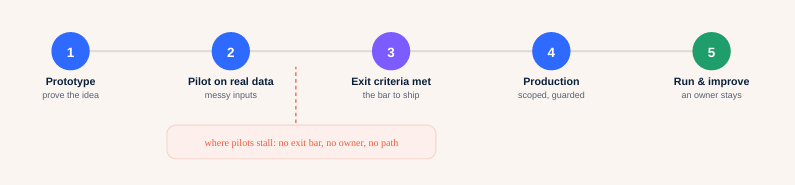
- Design for production from the start. Build the boring parts into the pilot, the integration with real systems, basic monitoring, a way to measure quality, so “ship it” is a short step, not a second project. The unglamorous infrastructure is what lets a pilot graduate.
- Test on real, messy work. Run the pilot on genuine inputs, including the ugly ones, not a curated set. Discover the edge cases while it’s a cheap pilot, not after launch when they’re expensive and public.
- Set exit criteria up front. Before you build, agree on the one number it must move and the bar that means “ready”: the turnaround it must hit, the accuracy it must clear, the cost it must beat. That decision turns endless refinement into ship or stop.
- Name the owner of production, not just the pilot. Someone must be accountable for getting it live and running it afterward, not only for the demo. Decide who that is before you start, and give them the time and the authority.
- Plan the handoff and the run. Decide up front who operates the thing once it’s live, how it’s monitored, and how it improves. A pilot with no answer to “who runs this on a Tuesday six months from now?” is a pilot designed to stall.
The Shape of a Pilot That Ships
Put those together and an AI pilot to production journey stops being a one-off demo and becomes the first leg of a real rollout. It starts narrow, on a real workflow with messy data. It has a number and a bar agreed before anyone builds. It’s wired into your systems early, not bolted on at the end. It has one owner accountable all the way to production, and a plan for who runs it afterward.
When it hits the bar, shipping is a short step, because everything shipping needs was built into the pilot. When it doesn’t, you stop early, having learned something cheaply. That’s the whole difference. A pilot designed to ship with AI development services will tell you, quickly and honestly, whether this belongs in your business, and if it does, it will already be most of the way there.
The demo was never the point. Getting past it is.
Why Let Your AI Pilot Stall?
Partner with Pinnasys to transform promising AI pilots into scalable, production-ready solutions.
Pinnasys builds and runs production AI for mid-market operators and AI-native startups. A Claude Service Partner, and the team has been shipping AI since 2016.
Key Takeaways
- A successful demo does not guarantee production success. The real challenge begins when AI must operate reliably in real business environments.
- Moving from AI pilot to production requires planning from day one. Integration, monitoring, governance, and scalability should be part of the pilot, not added later.
- Most AI pilots stall because of operational issues, not model performance. Unclear ownership, weak integration, and undefined success metrics are the most common obstacles.
- Test AI on real-world workflows and messy data. Production readiness depends on how well AI handles edge cases, not curated demonstrations.
- Define measurable exit criteria before building. Clear business metrics help teams decide whether to scale, improve, or stop the project.
- Assign a production owner early. Someone must be accountable for deployment, ongoing operations, and continuous improvement after the pilot ends.
- Build the pilot as the first phase of deployment. Treating the pilot as the foundation of a production system increases the chances of long-term success.
Frequently Asked Questions
1. Why do most AI pilots fail before reaching production?
Most AI pilots do not fail because the AI model performs poorly. They stall because of weak integration, unclear ownership, missing success metrics, and the absence of a structured production plan that supports long-term deployment and operational reliability.
2. What is the difference between an AI pilot and a production AI system?
An AI pilot proves that a concept can work under controlled conditions. A production AI system must operate reliably with real users, messy business data, existing software, security requirements, monitoring, and continuous performance management.
3. How long should an AI pilot run?
An effective AI pilot should run only long enough to validate measurable business outcomes. Most organizations benefit from pilots lasting several weeks to a few months, provided clear success criteria and deployment plans are defined before development begins.
4. What should businesses measure during an AI pilot?
Instead of measuring how impressive the demonstration looks, businesses should track operational metrics such as processing time, accuracy, cost savings, user adoption, workflow efficiency, error rates, and overall business impact to determine production readiness.
5. Why is AI integration more difficult than building the model?
Building the AI model is often only one part of the project. The greater challenge is integrating AI with existing business systems, workflows, data sources, governance policies, and operational processes while maintaining reliability at production scale.
6. Who should own an AI implementation after the pilot ends?
Every successful AI implementation needs a dedicated production owner. This person is responsible for deployment, monitoring, maintenance, user adoption, ongoing optimization, and ensuring the AI solution continues delivering measurable business value after launch.
7. How can businesses improve the success rate of AI deployments?
Businesses improve AI deployment success by starting with a real operational problem, testing on production-like data, defining measurable exit criteria, planning integrations early, assigning clear ownership, and designing the pilot as the first phase of production.
8. What makes a successful AI pilot?
A successful AI pilot is not simply one that demonstrates impressive technology. It solves a specific business problem, produces measurable results, integrates with existing workflows, and creates a practical path toward reliable production deployment and long-term adoption.





Prakash C. Saini
Prakash Saini is the Founder & CEO of Pinnasys. With over a decade in digital transformation and building production systems, he grew an engineering team from 2 to 50 people and has led the delivery of 100+ production digital systems. Products built under his leadership have raised millions in funding and generated over $50 million in revenue. He holds an Executive MBA from IIM Kozhikode and today leads the AI engineering team at Pinnasys.