



An AI use case prioritization framework helps businesses decide where AI can deliver the most value. It weighs potential impact against the effort, risk, and resources required. This gives teams a clearer path from AI opportunities to practical investment decisions.
S&P Global and 451 Research report that organizations abandon 46% of AI proof-of-concept projects before they reach production. Every abandoned project represents more than wasted development time. It can also consume budget, internal resources, and stakeholder confidence. A structured AI use case prioritization framework helps decision-makers assess opportunities before those costs accumulate.
The blog focuses on impact vs. effort scoring, business value, technical feasibility, governance, and how prioritized use cases can shape a practical AI strategy roadmap.
What Is an AI Use Case Prioritization Framework?
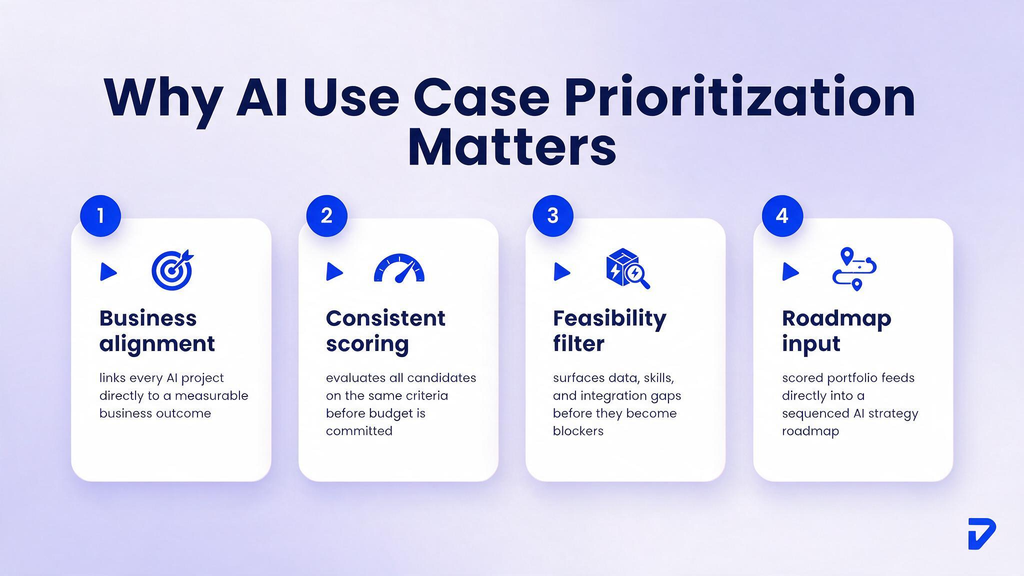
An AI use case prioritization framework is a structured way to evaluate potential AI initiatives and determine which ones deserve investment first. It considers factors such as business impact, implementation effort, data readiness, technical feasibility, risk, and strategic fit. The framework gives teams a consistent method for comparing different AI opportunities instead of relying on individual opinions, technology trends, or the urgency of a single department. Each potential use case can be assessed against the same criteria to determine its expected value, required resources, technical dependencies, and potential challenges. This makes it easier to identify initiatives that can deliver meaningful business outcomes while avoiding projects that require significant effort without a clear return. A structured prioritization process can also help organizations distinguish between quick wins that can be implemented with relatively low effort and larger strategic investments that may require additional planning, resources, or phased implementation. By combining business value with feasibility, data readiness, risk, and strategic alignment, organizations can create a ranked portfolio of AI opportunities that provides a clearer basis for funding decisions and supports the development of a practical AI strategy roadmap.
This matters because not every promising AI idea is practical or valuable enough to pursue. RSM’s 2025 Middle Market AI Survey found that 41% of organizations experiencing AI implementation problems cited data quality as their top barrier. Evaluating these factors early helps businesses avoid weak use cases and focus resources on initiatives with a stronger path to measurable value.
The Impact vs Effort Model for AI Use Cases
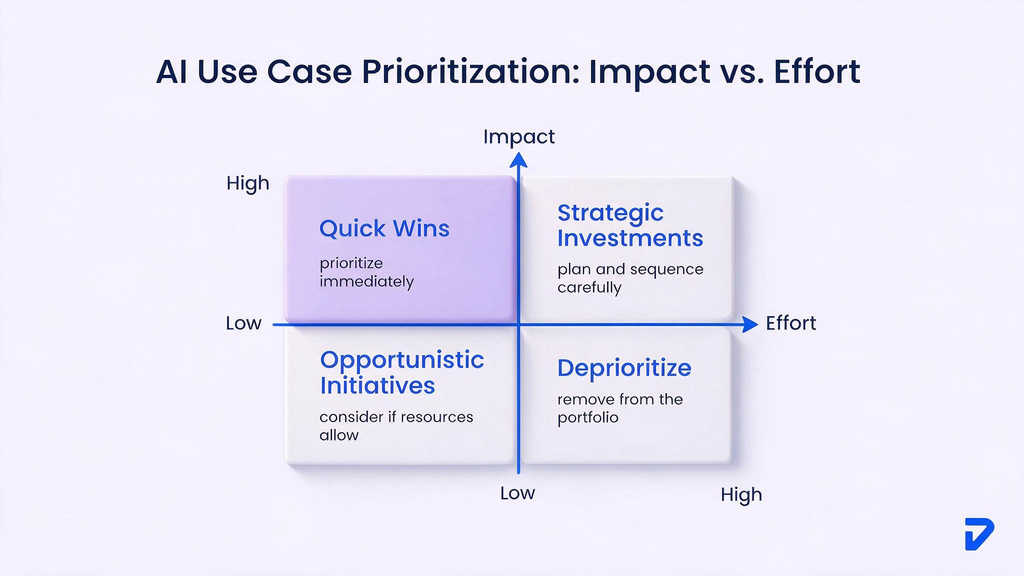
Impact vs. effort scoring helps organizations compare AI opportunities based on their potential value and implementation requirements. It provides a simple way to identify quick wins, strategic investments, and initiatives that may not justify the effort.
What Impact Means When Evaluating AI Opportunities
Impact represents the measurable business value an AI use case could generate. This can include higher revenue, lower operating costs, faster processes, fewer errors, or better customer outcomes. The score should be based on specific outcomes rather than broad claims. For example, “improves customer experience” is difficult to measure, while “reduces response time by 60%” provides a clearer basis for evaluation.
What Effort Means in an AI Implementation
Effort reflects the time, resources, technical complexity, and organizational change required to deploy an AI use case. It includes data preparation, integration, development, testing, and maintenance. Deloitte found that only 6% of organizations achieved satisfactory AI payback within one year, highlighting why implementation demands and time to value should influence prioritization.
The Four Quadrants of an Impact-Effort Matrix
| Quadrant | Impact | Effort | Recommended Action |
| Quick Wins | High | Low | Prioritize first |
| Strategic Investments | High | High | Plan and sequence |
| Opportunistic Initiatives | Low | Low | Consider when practical |
| Deprioritize | Low | High | Avoid or postpone |
When Impact-Effort Scoring Alone Is Not Enough
Impact and effort provide a useful first filter, but they don’t tell the whole story. Data readiness, technical feasibility, security, regulatory requirements, scalability, and internal capabilities can change the priority of a use case. These factors should be added as separate criteria before making the final investment decision.
Key Criteria for Scoring AI Use Cases
A rigorous scoring model uses defined criteria to keep evaluations consistent across teams. The table below outlines eight key criteria and the question each answers.
| Criterion | What it evaluates |
| Business value and revenue potential | What is the direct financial return or cost saving? |
| Cost reduction and operational efficiency | Which manual steps or error-prone processes does it remove? |
| Customer and employee impact | How does it change the experience for the people using the output? |
| Data availability and quality | Is the right data accessible, labeled, and clean enough to train and run a model? |
| Technical feasibility | Can the organization build, integrate, and maintain this with current or acquirable skills? |
| Implementation complexity | How many systems, teams, and change-management steps are involved? |
| Risk, compliance, and governance | What regulatory, ethical, or reputational risks does this use case carry? |
| Time to value and expected ROI | How long before this generates a measurable return? |
Data Availability and Quality
Data quality directly affects whether an AI use case can reach production. Incomplete, inconsistent, or inaccessible data can undermine even high-impact initiatives. RSM’s 2025 Middle Market AI Survey found that 41% of organizations experiencing AI implementation problems cited data quality as their top barrier. Data readiness should therefore receive a clear score during prioritization.
Risk, Compliance, and AI Governance
Governance risks should be assessed before an AI initiative receives funding. Personal data, automated decisions, and regulated outputs can create significant exposure. The IAPP’s 2025 AI Governance Profession Report found that 77% of organizations are actively working on AI governance. Risk and governance readiness should therefore be included in the prioritization process.
Time to Value and Expected ROI
Time to value helps organizations determine how quickly an AI initiative can deliver measurable business returns. ROI estimates should account for implementation timelines, required resources, operating costs, and expected outcomes. Clear milestones also help teams track whether the initiative is progressing toward its projected business value.
Turn AI Opportunities into Clear Priorities!
Pinnasys helps businesses assess potential use cases by impact, effort, and feasibility to determine where AI investment can deliver the most value.
Step-by-Step Guide to AI Use Case Prioritization
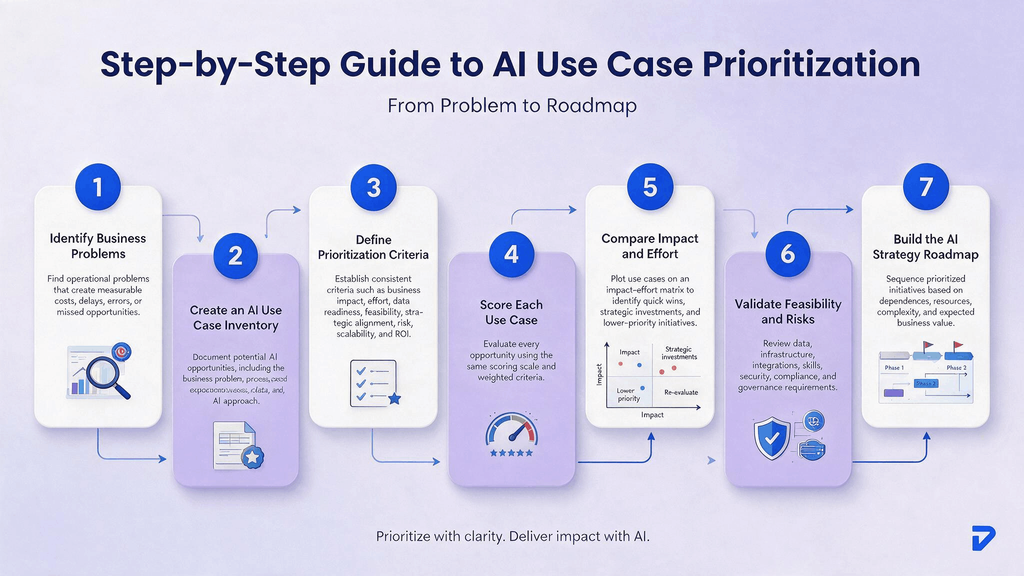
A practical AI use case prioritization framework helps teams move from business problems to actionable AI initiatives. Each step evaluates value, feasibility, resources, and expected outcomes.
Step 1: Identify Business Problems
Start by identifying operational problems that create measurable costs, delays, errors, or missed opportunities. Speak with teams across operations, finance, sales, customer service, and other functions to understand where AI could address genuine business needs.
Focus on the problem rather than the technology. A clear problem statement makes it easier to determine whether AI can provide meaningful improvement and gives teams a measurable outcome to evaluate later.
Step 2: Create an AI Use Case Inventory
Document every potential AI opportunity in a centralized inventory. Record the business problem, affected process, expected outcome, users, required data, and potential AI approach for each use case.
Keep the initial inventory broad rather than eliminating ideas too early. The purpose is to create a complete view of opportunities before applying scoring criteria or deciding which initiatives deserve investment.
Step 3: Define Prioritization Criteria
Establish the criteria before evaluating individual use cases. Common factors include business impact, implementation effort, data readiness, technical feasibility, strategic alignment, risk, scalability, and expected ROI.
Assign weights to each criterion based on organizational priorities. For example, a company with limited data infrastructure may give greater weight to data readiness than an organization with mature data systems.
Step 4: Score Each Use Case
Score every use case against the same criteria and scale. A simple one-to-five scoring system can make comparisons easier, while weighted scores ensure that the most important business factors have greater influence.
Keep the scoring process consistent across teams. Document why each score was assigned so stakeholders can challenge assumptions, identify gaps, and understand how the final ranking was calculated.
Step 5: Compare Impact and Effort
Plot the scored use cases on an impact-effort matrix. High-impact, low-effort initiatives can become quick wins, while high-impact, high-effort projects may require phased investment and stronger planning.
The matrix makes trade-offs easier to evaluate and supports more informed prioritization. Organizations can also use decision intelligence solutions to bring business priorities, expected outcomes, and available resources together when evaluating competing initiatives.
Step 6: Validate Feasibility and Risks
Review shortlisted use cases with technical, operational, security, and compliance teams. Confirm that the required data, infrastructure, integrations, skills, and governance controls are available before approving the initiative.
This validation can change the original ranking. A use case may appear attractive on paper but become less viable when integration requirements, regulatory obligations, resource constraints, or data limitations are considered.
Step 7: Build the AI Strategy Roadmap
Turn the prioritized use cases into a roadmap based on dependencies, resources, implementation complexity, and expected business value. Group initiatives into near-term, medium-term, and longer-term phases.
Assign ownership, define KPIs, and set clear milestones for every initiative. Review the roadmap regularly to keep priorities aligned with changing business needs, resources, data maturity, and AI capabilities.
Common AI Use Case Prioritization Mistakes to Avoid
Poor AI use case prioritization framework decisions can waste resources before an AI project even reaches development. Recognizing common mistakes helps teams identify weak assumptions early and make more informed investment decisions.
- Choosing Technology Over Business Need: Don’t prioritize a use case simply because a new AI capability is available. Start with a clear business problem and determine whether AI is the right solution.
- Ignoring Data Readiness: A strong business case cannot compensate for poor-quality or inaccessible data. Evaluate data availability, quality, and accessibility before assigning a high priority.
- Underestimating Integration Complexity: Production AI often depends on CRMs, ERPs, and operational systems. Include integration requirements, testing, and technical dependencies in the effort score.
- Running Too Many Pilots: Spreading resources across numerous pilots can prevent initiatives from reaching production. Prioritize fewer use cases with clear scaling potential and sufficient resources.
- Overlooking Governance Risks: Privacy, security, compliance, and regulatory requirements can delay deployment. Assess these risks during prioritization rather than addressing them after development begins.
The Bottom Line
A structured AI use case prioritization framework does not slow down AI adoption. It accelerates the adoption that actually matters by directing resources toward the initiatives most likely to survive from concept to production and generate a measurable return. Organizations that skip this step end up with a portfolio full of promising pilots and very little production impact.
Pinnasys works with mid-market operators to run prioritization exercises that produce a scored use case portfolio, a feasibility-validated roadmap, and governance criteria built in from the start. If your organization is evaluating where to invest in AI over the next 12 to 18 months, start with a clear-eyed view of which opportunities are worth pursuing, not just which ones are technically possible. Reach out to our team at Pinnasys to discuss where to begin.
Key Takeaways from the Article
- Forty-six percent of AI proof-of-concept projects are abandoned before reaching production.
- Impact vs effort scoring separates quick wins from strategic investments and flags projects to drop.
- Data readiness, integration complexity, and governance must be scored before budget is committed.
- Only 6% of organizations achieve AI payback within 12 months, so ROI timelines need grounding in reality.
- A prioritized use case portfolio is the essential input to a sequenced, actionable AI strategy roadmap.
Frequently Asked Questions About AI Use Case Prioritization
How Do I Approach an AI Use Case Prioritization Framework?
Start by mapping genuine business problems across your organization and creating a clear use case inventory. Evaluate each opportunity against business value, data readiness, technical feasibility, implementation effort, and governance risk. Apply weighted scoring to rank the opportunities before allocating resources or moving individual projects into development.
What Is the Best Way to Implement an AI Use Case Prioritization Framework?
Begin by defining scoring criteria and their weights before evaluating specific projects. Bring together stakeholders from business operations, IT, finance, and leadership to assess each use case consistently. Score opportunities independently, review differences, and validate the final ranking against technical and operational realities.
What Does a Good AI Use Case Prioritization Framework Look Like?
A strong framework is business-led rather than technology-led. It uses measurable criteria, clear scoring definitions, and factors such as business impact, data readiness, implementation complexity, risk, and strategic fit. The final ranking should produce a practical portfolio that can feed directly into an AI strategy roadmap with defined KPIs.
What Mistakes Should I Avoid With AI Use Case Prioritization?
Avoid choosing projects simply because the technology is available or a stakeholder supports the idea. Other common mistakes include overlooking data quality, underestimating integration requirements, ignoring governance risks, and launching too many pilots at once. Prioritization should also account for scalability and whether the organization has the resources required for implementation.
How Long Does an AI Use Case Prioritization Framework Take to Implement?
The timeframe depends on the number of use cases, business functions, stakeholders, and technical dependencies involved. A focused assessment of four to eight opportunities can take around two weeks. Broader evaluations involving multiple departments, technical validation, and roadmap development may take four to six weeks.
How Does Impact vs. Effort Scoring Work for AI Use Cases?
Each use case receives a defined score for expected business impact and implementation effort. These scores are plotted on a two-axis matrix to identify quick wins, strategic investments, lower-priority opportunities, and initiatives that require disproportionate effort. Data readiness, governance, and technical feasibility can then refine the final ranking.




Prakash C. Saini
Prakash Saini is the Founder & CEO of Pinnasys. With over a decade in digital transformation and building production systems, he grew an engineering team from 2 to 50 people and has led the delivery of 100+ production digital systems. Products built under his leadership have raised millions in funding and generated over $50 million in revenue. He holds an Executive MBA from IIM Kozhikode and today leads the AI engineering team at Pinnasys.