


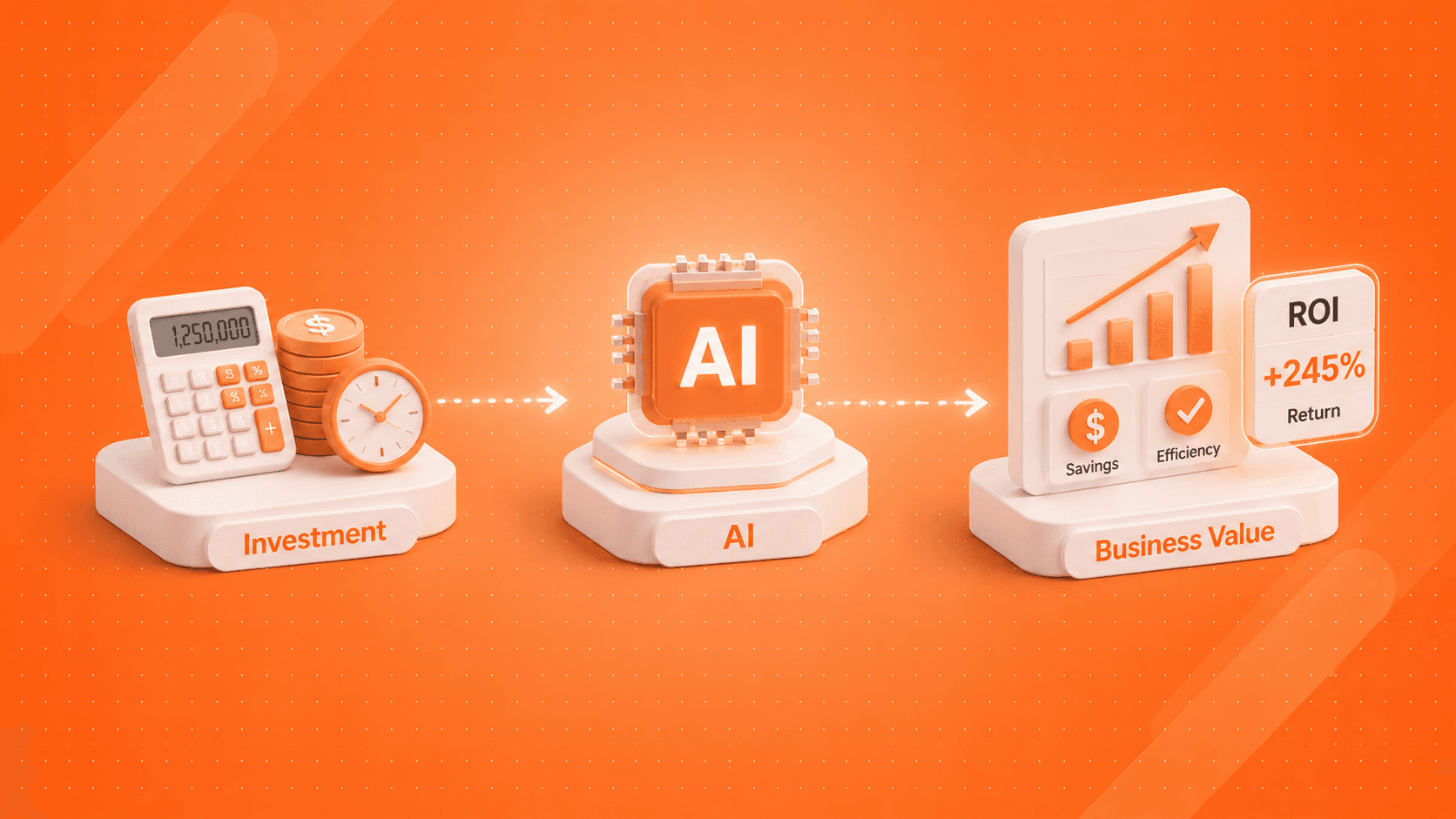
Measuring AI ROI means tracking hard metrics such as cost savings and revenue growth alongside soft metrics such as customer experience and decision quality, all compared against a clear pre-AI baseline over time.
Every business leader has sat through a version of the same conversation. Someone on the executive team asks how the AI initiative is performing, and the answer is a mix of enthusiasm and vague reassurance rather than a number. Teams describe things as feeling faster or smarter, but when the CFO asks for a figure to place next to the investment, the room goes quiet.
This isn’t unusual. Most companies have moved past AI experimentation and into active deployment, yet a surprisingly small share can say with confidence what that deployment is actually returning. The technology has outpaced the measurement discipline around it. That gap is where budgets get questioned, and genuinely useful tools lose support before they’ve had a chance to prove themselves.
Why Measuring AI ROI Is Harder Than It Looks

Calculating the return on a new piece of manufacturing equipment or a marketing campaign is relatively straightforward. You know the cost, you know the expected output, and you can draw a fairly clean line between the two. AI doesn’t play by those rules, and pretending otherwise is where most ROI conversations go sideways.
The Gap Between AI Adoption and Proven Returns
Adoption numbers across industries look impressive on the surface. Companies are integrating AI into customer service, sales, operations, and product development at a rapid pace. But adoption isn’t the same thing as value creation, and plenty of organizations have learned that the hard way after months of deployment with little to show for it financially.
Recent industry research from IBM has found that a large share of generative AI pilots fail to deliver on their expected outcomes, not because the technology doesn’t work, but because the surrounding process, data, and measurement weren’t built to capture what it was actually producing. The tools were live, the usage was real, and the returns were still invisible.
Why Traditional ROI Formulas Fall Short for AI
The classic ROI formula, net gain divided by cost, assumes a fairly direct and immediate relationship between spend and payoff. AI investments rarely behave this way. A voice agent that shortens response time doesn’t hand you a dollar figure at the end of the month; it hands you a faster response time, and it’s up to your team to connect that improvement to lead conversion, revenue, and retention. Many of AI’s benefits are indirect, cumulative, and only visible when you’ve established the right baseline to compare against. Without that baseline, you’re left arguing about impressions rather than proving impact.
There’s also a timing mismatch that traditional formulas don’t account for well. A piece of equipment starts producing value the day it’s turned on. An AI system usually needs a ramp-up period, where the model learns from real interactions, teams adjust their workflows around it, and early friction gets ironed out. Judging ROI too early in that window often produces misleading numbers in either direction, either underselling a tool that just needs more time to reach its stride or overselling one riding a temporary novelty effect that fades once the initial excitement wears off.
Hard ROI vs. Soft ROI: The Two Sides of AI Value
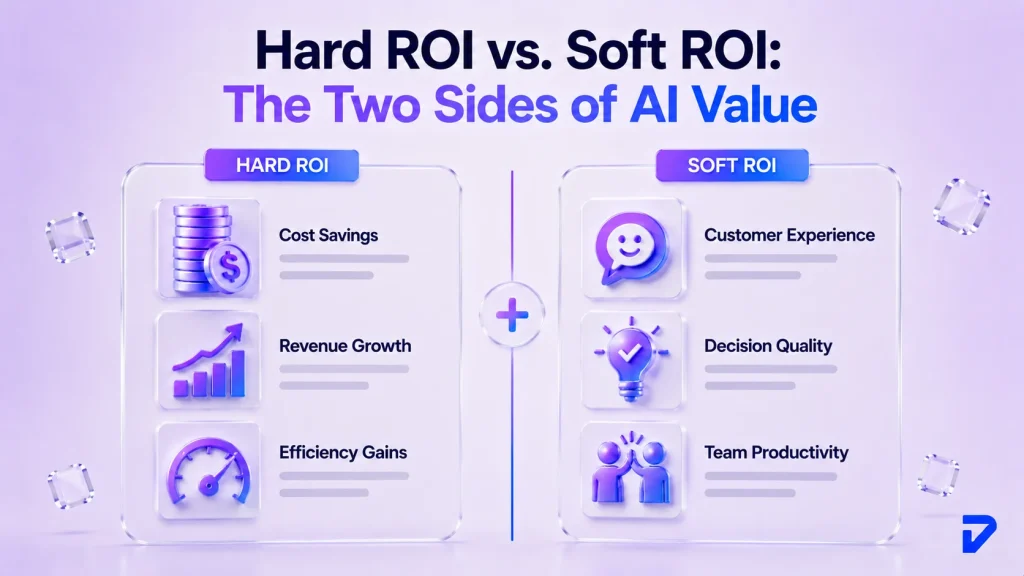
Financial analysts have long split ROI into two buckets, and this distinction becomes especially useful when you’re trying to justify AI spend to a room full of stakeholders who each care about different things.
Hard ROI: Cost Savings, Revenue Growth, and Efficiency Gains
Hard ROI covers the tangible, dollars-and-cents outcomes that finance teams want to see. This includes labor hours saved through automation, measurable reductions in operational costs, increases in lead volume or conversion rates, and new revenue generated by AI-powered products or services. If an AI system cuts the time it takes to process an order, qualify a lead, or resolve a support ticket, that time savings can usually be translated into a dollar figure fairly quickly, which makes hard ROI the easiest starting point for any measurement effort.
Soft ROI: Customer Experience, Decision Quality, and Team Productivity
Soft ROI is where things get more nuanced, and it’s often where the real long-term value of AI actually lives. Improved customer satisfaction, better decision-making from faster access to accurate data, and higher employee retention because repetitive work has been automated away all fall into this category. These outcomes don’t show up on a balance sheet immediately, but they compound over time and frequently show up later as hard ROI in the form of reduced churn, fewer costly errors, and stronger team performance. A mature AI ROI strategy tracks both categories side by side rather than dismissing soft ROI as unmeasurable.
The Core Metrics and KPIs for Measuring AI ROI
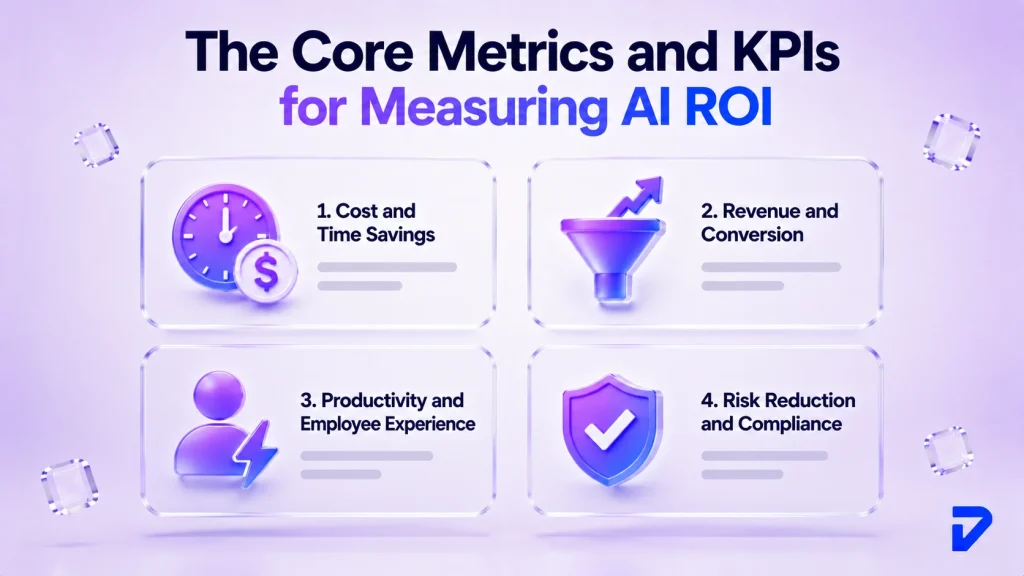
Once you’ve accepted that ROI needs to be tracked across both hard and soft categories, the next step is choosing metrics that are specific enough to actually mean something in a boardroom. Vague statements like “AI is helping us work faster” don’t survive a budget review. Numbers do, and the following four categories cover most of what a business actually needs to build a credible case.
Cost and Time Savings Metrics
Start with the basics: hours saved per week or month due to automation, reduction in manual processing time, and the drop in cost per task before and after AI implementation. These numbers are usually the easiest to capture because they rely on operational data you likely already have access to.
Revenue and Conversion-Based Metrics
This is where AI’s growth impact becomes visible. Track lead-to-customer conversion rate, average deal size, sales cycle length, and revenue attributable to AI-assisted personalization or recommendations. If your AI tools touch any part of the customer acquisition funnel, these metrics will tell you far more than a general productivity score ever could.
Productivity and Employee Experience Metrics
Look at output per employee, time reallocated from repetitive tasks to higher-value work, and employee satisfaction scores tied specifically to AI-assisted workflows. A team that’s freed up from manual data entry isn’t just “happier” in an abstract sense; that freed-up time is capacity your business can redirect toward revenue-generating activity.
Risk Reduction and Compliance Metrics
AI’s ability to catch errors, flag anomalies, and reduce compliance risk is often underreported because it’s harder to quantify what didn’t happen. Still, tracking the reduction in manual errors, faster detection of fraud or compliance issues, and fewer costly mistakes gives you a defensible way to put a number on risk that AI has helped you avoid.
A Practical Framework for Calculating AI ROI
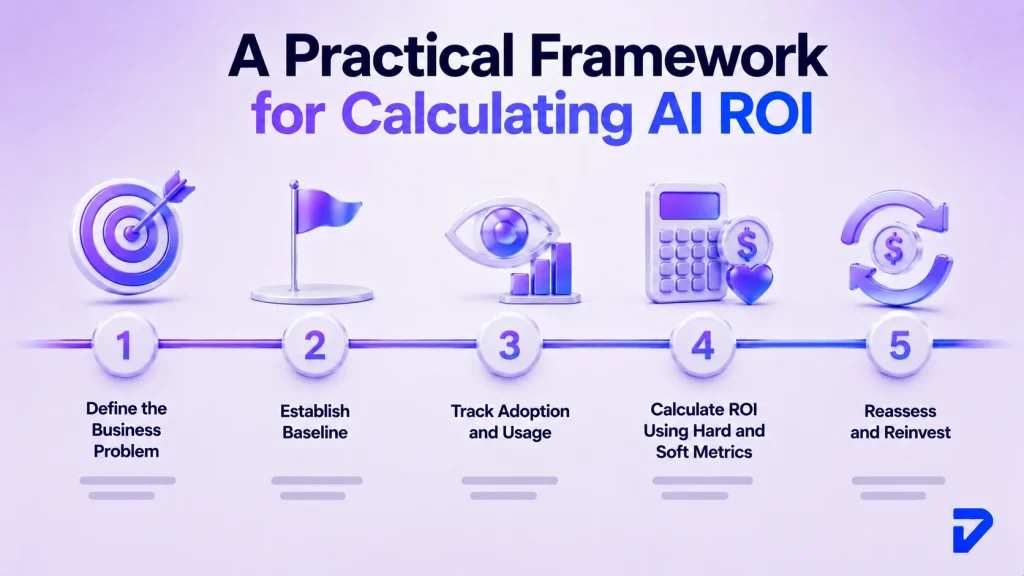
Metrics only matter if you have a repeatable process for applying them. Here’s a five-step framework that works whether you’re evaluating a single AI tool or a company-wide initiative. Run through it once for each major use case rather than trying to apply it to your entire AI strategy at once, since different tools will move different metrics at different speeds.
Step 1: Define the Business Problem Before the AI Use Case
The most common mistake companies make is choosing an AI tool first and then scrambling to find a use case that justifies it. Flip that order. Start with a specific business problem, such as slow lead response times or high customer service costs, and only then evaluate whether AI is the right solution.
Step 2: Establish a Pre-AI Baseline
You can’t measure improvement without knowing where you started. Document your current performance on the metrics that matter, whether that’s average response time, cost per lead, or hours spent on manual reporting, before you deploy anything. Skip this step and every ROI claim you make later will be based on guesswork.
Step 3: Track Adoption and Usage, Not Just Output
A tool that’s technically live but barely used won’t generate meaningful ROI no matter how capable it is. Monitor how consistently your team is actually using the AI system, since low adoption is often the real reason a promising pilot fails to deliver results.
Step 4: Calculate ROI Using Hard and Soft Metrics Together
Combine your tangible savings and revenue gains with the softer indicators like customer satisfaction and decision quality. Present both in your ROI report rather than leading with only the number that looks best, because a complete picture builds far more credibility with stakeholders than a cherry-picked one.
Step 5: Reassess and Reinvest in High-Performing Use Cases
ROI measurement isn’t a one-time report you file away. Revisit your numbers quarterly, identify which use cases are outperforming expectations, and reinvest in scaling those specifically rather than spreading your AI budget evenly across every initiative regardless of performance. This is also the point where it’s worth cutting or pausing tools that aren’t earning their keep.
How Is AI Used in Real Estate?
Few industries illustrate this framework as clearly as real estate. The sector runs on speed, data, and relationships, which makes it an ideal environment for AI to prove its value quickly and visibly. Every one of these use cases can be traced back to a baseline metric an agency, brokerage, or property team was already tracking before AI entered the picture, which is exactly what makes the ROI conversation so much easier here than in less data-driven industries.
Real Estate AI Use Cases Driving Measurable Returns
Real estate AI now touches nearly every stage of the transaction, from the first inbound inquiry to the final closing. Brokerages and property teams are using AI for lead qualification, automated follow-up, market analysis, and document processing, and the common thread across these real estate AI use cases is that each one maps directly to a metric a broker or property manager already cares about: response time, conversion rate, or agent capacity.
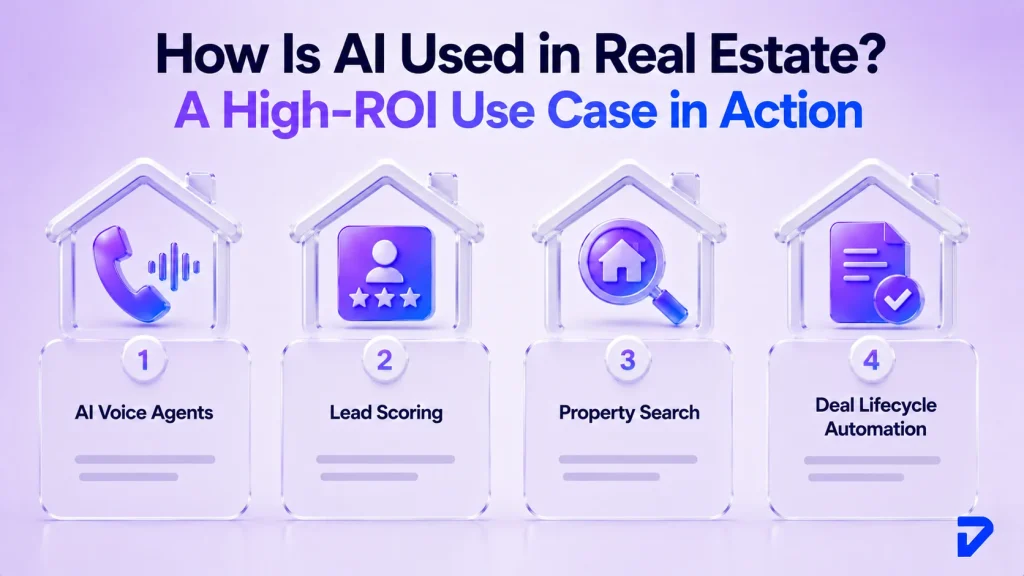
AI Voice Agents for Real Estate: Measuring Response Time and Conversion ROI
An AI voice agent for real estate can answer inbound calls, qualify a caller’s intent, and schedule a showing within seconds of a lead coming in, something that’s nearly impossible for a human team to match consistently around the clock. The ROI here is easy to track: measure the drop in average response time, then compare lead-to-tour conversion rates before and after the voice agent went live. Firms that have deployed AI voice agents for real estate typically see the biggest gains in after-hours and weekend lead capture, since that’s when human response times tend to be slowest, and leads are most likely to go cold.
Real Estate Lead Scoring: Turning Buyer Data into Revenue Predictability
Real estate lead scoring uses behavioral and demographic data to rank incoming leads by how likely they are to convert, which lets agents spend their time on the prospects most worth pursuing instead of working every lead with equal effort. AI lead scoring in real estate improves on manual scoring by continuously learning from closed deals, which means the model gets sharper the longer it runs. The ROI shows up as a higher close rate per agent and a shorter average sales cycle, both of which are easy to present in a quarterly report.
AI Property Search and Proptech AI: Reducing Time-to-Close
AI property search tools help buyers filter listings based on natural-language preferences rather than rigid filters, surfacing better-matched properties faster and reducing the number of showings needed before a buyer commits. This is one of the more visible examples of proptech AI in action, and it directly shortens time-to-close, a metric that has a clear dollar value attached to it for any brokerage tracking deal velocity.
Real Estate Automation Across the Deal Lifecycle
Beyond lead generation, real estate automation is streamlining contract generation, transaction coordination, and compliance checks, tasks that used to consume hours of administrative time per deal. When you add up the time saved across every stage of the lifecycle, from first contact to signed contract, the cumulative ROI of real estate automation often exceeds what any single tool would show in isolation, which is exactly why measuring it holistically matters.
Common Mistakes That Undermine AI ROI Measurement
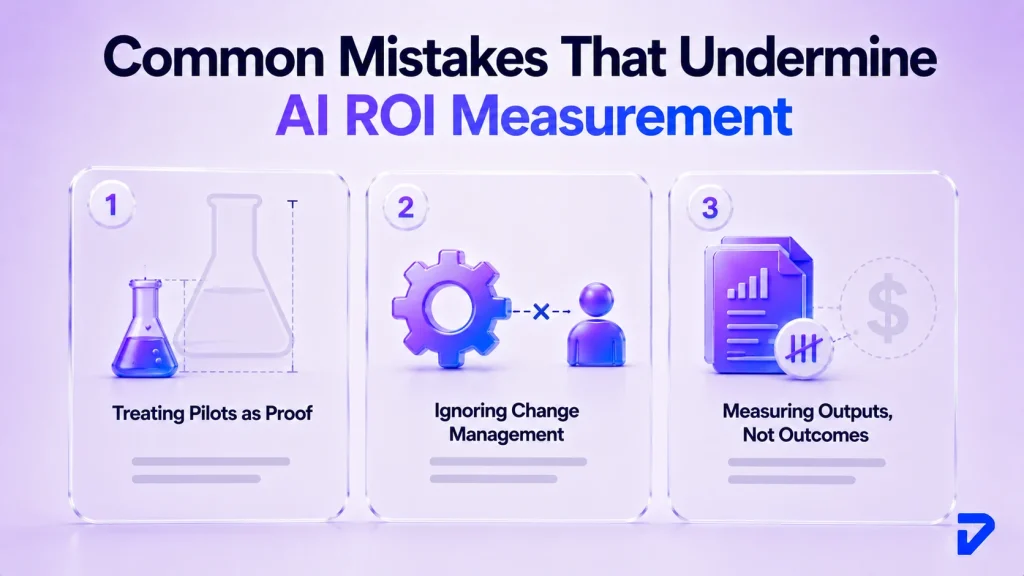
Treating Pilots as Proof of Value
A successful pilot demonstrates that a tool works in a controlled environment, not that it will deliver the same results at scale. Too many organizations extrapolate enterprise-wide ROI from a small test group, then wonder why the numbers don’t hold up once the tool rolls out company-wide.
Ignoring Organizational and Change Management Factors
Technology rarely fails on its own merits. It fails when teams aren’t trained properly, when workflows aren’t adjusted to fit the new tool, or when leadership doesn’t reinforce adoption. Culture and process gaps are consistently cited as bigger barriers to AI ROI than any technical limitation.
Measuring Outputs Instead of Business Outcomes
Tracking how many queries an AI tool processed or how many reports it generated tells you it’s being used, not that it’s creating value. Outputs need to be tied back to an outcome, whether that’s revenue, retention, or cost reduction, or the measurement exercise is just busywork dressed up as analytics.
Building an AI ROI Reporting Process Leadership Will Trust
A number is only as useful as the process behind it. Leadership needs to trust that your ROI figures are consistent, current, and honest about both wins and shortfalls.
Choosing the Right Reporting Cadence
Monthly reporting works well for fast-moving metrics like lead conversion or response time, while quarterly reviews are better suited to slower-moving indicators like employee retention or customer lifetime value. Matching your cadence to how quickly a metric actually changes prevents you from either overreacting to noise or missing meaningful trends.
Aligning KPIs With Department and Executive Goals
Sales leadership cares about conversion and pipeline velocity. Operations cares about cost per task. The C-suite cares about how it all rolls up into revenue and margin. An ROI report that speaks to each of these audiences in their own language, rather than presenting one generic dashboard, is far more likely to keep AI initiatives funded.
How Pinnasys Helps Businesses Prove and Scale AI ROI
Proving AI ROI starts with building systems that were designed to be measured in the first place, not tools bolted onto a workflow and hoped for the best.
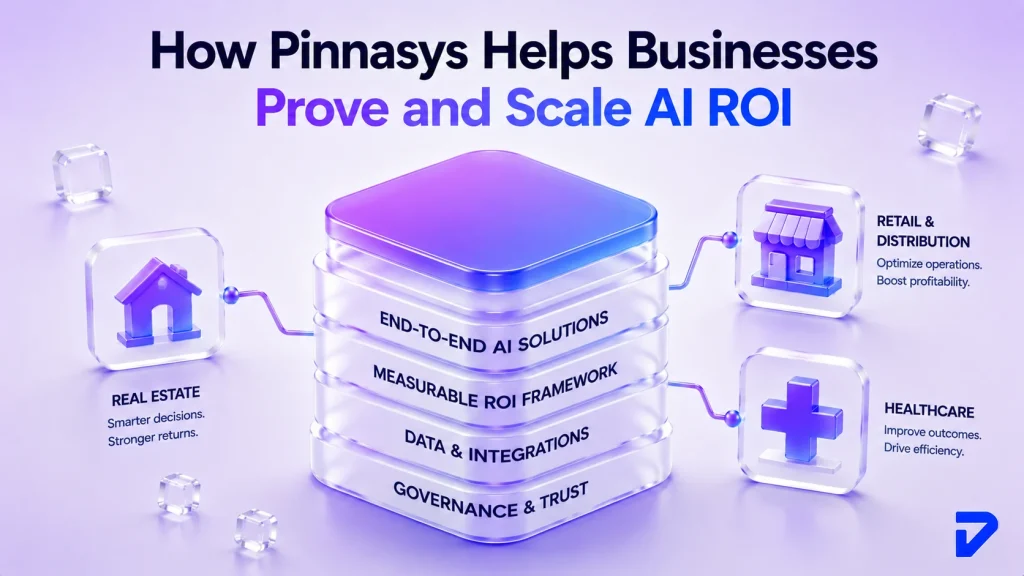
End-to-End AI Systems Built for Measurable Outcomes
At Pinnasys, every AI system we build, whether it’s a voice agent, a lead scoring model, or a workflow automation, is designed around the specific business metric it’s meant to move. That means baseline data collection and reporting infrastructure are part of the build from day one, not an afterthought bolted on after deployment.
From Real Estate AI Agents to Enterprise-Wide Automation
Our work spans real estate AI agents that qualify leads and schedule showings in real time, through to broader enterprise automation across distribution, retail, and healthcare use cases. In every engagement, the goal is the same: give your team a system that performs and a clear, defensible way to show exactly how much value it’s created.
The Bottom Line
AI ROI isn’t something you calculate once and file away. It’s an ongoing discipline that requires the right baseline, the right metrics, and the discipline to track both the hard numbers and the softer, longer-term indicators that don’t show up on a spreadsheet right away.
If you’re ready to move past pilots and build AI systems designed to prove their own ROI from day one, Pinnasys can help. Our AI automation services are built to streamline manual workflows and deliver the kind of measurable outcomes this article has walked through, so the value of your investment is clear from the very first report.
Key Takeaways
- ROI on AI investments is harder to measure than traditional ROI because much of the value is indirect, delayed, or distributed across teams.
- A complete ROI picture combines hard metrics like cost savings and revenue growth with soft metrics like customer experience and decision quality.
- A five-step framework, defining the problem, setting a baseline, tracking adoption, calculating combined ROI, and reinvesting in what works, makes ROI measurement repeatable rather than one-off.
- Real estate offers some of the clearest, fastest-to-measure AI ROI use cases, from voice agents and lead scoring to property search and deal automation.
- The most common reasons AI ROI measurement fails have little to do with the technology itself and everything to do with process, adoption, and tracking the wrong things.
FAQs
How long does it take to see ROI from AI investments?
It depends heavily on the use case. Tools tied to a specific, high-frequency task, like a voice agent handling inbound calls, can show measurable ROI within a few months. Broader initiatives tied to culture change or long sales cycles may take two to three quarters before the numbers become clear, which is why establishing a baseline early matters so much.
What’s the difference between hard ROI and soft ROI in AI? ‘’
Hard ROI refers to tangible, easily quantified outcomes like cost savings, revenue growth, and reduced processing time. Soft ROI covers benefits that are real but harder to attach a dollar figure to right away, such as improved customer satisfaction, better decision-making, and higher employee retention. Both matter, and the strongest ROI reports include both.
How is AI used in real estate to generate measurable returns?
Real estate teams use AI for lead qualification, automated follow-up through voice agents, lead scoring, natural-language property search, and back-office automation across the transaction lifecycle. Each of these use cases maps to a specific, trackable metric, such as response time, conversion rate, or time-to-close, which makes real estate one of the easier industries in which to demonstrate clear AI ROI.
What KPIs should businesses track to prove AI ROI?
At minimum, track cost and time savings, revenue or conversion impact, productivity gains, and risk or error reduction. The specific KPIs will vary by department, but the goal is always to connect AI usage back to a business outcome rather than just an activity metric.
Can small and mid-sized businesses measure AI ROI the same way as enterprises?
Yes, and in some ways it’s easier. Smaller organizations typically have simpler workflows and fewer data silos, which makes establishing a clean baseline and tracking change more straightforward. The core framework- define the problem, measure the baseline, track adoption, and calculate combined ROI- applies at any company size.





Prakash C. Saini
Prakash Saini is the Founder & CEO of Pinnasys. With over a decade in digital transformation and building production systems, he grew an engineering team from 2 to 50 people and has led the delivery of 100+ production digital systems. Products built under his leadership have raised millions in funding and generated over $50 million in revenue. He holds an Executive MBA from IIM Kozhikode and today leads the AI engineering team at Pinnasys.