



Most AI projects fail not because of weak models, but because of a missing strategy. A working AI strategy ties every initiative to a P&L metric, scores use cases by value and feasibility, and moves them from pilot to production through staged roadmaps and clear KPIs.
Artificial intelligence has come out of the experimental phase and become part of the strategies used by modern businesses. According to Gartner, 80% of organizations will have used or deployed Generative AI in their operations by 2026. Various companies have tried to understand how they could benefit from an AI strategy in terms of efficiency, better service delivery, and even finding new sources of income.
However, it is hard for most companies to develop a coherent strategy for using artificial intelligence. It’s certainly not the technology itself, but the strategy and roadmap. A clear-cut enterprise AI strategy will make things easier. This blog breaks down how businesses can turn that clarity into action and build an AI roadmap that actually delivers results.
What is an AI Strategy?
AI strategy is a framework that helps a company articulate its approach toward applying AI technologies and achieving tangible benefits. It is more than a deck made to impress executives and stakeholders. A strategy is a tool that ties together business objectives, data assets, technologies, and people.
Businesses typically approach AI solutions with great zeal; however, they soon find out that tools alone don’t produce results. A strategy imposes order upon such enthusiasm. An effective AI strategy will be helpful for answering some fundamental questions, such as priorities, the type of available data, required skills, and ways to evaluate achievements.
Why Your Business Needs a Successful AI Strategy?
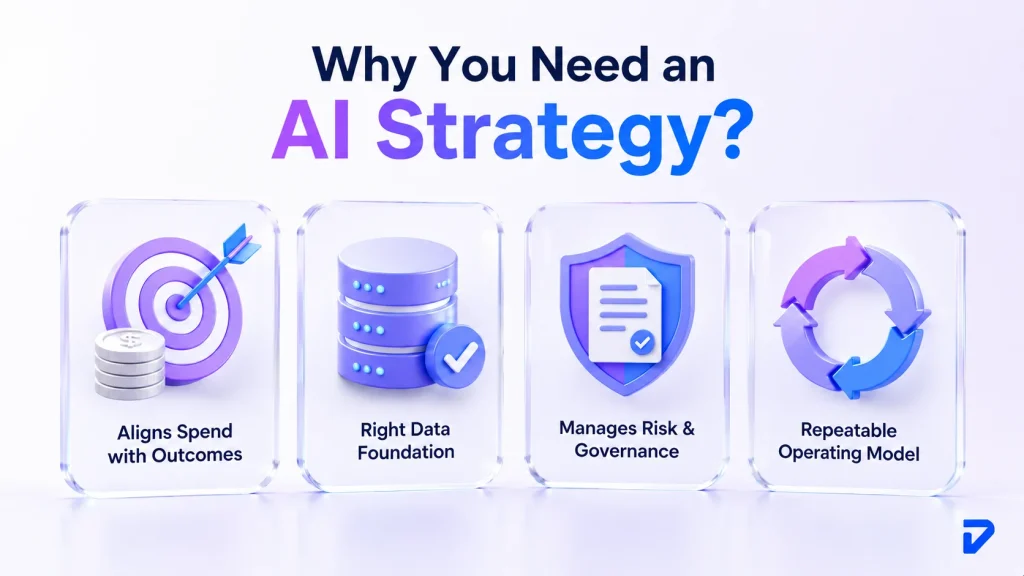
Aligns AI Spend With Business Outcomes
When organizations implement an AI transformation strategy, they usually do so very rapidly and chaotically. It leads to significant overspending because of a lack of alignment with organizational goals, which may include growth, operational efficiency, or customer retention. However, the strategy implementation will allow decision makers to monitor all activities and understand how the invested money is utilized and whether it helps achieve the expected results.
Builds the Right Data Foundation
Data is crucial for AI models, and to ensure their efficiency, a strategy allows companies to assess their data infrastructure at an early stage and deal with all possible issues before launching large-scale projects. Such issues may refer to inconsistencies in data usage across different platforms, problems with data accessibility, and many other problems.
Manages Risk and Governance Early
The AI technologies implementation requires the consideration of several risks, including security concerns and issues associated with biased decisions. The use of strategies is essential in order to build proper data management and governance procedures. Companies need to establish clear rules for data usage and model development to avoid ethical concerns and legal issues.
Creates a Repeatable Operating Model
In order to be successful in the long run, companies need to ensure that they operate in an effective way that can be repeated in case they wish to launch other AI projects. The creation of a proper strategy and definition of key procedures will help organizations develop a working model that they will be able to reuse in the future.
Step-By-Step Process to Build an Enterprise AI Strategy
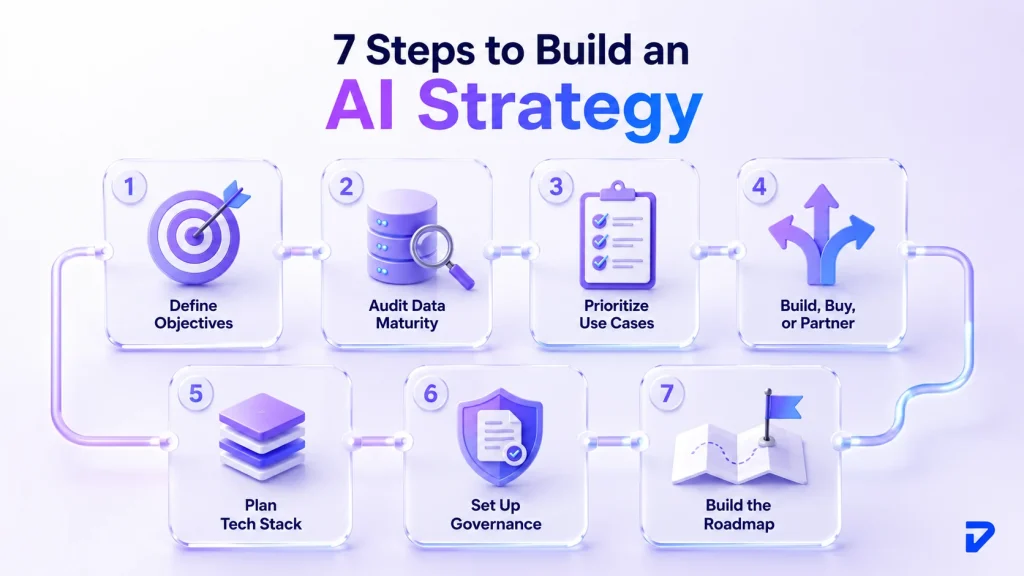
Step 1: Define Business Objectives First
Every successful project starts with the definition of business goals and objectives. A company needs to outline its aspirations and determine how the application of AI can help reach them. For instance, the goal might be to boost customer satisfaction rates or increase the company’s revenue. Such objectives provide a framework for the subsequent development of an AI strategy as they help align business leaders, managers, and technical specialists.
Step 2: Audit Your Data Maturity
Data maturity is crucial to successfully implementing any AI initiative. The audit of current capabilities of a business helps understand how ready it is for further action. Data assessment identifies gaps that need to be covered in order to ensure the reliable operation of machine learning models. It also enables companies to address existing infrastructure and governance-related issues, which is important for future growth and scalability.
Step 3: Identify and Prioritize AI Use Cases
Another important step towards building an AI strategy involves selecting a number of use cases for further implementation. Companies are advised to concentrate on the areas where AI can make a difference and offer some real value to a business. The priority list of use cases depends on several factors: business goals, available data, and ease of implementation.
Step 4: Choose Your Build, Buy, or Partner Model
Companies may choose to develop their own AI technology from scratch, purchase something ready-to-go, or collaborate with other organizations that have enough competencies in the matter. Each approach comes with advantages and disadvantages. However, the third option seems to be more viable than the others. Various models of development help to increase the efficiency of AI technologies.
Step 5: Plan the Tech Stack and Architecture
Technology architecture is important for building a robust AI strategy because of scalability. Organizational leaders are supposed to design data pipelines, select cloud services, pick machine learning platforms, etc. They can choose between different solutions for particular components of the system and design a flexible architecture that will be easy to update and grow in the long term.
Step 6: Set Up Governance and Risk Controls
Another critical part of the strategy development process is governance and risk control. This is necessary for addressing legal requirements, minimizing risks associated with AI, and ensuring high-quality performance of developed models. By defining key principles of data handling, companies can reduce potential liabilities and make the whole process much more predictable.
Step 7: Build the AI Roadmap and Lock the KPIs
The AI roadmap refers to a plan of action designed to implement machine learning solutions effectively and consistently. This roadmap identifies such important components as particular milestones, interdependencies between projects, resources needed, and deadlines for the accomplishment of certain tasks. It is also necessary to mention KPIs because they allow assessing the outcomes generated by employees.
Stuck between a pilot that worked and a production rollout that hasn’t?
Book a discovery call with Pinnasys to map the path from proof of concept to live deployment.
5 Most Common Roadblocks to AI Transformation Strategy
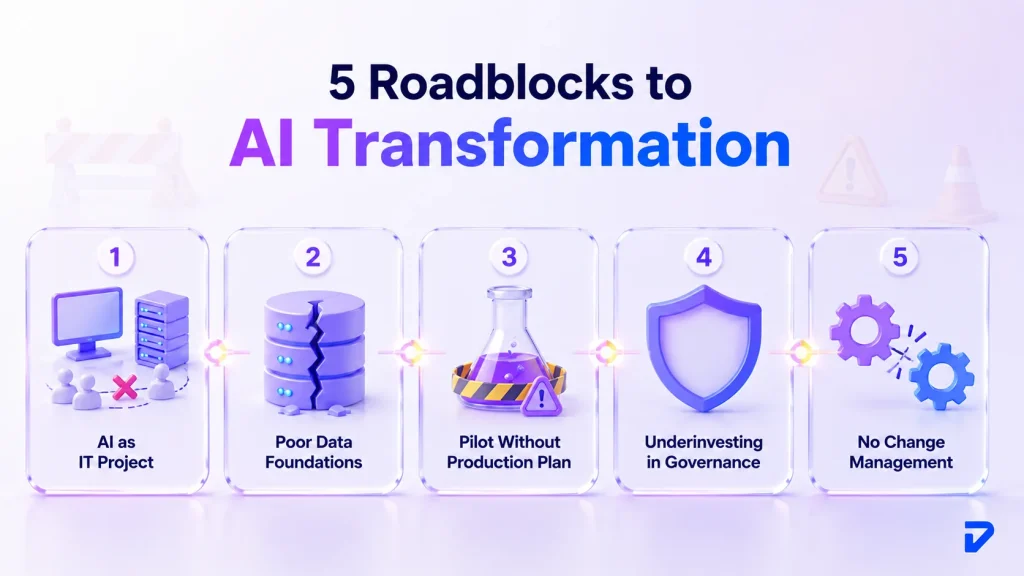
Treating AI as an IT Project
Often, AI projects are positioned inside IT departments without the participation of business-side people right from the start. Such an approach restricts the ability to make changes within a business process, as well as creates solutions without addressing any real needs in business. Therefore, collaboration of leaders, operations managers, and tech specialists is needed to develop impactful solutions.
Poor Data Foundations
All AI tools are based on certain data sets. Inconsistency in data, absence of the necessary data, or poor data governance prevent businesses from making efficient AI tools. Thus, companies have to take care of data governance, standardization, and other processes to provide high-quality data for AI modeling. Otherwise, the project would lead to unexpected delays or failed attempts.
Pilot Without a Production Plan
The main challenge faced by most firms is their inability to scale successful AI projects up to a production environment. The lack of a production plan leads to numerous problems connected with infrastructure or the lack thereof, which makes AI projects impossible to launch in production. For this reason, a clear production strategy is required.
Underinvesting in Governance
Governance is often undervalued at the initial stages. Thus, there is no way to exercise any degree of control over potential challenges and issues, including the issue of compliance, data privacy, and ethical considerations, not to mention output quality. In order to manage all possible risks connected with outputs of an AI solution, enterprises should pay close attention to governance and control measures.
No Change Management
Change management is a crucial part of any AI adoption project. Otherwise, it would be difficult to implement changes associated with using an AI solution since employees may resist any attempts. As a result, it would be harder to gain the desired results. Thus, businesses should pay attention to developing a change management strategy.
AI Implementation Roadmap – From Pilot to Production
A structured implementation roadmap ensures a smooth transition:
| Stage | Description |
| Pilot | Start with piloting AI implementation by focusing on one use case only with tangible results and a minimal amount of data. This step enables you to ensure the feasibility of AI implementation, discover possible risks, and create benchmarks. |
| Validation | Proceed to validation, where you test AI models using real-life data and improve their performance. This step guarantees the reliability of your model, shows integration difficulties, and gives more assurance of success. |
| Scalability | Progress further with scalability, where you increase the volume of your database, expand infrastructure, and integrate AI models into existing business applications. At this stage, standardized processes become essential. |
| Implementation | Implement solutions by putting them into action and integrating them into your business environment. It includes ongoing monitoring of your AI solution’s stability and governance practices to ensure regulatory compliance. |
| Optimization | Iterate through optimization where you train your model regularly using new data and constantly improve its performance and efficiency. |
| Expansion | Scale further by deploying your AI solution to more use cases across different departments. |
What Do AI Technical Architectures Look Like in Practice?
Real-Time Personalization Architecture
Real-time personalization architecture uses data streaming to offer instant and personalized experiences to customers. In doing so, it integrates various types of data pipelines, machine learning models, and APIs to create recommendation engines.
Back-Office Decision Intelligence
Back-office decision intelligence uses big data processing techniques to analyze both structured and unstructured data sets to improve business functions such as finance, supply chain management, and human resource management. The technology enables more accurate decision-making through data analytics.
Sample MLOps Pipeline
The MLOps Pipeline standardizes the whole process of using machine learning algorithms from their inception stage until their maintenance and improvement phase. This standardized lifecycle makes sure that all the stages are consistent and can be optimized.
KPIs and Model Metric Mapping
In order for KPIs to become useful for businesses, their alignment with certain metrics should be ensured. Some important metrics include accuracy and error rate. These metrics should have direct connections with business benefits, such as improved customer satisfaction.
The Bottom Line
A strong AI strategy is not a slide deck. It is a living plan that ties business outcomes to data, models, and operating discipline. Start with goals, not models. Audit your data. Pick a small portfolio of use cases. Build governance in from day one. Move from pilot to production on a clear roadmap.
That is how startups, scaleups, and enterprises turn AI from hype into hours saved, errors reduced, and revenue unlocked. If you want a partner that builds and runs production-ready AI alongside you, explore Pinnasys’s AI consulting services. Book a discovery call when you are ready to start.
Key Takeaways from the Article
- AI strategy aligns AI investments with revenue, cost, and risk goals.
- Data readiness decides AI success more than model choice.
- Prioritize use cases by value and feasibility, not novelty.
- A roadmap moves AI from pilot to production in clear stages.
- Governance and change management protect long-term AI ROI.
Frequently Asked Questions About AI Strategy and Roadmap
What is the Cost of Building an AI Strategy?
A focused AI strategy engagement typically ranges from $25,000 to $150,000, depending on company size and scope. Costs cover use-case discovery, data audit, architecture design, and roadmap creation. Implementation costs sit separately and depend on the chosen use cases.
How to Measure Success in Business AI Strategy?
Measure success against business KPIs first, then model metrics. Track hours saved, errors reduced, revenue uplift, and cost-to-serve. Pair these with model-level metrics like accuracy, drift, and latency. Review quarterly and adjust the roadmap accordingly.
What are the Risks of Not Having an AI Strategy?
Without a strategy, AI spend gets fragmented across pilots that never scale. Risks include wasted budget, poor data quality, governance gaps, and missed competitive ground. Companies also expose themselves to compliance issues in regulated sectors like finance and healthcare.
What Should Be in an AI Roadmap?
A solid AI roadmap includes prioritized use cases, data readiness milestones, architecture choices, governance checkpoints, and KPIs. It sequences work over 6, 12, and 24 months. Each milestone ties to a business outcome and a clear owner accountable for delivery.
What are the Guiding Principles for an Enterprise AI Strategy?
Five principles hold across industries: start with business outcomes, fix data first, and build for production, not demos. Add embedded governance and strong change management. Together, they keep AI work tied to value and resilient to model shifts.





Prakash C. Saini
Prakash Saini is the Founder & CEO of Pinnasys. With over a decade in digital transformation and building production systems, he grew an engineering team from 2 to 50 people and has led the delivery of 100+ production digital systems. Products built under his leadership have raised millions in funding and generated over $50 million in revenue. He holds an Executive MBA from IIM Kozhikode and today leads the AI engineering team at Pinnasys.