


Distribution and wholesale companies generate enormous data but rarely have a clear path to turning it into results. AI consulting gives you a structured way to identify where AI pays off, build a strategy, and reach production without burning the budget on pilots that never scale.
Introduction
Epicor’s survey of distribution executives found that 83% of distributors have now implemented AI in at least one business function, up from 35% in 2023. The shift is fast, but the gap between experimenting and extracting real value is wide. Fewer than 10% of distribution companies have developed a formal AI roadmap and prioritized deployment use cases, according to McKinsey research on AI in distribution operations. That gap is exactly where AI consulting for distribution pays its way: it connects the business problem to the right workflow, in the right sequence, with a clear measure of success before a line of code gets written.
In this guide, we’ll look at why distribution businesses are turning to AI consulting, how consulting engagements typically work, and which AI use cases offer the strongest opportunities. We’ll also cover how to build an AI strategy, measure ROI, choose the right consulting partner, and prepare for successful implementation.
Why Distribution and Wholesale Companies Are Turning to AI Consulting
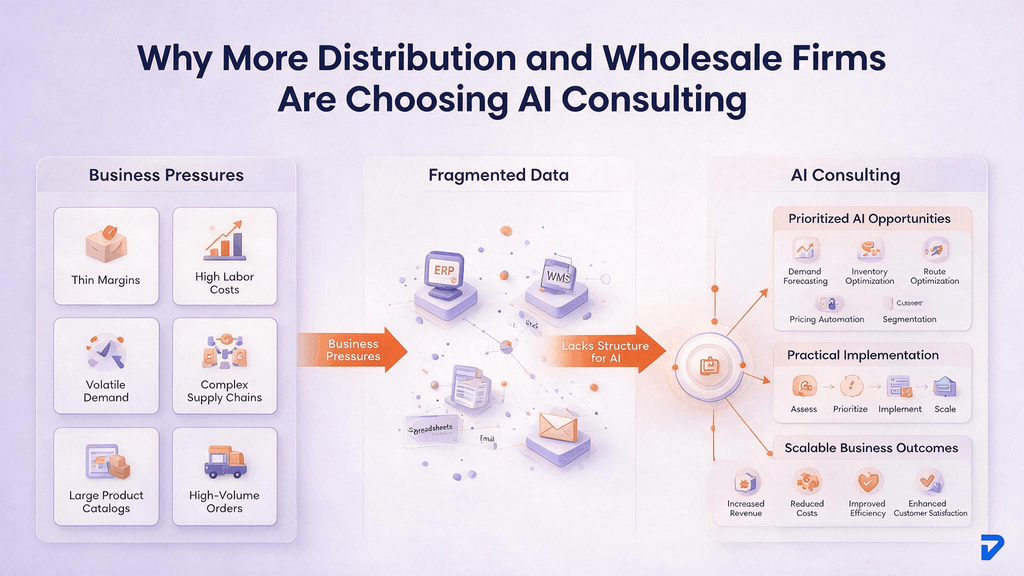
The economics of distribution are punishing. Thin margins, high labor costs, volatile demand, and complex multi-tier supply chains leave little room for guessing. Distributors managing large catalogs, diverse customer accounts, and high-volume order flows are sitting on data that AI can use, but most of that data is scattered across an ERP, a WMS, spreadsheets, and email inboxes. The data exists; the structure to use it does not.
That structural gap is why AI consulting for distribution has become a priority rather than an optional upgrade. Most distributors do not lack ambition. They lack a clear picture of which AI investment pays off first, what their current systems can actually support, and how to sequence the work so each step builds on the one before it. An AI strategy built around guesswork tends to produce expensive pilots that never move beyond the demo stage.
What Is AI Consulting for Distribution Companies?
AI consulting is the process of working with a specialist team to identify where AI can improve your operations, assess whether your data and technology stack can support it, and design a deployment plan that connects each use case to a specific business outcome. It is not the same as buying an AI software product. A software vendor sells a solution looking for a problem; an AI consultant starts with your problem and works backward to the right solution. For distribution and wholesale companies, this means examining operational processes such as demand forecasting, inventory management, order processing, supply chain planning, pricing, sales, and warehouse operations to determine where AI can create measurable improvements. The consulting process also evaluates the systems and data behind these workflows, including ERP, WMS, CRM, spreadsheets, and other business applications, to identify integration requirements and data-quality limitations. Potential AI use cases can then be prioritized according to expected business impact, available data, implementation complexity, cost, and return on investment. This approach helps companies avoid investing in AI projects simply because a technology is popular and instead focuses resources on workflows where automation, prediction, or better decision-making can solve a specific operational problem. A well-structured AI consulting engagement can also define the technical architecture, implementation roadmap, governance requirements, and performance metrics needed to move an AI initiative from an initial assessment through pilot development and into production. By connecting AI capabilities with existing business processes and measurable goals, distribution companies can build a practical AI strategy that supports operational efficiency, better decision-making, and long-term scalability.
For distribution companies, that distinction matters because the highest-value opportunities are rarely the most obvious ones. The AI use case your competitor is publicizing may not be the right first step for your business. A consulting engagement surfaces what is actually holding your operation back, whether that is forecast error driving dead stock, manual order entry slowing fulfillment, or inconsistent pricing eroding margin on high-volume accounts.
How Do Distribution Companies Use AI Consulting?
A structured AI consulting engagement for distribution typically moves through six stages, each building on the last. The sequence matters because skipping steps tends to produce use cases that are technically interesting but commercially irrelevant.
| Stage | What happens | Output |
| Business and operations discovery | Map operational workflows, pain points, and decision bottlenecks | Priority list of business problems |
| Data and technology assessment | Audit ERP, WMS, CRM, and data quality | AI readiness score |
| AI opportunity mapping | Match business problems to viable AI approaches | Candidate use-case list |
| Use case prioritization | Score by ROI potential, data readiness, and implementation risk | Ranked use-case roadmap |
| Solution and integration planning | Design the architecture and system integration plan | Technical blueprint |
| Pilot development and scaling | Build, test, and deploy the highest-priority use case, then expand | Production AI system |
Consulting shouldn’t end with the roadmap. Keeping the same team involved through implementation and production deployment helps preserve alignment between business goals, technical execution, and measurable outcomes.
Best AI Consulting Use Cases in Distribution and Wholesale
These use cases show where AI can deliver measurable results across distribution and wholesale operations. The right priorities depend on your data quality, systems, and operational maturity.
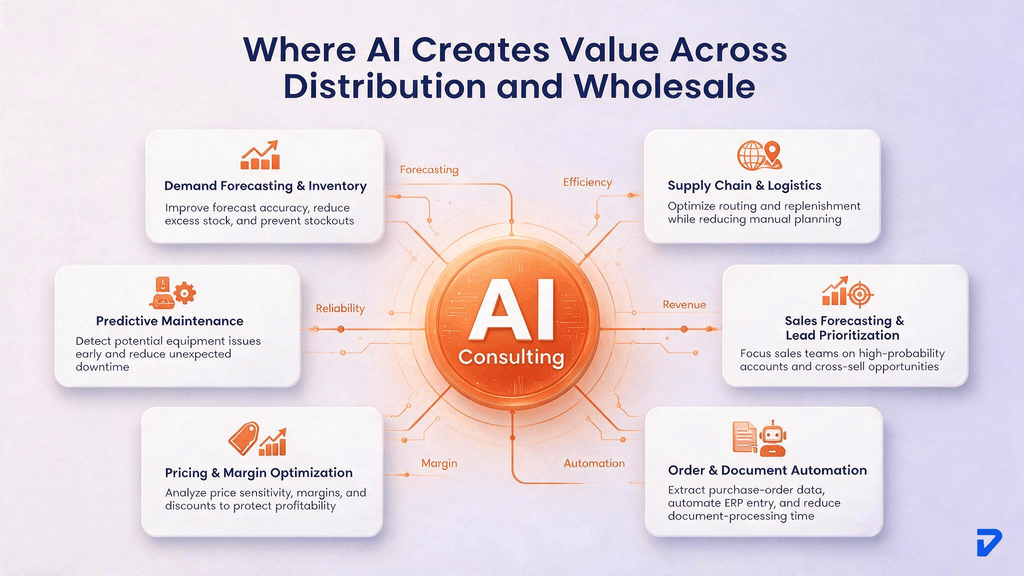
Demand Forecasting and Inventory Optimization
AI analyzes historical sales, supplier lead times, seasonality, and demand signals to improve forecasting accuracy. Better forecasts help distributors maintain appropriate inventory levels, reduce excess stock, and prevent stockouts. This creates a stronger balance between product availability and inventory costs.
Supply Chain and Logistics Planning
AI-enabled routing and replenishment tools reduce manual planning time and improve fill rates. General Mills deployed an AI-driven supply chain optimization system that evaluates over 5,000 daily shipments and has generated more than $20 million in savings since fiscal 2024, flagging exceptions for human review rather than pausing on routine decisions.
Sales Forecasting and Lead Prioritization
AI models that score accounts by purchase probability, flag at-risk customers, and surface cross-sell opportunities allow sales teams to focus on the conversations most likely to close. In field-heavy distribution businesses, that reallocation of rep time often produces more impact than the underlying forecast improvement.
Order Processing and Document Automation
NLP-based (natural language processing) order entry reads purchase orders from emails and documents, maps line items to product IDs, and routes them into the ERP without manual re-entry. McKinsey research on generative AI in distribution documented a 60% reduction in shipment-document preparation time in one pilot, alongside roughly 95% tariff-code accuracy, reducing compliance risk.
Pricing and Margin Optimization
According to the National Association of Wholesaler-Distributors, 73% of distributors pursuing AI pricing tools expect margin improvements of 2% or more, and 16% have already achieved those results. AI pricing tools analyze customer price sensitivity, competitor positioning, and product-level margin data to set floor pricing, flag contract conflicts, and route risky discounts to the right approver.
Predictive Maintenance
AI can analyze equipment sensors, maintenance records, operating conditions, and failure patterns to identify potential issues. Distributors operating warehouses or vehicle fleets can schedule maintenance earlier, reduce unexpected breakdowns, and minimize operational disruptions caused by equipment failures.
Building an AI Strategy for a Distribution Business
An AI strategy for distribution is not a list of tools to buy. It is a documented plan that ties each AI investment to a business goal, defines the data and integration requirements, sets the ROI target, and sequences the work. Each phase should build organizational capability rather than simply producing another disconnected pilot.
A practical AI strategy should cover six core areas: the business goals driving the initiative; a process map of the workflows under consideration; a scored list of AI opportunities ranked by ROI and data readiness; a technical feasibility assessment, including AI integration services needed for existing systems; an estimated cost and return model; and a governance framework covering model review, decision auditing, and ongoing production maintenance.
What ROI Can Distribution Companies Expect From AI Consulting?
AI ROI varies by use case, data quality, implementation complexity, and how well the system fits existing workflows. A consulting engagement should establish measurable targets before implementation so results can be compared against a clear baseline.
Deloitte’s analysis of generative AI in wholesale distribution found that applying AI to sales enablement, quote generation, and post-sales support could produce 75 to 100 basis points of EBIT improvement for the average distributor. Sales and service labor also represents a high operating cost, making these areas practical starting points.
ROI isn’t limited to direct cost savings. Faster quotes, fewer order errors, shorter response times, lower inventory costs, and improved planner productivity can all be measured. The right consulting approach connects each AI initiative to specific business KPIs before development begins.
How to Choose an AI Consulting Partner for Distribution
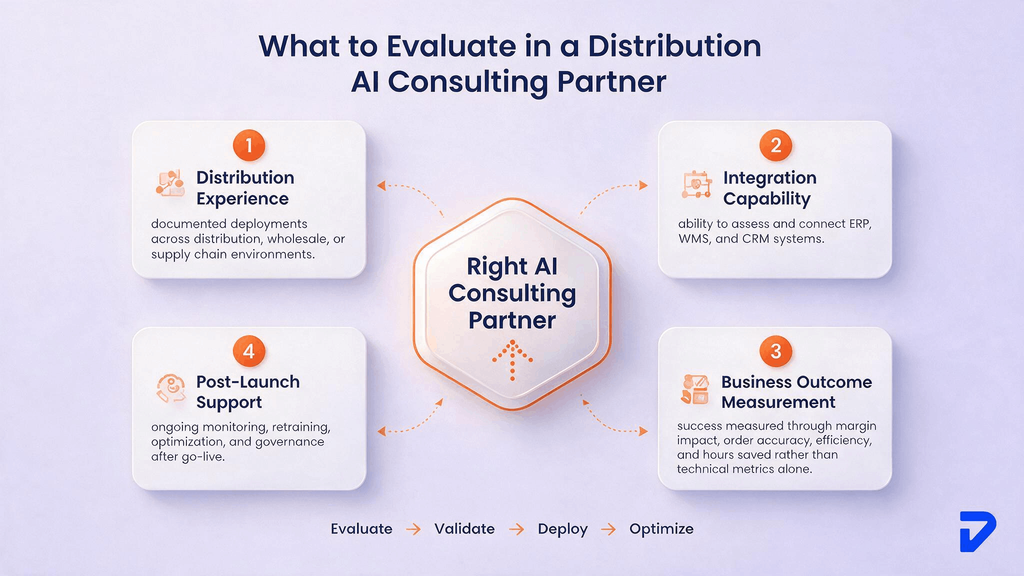
Not every AI consulting firm has meaningful experience in distribution and wholesale. The questions worth asking before you engage:
- Do they have documented deployments in distribution, supply chain, or adjacent industries, or is distribution just a label on a generic AI slide?
- Can they assess your ERP, WMS, and CRM integrations, or do they treat system integration as someone else’s problem?
- Do they measure success in business outcomes or in technical deliverables? A team that reports on model accuracy without connecting it to margin impact or order error rate is solving the wrong problem.
- What does ongoing support look like after go-live? A production AI system needs monitoring, retraining, and governance support, not just a handover document.
Pinnasys builds, ships, and runs AI systems for mid-market distribution and wholesale businesses. The team covers strategy through production deployment, with integrations across the major ERP and WMS platforms. For companies evaluating partners, the AI readiness assessment is a practical starting point.
The Bottom Line
AI consulting for distribution and wholesale works best when it starts with the business problem and works backward to the technology, not the other way around. The research is clear: the gap between experimenting with AI and running on it is wide, and most distributors are still in the pilot phase. The companies that close that gap do so by connecting each AI investment to a specific workflow, a specific data foundation, and a specific measure of success before they build anything.
Pinnasys’s team helps distribution and wholesale companies move from scattered AI experiments to production-grade systems that generate measurable ROI. Whether the priority is inventory accuracy, order automation, or sales productivity, the right starting point is a clear strategy, not a rushed deployment. When you are ready to make that move, the AI integration services team can map the path from your current systems to a working production AI environment.
Key Takeaways from the Article
- Fewer than 10% of distributors have a formal AI roadmap, creating a real competitive advantage for early movers.
- Starting with an AI strategy assessment prevents costly pilots that never reach production.
- Demand forecasting, order automation, and pricing AI consistently deliver the highest near-term ROI in distribution.
- Deloitte research shows AI in sales and service can improve distributor EBIT by 75 to 100 basis points.
- AI governance determines whether a production system stays accurate and trusted over time.
Frequently Asked Questions About AI Consulting for Distribution
How do I get started with AI consulting for distribution?
Start by identifying your most painful operational bottleneck, whether that is forecast error, manual order entry, or inconsistent pricing. A consulting-led AI readiness assessment then maps your data quality and system capabilities against potential use cases, so the first investment goes to the highest-value workflow rather than the most-hyped technology.
What are the best AI consulting use cases in distribution?
Demand forecasting, order processing automation, pricing optimization, and sales lead prioritization consistently deliver the strongest ROI in distribution. Generative AI for internal knowledge retrieval and quote generation is also producing measurable results, with Deloitte estimating up to 100 basis points of EBIT improvement from AI-driven sales and service workflows.
How much does AI consulting cost for a distribution company?
Costs vary by scope, from a focused readiness assessment costing tens of thousands of dollars to a full AI strategy roadmap and pilot build running into six figures. The investment is best evaluated against the operational problem being solved: a 1% inventory carrying cost reduction or 2% margin improvement in a mid-sized distribution business typically dwarfs the consulting fee within the first year.
Do distribution companies need an AI readiness assessment before implementation?
Yes. An AI maturity model assessment reveals whether your data is centralized enough, whether your ERP and WMS can support the required integrations, and whether your team has the process maturity to act on model outputs. Skipping this step is the most common reason AI pilots fail to reach production.
Can AI consulting integrate with our existing ERP and WMS?
Yes, and integration planning is a core part of any well-structured AI strategy engagement. AI systems need to read from and write to your existing platforms, whether those are SAP, Oracle, Infor, Manhattan, Blue Yonder, or others. The consulting engagement should include an integration architecture that maps data flows, API requirements, and security controls before development begins.
Is AI consulting worth it for a mid-sized distribution business?
For most mid-market distributors, the ROI case is strongest when the use case is clearly defined and the data foundation is ready. AI consulting helps identify practical opportunities, assess technical readiness, prioritize initiatives, and build a focused roadmap. This strategy ensures technology investments address real operational challenges and deliver measurable business improvements.




Prakash C. Saini
Prakash Saini is the Founder & CEO of Pinnasys. With over a decade in digital transformation and building production systems, he grew an engineering team from 2 to 50 people and has led the delivery of 100+ production digital systems. Products built under his leadership have raised millions in funding and generated over $50 million in revenue. He holds an Executive MBA from IIM Kozhikode and today leads the AI engineering team at Pinnasys.