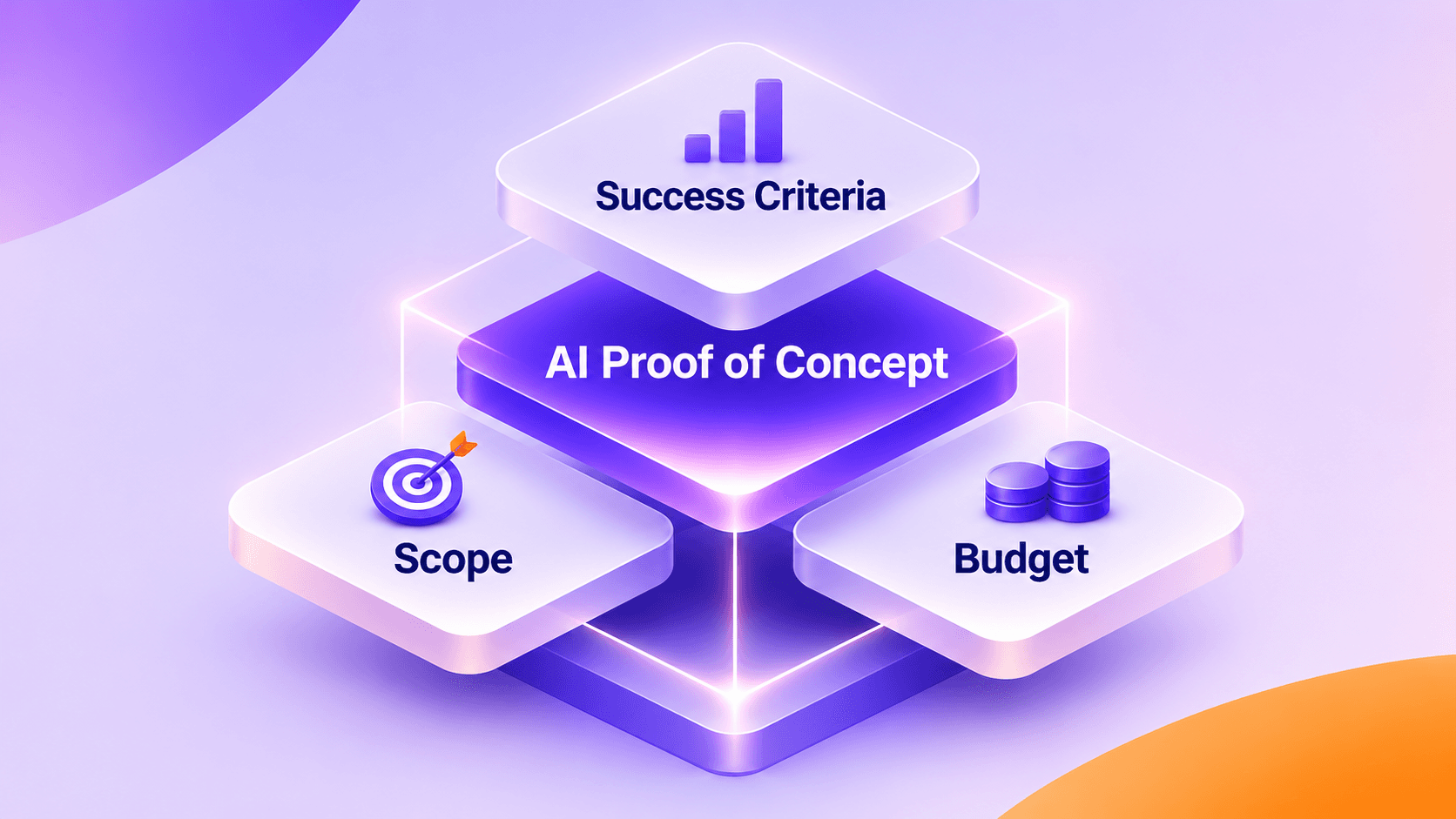
An AI proof of concept is a time-boxed test that answers one business question with real data. Scope it to one use case, set pass thresholds first, and budget $15,000 to $60,000 for most projects.
At least 30% of generative AI projects were expected to be abandoned after the proof of concept stage by the end of 2025. That figure comes from a Gartner forecast on generative AI projects, which pointed to poor data quality, weak risk controls, rising costs, and unclear business value.
Each of those causes is one a well-run AI proof of concept can expose early, while the money at stake is still small. Even so, many teams start with a model and a demo, then discover months later that nobody agreed on what success meant. A disciplined test, paired with practical custom AI development, turns that risk into an evidence-based decision. The sections below walk through scope, data, success criteria, budget, and timeline.
What Is an AI Proof of Concept?
An AI proof of concept is a small, time-boxed experiment that tests whether a specific AI approach can solve a specific business problem with your own data. Its output is a decision backed by evidence, rather than a product ready for users. That difference carries real weight, since nearly two-thirds of McKinsey survey respondents said in 2025 that their organizations had not yet begun scaling AI across the enterprise.
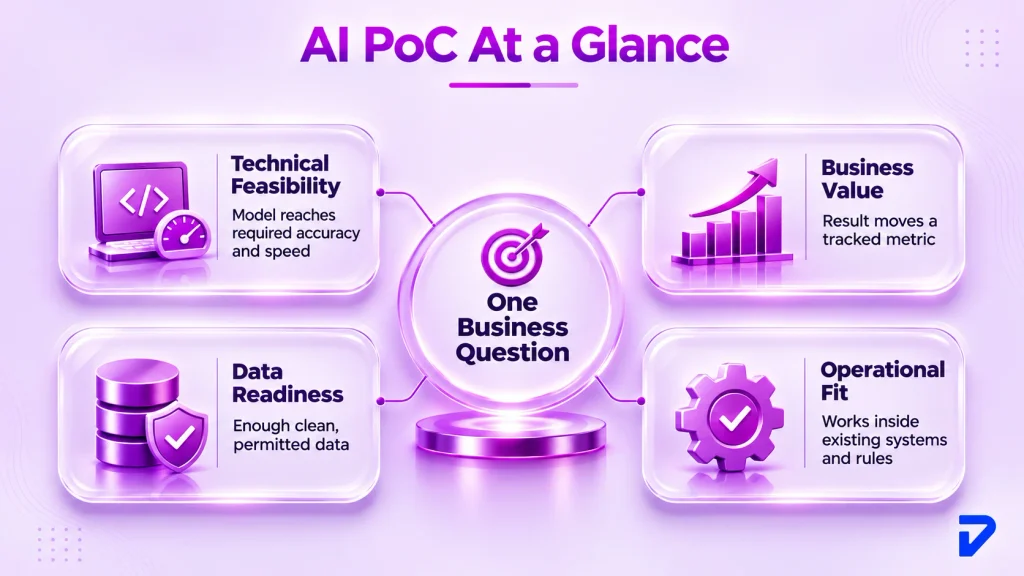
A good test belongs inside your wider AI strategy, where it answers a question leadership already cares about. In practice, a well-designed test examines four risks at the same time.
- Technical feasibility. The model reaches the required accuracy and speed on real inputs.
- Business value. A good result moves a metric that leadership already tracks.
- Data readiness. The team can access enough clean, permitted data.
- Operational fit. The solution works inside existing systems, workflows, and compliance rules.
How Is a Generative AI PoC Different?
A generative AI PoC tests a system that writes new content, so the same prompt can return different answers. A contract summarizer may read well yet omit a liability clause, for example. Evaluation therefore needs human reviewers and a labeled test set alongside automated scores. Many builds add RAG, the retrieval step that fetches documents before the model answers.
What Is the Difference Between an AI PoC and an MVP?
An AI PoC asks whether something can work, while an MVP asks whether real users will adopt it. Teams that blur the two often fund a product before proving the idea. That habit gets expensive, since the average organization scrapped 46% of its AI proofs of concept before production in a 2025 S&P Global Market Intelligence survey. A clear AI PoC vs MVP distinction also keeps budgets realistic, because each stage answers a different question.
| Stage | Core Question | Data Used | Typical Length | Main Output |
|---|---|---|---|---|
| Proof of concept | Can this work? | Representative sample of real data | 4 to 8 weeks | Go, pivot, or stop decision |
| Prototype | What will it look like? | Mock or limited data | 2 to 4 weeks | Clickable workflow for feedback |
| MVP | Will users keep using it? | Limited production data | 3 to 6 months | Usage and retention signals |
| Pilot | Will it hold up at scale? | Live data, full integration | 3 to 6 months | Stability and rollout readiness |
A pilot also needs its own definition of done. Your AI pilot scope should name the user group, integration points, support model, and rollback plan, whereas a PoC can run on exports and a simple interface. An MVP sits in a different lane again, since it exists to learn whether users return and what they will pay for. A blend of those goals usually produces a test too thin to sell and too expensive to discard.
When Can You Skip the PoC?
Skip it when a proven product already solves the problem, and your main question is adoption. A help desk buying a mature ticket-routing tool, for instance, can move straight to a limited pilot. Custom logic, sensitive data, or an unproven accuracy target all point the other way, so settle the build vs buy decision before funding any test.
How Do You Scope an AI Proof of Concept?
Scope an AI proof of concept around one use case, one dataset, and one measurable question, then write down everything that stays out. Every extra scenario needs its own test data and evaluation, so breadth quietly drains both budget and clarity. A simple AI use-case prioritization framework helps here, because the best candidates pair high business value with data you can already reach.
Real operating conditions belong inside that scope as well. McDonald’s ended its AI drive-thru test in 2024 after a run across more than 100 restaurants, with sources telling CNBC that accents and dialects hurt order accuracy. Noise, messy inputs, and edge cases should therefore shape the test rather than surprise you after launch.
Which Stakeholders Should Be Involved?
Name four roles before the kickoff meeting. A business owner sets the goal, a domain expert judges output quality, an IT or data lead secures access, and a compliance reviewer checks data handling. Consider an insurance claims test, where only an experienced adjuster can tell a usable summary from a risky one. Technical scores alone would miss that distinction.
What Belongs in an AI PoC Template?
A one-page AI PoC template forces every decision into writing before spending starts. Sponsors can then approve a clear experiment instead of a vague idea. The example below uses invoice matching at a distributor, and each entry is illustrative, so replace it with your own numbers. If a field stays blank, the scope is still unfinished and needs more discussion.
| Template Field | Example Entry |
|---|---|
| Business problem | Manual invoice matching delays month-end close |
| Hypothesis | AI can match invoice lines to purchase orders at 95% accuracy |
| In scope | PDF invoices from the top 20 vendors |
| Out of scope | ERP write-back and vendor payment approval |
| Data | 1,000 past invoices with verified outcomes |
| Success metrics | Accuracy, p95 latency, cost per invoice, hours saved |
| Stakeholders | AP manager, senior AP clerk, IT lead, controller |
| Budget and timeline | $35,000 over six weeks |
| Decision rule | Go, pivot, or stop against agreed thresholds |
What Data Do You Need for an AI PoC?
You need a representative sample of the real data the system will face, permission to use it, and a set of verified answers to score against. RAND’s study of AI project failures, which cites estimates that more than 80 percent of AI projects fail, lists missing training data among five root causes.
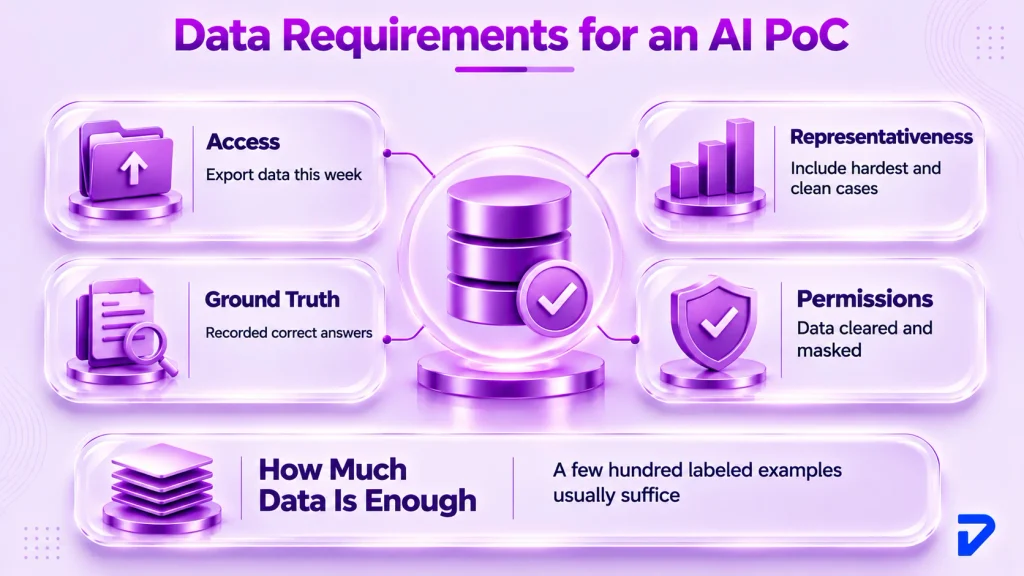
A short AI readiness assessment scores your data readiness early and often becomes the first deliverable of the engagement. Before an AI proof of concept begins, confirm these four points.
- Access. Someone can export the data this week, not next quarter.
- Representativeness. The sample includes your hardest cases along with the clean ones.
- Ground truth. Experts have recorded correct answers, so the model has something to be scored against.
- Permissions. Legal has confirmed the data can be used, and personal details are masked where required.
How Much Data Is Enough?
The answer depends on the task, though a few hundred labeled examples usually support a credible first read on document or classification work. A customer email classifier with ten categories, for example, might use 500 real messages split across those categories. Time-series forecasting needs far more history, so confirm volume before you commit to the timeline.
What Success Criteria Should an AI PoC Have?
An AI PoC should have numeric thresholds for quality, speed, cost, and business impact, all agreed before the build starts. Numbers chosen after the results arrive tend to justify the outcome rather than test it. Strong AI PoC success criteria also connect each technical score to a business result, which is the same logic behind learning how to measure AI ROI in production.
| Category | Success Metrics | Example Threshold | What it Tells You |
|---|---|---|---|
| Quality | Accuracy, precision, recall | 95% correct on the test set | Outputs can be trusted |
| Speed | p95 latency | Under 2 seconds | Users will not wait or abandon |
| Cost | Cost per transaction | Under $0.03 per query | Unit economics survive at volume |
| Risk | Hallucination rate, critical errors | Zero critical errors | Failures stay safe and visible |
| Business | Hours saved, error reduction | 30% less handling time | The outcome justifies scaling |
| Adoption | Reviewer acceptance rate | 80% of outputs accepted | The team will really use it |
Treat these thresholds as starting points, since a medical coding assistant and an internal search tool carry very different risks. Speed targets deserve the same care. Nielsen Norman Group’s response-time limits of 0.1, 1.0, and 10 seconds remain a useful reference, and p95 latency simply means the time within which 95% of responses finish. For quality, keep a fixed golden dataset (a locked set of test questions with approved answers), so every prompt or model change gets scored the same way.
How Should the Go, Pivot, or Stop Decision Work?
Write the rule down before week one, then apply it without debate. Reviewers compare final results against each threshold and record the outcome, as in this simple logic. A pivot suits a close miss with a clear fix, while a wide miss across several metrics usually justifies stopping and keeping the budget.
GO     if every threshold is met

PIVOT  if one metric misses and a fix is identified

STOP   if two or more metrics miss with no clear fix
Unsure what your AI PoC should actually prove?
Pinnasys helps operators define the scope, thresholds, and budget for a focused test, so every funding decision rests on measured results instead of a polished demo.
How Much Does an AI Proof of Concept Cost?
Most AI proof of concept projects cost $15,000 to $60,000, while complex or regulated builds can reach $150,000. Treat the bands below as directional planning ranges drawn from public vendor quotes rather than a formal benchmark, because your AI PoC cost depends mostly on data condition and integration depth.
| Tier | Typical Scope | Budget Range | Timeline |
|---|---|---|---|
| Focused | One use case, one data source, no live integration | $15,000 to $30,000 | 3 to 4 weeks |
| Standard | Several sources, read-only integration, workflow logic | $30,000 to $60,000 | 4 to 6 weeks |
| Complex | Regulated data, several systems, or AI agents | $60,000 to $150,000 | 8 to 12 weeks |
Five factors usually move a project between those tiers.
- Data preparation. Messy or scattered records can consume a large share of the effort.
- Integration. A CSV export is far cheaper than connecting a poorly documented legacy system.
- Compliance. Regulated data needs secure environments and access controls, even in a test.
- Scenario count. Each added scenario brings its own test data and tuning.
- Presentation. A board-ready interface costs more than a working prototype.
Model choice matters less for the test itself than for what follows. Anthropic’s published API pricing currently lists Claude Haiku 5.5 at $0.10 per million input tokens and Claude Fable 5.1 at $10, a 100-fold gap. A side-by-side run during the test shows whether the cheapest model that passes your thresholds can carry production volume.
How Should You Build the Budget?
Start with the commercial picture rather than a rate card. Audit the workflow, record its baseline cost, then fix the scope. Next, separate one-time build costs from usage, data, and support costs, and project ROI against that baseline. A team spending $200,000 yearly on manual invoice handling, for example, can justify a larger test than one spending $20,000.
How Long Should an AI PoC Take?
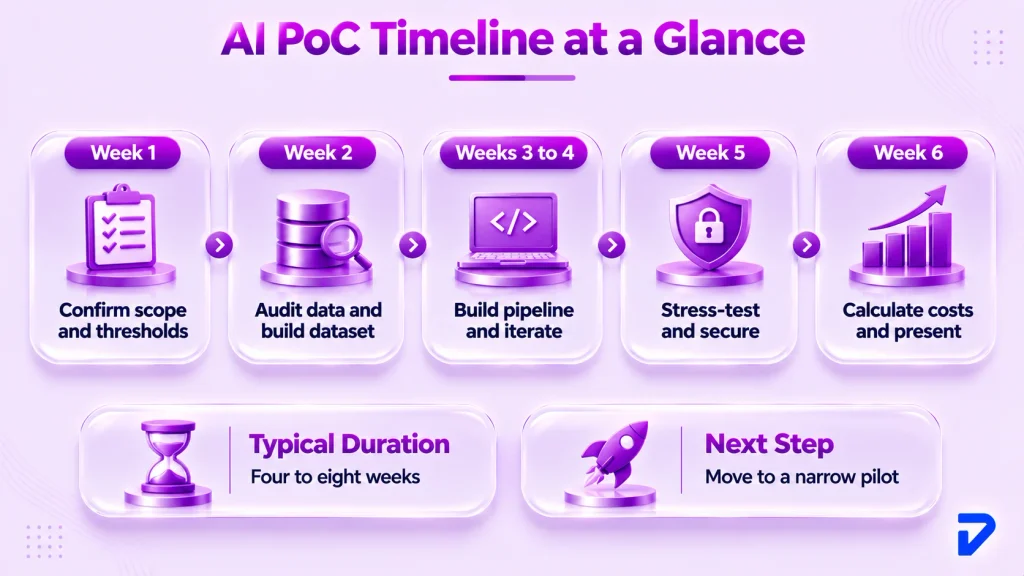
Most AI PoCs should take four to eight weeks, while agentic or multi-system builds can need up to 12. A fixed end date protects the budget and forces a decision, so a slipping timeline usually signals that the scope grew or the data arrived unprepared. The six-week plan below suits a standard project and adapts easily to shorter or longer tests.
Generative AI work often sits at the shorter end because it builds on existing models, whereas traditional machine learning needs extra time for feature work and training. Either way, a midpoint review protects the timeline and budget. If results sit far below the thresholds by then, extra weeks rarely rescue the outcome, so the sponsor should narrow the scope or stop early.
| Week | Focus | Exit Check |
|---|---|---|
| 1 | Confirm scope, stakeholders, and thresholds | Template signed by the sponsor |
| 2 | Audit data and build the golden dataset | Test set approved by experts |
| 3 to 4 | Build the pipeline and iterate | Midpoint review against thresholds |
| 5 | Stress-test edge cases and security | Failure modes documented |
| 6 | Calculate unit costs and present findings | Go, pivot, or stop recorded |
Week five deserves real attention, because security issues rarely appear in a friendly demo. The OWASP Top 10 for LLM applications ranks prompt injection, where crafted input steers a model toward unintended actions, as its first risk. Red-teaming (deliberately trying to break the system) therefore belongs in the plan for any tool that handles outside text.
What Happens After the Readout?
A passed AI proof of concept moves into a narrow pilot with an owner, a monitoring plan, and a production budget. Teams then add MLOps, the practices that deploy and monitor models, plus drift monitoring and human review. This AI pilot-to-production stage is where a passing result starts earning hours back for the business.
The Bottom Line
A strong AI proof of concept buys a clear decision for a fraction of the cost of a full build. Tight scope, ready data, and thresholds set in advance do most of that work, while a realistic budget and fixed timeline keep everyone accountable.
When a result clears the bar, the harder job begins, because production depends on monitoring, governance, and solid AI integration with the systems your team already runs.
The engineers at Pinnasys measure that success in hours saved, errors reduced, and revenue unlocked rather than in demos. If a workflow on your list deserves a closer look, pick one measurable question, fill in the template above, and start from there.
Key Takeaways from the Article
- A focused AI PoC tests one use case against one measurable business question.
- Pass or fail thresholds must be agreed before anyone builds or reviews results.
- Representative data with verified answers matters more than model choice at this stage.
- Most projects fit a $15,000 to $60,000 budget and a four-to-eight-week timeline.
- A stop decision protects capital, which makes it a useful outcome for sponsors.
Frequently Asked Questions on AI PoC
Should you run an AI PoC in-house or with a partner?
Partners often improve the odds. MIT NANDA research found purchased tools and vendor partnerships succeed about 67% of the time, while internal builds succeed roughly one-third as often, so compare skills and timelines first.
Does an AI PoC need a governance review?
Yes, scaled to the risk involved. The voluntary NIST Generative AI Profile, published in July 2024, offers a practical reference for AI governance checks. Apply them before any test touches customer or regulated data.
Can AI PoC code go straight into production?
Rarely, since test code usually skips hardening. Plan to reuse the prompts, evaluation sets, and architecture decisions, then rebuild security, logging, and vector database components to production standards, which typically takes a further three to six months.
What should you do after a failed AI PoC?
Record why it failed, then decide whether better data, a different approach, or a newer model could change the result. A $30,000 stop can protect a $300,000 build budget, so report it as a useful finding.
How many AI PoCs should a company run at once?
Most mid-market teams should run one or two at a time, because each needs a domain expert for four to eight weeks. A shared AI PoC template and golden dataset format will speed up later tests.