
Vibe coding vs agentic coding is a decision about risk, not taste. Vibe coding wins on raw speed for prototypes and throwaway tools, while agentic coding wins on production quality, auditability, and large codebases. Let the cost of a failure decide.
In February 2025, Andrej Karpathy gave developers a catchy phrase: vibe coding, or building apps by chatting with an AI and barely glancing at the code. A year later, he declared it passé and urged professionals toward “agentic engineering” instead. When a trend’s inventor retires it that fast, leaders should notice.
So what separates vibe coding vs agentic coding? Vibe coding means prompting an AI to build software and accepting the result on feel. Agentic coding means handing scoped tasks to AI agents that plan, edit, test, and open pull requests for human review. Both run on the same models, so the real question is how much risk your team can absorb, which now shapes how companies scope custom AI development.
What Is Vibe Coding?
Vibe coding is a conversational, outcome-first way of building software. A person describes what they want in plain language, an AI model writes the code, and the person judges success by whether the app appears to work rather than by reading the diff. Karpathy’s original description captured the spirit well: give in to the flow and stop worrying about the code itself.
The approach opened software creation to product managers, designers, and founders who never wrote a line of JavaScript. Tools such as Lovable, Bolt, Replit, and Cursor turned a paragraph of intent into a running web app within minutes.
Professional developers have been far more guarded, though. In the 2025 Stack Overflow Developer Survey, roughly three in four respondents said vibe coding was not part of their professional work, and 66% named “almost right” AI output as their top frustration. In short, vibe coding excels at producing a first draft but struggles to guarantee it’s correct, secure, or maintainable.
What Is Agentic Coding?
Agentic coding treats the AI as a delegated worker instead of a text generator. An AI coding agent (software that plans multi-step work and uses tools on its own) receives a scoped task, reads the relevant files, writes changes, runs the test suite, reads the errors, and repeats until the checks pass. The human sets the goal, the boundaries, and the definition of done.
Claude Code, GitHub Copilot coding agent, and OpenAI Codex are the best-known examples in 2026. Each can work across an entire repository, call a terminal, and return a pull request rather than a code snippet. Under the hood, most follow a plan-act-observe-revise loop, a structure explained in more depth in this guide to agentic AI design patterns.
What separates agentic coding from “vibe coding with a bigger model” is the control layer around the agent: permission rules, sandboxed environments, required reviews, and audit logs. Without that layer, an agent is simply a faster way to produce unreviewed code.
Vibe Coding vs Agentic Coding: Key Differences
| Criterion | Vibe Coding | Agentic Coding | Verdict |
| Speed to first version | Minutes to hours | Slower initial setup | Vibe coding faster |
| Upfront setup effort | Almost none | Repo context, CI, permissions | Vibe coding lighter |
| Running cost at scale | Short prompt sessions | Long agent loops use more tokens | Toss-up, depends on volume |
| Code quality | Varies, rarely reviewed | Tested before review | Agentic coding stronger |
| Security and auditability | Weak by default | Scoped access, logged actions | Agentic coding stronger |
| Large or legacy codebases | Struggles past small apps | Works across whole repos | Agentic coding better fit |
| Human skill required | Low barrier to entry | Needs senior oversight | Vibe coding more accessible |
How Vibe Coding and Agentic Coding Work
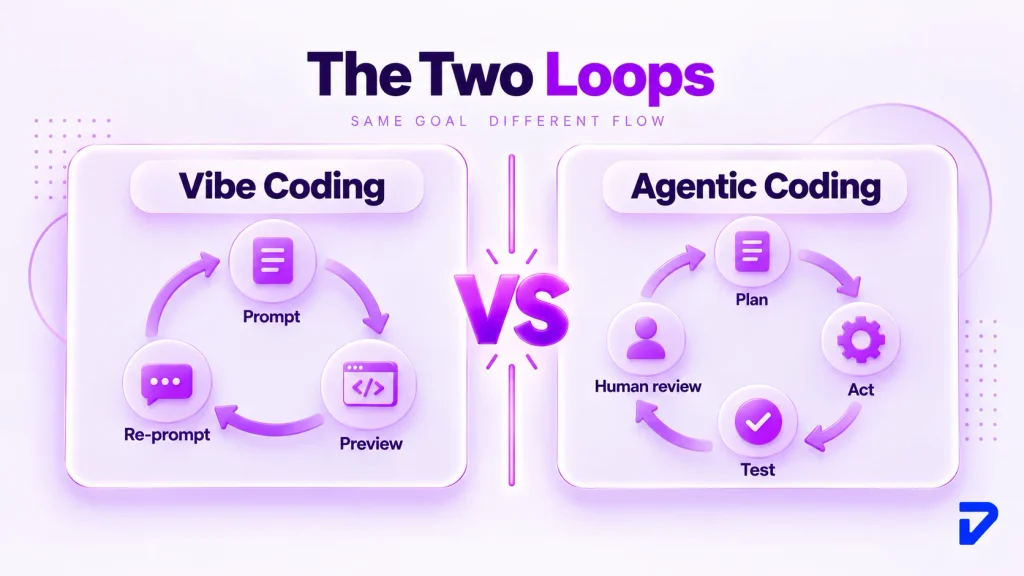
Both approaches start with natural language, yet the loops that follow look very different. One relies on a person reacting to what they see on screen; the other relies on automated checks and structured handoffs before any human looks at the result.
The Vibe Coding Workflow
A typical session looks like this: a founder opens Lovable, types “build a booking page with Stripe checkout and an admin dashboard,” and watches a preview render. When a button misbehaves, the founder pastes the error back into the chat and asks for a fix. Nobody writes a spec, a test, or a review comment. The loop is prompt, preview, and re-prompt, and it ends when the app looks right, which is not the same as being right.
The Agentic Coding Workflow
An agentic workflow begins with configuration instead of a prompt. Teams using Claude Code define what the agent may do in a shared settings.json permissions file, checked into the repository:
{
“permissions”: {
“allow”: [“Bash(npm run test *)”],
“ask”: [“Bash(git push *)”],
“deny”: [“Bash(rm *)”, “Read(./.env)”]
}
}
After that, an engineer assigns a ticket, the agent works on a branch, tests run automatically, and a human reviews the resulting pull request.
Vibe Coding vs Agentic Coding: Pros, Cons, and Risks
Neither approach is inherently safe or unsafe. The real difference lies in where each hides its risk, and how much effort a team must spend to surface it before customers find it.
Benefits of Vibe Coding
Speed is the headline benefit, and the evidence behind it is improving. METR, whose early-2025 trial found AI slowed experienced developers, published a February 2026 update estimating an 18% reduction in task time for returning participants, though with a wide confidence interval. Vibe coding also costs almost nothing to start, so a product manager can validate an idea over a weekend without borrowing engineering capacity.
Limitations of Vibe Coding
The best-known cautionary tale came from SaaStr founder Jason Lemkin, who vibe-coded an app on Replit in July 2025. As The Register reported, the AI deleted his production database despite instructions not to change code without permission. Unreviewed output, blurred environments, and missing backups turned a demo-friendly workflow into an outage, and that pattern repeats whenever vibe-coded apps quietly become production systems.
Benefits of Agentic Coding
Agentic coding pays off when a team already has solid engineering foundations. The 2025 DORA report from Google Cloud, based on nearly 5,000 technology professionals, found AI adoption now correlates with higher delivery throughput. Teams with strong automated testing and fast feedback loops captured those gains, and agentic workflows plug into those controls by design.
Limitations of Agentic Coding
Cost and complexity are the real brakes. Anthropic’s own Claude Code cost documentation puts enterprise usage at roughly $13 per developer per active day, or $150 to $250 a month, and parallel sessions or long agent loops push bills higher. Agents also fail in subtle ways: vague goals, weak test coverage, and missing ownership- the same issues behind why agentic AI projects fail more broadly.
Which Use Cases Fit Each Approach?
Use case matters more than tooling. The same engineer might vibe code a demo in the morning and supervise an agent on a payments service in the afternoon, so the practical question is which approach suits which class of work.
Prototyping and MVP Development
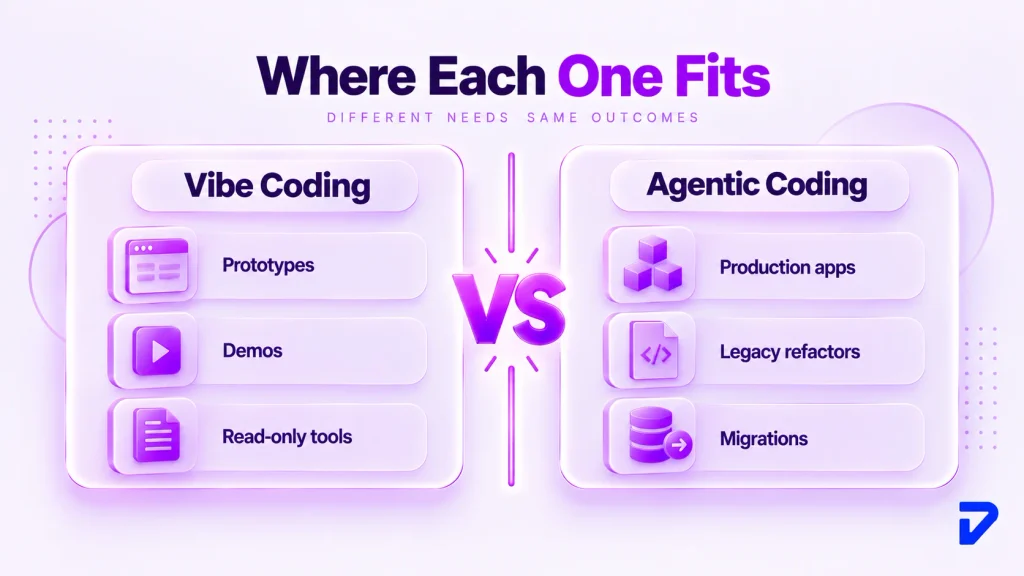
Vibe coding shines here. Y Combinator managing partner Jared Friedman said a quarter of the Winter 2025 batch had codebases that were 95% AI-generated, according to TechCrunch. Speed of learning beats code quality at this stage, as long as everyone agrees the prototype is disposable. The mistake is letting a demo drift into production without a rebuild or a hardening pass.
Internal Tools and Automation
Internal dashboards, admin panels, and data scripts sit in the middle ground. A vibe-coded tool is usually fine when it reads data and a small team uses it. Once the tool writes to core systems, touches customer records, or triggers downstream jobs, it deserves the same review discipline as any other AI automation workflow, and an agentic setup with scoped permissions becomes the safer default.
Production Applications
Production code is where agentic coding clearly earns its place, as long as humans stay in the loop. GitHub builds this into the product: its documentation states that pull requests from Copilot coding agents must be reviewed before merging, and Actions workflows do not run on them automatically. That design keeps automation fast while making accountability explicit, which is precisely what vibe coding lacks.
Legacy Code and Refactoring
Large, repetitive migration work is the strongest agentic use case today. Amazon reported that its Q Developer transformation agent moved tens of thousands of applications to Java 17, saving an estimated 4,500 developer-years and $260 million in annual costs. Legacy work also often requires careful AI integration with ERPs, mainframes, and older APIs, where vibe coding simply lacks the context to succeed.
Still weighing which parts of your delivery pipeline can safely run on agents?
Pinnasys helps teams set up agentic coding with scoped permissions, review gates, and audit trails built around their compliance needs.
How Agentic Coding Changes the Role of Software Engineers
Agentic coding moves engineers from typing code to directing and verifying it. Daily work shifts toward writing clear task specs, designing test suites agents must pass, reviewing diffs for architectural fit, and deciding what should never be delegated. Senior judgment becomes more valuable, not less, because a skilled engineer can supervise several agents while a novice simply produces broken code faster.
That shift carries a hidden cost for junior talent. In an Anthropic randomized controlled trial with 52 mostly junior engineers, the group using AI scored 17% lower on a follow-up quiz, with the largest gap on debugging questions. Participants who asked the AI to explain concepts retained far more than those who delegated everything.
As a result, engineering leaders need deliberate learning paths: pair juniors with agents on low-risk tickets, require them to explain every merged change, and rotate them through manual debugging. Teams that work with Pinnasys often treat this upskilling plan as part of the rollout itself, not an afterthought.
Security and Governance Considerations
Security is where the vibe coding vs. agentic coding gap is widest. Veracode’s 2026 GenAI Code Security Report found that roughly 44% of AI code generation tasks introduced a known vulnerability, with an average security pass rate of just 56%. Those numbers barely moved from the prior year, even as AI began authoring roughly half of committed code in adopting organizations.
Agents add a second layer of risk because they act, not just write. The OWASP Top 10 for Agentic Applications, published in December 2025, catalogs threats such as goal hijacking, tool misuse, and privilege abuse. A coding agent with broad terminal access and production credentials is a textbook example of that attack surface.
Practical governance therefore covers a few non-negotiables:
- Least-privilege permissions for every agent, with no production credentials by default
- Separate development, staging, and production environments with tested backups
- Mandatory static analysis and dependency scanning on all AI-authored changes
- Commit attribution so every agent change traces back to a human requester
- A written policy on which repositories and data agents may touch
This agentic AI governance framework offers a starting template that security and engineering teams can adapt together.
How Engineering Leaders Can Adopt AI Coding Workflows
Start With Low-Risk Projects
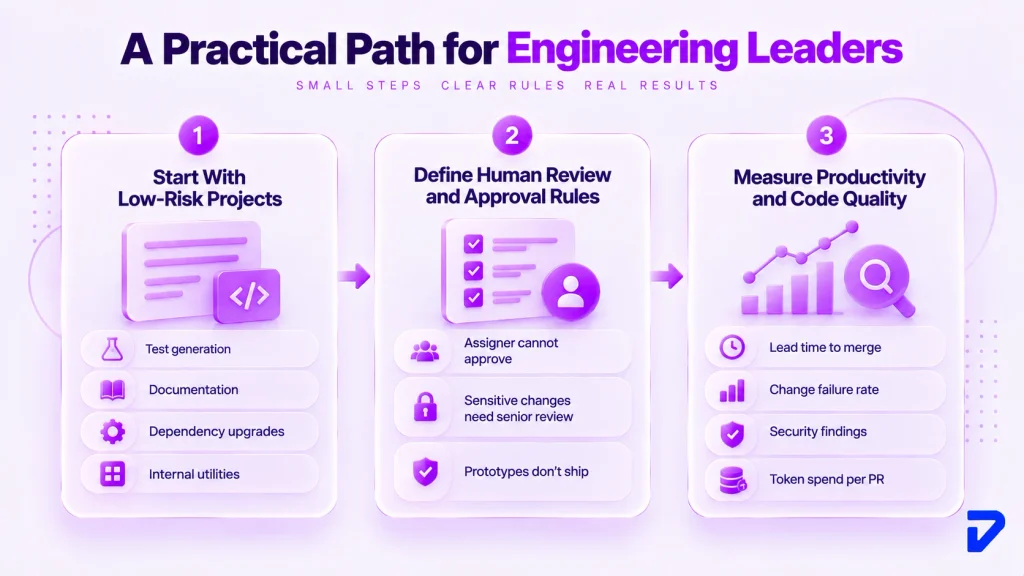
Begin where a mistake is cheap and visible: test generation, documentation, dependency upgrades, and internal utilities. Gartner expects over 40% of agentic AI projects to be canceled by the end of 2027, citing escalating costs, unclear value, and weak risk controls.
A narrow first scope avoids all three traps. This walkthrough on picking a first AI agent use case outlines how to score candidates by value and risk before committing budget.
Define Human Review and Approval Rules
Write the rules down before the first agent merges anything. Effective policies usually specify that the person who assigned a task cannot approve its pull request, and that changes to authentication, payments, or infrastructure need a senior reviewer. That workflow keeps files and secrets off-limits. Vibe-coded prototypes need a rule too: nothing ships to customers until it’s rebuilt or reviewed to production standards.
Measure Productivity and Code Quality
Perception is an unreliable metric. In METR’s original randomized trial, developers believed AI cut their completion time by 20%, but it actually increased it by 19%. Track outcomes instead of impressions:
- Lead time from ticket to merged change
- Change failure rate and rework volume
- Security findings per thousand lines of AI-authored code
- Token spend per merged pull request
A Practical Decision Framework for Vibe Coding vs Agentic Coding
Start with four questions. How senior is the team reviewing the output? Is the budget shaped around a one-time experiment or an ongoing run rate? Does the code touch regulated data under SOC 2, HIPAA, or GDPR? Is the deadline measured in days or quarters?
Choose vibe coding if:
- The output is a disposable prototype, demo, or internal experiment
- A non-engineer needs to validate an idea without engineering time
- No customer data, payments, or production systems are involved
- Speed of learning matters more than long-term maintainability
Choose agentic coding if:
- The code will run in production and needs an owner for years
- The work spans a large, legacy, or multi-service codebase
- Compliance requires traceable, reviewable changes
- The team has senior engineers and solid automated tests
A genuine hybrid exists: vibe code the prototype to prove demand, then rebuild the winning version through a governed agentic pipeline.
The Future of AI-Assisted Software Development in 2026
The direction of travel is clear, even if the pace is not. The JetBrains Developer Ecosystem Survey 2026, covering more than 15,000 professionals, found that 90% of developers used AI coding agents at work at least weekly and 68% used them daily. As that usage becomes routine, the developer’s role keeps shifting from implementation toward orchestration and system design.
Three trends will shape the next year. Agent platforms are adding stronger sandboxes and policy engines, making governance configurable rather than improvised. Token economics will push simple tasks to smaller models. Meanwhile, vibe coding will settle into its natural home as the fastest way to sketch and discard ideas.
Conclusion
The real divide in the vibe coding vs agentic coding debate is accountability. Vibe coding trades review for speed, which is a smart bet when the output is disposable and a risky one when it quietly becomes production. Agentic coding keeps the speed while adding tests, permissions, and human approval, at the price of more setup, more token spend, and more senior attention.
The strongest teams use both on purpose, matching each approach to the stakes of the work. If you want help drawing that line, talk with Pinnasys about a governed rollout, or start with an AI consulting engagement that maps which workflows are ready for agents today. Pick one low-risk repository, set the rules, and measure what actually changes.
Key Takeaways from the Article
- Vibe coding is fastest for disposable prototypes but weak on security and review.
- Agentic coding fits production work when permissions, tests, and human approvals are in place.
- AI-generated code failed security checks in roughly 44% of Veracode’s 2026 tasks.
- Junior engineers need deliberate learning plans, since delegating to AI can erode debugging skills.
- Measure lead time, failure rate, and token cost rather than developer perception.
Frequently Asked Questions on Vibe Coding vs Agentic Coding
What Is the Difference Between Vibe Coding and Agentic Coding?
Vibe coding generates software from prompts with little review, judged by whether it seems to work. Agentic coding delegates scoped tasks to autonomous coding agents that run tests and submit pull requests for human approval before any merge.
Is Agentic Coding Better Than Vibe Coding?
Neither is universally better. Agentic coding suits production systems and legacy codebases, while vibe coding suits rapid prototyping. A quarter of YC’s Winter 2025 startups relied heavily on AI generation, showing prompt-driven development still has clear early-stage value.
Is Vibe Coding Suitable for Production?
Rarely without a hardening pass. Veracode’s 2026 testing found that about 44% of AI code generation tasks introduced known vulnerabilities, so vibe-coded apps need security review, automated tests, and human code review before handling real users or data.
Will Agentic Coding Replace Software Engineers?
Agentic coding changes the job more than it removes it. JetBrains found 68% of developers already use coding agents daily, yet AI pair programming still depends on people who specify tasks, review architecture, and debug failures.
What Are the Risks of Agentic Coding?
Key risks include prompt injection, over-privileged tool access, runaway token costs, and unreviewed changes. The OWASP agentic list names ten categories, and autonomous code generation without least-privilege permissions can expose production systems within minutes.
How Should Engineering Leaders Use AI Coding Agents?
Start with low-risk tasks like tests and dependency upgrades, enforce independent pull request review, and track change failure rate alongside speed. DORA’s 2025 research shows AI amplifies existing engineering practices, both strong and weak.