


An agentic AI governance framework helps teams define ownership, control permissions, monitor agent behavior, and establish oversight processes that keep autonomous AI agents reliable, secure, and accountable in real-world workflows.
As AI agents move from simple assistants to systems that can take actions across business workflows, governance becomes a critical requirement. An agent that drafts emails may improve productivity, but an agent that processes invoices, routes claims, or triggers purchase orders becomes part of an important business process that requires clear controls and accountability.
According to McKinsey, only 27% of organizations review all AI-generated content before it reaches users, highlighting the need for stronger oversight as AI agents become more involved in business operations. Teams need defined ownership, permission controls, monitoring processes, and review mechanisms to ensure agents operate within approved boundaries.
The framework outlines how mid-market teams can establish an agentic AI governance framework with practical oversight controls, clear ownership, and an AI agent oversight checklist to manage risks, improve accountability, and maintain reliable AI agent operations.
What Is an Agentic AI Governance Framework?
An agentic AI governance framework is a set of policies, controls, and oversight mechanisms that define how AI agents are authorized to act, monitored during operation, and corrected when they deviate. It establishes clear ownership, permission boundaries, escalation paths, and audit requirements to answer three key questions: who is responsible for the agent, what it is allowed to do, and how issues are identified.
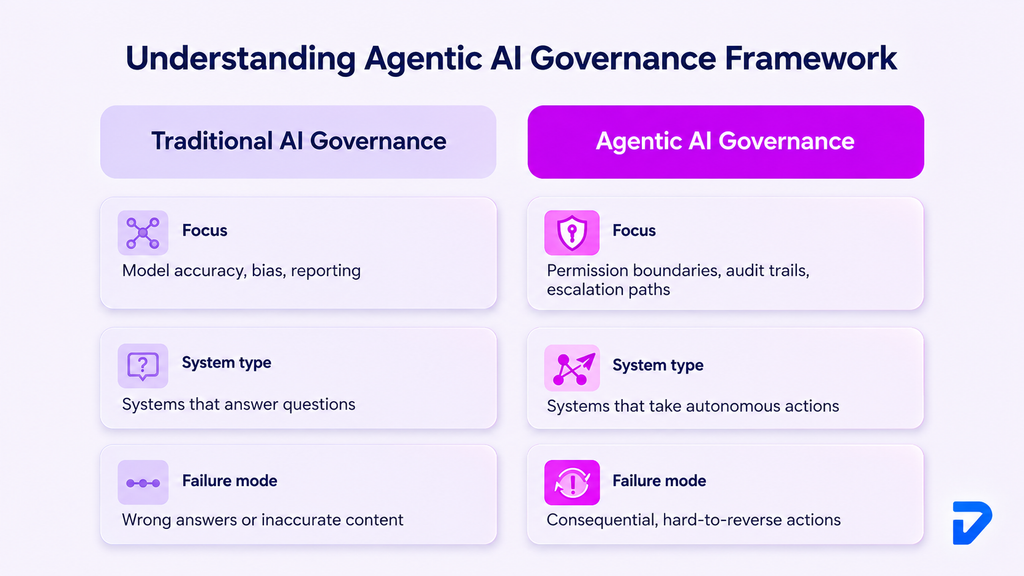
Unlike traditional AI governance, which focuses on model accuracy, bias, and reporting, agent governance manages systems that can take actions, trigger workflows, and interact with business systems. An effective framework ensures every agent action is traceable, controlled, and accountable by maintaining clear responsibilities, access limits, and monitoring processes.
Why Mid-Market Teams Need a Governance Model
Mid-market teams face unique governance challenges with limited resources, faster deployments, and fewer dedicated compliance roles. The solution is practical governance designed around their operational capacity.
Limited AI Resources and Operations
Most mid-market operators deploying AI agents have one to three people overseeing the technology, not a dedicated governance team. A governance model requiring weekly committee reviews will not survive contact with reality. The framework needs to be specific enough to enforce and light enough to maintain, covering the minimum viable set of controls that actually prevent the failures that matter most when agents operate on live business data.
Faster Deployment Cycles
Mid-market teams move faster than large organizations, which is a competitive advantage and also a governance risk. Less than one-third of organizations have implemented multiple responsible AI practices, even as AI adoption accelerates. Speed without structure means agents get deployed before permission boundaries are defined, which creates exposure that accumulates silently until a failure surfaces at the business level.
Balancing Innovation with Accountability
Governance is not the opposite of speed. A completed AI agent oversight checklist takes roughly one hour per agent and prevents the weeks of remediation that follow an unchecked agent error in production. Teams that adopt this framing find governance is what lets them add more agents safely over time, not what forces them to add fewer in the short term.
Avoiding Unnecessary Complexity
The framework in this article produces three outputs per agent: a named owner, a defined permission scope, and a monitoring dashboard. Teams that start with those three outputs have everything needed to govern responsibly without building infrastructure they do not have the staff to run or the budget to maintain as the agent portfolio grows.
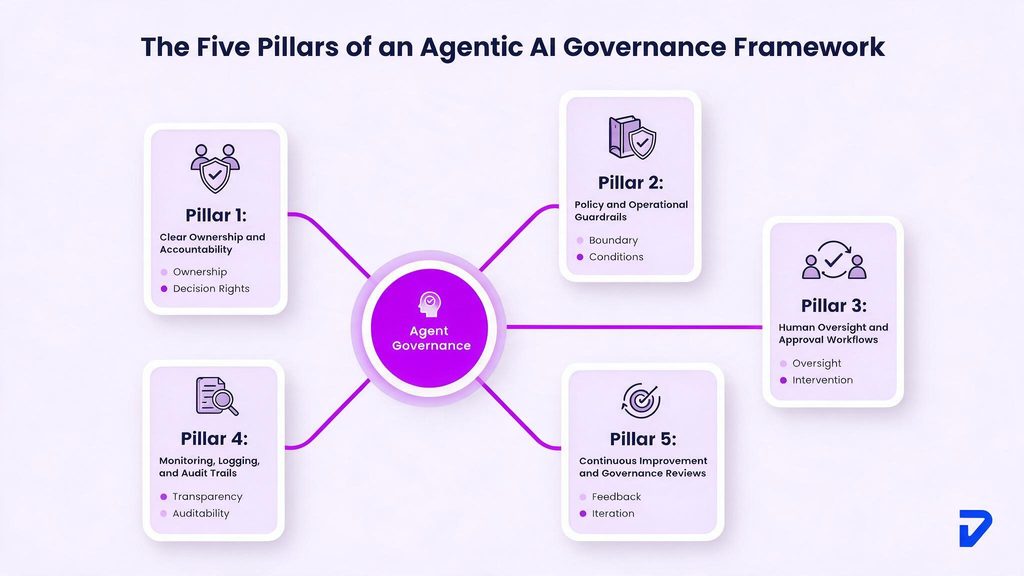
The Five Pillars of an Agentic AI Governance Framework
This is the structural core. Each pillar answers a specific governance question, and covering all five gives a team a complete foundation for governing agents in production.
Clear Ownership and Accountability
Every AI agent needs a clearly assigned owner responsible for monitoring performance, approving changes, and addressing unexpected behavior. Ownership ensures accountability does not become unclear when agents interact with multiple teams or systems. A RACI matrix helps define responsibilities and establish clear decision-making authority.
Policy and Operational Guardrails
Guardrails define the boundaries of what an AI agent can access and execute. These controls should be enforced through technical permissions, approved data sources, and restricted system access rather than relying only on instructions. Strong guardrails prevent unauthorized actions and reduce operational risks from unexpected inputs.
Human Oversight and Approval Workflows
Human oversight ensures important decisions receive appropriate review before execution. Teams should define when agents can operate independently and when approval is required for sensitive actions. A tiered review process allows low-risk tasks to run automatically while maintaining human control over higher-impact decisions.
Monitoring, Logging, and Audit Trails
Monitoring helps teams understand whether an AI agent is performing as expected, while logging provides visibility into actions and decisions. Production agents should maintain records of inputs, outputs, tool usage, and changes. These audit trails make troubleshooting easier and support accountability during reviews or incidents.
Continuous Improvement and Governance Reviews
AI agent governance requires ongoing maintenance as workflows, models, and connected systems change. Regular reviews help teams identify new risks, update permissions, and refine oversight processes. A consistent review process ensures governance remains effective and keeps AI agents aligned with business requirements over time.
Building Your Agent Governance Layer
Before the first agent goes into production, five design decisions need to be made explicitly. Leaving any of them undefined is what turns a governance gap into a production incident.
Define Business Objectives
Every AI agent should begin with a clearly defined business goal. Whether the objective is reducing invoice processing time, improving claims handling, or speeding up customer support responses, the expected outcome should be specific and measurable.
A clear objective helps teams define the agent’s scope, evaluate performance, and determine whether the system is delivering the intended value. If the purpose cannot be explained simply, the workflow may be too broad for an initial deployment.
Map Agent Responsibilities
Teams should document every action the agent can perform, the systems it can access, and the information sources it can use. This responsibility map creates visibility into the agent’s role and establishes the foundation for permissions and monitoring.
A well-defined responsibility map also prevents scope expansion without review. When new requests or capabilities are added, teams can evaluate whether additional access or controls are needed before changing the agent’s behavior.
Identify High-Risk Actions
Not all agent actions carry the same level of risk. Teams should identify activities involving financial transactions, customer communication, record changes, or decisions that can create significant downstream effects.
High-risk actions should include human review or approval steps before execution. This additional control reduces the impact of incorrect outputs and ensures important decisions receive appropriate oversight.
Establish Permission Boundaries
Permission controls define what an AI agent can access and what actions it can perform. Teams should follow the principle of least privilege by providing only the access required for the agent’s specific workflow.
For example, an agent handling customer support tickets may need access to ticketing systems but should not automatically access financial records. Technical permission limits help prevent unauthorized actions and reduce security risks.
Create Escalation Paths
Every AI agent needs a defined process for handling errors, unexpected inputs, or requests outside its approved responsibilities. An agentic AI governance framework should include clear escalation paths that ensure issues reach the right person quickly and prevent agents from continuing incorrect actions without human review.
Testing escalation workflows before deployment helps teams verify that problems are identified and resolved effectively. A reliable escalation process improves accountability and ensures AI agents operate safely within defined boundaries.
AI Agent Oversight Checklist
Use this checklist before deploying any new agent and review it quarterly for agents already running. A completed checklist confirms the governance layer is in place, not just planned.
| Checklist Item | What to Verify |
| Ownership assigned | A named owner is documented with contact details and monthly review responsibilities |
| Approved data sources | Every data source the agent reads is documented and access is formally authorized |
| Permission controls | Scope is enforced via OAuth tokens; access is limited to task requirements only |
| Human approval triggers | High-risk actions have a defined human review step before execution |
| Monitoring dashboards | A real-time view shows task completion rate, error rate, and tool call outcomes |
| Audit logging | Every prompt, tool call, and output is logged with a timestamp and session ID |
| Performance metrics | KPIs are defined, and baseline measurements exist before the agent goes live |
| Security validation | Prompt injection testing and adversarial input scenarios have been completed |
| Compliance review | Data handling is reviewed against applicable data protection requirements |
| Incident response plan | A documented process exists for disabling the agent and notifying affected parties |
42% of organizations experienced an AI-related security or privacy incident in the previous year, according to IBM. A completed oversight checklist is the primary control that catches configuration gaps and permission oversights before they reach production.
Governance Across the AI Agent Lifecycle
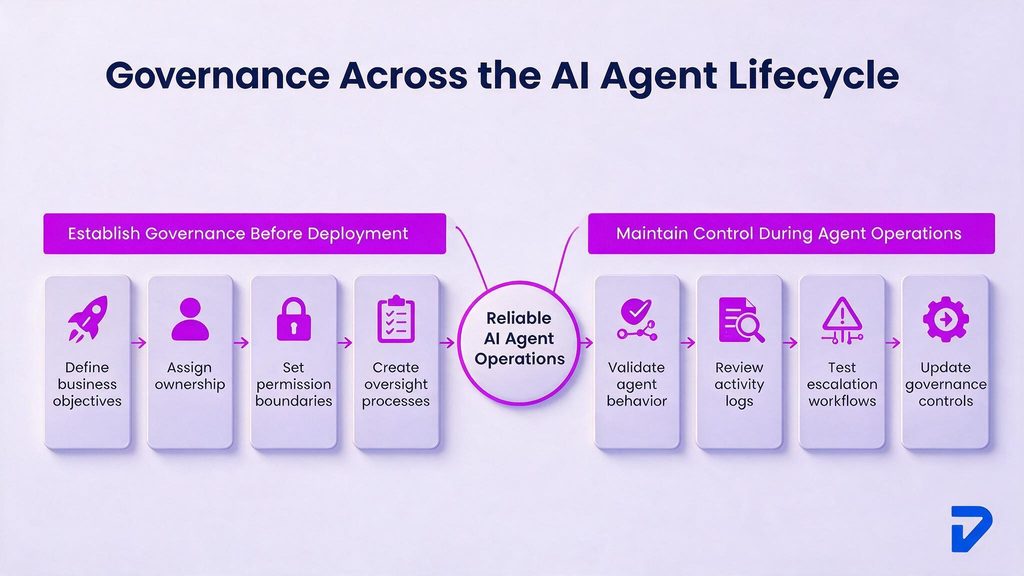
Governance should begin during the planning stage, not after deployment. Teams should define business objectives, assign ownership, establish permission boundaries, and create oversight processes before development begins. Using agentic AI services helps integrate governance controls into the agent architecture, reducing risks and improving operational reliability.
Throughout development, testing, deployment, and monitoring, teams should validate agent behavior, review activity logs, test escalation workflows, and update controls as requirements change. A structured lifecycle approach helps ensure AI agents remain secure, accountable, and aligned with business goals over time.
Common Governance Mistakes Teams Should Avoid
Many AI agent failures result from weak governance practices. An effective agentic AI governance framework helps teams avoid mistakes around permissions, ownership, monitoring, and oversight while maintaining control and building reliable agent operations.
- Giving agents excessive permissions: Grant only the access an AI agent needs. Excessive permissions increase security risks and allow unintended actions beyond the agent’s intended workflow.
- Missing audit trails: Without proper logs, teams cannot track agent actions, investigate failures, or understand decision-making. Audit trails provide visibility, accountability, and easier troubleshooting.
- Undefined ownership: Every AI agent needs a responsible owner who monitors performance, approves changes, and handles issues. Clear ownership prevents accountability gaps during operation.
- No fallback process: AI agents need escalation paths for errors, unexpected inputs, and uncertain decisions. A fallback process ensures human review instead of repeated incorrect outputs.
- Ignoring workflow changes: Business processes evolve over time, affecting agent behavior. Regular reviews help update controls, permissions, and workflows to keep agents aligned.
- Monitoring only accuracy: Tracking accuracy alone is not enough. Teams should measure business outcomes, user impact, and operational performance to ensure agents deliver meaningful results.
Recommended Tools That Support Agent Governance
The right governance tools help teams monitor, control, and evaluate AI agents throughout their lifecycle. These solutions support secure permissions, workflow management, testing, and visibility across agent operations.
| Tool Category | Governance Function | Example Tools |
| Workflow orchestration | Task sequences, permission checks, and escalation logic | LangChain, AutoGen, Temporal |
| Observability and monitoring | Dashboards, alerting, and structured logging | Datadog, OpenTelemetry, Langfuse |
| Policy enforcement | Guardrails and content filtering for agent outputs | Guardrails AI, NVIDIA NeMo Guardrails |
| Identity and access management | Scope permissions; enforce least-privilege access | Okta, AWS IAM, Azure Entra ID |
| Evaluation and testing | Adversarial testing and behavioral benchmarking | Promptfoo, DeepEval, RAGAS |
51% of executives identify data security and privacy as the primary barrier to scaling AI initiatives, according to Deloitte. The identity and access management category addresses that barrier directly by enforcing the permission boundaries that keep agents within their defined scope.
The Bottom Line
Governance is not the obstacle between your team and AI agents. It is the foundation that makes deploying more agents safely achievable. A team with an agentic AI governance framework, a completed oversight checklist before each deployment, and quarterly governance reviews has the structure needed to run agents in production without incidents that disrupt progress.
Pinnasys builds production-grade agentic AI systems for mid-market operators across insurance, distribution, and field services, with governance built alongside the technology rather than bolted on afterward. If your team is ready to put agents into production and wants the oversight layer right the first time, start with an AI consulting session that maps agent scope, permission boundaries, and monitoring requirements before any code is written. Govern early, and scale confidently.
Key Takeaways from the Article
- Every deployed AI agent needs a named owner, a defined permission scope, and a monitoring dashboard.
- Governance begins at the planning stage, not deployment; retrofitting controls costs more than building them in.
- The AI agent oversight checklist covers ten criteria and must be completed before any agent goes live.
- Monitoring only accuracy misses the business-outcome metrics that show whether agents are delivering real value.
- Governance-as-code and automated compliance checks are the near-term future of AI agent oversight at scale.
Agentic AI Governance: Key Questions Answered
What is an agentic AI governance framework?
An agentic AI governance framework is a structured approach for managing AI agents through clear ownership, permission controls, monitoring processes, and accountability rules. It helps teams define what AI agents can access, what actions they can perform, and how their behavior is reviewed over time.
How is AI agent governance different from traditional AI governance?
Traditional AI governance focuses on model usage, performance, and compliance requirements. AI agent governance addresses systems that can take actions, access business information, and interact with workflows, requiring additional controls for permissions, oversight, and operational safety.
Why do mid-market teams need AI agent oversight?
Mid-market teams need AI agent oversight to ensure AI systems operate within defined boundaries. A practical governance structure helps teams manage risks, assign accountability, monitor agent behavior, and maintain control as they introduce more AI-powered workflows.
What should an AI agent oversight checklist include?
An AI agent oversight checklist should include ownership assignment, approved data sources, access permissions, human approval points, activity monitoring, audit logs, performance tracking, security reviews, compliance checks, and an incident response process.
How often should AI agent governance policies be reviewed?
AI agent governance policies should be reviewed regularly and updated whenever workflows, data sources, models, or permissions change. Continuous reviews help teams maintain reliable AI operations and ensure agents continue following established rules.
Can small teams implement AI agent governance without dedicated compliance staff?
Yes. Small teams can implement AI agent governance by defining responsibilities, documenting processes, setting access controls, and monitoring agent activity. A lightweight framework allows teams to manage AI risks without requiring a large governance function.




Prakash C. Saini
Prakash Saini is the Founder & CEO of Pinnasys. With over a decade in digital transformation and building production systems, he grew an engineering team from 2 to 50 people and has led the delivery of 100+ production digital systems. Products built under his leadership have raised millions in funding and generated over $50 million in revenue. He holds an Executive MBA from IIM Kozhikode and today leads the AI engineering team at Pinnasys.