


Your first AI agent use case sets the trajectory for every project that follows. Selecting the right use case helps maximize business value, reduce implementation risks, and establish a strong foundation for successful agentic AI adoption.
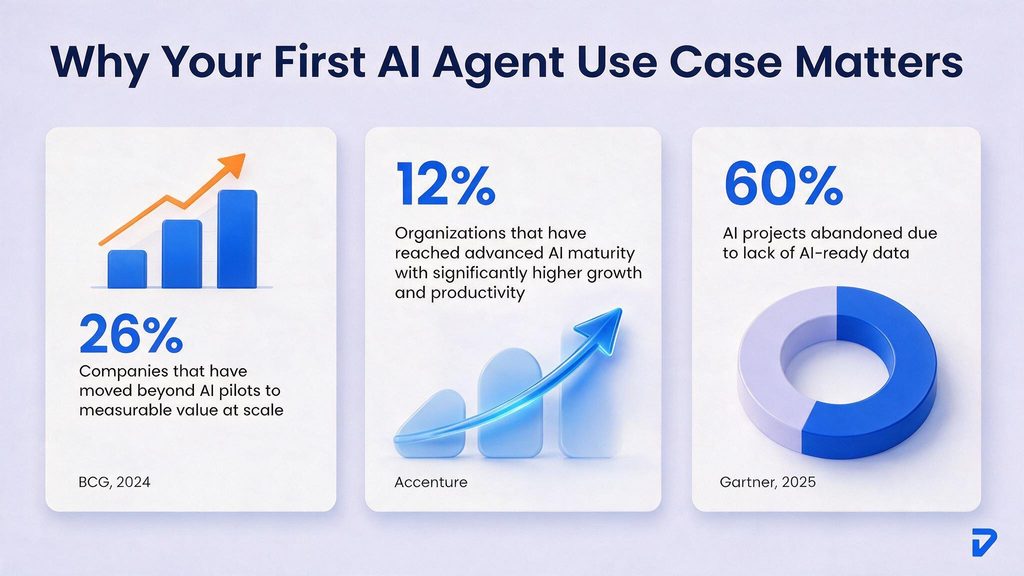
Only 26% of companies have developed the capabilities needed to move beyond AI pilots and generate measurable value at scale, according to Boston Consulting Group. The other 74% are stuck in a cycle of exciting demos that never reach production. In most cases, the root cause is not a technology problem. It is a selection problem: the first AI agent use case was chosen based on enthusiasm rather than operational readiness. The wrong starting point produces expensive lessons, skeptical stakeholders, and a roadmap that stalls before it starts.
In this guide, you’ll learn how to evaluate potential AI agent use cases using a practical framework that helps you identify high-impact opportunities, reduce implementation risk, and choose a project that can move from pilot to production with measurable business value.
Why Your First AI Agent Decision Matters
Your first AI agent use case is more than a pilot. It establishes the data foundation, integration approach, governance standards, and success metrics that future AI projects will follow. A strong first deployment creates momentum, while the wrong choice can delay adoption and reduce confidence across the organization.
Although AI adoption continues to grow, many organizations still struggle to move from strategy to production. The challenge is rarely the technology itself. More often, teams select a use case that is too complex, lacks reliable data, or cannot deliver measurable value within a reasonable timeframe.
This is why agentic AI use case prioritization matters. A structured evaluation process helps teams identify opportunities with clear business value, manageable implementation effort, and measurable outcomes. Choosing the right first AI agent use case increases the likelihood of an early win and creates a repeatable framework for future AI initiatives.
What Makes a Good First AI Agent Use Case?
Choosing the right first AI agent use case is the foundation of long-term AI success. The best projects deliver measurable business value quickly, minimize implementation risk, and create a repeatable framework for future AI initiatives.
Choose High-Frequency Workflows
The best first AI agent use case is a task performed consistently, whether daily or weekly. Frequent workflows generate enough activity to measure accuracy, efficiency, and business impact within a relatively short evaluation period.
Look for work that consumes employee time but follows established rules. Repetitive activities provide enough data for testing while allowing teams to improve prompts, workflows, and automation logic without waiting months for meaningful results.
Prioritize Clear Inputs and Existing Data
Successful AI agents depend on reliable information. Select processes that already use structured records, forms, documents, or databases instead of workflows requiring significant data collection or cleanup before automation begins.
Clear inputs and expected outputs also simplify performance measurement. Teams can evaluate processing time, accuracy, exception rates, and business outcomes using objective metrics instead of relying on subjective opinions.
Look for Low-Risk Business Processes
Early AI projects should minimize operational risk. Choose workflows where human review remains part of the process and occasional mistakes have limited business impact during testing and refinement.
Examples include invoice processing, customer support ticket routing, document summarization, and insurance FNOL intake. These processes are structured enough to demonstrate value while remaining practical for controlled deployment.
Avoid Overly Complex Processes
Not every workflow is suitable for a first deployment. Avoid processes with inconsistent decision paths, incomplete data, or significant legal and regulatory consequences unless experienced reviewers remain involved throughout execution.
If employees perform the same task differently every time, standardize the workflow before introducing automation. Effective agentic AI use case prioritization starts with stable business processes, making implementation faster, measurement easier, and long-term scaling more successful.
First AI Agent Use Case Prioritization Scorecard
This is the core tool. Score each candidate use case on the ten criteria below, using a 1-to-5 scale. A score of 1 means the criterion is not met; 5 means it is fully met. Total the scores and use the interpretation guide in the next section to decide whether to proceed.
| Evaluation Criterion | Score (1-5) | What to Look For |
| High business impact | Does this workflow affect revenue, cost, or a key customer metric if it slows or fails? | |
| Repetitive workflow | Does this task follow a consistent pattern that repeats at least weekly? | |
| Clear inputs and outputs | Can you define exactly what goes in and exactly what should come out? | |
| Available structured data | Does the data already exist, and can the agent access it without a major build? | |
| Low operational risk | If the agent makes an error, is it catchable before it causes a serious problem? | |
| Human approval available | Is there a natural point where a human can review the agent’s output before it acts? | |
| Easy system integration | Does this workflow connect to systems that already have APIs or data exports? | |
| Measurable ROI | Can you define a clear metric (time saved, error rate, cost per transaction) to track? | |
| Implementation complexity | Rate the technical complexity inversely: 5 = straightforward, 1 = requires major infrastructure | |
| Time to value | Rate the speed to a working pilot inversely: 5 = pilot in 30 to 60 days, 1 = six months or more |
Scoring guide: For each criterion, assign 1 (not met), 2 (partially met), 3 (moderately met), 4 (largely met), or 5 (fully met). Be conservative rather than optimistic, because overscoring a criterion does not make the implementation easier.
How to Interpret Your Score
Your total score out of 50 tells you how ready a given use case is for a first AI agent project.
| Total Score | Interpretation | Recommended Action |
| 40 to 50 | Excellent first AI agent use case | Proceed to scoping and pilot design |
| 30 to 39 | Good candidate with minor improvements | Address the lowest-scoring criteria before committing |
| 20 to 29 | Reassess scope before moving forward | Narrow the workflow scope or improve data readiness first |
| Below 20 | Choose a different process first | This use case belongs in phase two, not phase one |
A score below 20 does not mean the use case is a bad idea. It means the conditions for a reliable first project are not yet in place. The right response is to either address the gaps (improving data quality, adding a human review step, simplifying the integration requirements) or move to a higher-scoring candidate and return to this one once the infrastructure exists to support it.
Only 12% of organizations have achieved advanced AI maturity, according to Accenture, and those companies generate significantly higher growth and productivity than their peers. The differentiator in almost every case is disciplined use-case selection in the early stages, not superior technology.
Not sure where to start with AI agents?
Pinnasys helps you find the right use case, reduce implementation risks, and create a roadmap for successful AI adoption.
Common Mistakes in Agentic AI Use Case Prioritization
Understanding where selection goes wrong is as useful as knowing what good looks like. These five mistakes account for the majority of first-project failures.
- Starting with overly complex workflows: Large, cross-functional processes often involve inconsistent data, multiple dependencies, and numerous exceptions. They take longer to implement, making it difficult to demonstrate value quickly.
- Ignoring data quality: Even a high-value use case will struggle without reliable, structured data. Prioritize workflows with accessible, AI-ready information instead of spending months cleaning and organizing data.
- Defining no success metrics: Establish baseline KPIs such as processing time, error rates, cost savings, or turnaround time before implementation. Clear metrics make it easier to measure business impact and justify future AI investments.
- Removing human oversight too early: Keep a human review step during initial deployments. Human validation reduces operational risk, improves trust, and allows teams to refine AI outputs before increasing automation.
- Following trends instead of business needs: Don’t choose a project because it’s popular. Select a workflow with high volume, repetitive tasks, and measurable business value where AI can solve a real operational challenge.
Practical Examples of Successful AI Agent Use Cases
Successful first AI agent use cases focus on repetitive, data-rich workflows with measurable outcomes, delivering quick wins while creating a foundation for future AI initiatives.
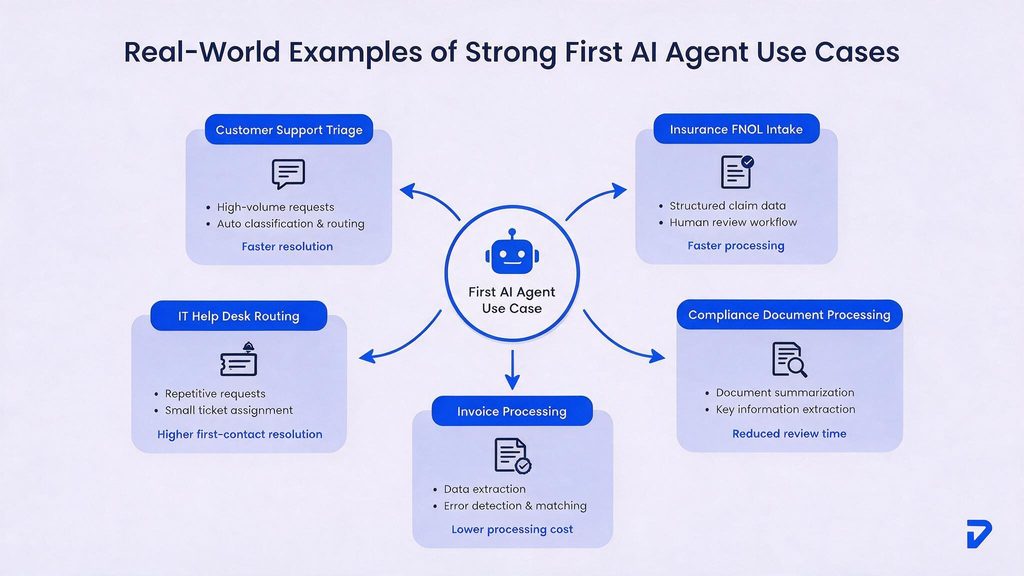
Customer Support Ticket Triage
Customer support ticket triage is an ideal first project because requests follow predictable patterns and require minimal decision-making. AI agents can classify, prioritize, and route tickets automatically, improving response times and reducing manual effort.
Insurance FNOL Intake
FNOL intake remains one of the strongest use cases for AI in Insurance. AI agents capture claim details, validate policy information, and prepare files for adjusters while keeping human review in the workflow. The structured process makes implementation straightforward and results easy to measure.
IT Help Desk Request Routing
Internal IT teams process thousands of repetitive service requests every month. AI agents categorize incidents, assign priorities, and route tickets automatically, helping support teams improve response times while reducing ticket backlogs.
Compliance Document Processing
Compliance teams spend significant time reviewing contracts, policies, and regulatory documents. AI agents retrieve relevant information, summarize lengthy documents, and highlight important clauses, allowing reviewers to complete assessments more efficiently.
Invoice Processing and Matching
Invoice processing is a proven Document Intelligence use case because invoices follow consistent formats and validation rules. AI agents extract key information, compare invoices with purchase orders, identify exceptions, and prepare transactions for approval with greater speed and accuracy.
Your 90-Day Roadmap for Implementing Your First AI Agent
Once a use case scores above 30 and your team decides to proceed, the 90-day window is the right frame for a first pilot. This timeline is tight enough to maintain momentum and long enough to produce results worth measuring.
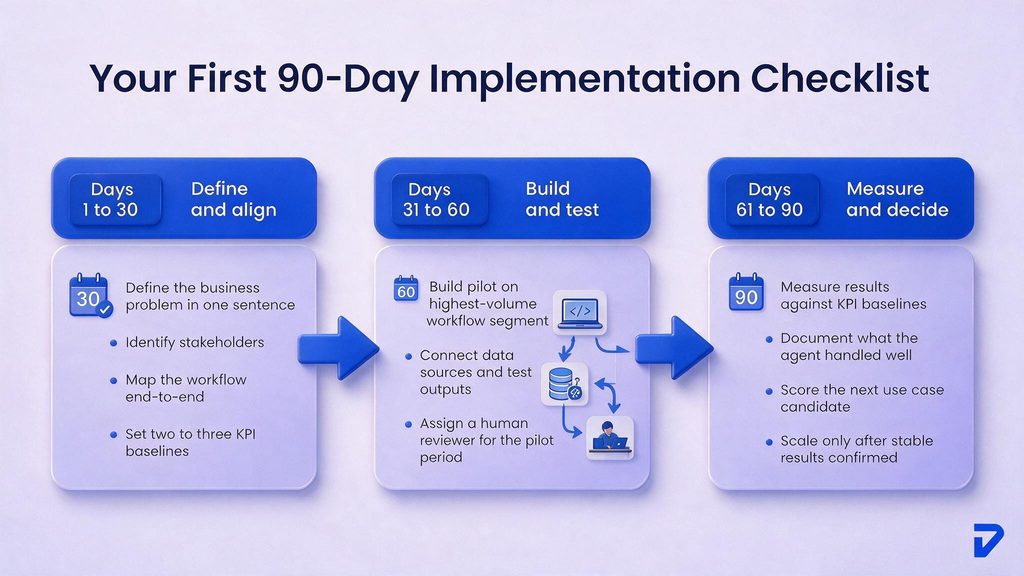
Days 1 to 30: Define and align
- Define one specific business problem in one sentence. If it takes more than a sentence, the scope is too wide.
- Identify the stakeholders who own the workflow, the data, and the success criteria.
- Map the workflow end-to-end: document every step, every input source, every handoff, and every exception the current process handles manually.
- Choose two to three KPIs that can be measured before the pilot begins to establish a baseline.
Days 31 to 60: Build and test
- Build a pilot scoped to the highest-volume, most consistent segment of the workflow. Do not try to handle every edge case in the first build.
- Connect to data sources and test the agent’s outputs against the baseline.
- Assign a human reviewer for the pilot period. The agent’s outputs go to a reviewer before they act, and the reviewer’s corrections feed back into the training data.
Days 61 to 90: Measure and decide
- Measure results against the KPIs defined in week one.
- Document what the agent handled well and what it could not handle.
- Use the scorecard again on the next candidate use case, now with real integration experience informing the scores.
- Scale the pilot only after the first segment is producing stable, measurable results.
A narrow focus during the first 90 days separates successful AI projects from unused demos. NVIDIA’s State of AI survey found that 69% of organizations report increased annual revenue from AI initiatives, highlighting the value of measurable, well-scoped AI projects.
The Bottom Line
The right first AI agent use case is not the most ambitious one. It is the one your organization can execute, measure, and build on. A high-scoring candidate on this scorecard shares four properties: it runs on data you already have, follows a workflow that is already documented, produces outputs a human can review, and delivers a result you can measure against a known baseline. Start there, and the second use case becomes faster, cheaper, and easier to defend.
Pinnasys works with mid-market operators across insurance, distribution, and field services to identify the right starting point and build toward production. If your team has a list of AI ideas and no structured way to decide which one to build first, the AI integration and governance work begins with exactly this kind of prioritization. Get the first one right, and the rest follow.
Key Takeaways from the Article
- Only 26% of companies have developed the capabilities to move beyond AI pilots to measurable results at scale.
- Score every candidate use case on ten criteria before committing to a first project.
- A total score above 40 out of 50 signals an excellent first AI agent use case.
- Poor data quality causes 60% of AI project abandonment, making it the highest-risk scorecard criterion.
- The first 90-day pilot should cover one narrow segment of the workflow, not the full process.
Frequently Asked Questions
What is a first AI agent use case, and why does it matter?
A first AI agent use case is the initial workflow a team automates with an autonomous AI system. It matters because it sets the data infrastructure, integration patterns, and internal credibility that all subsequent projects inherit. A well-chosen first use case cuts the time to value for every project that follows.
How do you prioritize agentic AI use cases?
Score each candidate on business impact, workflow repeatability, data availability, operational risk, integration complexity, and time to value. Use cases scoring 40 or above on a 50-point scale are ready to pilot. Those scoring below 20 need either scope reduction or data infrastructure investment before proceeding.
Which workflows make the best first AI agent use cases?
High-volume, well-structured workflows with clear inputs and outputs make the strongest first candidates. Invoice processing, IT help desk triage, insurance FNOL intake, compliance document summarization, and customer support classification all score consistently above 35 on the prioritization scorecard and deliver visible results within 60 to 90 days.
How long should a first AI agent pilot take?
A well-scoped first pilot should reach measurable results within 60 to 90 days. If a pilot cannot show a working result within that window, the scope is likely too wide. The 90-day frame is tight enough to maintain stakeholder momentum and long enough to produce data worth acting on.
What are the biggest mistakes in agentic AI use case selection?
The five most common mistakes are starting with a workflow that is too complex, ignoring data quality problems, setting no success metrics before the pilot starts, skipping human oversight in early deployment, and choosing a use case because it sounds impressive rather than because it fits the organization’s operational readiness. Each of these is preventable with the structured scorecard approach.





Prakash C. Saini
Prakash Saini is the Founder & CEO of Pinnasys. With over a decade in digital transformation and building production systems, he grew an engineering team from 2 to 50 people and has led the delivery of 100+ production digital systems. Products built under his leadership have raised millions in funding and generated over $50 million in revenue. He holds an Executive MBA from IIM Kozhikode and today leads the AI engineering team at Pinnasys.