


Agentic AI design patterns give businesses a repeatable blueprint for building autonomous agents that complete complex workflows reliably, stay auditable under regulatory scrutiny, and fail gracefully when reality diverges from the happy path.
By 2028, Gartner projects that 33% of business software applications will include agentic AI, up from less than 1% in 2024. The challenge is no longer the models. It is engineering systems that are reliable, explainable, and capable of handling complex business workflows.
Pinnasys builds production-grade agentic systems across insurance, distribution, and financial services. This guide explores the core building blocks, eight essential design patterns, reliability and auditability practices, and the metrics businesses should use to evaluate whether their AI agents perform consistently in production.
Why Agentic AI Can’t Scale Without Design Patterns
As businesses adopt autonomous AI systems, design patterns ensure agents remain reliable, scalable, auditable, and safe in production environments.
The Shift from AI Assistants to Autonomous Agents
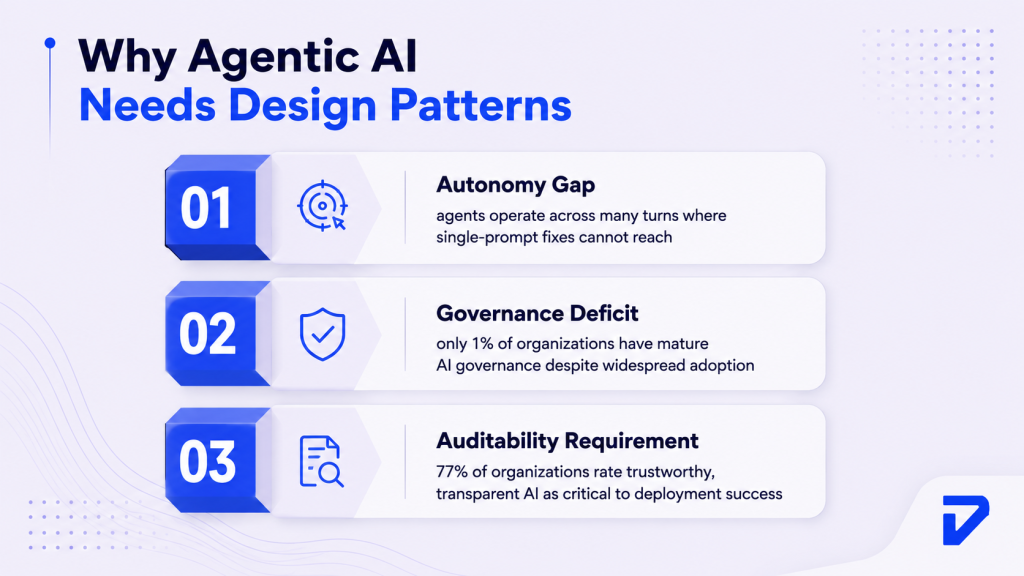
A chat assistant answers a question and stops. An autonomous agent plans, reasons, uses tools, and adapts until a goal is completed. According to McKinsey, 78% of organizations now use AI in at least one business function, making reliable agent architectures increasingly important as autonomous workflows expand.
Why Prompt Engineering Alone Is No Longer Enough
Prompt engineering improves individual interactions, but business agents execute multi-step workflows across tools, APIs, and external systems. A single prompt cannot recover from malformed outputs or failed tool calls. Architectural design patterns provide the resilience these production systems require.
The Growing Need for Reliable and Auditable AI Systems
According to IBM’s Global AI Adoption Index, 77% of organizations consider trustworthy AI, including governance, transparency, and auditability, critical to successful deployment. Design patterns enable traceable decision-making, helping businesses explain agent actions during audits, compliance reviews, and regulatory investigations.
What Are Agentic AI Design Patterns?
Agentic AI design patterns are proven architectural approaches for building autonomous systems that plan, use tools, manage memory, and recover from failures. A 2024 ACM Computing Surveys review identifies planning, memory, tool use, reflection, and multi-agent collaboration as the core patterns behind reliable AI agents.
Unlike traditional AI that produces a single prediction, agentic systems make decisions across multiple steps while adapting to changing conditions. Applying agentic AI design patterns improves AI agent reliability, reduces cascading failures, simplifies debugging, and creates autonomous systems that are easier to govern and scale.
The Building Blocks of Reliable AI Agents
Before any design pattern can be applied, the underlying components need to be understood as discrete engineering concerns, each of which can be designed well or badly.
1. Planning and Reasoning
Planning and reasoning enable an agent to break a goal into smaller, executable steps. Production-ready agents also anticipate failures by creating fallback paths when a task, tool, or workflow does not behave as expected.
2. Memory Management
Memory determines what an agent remembers during and after a task. The four key types are working memory, short-term memory, long-term memory, and episodic memory. A 2024 survey found that effective memory management, planning, and feedback loops are essential for improving AI agent reliability.
3. Tool Integration
AI agents rely on external tools such as APIs, databases, search engines, and code execution environments. Because every tool call can fail, the architecture should include validation, error handling, retries, and recovery mechanisms to maintain reliable execution.
4. Decision-Making
Decision-making defines how an agent chooses its next action. Rather than making arbitrary choices, reliable agents follow structured logic to determine whether to continue, request clarification, escalate to a human, or stop the workflow.
5. Reflection and Self-Correction
Reflection allows an agent to review its own output before taking action. By evaluating responses and correcting mistakes, agents can reduce hallucinations, improve accuracy, and prevent errors from spreading through later workflow steps.
6. Human-in-the-Loop (HITL)
Human-in-the-loop (HITL) introduces review checkpoints before high-risk or irreversible actions. This approach combines AI speed with human judgment, making autonomous systems safer for regulated or business-critical workflows.
7. Guardrails and Policy Enforcement
Guardrails define what an agent is allowed to do through enforceable rules rather than prompt instructions. Code-level policies restrict unsafe actions, ensure compliance, and prevent users or unexpected inputs from bypassing operational limits.
Core Agentic AI Design Patterns Every Business Should Know
Most production AI systems combine multiple agentic AI design patterns, with each pattern solving a specific engineering challenge to improve reliability, scalability, and governance.
1. Planner–Executor Pattern
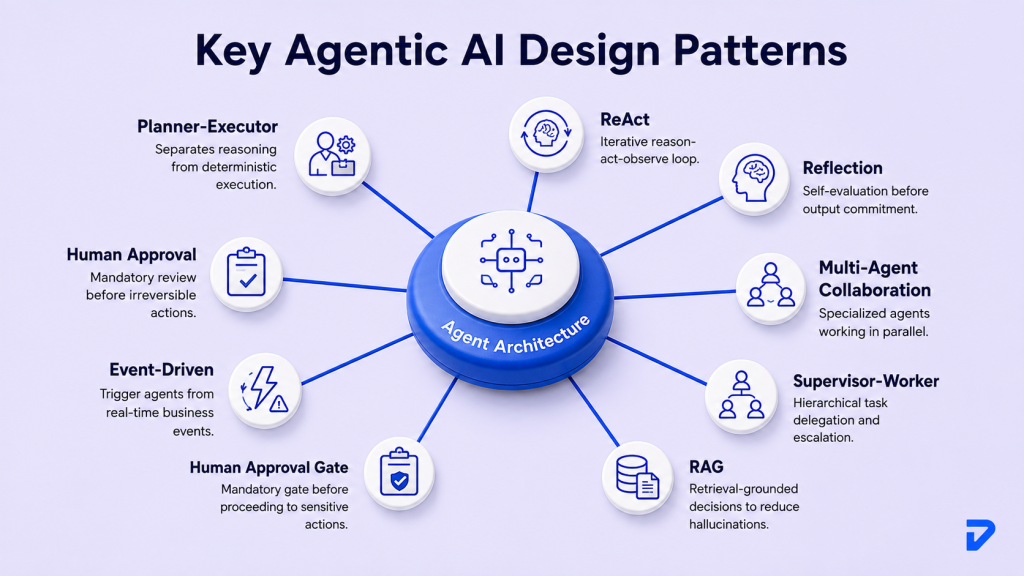
The Planner–Executor pattern separates reasoning from execution. One module creates a step-by-step plan, while another performs tool calls and updates system state. This separation simplifies debugging, improves reliability, and works well for structured workflows such as claims processing, reporting, and document automation.
2. ReAct (Reason + Act) Pattern
The ReAct pattern follows a continuous cycle of reasoning, action, observation, and refinement. Instead of following a fixed plan, the agent adapts based on real-time tool outputs. Supported by frameworks like LangChain and LlamaIndex, it improves flexibility but increases token usage and execution costs.
3. Reflection Pattern
The Reflection pattern evaluates an agent’s response before it is delivered. A second review checks for factual errors, policy violations, missing information, or formatting issues. This extra validation step improves output quality, reduces hallucinations, and significantly strengthens AI agent reliability in high-risk applications.
4. Multi-Agent Collaboration Pattern
Instead of assigning every task to one agent, this pattern distributes work across specialized agents. For example, separate agents can manage document extraction, compliance, and customer communication. This approach improves scalability, simplifies maintenance, and enables parallel execution for faster, more reliable workflows.
5. Supervisor–Worker Pattern
In this pattern, a supervisor agent breaks complex tasks into smaller assignments and delegates them to specialized worker agents. The supervisor monitors progress, handles failures, and coordinates execution without performing tasks directly. It is ideal for workflows involving multiple teams or business systems.
6. Retrieval-Augmented Generation (RAG) Pattern
The Retrieval-Augmented Generation pattern retrieves relevant documents from a knowledge base before generating a response. By grounding decisions in trusted information instead of model memory alone, it reduces hallucinations, improves accuracy, and enables AI agents to deliver more reliable answers in domain-specific scenarios.
7. Event-Driven Agent Pattern
Event-driven agents respond automatically to business events instead of waiting for manual requests or scheduled jobs. A new customer inquiry, policy update, or shipment delay can immediately trigger the appropriate workflow, enabling faster responses and seamless integration with modern business systems.
8. Human Approval Pattern
The Human Approval pattern requires a person to review high-risk decisions before an agent takes action. The agent presents its recommendation with supporting reasoning, while the reviewer approves, modifies, or rejects it. This approach strengthens governance, reduces operational risk, and supports regulatory compliance.
Designing Reliable AI Agents
Building reliable AI agents requires more than choosing a powerful language model. Reliability comes from architectural decisions that help agents recover from failures, maintain context, and make trustworthy decisions in production environments.
1. Reducing Hallucinations
Reducing hallucinations starts with Retrieval-Augmented Generation (RAG), which grounds responses in trusted knowledge instead of relying only on model memory.
Output validation adds a second layer by checking responses against predefined rules before delivery. Combining both techniques significantly improves factual accuracy and AI agent reliability.
2. Confidence Scoring
Confidence scoring estimates how reliable an agent’s response is using retrieval quality, consistency checks, and other evaluation signals instead of the model’s self-reported confidence.
Low-confidence outputs can be routed to human reviewers, reducing the risk of incorrect automated decisions while improving trust in production AI systems.
3. Fallback Strategies
Fallback strategies define how an agent responds when tools fail, confidence drops, or a workflow cannot continue as expected.
Instead of failing silently or generating incorrect information, reliable agents return structured errors that allow systems or users to recover quickly.
4. State Management and Context Preservation
State management ensures important information remains available throughout long-running workflows, even after the model’s context window reaches its limit.
External storage systems preserve conversation history and workflow state, enabling agents to complete tasks that span multiple sessions or extended periods.
5. Exception Handling
Exception handling prepares agents for unexpected events such as API failures, planning errors, guardrail violations, or execution timeouts.
By defining response strategies during system design, development teams can improve stability, simplify debugging, and maintain consistent performance under changing conditions.
Building Auditable AI Agents
Auditability ensures every AI decision can be traced, reviewed, and explained. By combining structured logging with explainable decision-making, organizations can improve compliance, simplify investigations, and build greater trust in autonomous AI systems.
Decision Traceability, Logging, and Audit Trails
Every agent decision should be recorded with its inputs, tool calls, outputs, timestamps, and model versions. Structured, machine-readable logs make it possible to reconstruct how a decision was made.
These audit trails help compliance teams investigate issues, support regulatory reviews, and verify that AI systems behaved as expected throughout the entire workflow.
Explainability and Regulatory Compliance
Explainability allows AI agents to provide clear, human-readable reasons for their decisions instead of returning unexplained results. This improves transparency and supports compliance with evolving AI regulations.
Maintaining version control for prompts, models, and workflows ensures every decision can be reproduced and validated. Without version tracking, reliable explanations and regulatory audits become significantly more difficult.
Multi-Agent Orchestration Patterns
According to IBM, 61% of CEOs are actively adopting AI agents and preparing to deploy them at scale, making multi-agent orchestration essential for reliable AI systems.
1. Sequential Orchestration
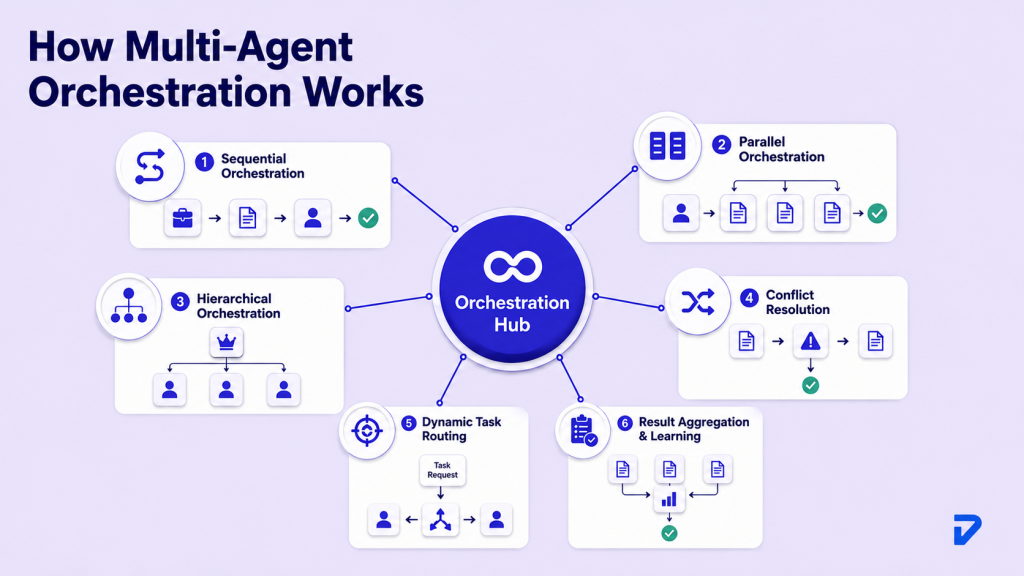
Sequential orchestration passes tasks from one agent to the next in a predefined order. Each agent completes its responsibility before handing the workflow to the following agent.
This approach works best for predictable processes such as document processing, claims handling, approval workflows, and customer onboarding where each step depends on the previous one.
2. Parallel Orchestration
Parallel orchestration allows multiple agents to work on independent tasks simultaneously. Running tasks in parallel reduces overall execution time and improves system efficiency.
The results are combined after execution using a merge process that validates outputs, resolves inconsistencies, and handles any partial failures before moving forward.
3. Hierarchical Orchestration
Hierarchical orchestration uses supervisor agents to coordinate specialized worker agents across multiple layers. Each worker focuses on a specific responsibility while the supervisor manages the overall workflow.
This pattern scales well for complex business operations, making it easier to assign tasks, monitor progress, and coordinate large groups of AI agents.
4. Conflict Resolution
Conflict resolution defines how the system responds when multiple agents produce different recommendations or outputs. Clear rules prevent inconsistent decisions from affecting downstream workflows.
Reliable systems use predefined priorities, confidence scores, or human review to resolve disagreements while recording every decision for future audits and compliance.
5. Dynamic Task Routing
Dynamic task routing automatically directs requests to the most suitable AI agent based on task type, priority, or required expertise. This ensures work reaches the best available resource.
If an agent becomes unavailable or overloaded, the routing layer can redirect tasks to another qualified agent, improving reliability and reducing service disruptions.
6. Result Aggregation & Learning
Result aggregation combines outputs from multiple AI agents into a single, validated response. The system compares results, resolves inconsistencies, and ensures only accurate, complete information moves to the next stage.
Learning uses execution history, feedback, and past outcomes to improve future performance. By analyzing successful and failed workflows, AI systems continuously refine decision-making, orchestration strategies, and overall reliability.
Ready to build reliable AI agents?
Pinnasys designs and deploys production-ready agentic AI systems with secure architectures, intelligent orchestration, and governance built for real-world business applications.
Real-World Use Cases for Agentic AI Design Patterns
According to Capgemini, over 80% of business leaders expect AI agents to become essential digital team members within the next two years. Across industries, agentic AI design patterns are enabling reliable automation, better decision-making, and scalable AI operations.
| Industry | Use Case | Primary Patterns Used |
| Insurance operations | FNOL intake to settlement triage | ReAct, Supervisor–Worker, Human Approval |
| Financial services | Compliance monitoring and reporting | Event-Driven, RAG, Reflection |
| Customer support | Autonomous query resolution | ReAct, RAG, Human Approval |
| Software engineering | Code review and test generation | Planner–Executor, Reflection, Multi-Agent |
| Healthcare workflows | Prior authorization and clinical summarization | RAG, Human Approval, Guardrails |
| Supply chain automation | Exception detection and rerouting | Event-Driven, Supervisor–Worker |
| IT operations | Incident triage and remediation | Event-Driven, ReAct, Planner–Executor |
Across all of these contexts, the pattern that appears in every production deployment is the Human Approval pattern. Autonomous agents and human oversight are not alternatives to each other in business AI. They are complements, and the design challenge is calibrating where the boundary sits.
Common Mistakes When Designing AI Agents
Avoiding these common mistakes can significantly improve AI agent reliability, reduce production failures, and make autonomous systems easier to maintain and scale.
- Overloading a single agent: Assigning too many responsibilities to one agent creates slower workflows, increases failure risks, and makes debugging more difficult. Split complex tasks across specialized agents whenever possible.
- Skipping tool validation: Always validate inputs before calling external tools and verify outputs before using the results. This prevents malformed data from spreading through downstream workflows.
- Poor memory management: Allowing irrelevant context to accumulate reduces reasoning quality over time. Effective memory management keeps only the information needed for accurate decision-making.
- Granting excessive permissions: Agents should follow the principle of least privilege. Limit access to only the tools and actions required for a specific task to reduce security risks.
- Ignoring monitoring and observability: Track agent performance with structured logs, metrics, and alerts. Continuous monitoring helps detect failures, performance degradation, and unexpected behavior before they impact users.
- Not planning for failures: Design workflows to handle API failures, missing data, tool outages, and unexpected inputs. Reliable AI agents recover gracefully instead of failing silently or producing incorrect results.
The Future of Reliable Agentic AI
The future of agentic AI will be shaped by self-improving agents, adaptive orchestration, and interoperable frameworks that enable more intelligent automation. As these technologies mature, agentic AI design patterns will become increasingly important for building scalable, secure, and reliable autonomous systems.
Future AI systems will combine greater autonomy with stronger governance, explainability, and human oversight. Organizations that prioritize reliable AI agents and continuously improve AI agent reliability through robust architecture and engineering practices will be best positioned to scale AI with confidence.
The Bottom Line
Design patterns are the foundation of production-ready autonomous AI systems. They help agents make consistent decisions, recover from failures, work safely with external tools, and provide the transparency needed for governance and long-term success.
If you’re looking to implement these architectures in production, Pinnasys helps organizations design and deploy scalable agentic AI systems with proven engineering practices. From intelligent automation to governance and orchestration, our team builds AI solutions that are ready for real-world business environments.
Key Takeaways from the Article
- Agentic AI design patterns solve structural engineering problems that prompt engineering cannot address.
- The eight core patterns, ReAct, Planner–Executor, Reflection, RAG, Multi-Agent, Supervisor–Worker, Event-Driven, and Human Approval, cover most production agent architectures.
- Memory architecture (working, short-term, long-term, episodic) is the most underspecified and most failure-prone component of business agents.
- Auditability requires structured logging of every prompt, tool call, and output, not narrative logs.
- Human intervention rate should be calibrated to risk threshold, not minimized indiscriminately.
FAQs About Agentic AI Design Patterns
What Are Agentic AI Design Patterns?
Agentic AI design patterns are reusable architectural templates that solve recurring problems in autonomous agent systems, how to structure planning, manage memory, validate tool calls, and insert human oversight. They borrow directly from software engineering’s design pattern tradition and apply it to LLM-based agent systems.
Why Are Design Patterns Important for Reliable AI Agents?
Without structural patterns, teams solve the same engineering problems from scratch on every project, producing fragile systems that fail unpredictably in production. 71% of organizations now use generative AI regularly, and the reliability gap between pattern-based and ad-hoc agent architectures is widening as workflows grow more complex.
How Do Design Patterns Improve AI Agent Reliability?
Patterns like Reflection add self-evaluation before output commitment, reducing error propagation. Patterns like Planner–Executor separate reasoning from execution, making failures easier to diagnose. Guardrail patterns enforce policy constraints in code rather than in prompts, making them robust to adversarial inputs. Each pattern addresses a specific failure mode.
What is the Planner–Executor Pattern?
The Planner–Executor pattern separates the agent into a planning module, which uses the LLM to decompose a goal into steps, and an execution module that carries out each step deterministically. This separation makes planning failures and execution failures independently diagnosable and fixable without touching the other component.
What Is the ReAct Pattern in Agentic AI?
ReAct (Reason + Act) is an iterative loop where the agent reasons about the current state, calls a tool, observes the result, and reasons again until the task is complete. It is the most widely deployed agentic pattern and is natively supported in frameworks including LangChain, LlamaIndex, and AutoGen.
How does RAG improve AI agent reliability?
RAG (Retrieval-Augmented Generation) grounds the agent’s reasoning in retrieved source documents rather than the model’s parametric memory, which is prone to hallucination on domain-specific questions. Retrieval match scores also serve as a signal for confidence scoring: low retrieval similarity indicates low-confidence territory, triggering fallback or human review.
How Do You Make AI Agents Auditable?
Auditability requires structured logging of every prompt, tool call, tool response, and agent output, machine-queryable records with timestamps, session IDs, and the specific model and prompt version used. Chain-of-thought step logging and prompt version control are the two additional requirements. Without these, an explanation cannot be reproduced for a given decision.
What Metrics Should Be Used to Evaluate Reliable AI Agents?
The eight core metrics are task completion rate, tool success rate, hallucination rate, human intervention rate, accuracy against a ground-truth test set, end-to-end latency, cost per task, and user satisfaction. Human intervention rate is the most commonly misread: lower is not always better on high-risk decision workflows.
Which Industries Benefit Most from Agentic AI Design Patterns?
Insurance, financial services, healthcare, and supply chain operations benefit most, because all four involve high-volume structured workflows with regulatory auditability requirements and clearly defined human-oversight thresholds. The pattern-based approach is particularly valuable where explainability and AI governance are compliance requirements, not optional enhancements.
What Frameworks Support Agentic AI Development?
The leading open-source frameworks are LangChain, LlamaIndex, AutoGen, and CrewAI. OpenAI’s Assistants API and Anthropic’s agent tooling provide managed alternatives. Framework choice affects which patterns are natively supported and how much infrastructure the team must build to achieve full observability and auditability.





Prakash C. Saini
Prakash Saini is the Founder & CEO of Pinnasys. With over a decade in digital transformation and building production systems, he grew an engineering team from 2 to 50 people and has led the delivery of 100+ production digital systems. Products built under his leadership have raised millions in funding and generated over $50 million in revenue. He holds an Executive MBA from IIM Kozhikode and today leads the AI engineering team at Pinnasys.