


Agentic AI projects fail when organizations treat autonomous AI as a technology experiment instead of a business transformation. Success depends on selecting the right use cases, building reliable data and governance frameworks, and deploying production-ready AI agents with continuous monitoring.
Gartner’s research confirms what operations leaders are quietly discovering: the shift from generative AI experiments to autonomous AI systems is far harder than a vendor demo suggests. Organizations investing in agentic AI deployment are discovering that AI agents require a fundamentally different approach to architecture, data, and governance than the AI tools they have tried before. Many agentic AI project failures occur because organizations underestimate these production requirements and treat autonomous AI as an extension of traditional generative AI deployments. The gap between what an AI agent can do in a controlled environment and what it reliably delivers in production is where most projects break. This article explains why that gap exists, how to close it, and what production-ready agentic AI actually requires.
Understanding the causes of agentic AI project failures is the first step toward building production-ready AI agents.
Why Do Agentic AI Projects Fail? The Five Root Causes
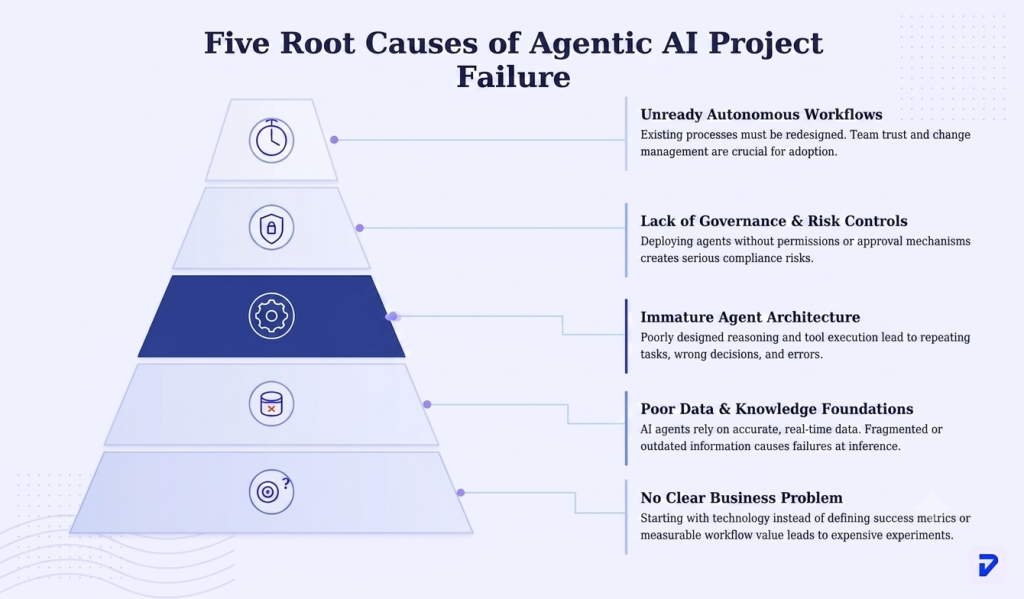
The McKinsey State of AI 2025 report found that 62% of organizations are experimenting with AI agents, yet only 39% report enterprise-level EBIT impact from AI adoption. Most companies are still trapped in the pilot phase. These agentic AI project failures cluster around five consistent failure modes.
1. No Clear Business Problem Behind the AI Agent
Many agentic AI projects start with technology instead of business outcomes. Teams build agents without defining the workflow, success metrics, or measurable value they expect to create.
Without a clear objective, AI initiatives become expensive experiments rather than business solutions. Companies must identify high-impact processes where autonomous decision-making can improve efficiency, revenue, or customer experience.
2. Poor Data and Knowledge Foundations
AI agents depend on accurate, accessible, and updated information to make reliable decisions. Fragmented systems, outdated documents, and disconnected data sources often limit agent performance in real-world environments.
A strong knowledge layer, including RAG-based retrieval systems, helps agents access relevant information before responding. However, even advanced AI models fail when the underlying data quality is poor. Poor data quality remains one of the leading contributors to agentic AI project failures across industries.
3. Immature Agent Architecture
Agentic AI systems require structured workflows, effective reasoning, and reliable tool execution. Poorly designed architectures can cause agents to repeat tasks, make incorrect decisions, or fail when handling complex scenarios.
The ReAct framework, short for Reasoning and Acting, established that effective AI agents need to interleave thinking with external tool use rather than deciding first and acting blindly. Production deployments that skip this kind of structured planning pay for it through task failures that are difficult to trace and expensive to fix.
4. Lack of Governance and Risk Controls
Autonomous AI agents require clear boundaries before they are deployed into business operations. Without permissions, monitoring, and approval mechanisms, agents can create security, compliance, and operational risks.
Organizations must design governance frameworks based on agent responsibilities and risk levels. A customer support agent and a financial decision-making agent require completely different levels of control and oversight.
5. Organizations Are Not Ready for Autonomous Workflows
Even reliable AI agents can fail when organizations are not prepared to adopt new ways of working. Existing processes often require redesign to support AI-driven decisions and automation.
Employee trust, clear ownership, and AI operating models play a major role in adoption. Without proper change management, teams may avoid using agents or create duplicate manual workflows.
How to Build Agentic AI Systems That Actually Work
Avoiding agentic AI project failures requires changing how organizations design, deploy, and monitor AI agents. The difference between a pilot that impresses and a system that delivers comes down to five specific decisions made before development starts and during the production build.
1. Start With the Right Agent Use Cases
Agentic AI creates the most value in workflows that are repetitive, complex, and decision-heavy, the kind of work where a human expert follows a consistent process but spends most of their time on data gathering, matching, and routing rather than genuine judgment. Claims triage, order exception handling, field service dispatch, and lead qualification all fit this profile.
The selection test is simple: can you write down the rules the agent will follow? If the workflow is so ambiguous that even your best employee cannot articulate what they do and why, an agent will not clarify it. Start with structured, high-volume, rules-driven processes, and define measurable success criteria before the first line of code is written.
2. Build a Strong Data and Knowledge Layer
Reliable agents need reliable information. That means creating data pipelines that pull from authoritative enterprise sources, maintaining those sources in real time, and using a well-structured RAG pipeline to give the agent accurate, contextually appropriate inputs at inference time.
Knowledge graphs add an additional layer of structured context, connecting entities and relationships across an enterprise in ways that flat document retrieval cannot. For industries like insurance, logistics, and field services, where decisions depend on product rules, coverage terms, or equipment history, this structured knowledge layer is the difference between an agent that reasons correctly and one that invents answers confidently.
3. Design Production-Ready Agent Architectures
Production architecture is not the same as demo architecture. Where a demo can tolerate an agent that occasionally halts or loops, a production system needs deterministic fallback paths, validation loops before any consequential action is executed, and a clear separation between agents that plan and agents that act.
The table below captures the core architectural choices and what each decision affects in production:
| Architecture Decision | Demo Approach | Production Approach |
| Task planning | Single-pass inference | ReAct or Plan-and-Execute with validation |
| Multi-agent orchestration | One agent handles all tasks | Specialist agents with an orchestrator |
| Tool permissions | Broad API access | OAuth-scoped calls per tool |
| Error handling | Retry or halt | Defined fallback and escalation paths |
| Monitoring | Manual review | Automated drift detection and alerting |
Single-agent designs are appropriate for focused, well-scoped workflows. Multi-agent architectures become necessary when a process spans multiple systems or requires different types of expertise, but they require significantly more orchestration investment to run reliably.
4. Implement AI Safety and Governance Frameworks
Governance is not a post-launch consideration. It needs to be designed into the agent at the architecture stage. Human-in-the-loop controls, where the agent pauses and requests approval before executing high-stakes actions, are the most practical starting point for most enterprise deployments.
Beyond that, production governance includes permission scoping (the agent can only access what it needs for the specific task), a full audit trail of every decision and action the agent takes, and active monitoring for behavioral drift over time. The AI Agent Index 2025 highlights that transparency and safety evaluation remain the weakest points in most deployed agent systems, which creates both a risk and a competitive differentiation opportunity for organizations that get this right.
5. Prepare Teams and Processes for AI Collaboration
When an agent takes over a task, the surrounding workflow needs to change with it. Processes that were designed around human handoffs need to be redesigned so the agent fits naturally into the flow without creating bottlenecks at the edges where human judgment is still required.
Employee adoption follows clarity. When a team understands what the agent does, what it cannot do, and how to escalate when something looks wrong, adoption is substantially faster and override rates drop. The organizations that succeed with agentic AI treat the workflow redesign as seriously as the technology build, and they assign clear ownership to a team that bridges business process and AI operations.
6. Monitor, Improve, and Scale Agentic AI Systems
Deploying an AI agent is only the beginning. Continuous monitoring is essential to track accuracy, task completion rates, costs, latency, and unexpected behaviors. Organizations should use feedback loops and performance insights to improve prompts, knowledge sources, workflows, and safety controls over time.
Scaling agentic AI requires standardized deployment practices, reusable components, governance frameworks, and monitoring systems. This allows organizations to move beyond isolated experiments and build reliable AI agent ecosystems that continuously improve and deliver measurable business value.
Measuring Agentic AI Success: Moving Beyond AI Demos
Production-ready AI agents require production-grade measurement. A demo that impresses is not evidence that the system is working. Real measurement happens at two levels.
Technical Metrics That Matter
| Metric | What it tells you |
| Task completion rate | The share of workflows the agent resolves without human intervention |
| Accuracy and error frequency | How often the agent takes a wrong action or produces an incorrect output |
| Response quality over time | Whether accuracy is drifting as data or conditions change |
| Escalation rate | The share of tasks the agent appropriately hands off vs. incorrectly attempts |
These metrics form the baseline health check for any deployed agent. Without them, teams tend to discover production problems through customer complaints rather than monitoring dashboards.
Business Metrics That Prove ROI
Technical accuracy is a precondition, not an outcome. The business case for agentic AI ROI needs to be expressed in terms that operators and finance teams can read: cost per transaction before and after, average process cycle time, revenue attributed to faster response, and customer satisfaction changes.
At Pinnasys, success is measured in hours saved, errors reduced, and revenue unlocked, not in the sophistication of the model running behind it. That framing matters, because it keeps teams accountable to the business case throughout the build rather than retreating to capability metrics when the ROI conversation arrives.
Continuous Improvement After Deployment
Production deployment is not the finish line. Agentic AI systems need ongoing monitoring of agent behavior, regular updates to the underlying knowledge layer, and structured feedback loops that use real-world performance data to improve agent workflows. The agents that deliver the most value over time are those that are actively maintained as business conditions change.
Ready to move beyond AI pilots?
Build production-ready AI agents that deliver measurable business outcomes with Pinnasys.
Agentic AI Impact Across Industries
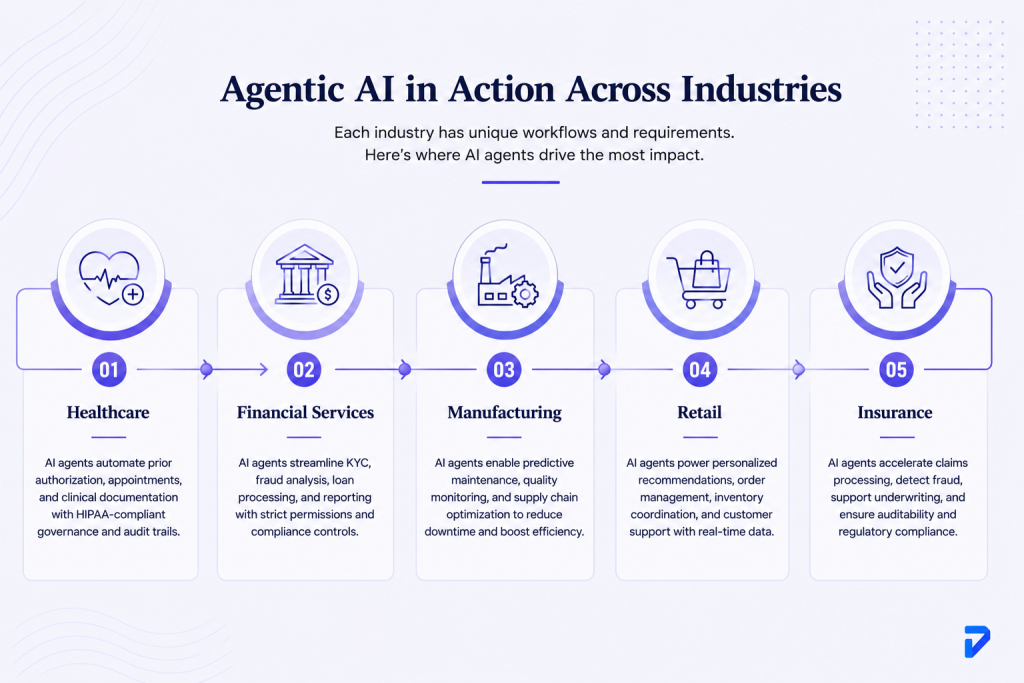
While the failure causes are universal, the solutions are industry-specific. Reducing agentic AI project failures requires adapting AI agents to each industry’s workflows, regulations, and operational requirements. Each sector has distinct workflow patterns that determine where AI agents create the most value.
1. Healthcare
AI agents are helping healthcare organizations automate prior authorization, appointment coordination, and clinical documentation. Success depends on HIPAA-compliant governance, audit trails, and human oversight to ensure reliable decisions while reducing administrative workload and allowing providers to focus more on patient care.
2. Financial Services
Banks are using AI agents for KYC verification, fraud analysis, loan processing, and regulatory reporting. However, strict permissions, explainability, and compliance controls are essential. Multi-agent architectures help separate tasks and improve reliability in high-risk financial workflows.
3. Manufacturing
Manufacturers are deploying AI agents for predictive maintenance, quality monitoring, and supply chain optimization. By analyzing operational data and triggering workflows automatically, these systems help reduce downtime, improve production efficiency, and enable faster responses to equipment and process issues.
4. Retail
Retailers are moving beyond chatbots by using AI agents for personalized recommendations, order management, inventory coordination, and customer support. Reliable outcomes depend on accurate real-time data across pricing, products, and policies to improve resolution speed and customer satisfaction.
5. Insurance
Insurance providers are adopting AI agents to automate claims processing, policy administration, underwriting support, fraud detection, and customer service. Success depends on secure access to polil̥cy data, regulatory compliance, explainable decision-making, and human review for complex claims. When integrated with core insurance systems, AI agents help reduce claim processing times, improve accuracy, and deliver faster customer experiences.
The Bottom Line
Although agentic AI project failures are common, they are largely preventable with the right strategy, architecture, and governance. The 40% failure rate reflects execution challenges rather than limitations of the technology itself. Organizations that define clear business objectives, build reliable data and knowledge foundations, embed governance from the beginning, and prepare teams for autonomous workflows are far more likely to achieve successful production deployments and measurable AI ROI.
Pinnasys exists to help mid-market operators close this gap. Our agentic AI services cover the full build, from use case selection and architecture design through production deployment and ongoing monitoring. If your organization is ready to move from AI experimentation to AI outcomes, we are built for exactly that.
Frequently Asked Questions
What is the most common reason agentic AI projects fail?
The most common cause is starting with the technology rather than a defined business problem. Without measurable success criteria and a workflow where autonomy creates clear value, most AI agent projects stall at the pilot stage before reaching production.
How long does it take to deploy a production-ready AI agent?
A focused agent targeting one well-defined workflow typically takes eight to sixteen weeks from scoping to production, including data preparation, architecture build, testing, and governance setup. Complex multi-agent systems take longer depending on the number of system integrations required.
What is the difference between an AI chatbot and an AI agent?
A chatbot responds to questions using pre-defined logic or a language model. An AI agent can plan multi-step tasks, use external tools, make decisions autonomously, and take actions in connected systems, operating beyond a simple question-and-answer exchange.
How do you govern an AI agent that makes autonomous decisions?
Effective governance includes permission-scoped tool access, human-in-the-loop review for high-stakes actions, a full audit trail of every agent decision, and active monitoring for behavioral drift. Governance design should match the risk level of the specific workflow, not be applied uniformly across all agents.
Which industries benefit most from agentic AI?
Insurance, financial services, logistics, manufacturing, and healthcare all have high-volume, rules-driven, data-intensive workflows that are strong candidates for agentic AI. The common thread is processes where a skilled human follows a repeatable pattern that can be defined, measured, and improved over time.
What does human-in-the-loop mean in agentic AI?
Human-in-the-loop (HITL) is an architecture pattern where an AI agent pauses before taking a consequential action and routes the decision to a human for approval. It is the most practical first-step governance control for enterprise AI deployments and can be gradually relaxed as agent reliability is established in production.





Prakash C. Saini
Prakash Saini is the Founder & CEO of Pinnasys. With over a decade in digital transformation and building production systems, he grew an engineering team from 2 to 50 people and has led the delivery of 100+ production digital systems. Products built under his leadership have raised millions in funding and generated over $50 million in revenue. He holds an Executive MBA from IIM Kozhikode and today leads the AI engineering team at Pinnasys.