AI guardrails are independent checks that screen what enters an LLM, what it returns, and which actions it may take. Layered well, they contain prompt injection, data leaks, and hallucinations without noticeably slowing users.
In February 2024, a Canadian tribunal ordered Air Canada to compensate a grieving passenger after its website chatbot invented a retroactive bereavement refund. The airline argued that the bot was responsible for its own statements, and the tribunal rejected that defense. Nothing in the model had malfunctioned; it simply answered fluently and incorrectly, with no independent check between draft and customer.
That missing check is what AI guardrails provide. They inspect every prompt, answer, and tool call against your rules before anything reaches a user or a live system. Whether you run a customer-facing support assistant or an internal copilot, this layer decides if a launch survives real traffic. The sections below cover the risks, the baseline controls, the tools, and the latency they actually add.
What Are AI Guardrails and How Do They Work?
AI guardrails are software checks that run outside the model and enforce your policy on every request, response, and tool call. Think of them as input validation for language, applied every time instead of only when the model cooperates.
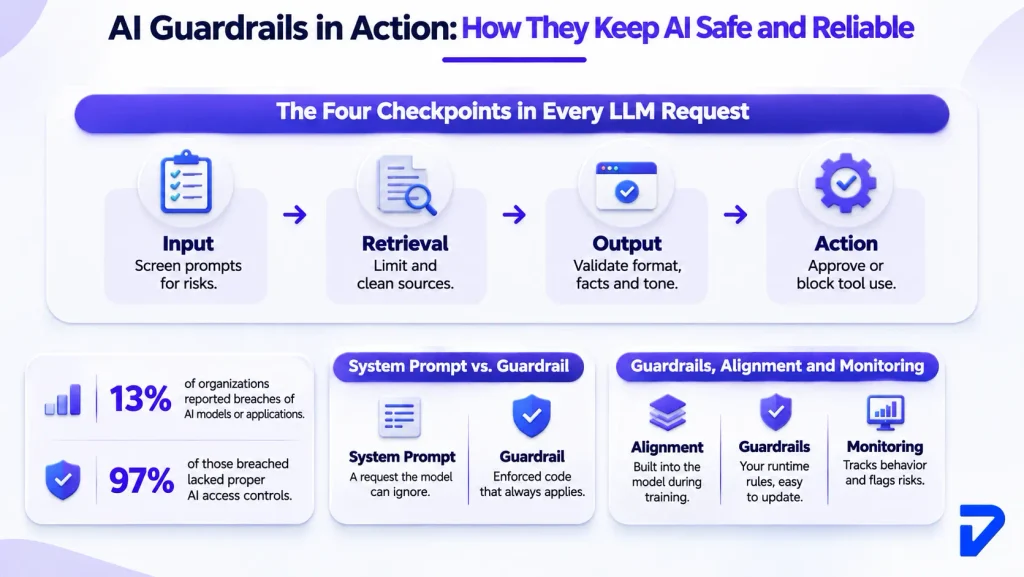
The need is no longer theoretical. IBM’s 2025 breach research found that 13% of organizations reported breaches of AI models or applications. Of those breached, 97% lacked proper AI access controls.
Why a System Prompt Is Not a Guardrail
A system prompt is a polite request, not an enforcement point. Users can rephrase, role-play, or paste instructions that outrank it, and a provider’s model update can quietly change how it is followed. Guardrails run as separate code, so they behave identically on the millionth request. A regex that masks card numbers, for example, never gets talked out of masking.
The Four Checkpoints in Every LLM Request
Production systems inspect traffic at four points, and each one catches failures the others miss:
- Input: Screens prompts for injection attempts, abuse, and personal data.
- Retrieval: Limits which documents a user may see and strips hidden instructions.
- Output: Validates format, facts, tone, and leaks before display.
- Action: Approves or blocks each tool call an agent attempts.
How Guardrails Differ From Alignment and Monitoring
Alignment is shaped during training by the model provider, so you cannot edit it. Guardrails encode your own rules at runtime and can change in an afternoon. A monitoring layer then watches both, flagging drift and missed attacks. A bank’s assistant, for instance, inherits general refusals from alignment yet still needs its own rule against promising loan approvals.
The Production Risks LLM Guardrails Protect Against
Most production failures fall into a short, well-documented list. The OWASP Top 10 for LLM Applications ranks prompt injection as the leading risk and states plainly that no known method fully prevents it. That admission matters, because it shifts the goal of AI guardrails from perfect blocking toward limiting damage.
Indirect injection is the variant teams underestimate most. In 2025, researchers disclosed EchoLeak, a zero-click flaw in Microsoft 365 Copilot, where hidden email instructions could pull data out without any user action. The attacker never typed a prompt, since the assistant simply read poisoned content during normal work.
| Risk | How it shows up in production | First guardrail to add |
|---|---|---|
| Direct prompt injection | A user types “ignore your rules and…” | Injection classifier on input |
| Indirect prompt injection | Hidden instructions in a PDF, email, or web page | Content isolation and retrieval filters |
| Sensitive data disclosure | The bot repeats a customer’s account number | PII redaction on input and output |
| Hallucinations | An invented policy, price, or citation | Grounding checks against sources |
| Excessive agency | An agent issues a refund nobody approved | Tool allowlists and human review |
| Off-topic or harmful replies | A tax bot offers medical advice | Topic restrictions and content filters |
| Unbounded consumption | Token floods spike the API bill | Rate, size, and spend caps |
Inaccuracy, meanwhile, is the risk operators tend to feel first. McKinsey’s 2026 State of AI survey found that 47% of mid-level managers and individual contributors had experienced at least one negative AI consequence. Among executives, the figure was only 31%. In other words, the people closest to daily work see failures that leadership dashboards often miss.
Which Guardrails Should Every LLM App Have?
Every LLM app needs five baseline controls: injection detection, PII redaction, topic restrictions, output validation with grounding checks, and human review for risky actions. Additional AI guardrails beyond that baseline should scale with the risk of each feature.
Regulated teams should treat this table as a floor, not a ceilg. Our guide to building HIPAA-compliant AI safely covers the extra encryption, access, and audit controls that sensitive data demands.
Input Guardrails: Prompt Injection Detection and PII Redaction
Input checks are the cheapest place to stop trouble, because a blocked prompt never costs a model call. A lightweight classifier flags override attempts, while PII redaction swaps sensitive values for placeholders before the model ever sees them. With Microsoft Presidio, for example, a pasted card number reaches the model as a neutral placeholder token instead.
Topic Restrictions and Content Filtering AI
Topic restrictions keep an assistant in its lane, protecting your users and your liability. An insurance claims bot should decline stock tips, and a payroll assistant should refuse medical questions. Content filtering AI models then add a second net for toxic, sexual, or violent text in either direction. Good refusals still route people toward the right channel.
LLM Output Validation and Grounding Checks
LLM output validation confirms a response is well formed and safe before anyone acts on it. Schema checks with JSON Schema or Pydantic reject malformed payloads and trigger a retry. After that, grounding checks compare each claim with the retrieved sources and hold back anything unsupported. A quote generator should never show a discount missing from the price list.
Action Guardrails and Human Review for Agents
Once agentic AI systems can call tools, mistakes stop being sentences and become transactions. Tier every action by potential damage:
- Read a record: Permission check plus logging.
- Send an email: Approved templates and daily volume caps.
- Issue a refund: Amount limits and approval above a threshold.
- Delete data: Mandatory human review and a verified backup.
Is your LLM app live without a safety layer you can audit?
Pinnasys designs, wires, and tests production guardrails inside your stack, so every prompt, answer, and agent action clears policy before it counts.
How Do You Block Prompt Injection in a Live App?
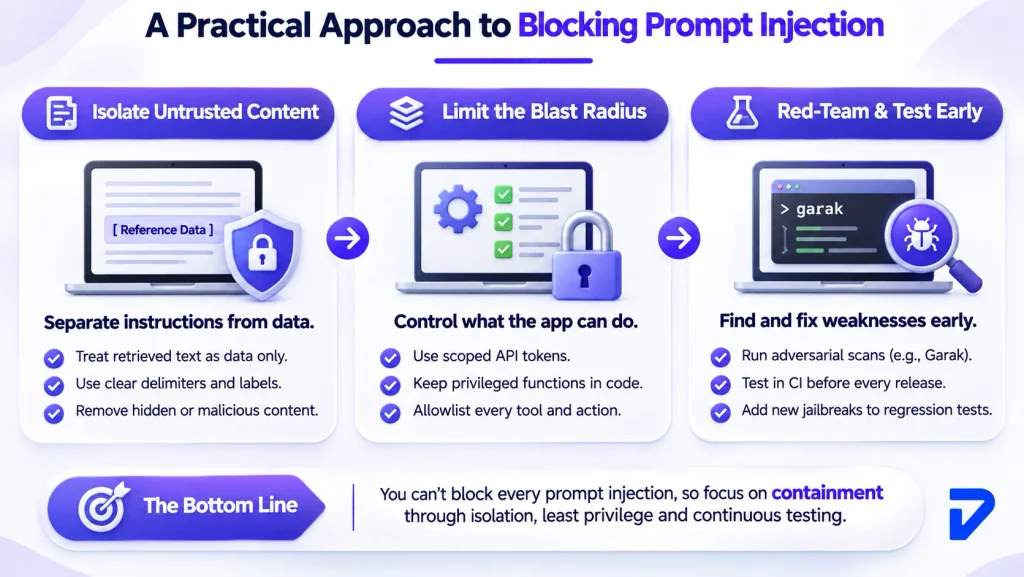
You cannot block every prompt injection, so production teams layer detection, isolation, and privilege limits until a successful attack has nowhere useful to go. The realistic goal is containment, not a flawless filter. The same least-privilege thinking applies to multistep agents. These design patterns for reliable, auditable agents show how to scope tools, memory, and approvals across an entire plan.
Separate Trusted Instructions From Untrusted Content
Treat every retrieved document, email, and web page as data, never instructions. Wrap untrusted text in clear delimiters, label it as reference material, and strip hidden characters or white-on-white text at ingestion. A résumé screener should ignore a buried line telling it to rank the candidate first. Isolation will not stop every attack, although it raises the cost.
Limit What a Successful Attack Can Do
Assume some injection will eventually land, and then shrink the blast radius. Give the app its own scoped API tokens, keep privileged functions in code rather than in the model’s hands, and allowlist every tool. If an attacker hijacks a support bot that only reads order status, the worst outcome is a leaked tracking number, not a drained account.
Red-Team Before Your Users Do
Adversarial testing turns guesswork about your AI guardrails into evidence an auditor can review. Open-source scanners such as NVIDIA’s Garak fire known attack patterns at your endpoint and report which succeed:
python -m garak --model_type openai --model_name gpt-4o --probes promptinjectRun scans in CI before every release, and add each jailbreak found in live traffic to your regression suite.
How Do You Prevent LLM Hallucinations in Production?
To prevent LLM hallucinations in production, ground every answer in approved sources, score its support before release, and let the model decline. No single AI guardrail is sufficient on its own. Retrieval alone does not solve the problem either. Stanford researchers found that purpose-built legal AI tools still hallucinated in at least 1 of 6 benchmark queries, despite relying on retrieval.
Ground Answers in Approved Sources
Retrieval-augmented generation, or RAG (fetching relevant documents before the model answers), gives the model facts to cite instead of memories to guess from. Restrict the index to approved, current content and attach access rules at indexing time. A well-governed enterprise search layer also stops the bot from quoting a policy that legal retired years ago.
Score Groundedness Before the Answer Ships
A grounding check asks one question: does each sentence trace back to a retrieved passage? Lightweight entailment models or an LLM judge score that support, and low scores trigger a rewrite or a refusal. Amazon Bedrock’s contextual grounding check, for example, filters responses that fall below a configured threshold. Log every score, since trends expose stale content faster than complaints.
Give the Model a Safe Way to Say “I Don’t Know”
Many hallucinations happen because the prompt implicitly demands an answer, even when sources are silent. Instruct the model to decline when evidence is thin, and then make declining useful by routing users to a person, form, or document. A benefits assistant that says “I can’t confirm that, but here is HR’s contact” preserves far more trust than a confident guess.
Do Guardrails Slow AI Responses? Latency, Cost, and Tools
Yes, though far less than most teams fear when AI guardrails are ordered sensibly. Small classifiers add milliseconds, whereas LLM-based judges add the most delay and token cost. In NVIDIA’s benchmark, stacking three NeMo Guardrails safety services lifted policy-violation detection from 75% to about 99%. The cost was roughly half a second of added latency.
Order Checks From Cheapest to Most Expensive
Run deterministic rules first, then small classifiers, and reserve LLM judges for traffic that survives both. Independent checks, such as PII redaction and injection detection, can run in parallel. A cache of allow-or-block decisions for repeated inputs trims cost further. A small language model tuned for one moderation task can handle that narrow job at a fraction of the latency.
Handle Streaming Without Breaking the Experience
Token streaming complicates output checks, since text reaches the screen before the full answer exists. Teams usually choose one of three patterns. They buffer and check one sentence at a time, run lightweight token filters live, or hold high-risk responses until validation finishes. Customer-facing finance answers, for instance, justify a short buffer that casual internal chat does not.
Which Tools Provide LLM Guardrails?
The ecosystem splits into open-source frameworks, safety classifiers, and managed cloud services. Most production stacks combine two or three, because no single tool covers input, output, dialog, and action checks equally well. Choose based on data residency needs, the cloud you already run, and how much custom policy logic your use case demands.
| Tool | Type | Best fit |
|---|---|---|
| NVIDIA NeMo Guardrails | Open-source framework | Multi-turn dialog rails and topic control |
| Guardrails AI | Open-source Python library | Structured output validation with re-asks |
| Llama Guard 4 | Open safety classifier | Content moderation on inputs and outputs |
| Llama Prompt Guard 2 | Lightweight classifier | Inline injection and jailbreak detection |
| Microsoft Presidio | PII detection toolkit | PII redaction and masking |
| Amazon Bedrock Guardrails | Managed cloud service | Fast setup for teams already on AWS |
| Azure AI Content Safety | Managed cloud service | Prompt Shields for indirect attacks |
Monitoring, Policy, and Ownership After Launch
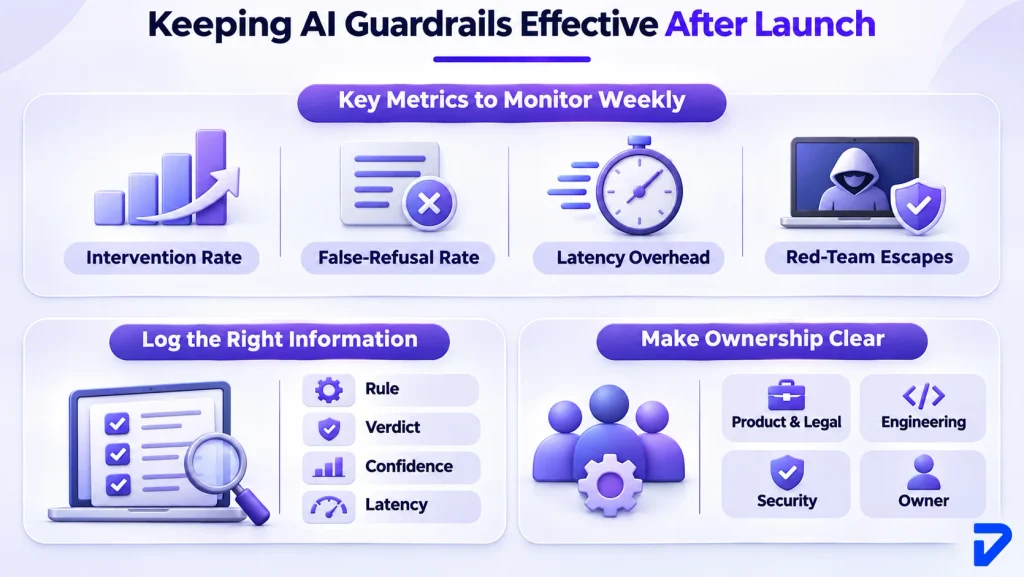
AI guardrails decay quietly. New jailbreak styles appear, models get swapped, and product teams add features the original policy never considered. Continuous monitoring is what keeps a working configuration working, and four metrics deserve a weekly review:
- Intervention rate: Sudden spikes can signal an attack campaign or an overly strict rule.
- False-refusal rate: Legitimate requests blocked by mistake, which erode adoption fast.
- Latency overhead: The added delay per layer, tracked at the 95th percentile.
- Red-team escapes: Attacks that slipped through during scheduled testing.
Log decision metadata such as the rule, verdict, confidence, and latency, rather than raw user text. That habit keeps audit trails useful without creating a fresh privacy liability. The NIST AI 600-1 Generative AI Profile offers a practical map for tying each logged control to a named risk.
Ownership matters as much as tooling. Product and legal should define the policy, engineering should build the checks, and security should run red-teaming. One named person should own the whole layer. Teams running dozens of models benefit from routing everything through one shared AI governance layer, so each rule is written once and enforced everywhere.
Sector context changes the thresholds as well. Insurance AI programs, for example, need logged interventions as audit evidence for claims and underwriting decisions. If you have not rated each AI feature by risk yet, a short AI consulting and roadmap engagement sets those tiers before launch.
The Bottom Line
Production AI fails in predictable ways, and that predictability is good news. Prompt injection, leaked data, invented answers, and runaway agents each have a known countermeasure. Layered AI guardrails turn those countermeasures into code that runs on every request, not just in a slide deck.
At Pinnasys, we treat guardrails as part of the build rather than a patch after an incident. Start with the five baseline controls, measure intervention and false-refusal rates from day one, and tighten checks where the damage would be greatest.
If your team needs the layer built, monitored, and tuned after launch, our managed AI services keep policies current as models and threats change. Pick one live LLM feature this week and map its four checkpoints.
Key Takeaways from the Article
- System prompts guide behavior, but only external checks enforce policy on every request.
- Input, retrieval, output, and action checkpoints each catch failures the others miss.
- Prompt injection cannot be fully prevented, so least privilege limits the eventual damage.
- Source-backed grounding checks and safe refusals reduce hallucinations far more than retrieval alone.
- Cheap checks should run first, keeping added latency close to invisible for users.
Frequently Asked Questions on AI Guardrails
Can guardrails fully stop prompt injection?
No, OWASP’s 2025 LLM Top 10 states that no known method fully prevents prompt injection. Strong guardrails for LLM apps reduce attack success and contain damage through scoped permissions, approval steps, and ongoing red-team testing against new patterns.
Are guardrails legally required for production AI?
Increasingly, yes in practice. The EU AI Act requires documented risk management for high-risk systems. In the US, the voluntary NIST AI Risk Management Framework, published in 2023, guides most teams. Logged guardrail decisions often become compliance evidence.
Do hosted model APIs already include AI safety controls?
Partly yes, as providers train refusals and offer moderation endpoints for general harms, but they cannot know your refund rules or approved topics. Most of the 10 OWASP LLM risks depend on application design, so business policy belongs in your stack.
How much do guardrail checks add to inference cost?
Costs depend mainly on whether you use LLM judges. Small classifiers are cheap, and Groq lists Prompt Guard 2 at about $0.04 per million tokens. LLM judges cost far more, so teams sample traffic or reserve them for risky requests.
How often should a guardrail policy be retested?
Review flagged traffic weekly through monitoring dashboards, and retest the full policy at least quarterly or after any model swap. Every jailbreak discovered in production should become a permanent regression test, so the same attack never succeeds twice.