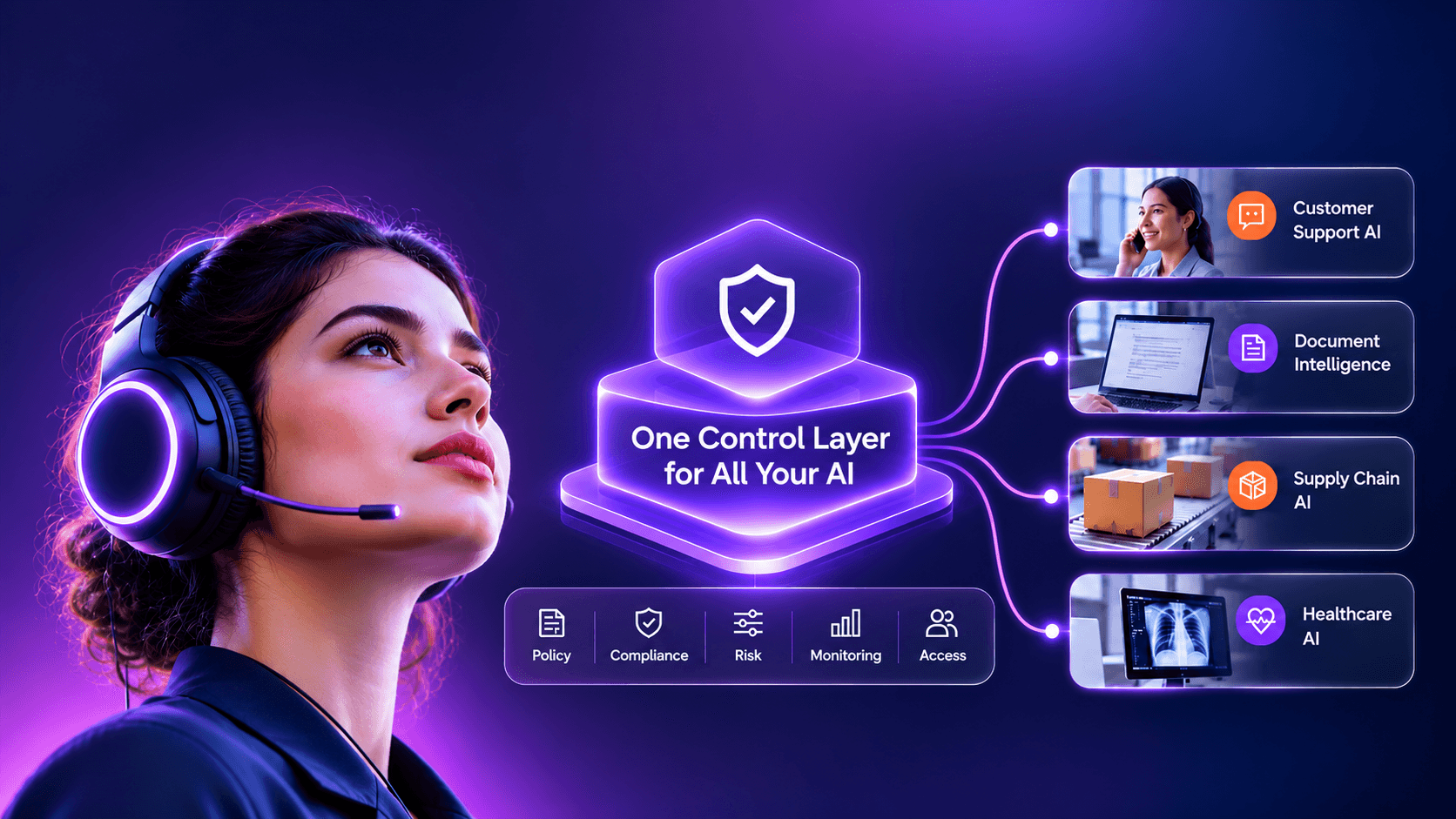
A unified AI governance architecture routes every model, agent, and AI tool through one shared layer of policy, access control, and logging. Teams write each rule once, enforce it everywhere, and prove it on demand.
Gartner expects the average global Fortune 500 enterprise to run over 150,000 AI agents by 2028, up from fewer than 15 in 2025. Even so, only 13% of organizations believe they have the right agent governance in place. Mid-market companies feel a smaller version of the same squeeze, because a chatbot, a coding assistant, and a few embedded SaaS features can each arrive with separate rules and separate logs.
A unified AI governance architecture closes that gap by moving policy out of individual tools and into one shared control layer. Approvals, permissions, and audit evidence then sit together, which turns AI compliance from a quarterly scramble into a daily operating habit. The sections below cover the components, the build order, and the limits worth planning around.
What Is a Unified AI Governance Architecture?
A unified AI governance architecture is a shared technical system that turns AI policy into decisions enforced on every model call, agent action, and tool request. Instead of each product carrying its own controls, every request crosses the same rules, so one policy produces one answer everywhere.
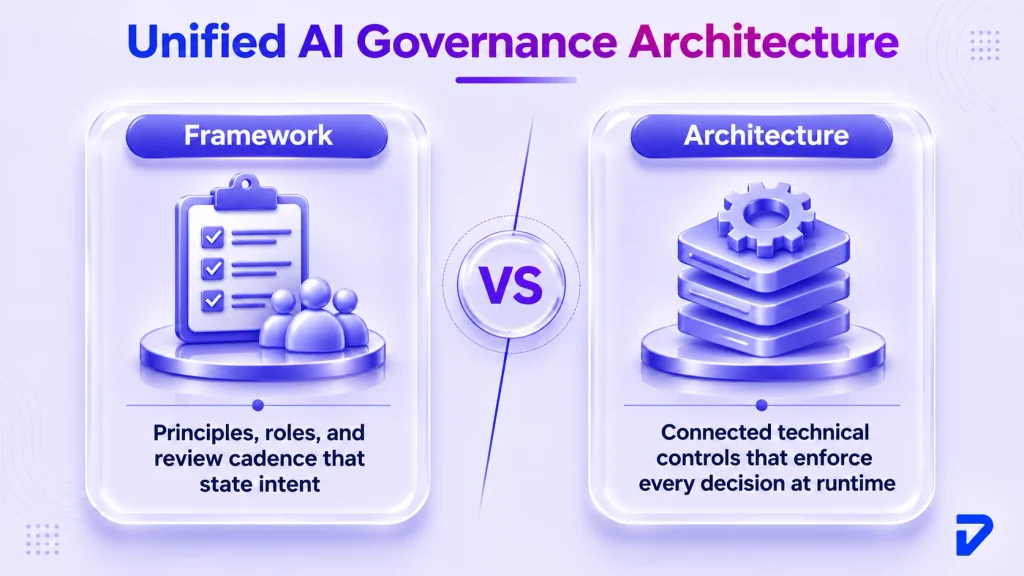
Think of it as air traffic control for your AI estate. Individual aircraft still fly their own routes, while one tower decides who may take off, tracks every movement, and keeps the record. The term is easy to confuse with an AI governance framework, which sets out principles, roles, and review cadences. A framework states intent, whereas an AI governance architecture carries that intent out at runtime, whether or not anyone is watching.
What Is an AI Control Plane?
An AI control plane is the runtime layer of this architecture, the place where identity, policy, and routing decisions happen before a request reaches a model. The name comes from networking, where the control plane decides, and the data plane delivers. For example, it can stop a marketing assistant from calling a finance tool, then record the denied attempt.
Why Do Fragmented AI Controls Fail as Tools Multiply?
Fragmented controls fail because each one sees only a slice of AI activity. A browser extension may watch one chatbot while missing a desktop assistant. Similarly, a cloud proxy may inspect traffic without knowing the account behind it, and a vendor’s audit log covers only that vendor’s product.
Most teams respond by adding another point tool, or by asking each product owner to configure rules locally. Yet that multiplies consoles without answering the question an auditor actually asks, which is who approved this output and under which rule. The answer ends up scattered across systems that disagree with one another.
The cost shows up in security data as well. IBM’s 2026 Cost of a Data Breach research found that only 40% of organizations use access controls on AI models and data. Among those reporting an AI-related breach, 92% lacked proper AI access controls.
The production-grade fix is a unified AI governance architecture, which moves the decision point outside each product. Requests cross one shared set of rules on the way in and on the way out, so a new tool inherits existing controls rather than reinventing them. Centralized AI governance of this kind also gives leaders a single, honest view of usage, spend, and risk.
Pressure rises further with agentic AI, because an agent can stay inside every approved limit while chaining individually valid actions into an outcome nobody authorized. A review done once before launch cannot catch that pattern. As a result, enforcement has to run on each action, and this is where most AI governance architecture work earns its budget.
Which Components Does AI Governance Need?
Model Inventory
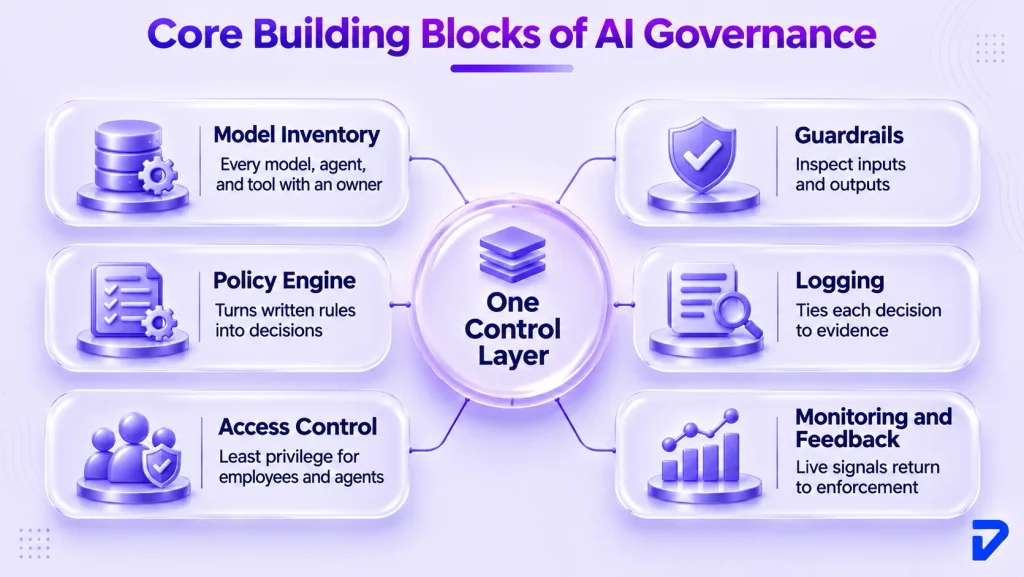
A model inventory records every model, prompt, agent, tool, and data connection in use, with an owner, purpose, and risk tier attached. Anything missing from it sits outside governance entirely. Retirement makes a useful test, because a retired claims model still marked active points to a record nobody maintains, and that gap tends to surface during audits.
Policy Engine
A policy engine turns written rules into decisions to allow, deny, redact, reroute, or pause for human review. Tools such as Open Policy Agent separate that decision from enforcement, so rules can change without redeploying applications. For instance, one rule can send any customer record to an approved private model, instead of relying on developers to remember.
Access Control
Access control extends least privilege to software as well as employees. Each agent needs its own non-human identity, with short-lived credentials scoped to one task, so it can be revoked and audited individually. A support agent, for example, may read an order on a customer’s behalf, yet refunds above a set amount wait for a named approver.
Guardrails
Guardrails inspect inputs and outputs as they pass through the layer. They catch risks like prompt injection, which OWASP ranks first among threats to large language model applications, along with sensitive data leaving in a prompt. In practice, a guardrail can mask a Social Security number before an external model sees it, then block a reply quoting unapproved pricing.
Logging
Each log entry becomes evidence when it ties together the actor, model version, policy version, decision, data used, and resulting action. A shared correlation ID links those steps into one story. Denied requests belong in the record too, since a blocked action proves the control works. An independent reviewer should be able to reconstruct any flagged decision alone.
Monitoring and Feedback
A monitoring layer closes the loop by feeding live signals back into enforcement. Model drift (performance slipping over time) and permission drift need separate tracking, because each has a different fix. When MLOps pipelines report a sudden accuracy drop on a pricing model, the layer can tighten permissions or reroute traffic automatically, well before the next quarterly review.
Still chasing AI rules across a dozen tools?
Pinnasys connects your models, agents, and assistants to one governed control layer, so your team enforces a single policy set and proves it on demand.
How Do You Govern Many AI Tools in One Place?
You govern many AI tools in one place by routing their traffic through a shared enforcement point, then feeding every decision into one inventory and one evidence store. An AI gateway usually fills that role in a unified AI governance architecture.
AI gateway governance places a proxy between business applications and model providers, so a request passes input inspection, policy and routing checks, and output review before it returns to the user. Because the gateway sees all of that traffic, AI policy enforcement stays consistent whether the caller is a chatbot, an internal app, or an agent. The payoff is measurable too, since a Gartner survey of 360 organizations found those deploying AI governance platforms were 3.4 times more likely to achieve high effectiveness in AI governance.
Retrieval adds a wrinkle of its own. Enterprise search tools built on RAG, the pattern that fetches approved documents before a model answers, must honor each user’s document permissions on every query. Three flows keep the whole setup honest.
- Design time. Registration, risk classification, testing, and sign-off all happen before launch.
- Runtime. Identity checks, policy decisions, and controlled execution occur on each request.
- Feedback. Telemetry triggers a permission change, rollback, or human escalation.
That said, a single rulebook still has to fit very different workloads, as the comparison below shows.
| AI Workload | Main Control Need | How Often It Runs |
|---|---|---|
| Predictive models | Validation, bias testing, drift checks | Before launch, then periodically |
| Generative assistants | Prompt and output guardrails | Continuously |
| RAG applications | Source permissions, content classification | On every query |
| Single agents | Tool permissions, action approval | On every action |
| Multi-agent systems | Delegation limits between agents | On every action and handoff |
Should Governance Be Centralized or Federated?
Most enterprise AI governance programs land on a hybrid. Global policy is written centrally, while lightweight enforcement points sit beside each workload and stream decisions to one evidence store. That design avoids a single bottleneck for real-time systems. A factory vision model, for example, can receive its decision locally while headquarters keeps the rulebook.
What Can a Control Layer Miss?
Even a strong layer has blind spots worth naming. Unmanaged personal devices stay outside an endpoint agent, certificate-pinned apps can reject traffic inspection, and SaaS features with built-in AI may never cross your gateway. A note-taking app granted calendar access through OAuth, for instance, needs a separate review of its permissions and scopes.
How Does AI Governance Support Compliance?
AI governance supports compliance by mapping one internal set of controls to many external rules, so evidence collected once can answer each regulator, auditor, and customer. Separate programs for overlapping obligations cost more and drift apart faster.
The EU AI Act is the binding reference point, with duties scaled to risk, including automatic event logging and human oversight for high-risk systems. Those two requirements alone explain why evidence and approval paths sit at the center of a unified AI governance architecture.
Deadlines have shifted, however. A 2026 amendment moved the high-risk dates to December 2, 2027, for stand-alone systems and August 2, 2028, for AI embedded in regulated products. Treat that extra runway as build time, since logs cannot be created retroactively for decisions already made.
Alongside the law, ISO 42001 gives companies a certifiable standard for an AI management system, while the NIST framework offers voluntary US guidance. Here is what the architecture supplies to each.
| Reference | Type | What the Architecture Supplies |
|---|---|---|
| EU AI Act | Binding EU regulation | Event logs, human oversight, risk records |
| ISO 42001 | Certifiable management standard | Defined roles, controls, improvement evidence |
| NIST AI RMF | Voluntary US framework | Inventory, risk mapping, monitoring |
| GDPR | Binding EU privacy law | Access records, lineage, residency rules |
Data sovereignty deserves early attention as well. When models train in one cloud and serve from another, lineage and access rules can fragment at each boundary, so residency and encryption policies should travel with the data. Well-built data pipelines make that far easier to prove.
More importantly, certification and runtime control answer different questions. A certificate shows a process exists and runs, while a log shows a specific control fired on a specific request. Auditors increasingly want both, and legal counsel should confirm which duties apply to your systems.
Where Should a Company Start With AI Governance?
A company should start by building a complete inventory of the AI already in use, then assigning owners and risk tiers before buying any platform. Discovery usually surprises leaders, since IBM reported that one in five organizations suffered a breach due to shadow AI, with heavy shadow AI use adding an average of $670,000 to breach costs.
Ownership comes next. McKinsey’s 2026 AI Trust Maturity Survey found that organizations with explicit ownership of responsible AI averaged a maturity score of 2.6, against 1.8 for those without a clearly accountable function. From there, a 90-day sequence keeps the work small enough to finish.
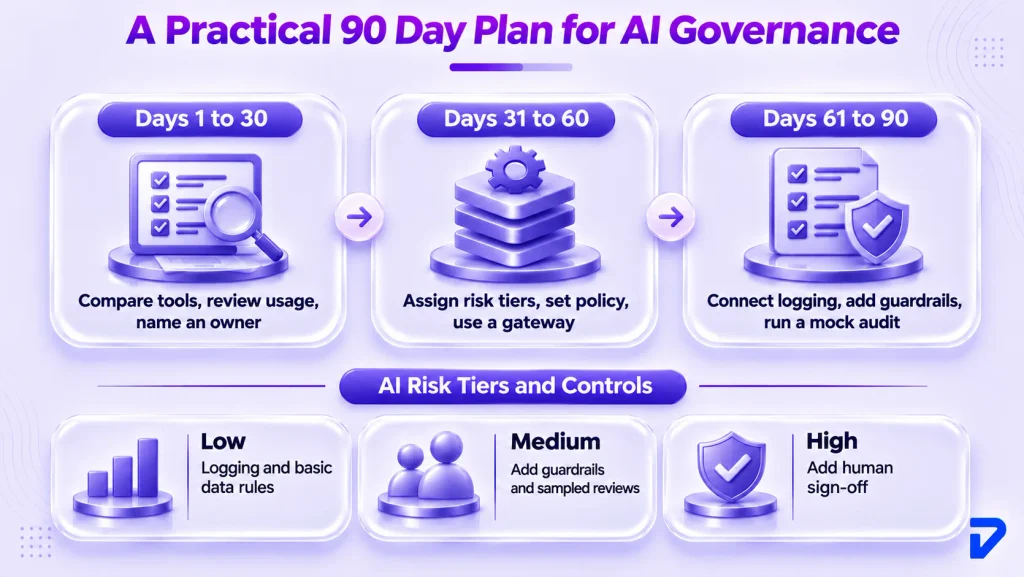
- Days 1 to 30. Compare approved tools against network traffic, API spend, and expense reports, then name an owner for each system.
- Days 31 to 60. Assign risk tiers, publish an acceptable-use policy, and route the highest-risk workflow through a gateway.
- Days 61 to 90. Connect logging to one evidence store, add guardrails, and run a mock audit on a single decision.
Success with a unified AI governance architecture needs numbers rather than impressions. Track policy coverage, trace completeness, human override rate, and audit reconstruction time- the hours a reviewer needs to explain one flagged decision. At Pinnasys, we hold this work to the same standard as any AI system, measured in hours saved, errors reduced, and revenue unlocked.
How Do Risk Tiers Set the Right Controls?
Risk tiers match control strength to potential harm, so low-stakes tools keep moving while sensitive ones slow down. A simple three-tier model suits most growing companies.
- Low. Internal drafting tools need logging and basic data rules.
- Medium. Customer-facing assistants add guardrails and sampled reviews.
- High. Credit, hiring, or safety decisions add human sign-off.
What Does Unified AI Governance Look Like by Industry?
Across industries, a unified AI governance architecture keeps the same shape, while risk tiers, retention rules, and approval paths change with each sector’s exposure. Smaller firms have an advantage here, because McKinsey’s State of AI survey shows 40% of organizations above $1 billion in revenue scaling AI agents, against 22% of smaller ones. Mid-market operators can therefore put controls in place before scale forces a retrofit.
| Industry | High-Risk Workflow | Priority Control |
|---|---|---|
| Finance | Credit and fraud decisions | Human sign-off, decision logs |
| Logistics | Carrier selection, freight documents | Tool permissions on system writes |
| Manufacturing | Quality inspection, maintenance | Local enforcement, change control |
| Healthcare | Patient messaging | Data redaction, retention rules |
Firms in financial services typically feel audit pressure first, so an unbroken record of every automated decision tends to matter most. A lender reviewing a declined application should be able to retrieve the model version, the policy applied, and the analyst who signed off.
Operators in logistics face a different exposure, since agents increasingly write into live order and shipping systems. Here, permission scoping carries more weight than output review, because one wrong update can spread across carriers and customers within minutes.
Whatever the sector, the team at Pinnasys builds these controls alongside the workflows they protect, which keeps governance part of delivery rather than a separate project.
The Bottom Line
Every new model, agent, or embedded feature adds another place where rules can drift. A unified AI governance architecture answers that by giving all of them one inventory, one policy layer, and one evidence trail, so the next tool inherits its controls on day one. Conversations with auditors, customers, and your board change as well, because the proof already exists when someone asks for it.
Pinnasys helps operators move from scattered AI rules to controls that hold up in production. When you are ready, a focused round of AI governance consulting can size your AI estate, set risk tiers, and sequence the first 90 days. Start with one honest list of what is running today, then build from there.
Key Takeaways from the Article
- Shared policy, identity, and evidence matter more than buying from one vendor.
- Fragmented point tools leave gaps that auditors and attackers tend to find first.
- Six connected components turn written AI rules into enforced runtime decisions.
- Risk tiers let low-stakes tools move fast while high-stakes decisions get human review.
- Inventory comes first, since nobody can govern AI they cannot see.
Frequently Asked Questions on Unified AI Governance
Does an AI governance layer slow down responses?
Rarely in a noticeable way. A well-designed policy check usually adds milliseconds, while a model response often takes a second or more. Latency becomes a design concern as rulebooks grow, so high-throughput systems evaluate policies locally for runtime enforcement.
What is the difference between an AI gateway and an API gateway?
An API gateway manages traffic, authentication, and rate limits for software services. An AI gateway adds model routing, token budgets, prompt inspection, and output filtering, so it understands LLM requests, tracks cost per token, and can fail over between providers.
Do small companies need an AI control plane?
A company running one or two AI tools can start with an inventory and an acceptable-use policy. Once several teams use three or more tools with customer data, shared controls usually cost less than separate AI risk management.
What are the penalties for breaking the EU AI Act?
Article 99 sets fines of up to 35 million euros or 7% of worldwide annual turnover for prohibited practices. Most other violations reach 15 million euros or 3% of worldwide annual turnover, with lower caps available for smaller businesses and startups.
Is ISO 42001 certification mandatory?
No, ISO/IEC 42001, published in December 2023, is a voluntary standard, though enterprise buyers increasingly request it during vendor reviews. Certification typically follows a three-year cycle with annual surveillance audits, which rewards ongoing AI auditing over one-time preparation.