


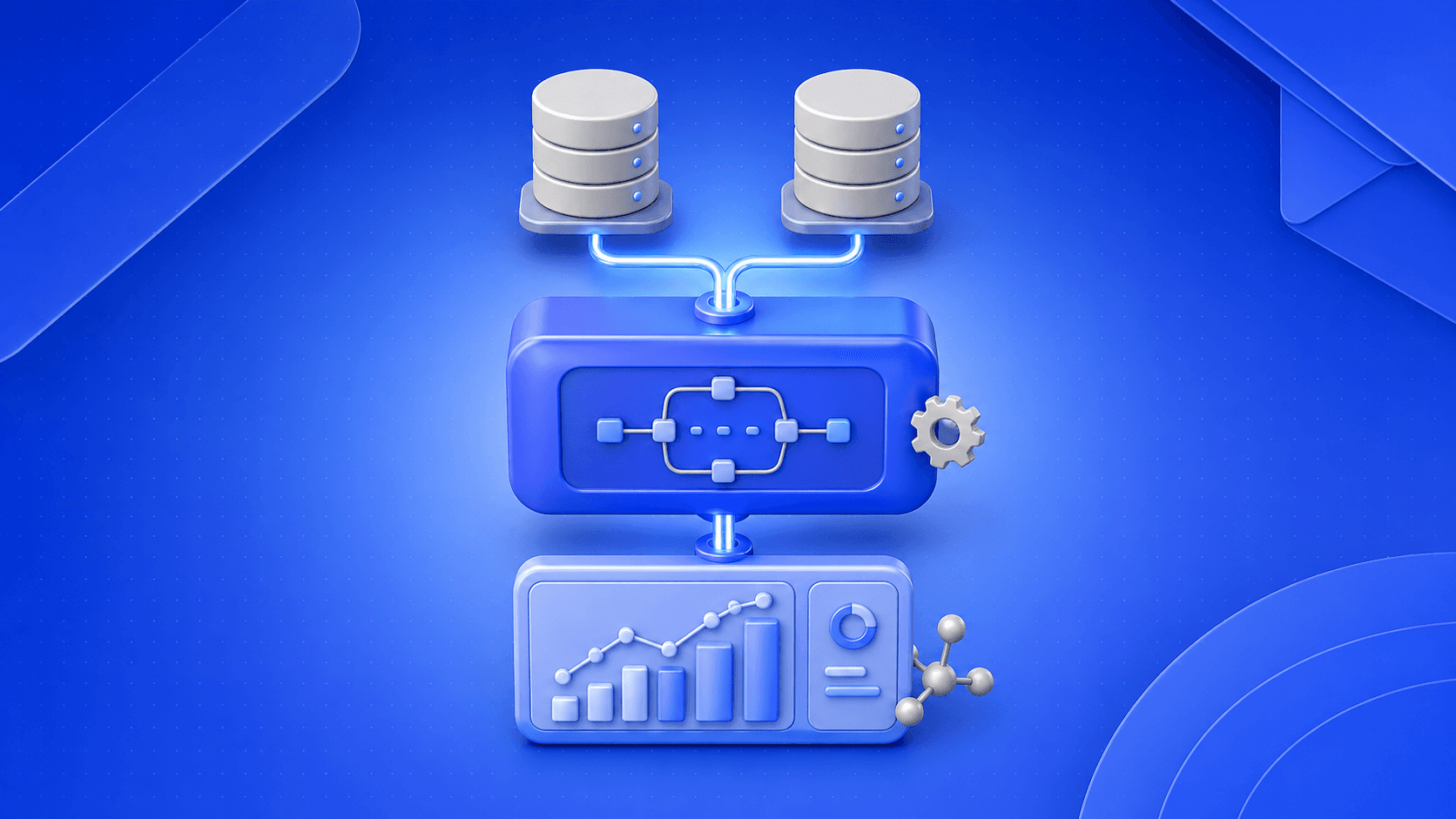
An AI data pipeline is a system that collects, processes, and delivers data for machine learning models. It supports both training and real-time predictions while handling structured and unstructured data. A well-designed pipeline ensures accuracy, scalability, and consistent AI performance in production.
AI often feels like magic, whether it generates recipes, answers complex questions, or mimics human conversation. Behind every intelligent output lies data, processed through sophisticated algorithms trained at scale. High-quality results depend on how well data gets collected, prepared, and delivered.
Studies suggest data preparation alone can take up to 80% of an AI project’s time. This entire flow runs through AI data pipelines. As AI moves from experimentation to real-world use, pipelines become the difference between models that work in theory and systems that perform in production.
What is an AI Data Pipeline?
An AI data pipeline is a structured system that collects, processes, transforms, and delivers data to machine learning models for training, evaluation, and real-time predictions. It connects multiple stages of data ingestion, cleaning, storage, feature engineering, model input, and monitoring into a continuous workflow.
AI Data Pipeline vs Traditional ETL Pipeline
| Feature | AI Data Pipeline | Traditional ETL Pipeline |
| Purpose | Powers machine learning training and real-time predictions | Prepares data for reporting and analytics |
| Data Types | Handles structured and unstructured data (text, images, logs) | Primarily handles structured data |
| Processing Style | Supports both batch and real-time processing | Mostly batch processing |
| Workflow | Includes data ingestion, transformation, feature engineering, and model integration | Focuses on extract, transform, and load steps |
| Feedback Loop | Continuous feedback and model retraining | Limited or no feedback loop |
| Output | Model-ready data and prediction outputs | Clean, structured datasets for dashboards |
| Flexibility | Adapts to changing data and model requirements | Follows predefined, static workflows |
| Complexity | Higher due to model dependencies and real-time needs | Lower compared to AI pipelines |
| Use Cases | Recommendation systems, fraud detection, NLP, and computer vision | Business intelligence, reporting, data warehousing |
Types of AI Data Pipelines
Batch AI Pipelines
AI pipelines operating in batches execute a massive amount of data on a time basis, such as every hour, every day, or every week. This is applicable where immediate output is not needed, where there is a need for analyzing historical data, creating models, etc.
Many of the ML models that use batch-based approaches to develop accurate patterns on the available historical data are relatively efficient and stable for structured, anticipated loads. They can be found in tasks such as training models, generating reports, etc.
Real-Time AI Pipelines
Real-time AI pipelines perform processing on the data as it is ingested. They generate results very quickly to allow real-time decision-making and insights. It is crucial for real-time pipelines that they deliver results immediately, as decisions are affected by event timings. Examples include fraud detection, recommendation engines, and live monitoring.
Such pipelines depend on low-latency infrastructure and efficient data streaming capabilities. Efficient monitoring tools are required in real-time applications for maintaining the quality and avoiding disruptions. Scale also emerges as a factor as the volumes and velocity of data increase.
Hybrid AI Pipelines
A hybrid AI pipeline uses batch and real-time data processing to strike a balance between speed and accuracy. The historic data is used to train the models in batches, and then the real-time data updates predictions as new data becomes available, providing both context and immediacy.
The hybrid pipeline type is a flexible and scalable solution for various use cases and allows teams to maintain a good level of accuracy with fast predictions for production environments. Hybrid models provide the most pragmatic approach to advanced AI systems.
Retrieval-Augmented Generation (RAG)
Retrieval Augmented Generation pipelines combine AI models with an external data retrieval component. During the execution time, the AI model can retrieve external and timely updated data sources (databases and knowledge bases). This allows significant improvement in the accuracy and relevance of the response.
Most present AI service providers use RAG solutions to generate more accurate and contextualized responses. They are particularly suited for chatbots, search agents, and knowledge retrieval systems. RAG pipelines also mitigate hallucinations by providing grounding for the generation.
Want a RAG-based AI data pipeline for your business?
Pinnasys holds an in-depth expertise in RAG development and integration. Our AI experts can help you understand, build, and implement an effective AI pipeline architecture.
How to Build an AI Data Pipeline Architecture?
1. Data Ingestion
Data ingestion brings information from multiple sources into the pipeline, such as APIs, databases, logs, or streaming platforms. The goal is to collect data reliably while handling different formats and volumes without loss.
A simple ingestion example using Python and an API:
import requests

import pandas as pd

url = "https://api.example.com/data"

response = requests.get(url)

data = response.json()

df = pd.DataFrame(data)

print(df.head())
This step should ensure fault tolerance, scalability, and support for both batch and streaming inputs.
2. Data Processing & Transformation
Raw data includes non-numeric values, errors, or missing entries, which need to be cleaned before their usage. Data cleaning involves preparing data to be used for machine learning tasks by transforming data or doing feature engineering.
Example of basic data cleaning:
df = df.dropna()  # remove missing values

df['price'] = df['price'].astype(float)

df['date'] = pd.to_datetime(df['date'])

# Feature engineering

df['day_of_week'] = df['date'].dt.dayofweek
Well-structured transformation ensures that models receive consistent and high-quality inputs.
3. Raw Storage / Data Lake
After ingestion, data is stored in a centralized system such as a data lake or warehouse. This storage layer keeps both raw and processed data for future use, retraining, and auditing.
Example of saving processed data:
df.to_csv("processed_data.csv", index=False)Modern pipelines often use cloud storage solutions to enable scalability, durability, and easy access across systems.
4. AI/ML Training
In this phase, the processed data is employed to train machine learning models, including train-test splitting and feature selection & evaluation.
Example using a simple model:
from sklearn.model_selection import train_test_split

from sklearn.ensemble import RandomForestClassifier

X = df.drop("target", axis=1)

y = df["target"]

X_train, X_test, y_train, y_test = train_test_split(X, y, test_size=0.2)

model = RandomForestClassifier()

model.fit(X_train, y_train)

print("Model trained successfully")
Model quality depends heavily on the consistency and relevance of the data provided in earlier stages.
5. Deployment
Once trained, the model is deployed so it can serve predictions in real-world applications. This is often done through APIs or microservices.
Example using a simple API with Flask:
from flask import Flask, request, jsonify

import pickle

app = Flask(__name__)

model = pickle.load(open("model.pkl", "rb"))

@app.route("/predict", methods=["POST"])

def predict():

    data = request.json

    prediction = model.predict([data])

    return jsonify({"prediction": prediction.tolist()})

app.run(debug=True)
Deployment should focus on scalability, low latency, and reliability in production environments.
6. Monitoring and Optimization
After deployment, continuous monitoring ensures the pipeline and model perform as expected. This includes tracking accuracy, detecting data drift, and retraining models when needed.
Example of simple performance tracking:
from sklearn.metrics import accuracy_score

y_pred = model.predict(X_test)

print("Accuracy:", accuracy_score(y_test, y_pred))
Optimization involves improving data quality, updating models, and refining pipeline components over time to maintain performance.
AI Data Pipeline Best Practices
Automate Data Quality Checks
Poor data results in a bad-quality model; thus, automation validation must be embedded at all pipeline levels. Check for missing values, schema conflicts, and anomalies to block bad data before feeding it to models.
Automation reduces the amount of manual work, but it guarantees the consistency of huge amounts of data. Continuous validation helps us find the errors in earlier stages to prevent risks in production systems and also build confidence in the output of the model.
Minimize Data Movement
Transferring data between several systems makes the pipeline costly, complex, and time-consuming. However, by moving processing close to the data source, one reduces unnecessary movement of data, which helps improve efficiency.
Minimizing data movement is also a step toward consistent data between systems. That said, a well-optimized pipeline minimizes the cost of infrastructure while running the operation in place when applicable.
Preserve Lineage and Metadata
Data lineage tracks where data originates and how it changes throughout the pipeline. This visibility is essential for debugging, auditing, and maintaining trust in AI systems. Clear lineage also helps identify issues faster across complex workflows.
Metadata tells us about datasets, features, and transformations applied to the model. Tracking correctly also means that we can reproduce what happened, and teams know how a decision was reached. Additionally, governance and compliance processes are eased.
Plan for Feedback from Day One
AI systems improve over time through feedback collected from real-world usage. Designing pipelines to capture this feedback early helps refine models and improve accuracy. Early planning ensures feedback is structured and usable for retraining.
Feedback loops enable continuous learning and adaptation to changing data patterns. This ensures that models remain relevant and effective in dynamic environments. Early feedback integration also reduces rework later in the lifecycle.
Design for Change
The requirements of an AI pipeline change not only due to changes in data sources but also due to changes in models and business processes. A rigid pipeline can quickly become outdated and costly to maintain, whereas a flexible design allows smoother integration of future technologies without expensive redesigns.
Such a flexible and modular design enables components to be added/modified without impacting the other components of the system. This increases the long-term viability and scalability of the infrastructure. Flexibility in the pipeline designs aids in more rapid prototyping.
The Bottom Line
AI data pipelines underpin every successful machine learning system; they ensure the smooth flow of data from its source to the model and ultimately into production. In fact, any ML algorithm, regardless of its sophistication, will only be as good as the pipeline that feeds it.
Pinnasys offers AI automation services to develop AI data pipelines that are robust, scalable, and suitable for production environments. We will aid you in accelerating data engineering efforts and enhancing pipeline performance while ensuring future-proofing for changes in data and models.
Key Takeaways from the Article
- AI data pipelines move data from source to model, enabling training and real-time predictions.
- A strong pipeline includes ingestion, processing, storage, training, deployment, and monitoring.
- Best results come from clean data, minimal movement, and flexible, scalable design.
Frequently Asked Questions About AI Data Pipelines
What is training-serving skew, and how does it break AI pipelines in production?
Training-serving skew happens when the data on which you trained your model and the data that you are serving the model with in production are different. If the data that you are serving your model on has different patterns that you did not train your model on, the accuracy of the prediction will suffer and eventually become unreliable.
Why do most AI pipeline projects fail before reaching production?
Bad quality data, messy architectures, and not enough monitoring are the main reasons behind failing AI pipelines. The systems aren’t real-time or scalable enough; feedback is absent, so learning and improving systems aren’t occurring, and switching from experimentation to production becomes difficult.
Can AI data pipelines handle unstructured data like text, images, and logs?
The core function of AI data pipelines is to deal with unstructured data such as text, images, logs, etc. They transform this raw data into a useful structured format through dedicated algorithms such as natural language processing, computer vision, etc., so that machine learning models can use this data.
What is the role of a feature store in an AI data pipeline?
A feature store is a data store that accepts ML features, where ML features are ingested, stored, and curated. Feature stores are key to bridging the gap between training and production data and enable feature reuse to speed up development.
How much does it cost to build and run an AI data pipeline?
The cost of building and running an AI data pipeline depends on data volume, infrastructure, and complexity. Expenses include storage, compute resources, and maintenance. Simple pipelines cost less, while large-scale, real-time systems require higher investment to ensure performance, scalability, and reliability.




Prakash C. Saini
Prakash Saini is the Founder & CEO of Pinnasys. With over a decade in digital transformation and building production systems, he grew an engineering team from 2 to 50 people and has led the delivery of 100+ production digital systems. Products built under his leadership have raised millions in funding and generated over $50 million in revenue. He holds an Executive MBA from IIM Kozhikode and today leads the AI engineering team at Pinnasys.