
In the SLM vs LLM decision, small language models win on inference cost, latency, data privacy, and fine-tuning speed. Large models still lead on open-ended reasoning and broad knowledge, so pick based on how narrow, repetitive, and sensitive your workload is.
Most teams meet the SLM vs LLM question when the first production invoice arrives. A support assistant that costs almost nothing in a pilot turns expensive once every ticket runs through a frontier model. Gartner predicts that by 2027 organizations will use small, task-specific models at least three times more than general-purpose LLMs. Still, large models reason better on messy work, so the call is rarely obvious.
A small language model (SLM) is a compact model, usually under 10 billion parameters, tuned for narrow tasks and cheap to run. A large language model (LLM) is a general-purpose model with far more parameters, built for almost any language task. Three things usually decide AI development choices: task scope, request volume, and data sensitivity.
How We Compare SLM vs LLM for Business Use
So, what is the difference between an SLM and an LLM? Model size is the obvious answer, yet training scope and deployment matter just as much. An SLM learns a narrow job deeply and can run on a laptop, a phone, or one server.
An LLM learns broadly, which usually means renting it through a cloud API. Model families now span both ends, so weighing open-source and proprietary models is part of the same decision. We scored both options on the seven criteria that actually decide real projects:
| Criterion | Small Language Model (SLM) | Large Language Model (LLM) | Verdict |
|---|---|---|---|
| Inference cost | Low per request at volume | No idle cost, higher per token | SLM at steady volume |
| Latency | Fast, even on device | Network and queue dependent | SLM |
| Accuracy | Strong on narrow tuned tasks | Stronger on open-ended reasoning | Toss-up, depends on task scope |
| Fine-tuning | Hours on one GPU | Costly or vendor-limited | SLM |
| Data privacy and deployment | Runs on-premises or on device | Usually a cloud API | SLM |
| Breadth and context | One job per model | Many jobs, very long context | LLM |
| In-house skills and time to value | Needs MLOps ownership | API key and good prompts | LLM |
Are Small Language Models Cheaper to Run?
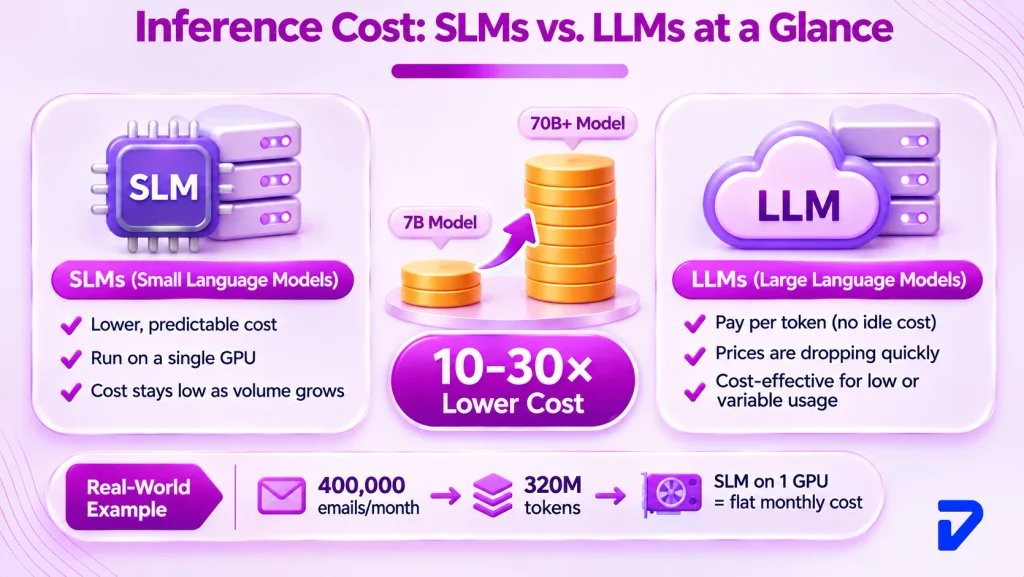
On inference cost, SLMs win once traffic is steady and predictable. NVIDIA researchers estimate that serving a 7B model costs 10 to 30 times less than running a 70B to 175B model. Their estimate includes latency, energy, and compute. That gap compounds in the SLM vs LLM math, because inference (answering each request) recurs daily, while training is a one-time bill.
SLMs on Inference Cost
A self-hosted SLM turns a per-token bill into a fixed GPU bill. Microsoft’s 3.8B Phi-4-mini, for example, fits comfortably on a single data center GPU, so one server can absorb thousands of daily requests. One command brings it online:
vllm serve microsoft/Phi-4-mini-instruct --max-model-len 16384 --gpu-memory-utilization 0.85After that, each extra request costs little beyond power until the GPU saturates, which is why steady volume favors small models.
LLMs on Inference Cost
Pay-per-token pricing keeps one real advantage for LLMs, since you pay nothing when nobody is asking. Their prices also keep falling fast. Stanford’s AI Index found that GPT-3.5-level performance dropped from $20 to $0.07 per million tokens between late 2022 and late 2024. For a team handling a few hundred requests a day, a frontier API often costs less than renting, patching, and monitoring an idle GPU.
Where the Cost Gap Actually Shows Up
Picture a distributor classifying 400,000 inbound emails a month at roughly 800 tokens each, which adds up to 320 million tokens through a premium API every month, billed on input and output. A fine-tuned SLM on one dedicated GPU handles the same load for a flat monthly cost. Volume like this is typical of high-volume workflow automation, which is exactly where per-token pricing starts to hurt.
Which Model Responds Fast Enough for Real Users?
Speed is the clearest SLM vs LLM gap, especially when the model sits on the same device as the user. Microsoft reports that its on-device Phi Silica model returns a first token in about 230 milliseconds for short prompts. It then streams up to 20 tokens per second on a laptop NPU, a chip built specifically for AI math. Because no request crosses the internet, response time stays steady even when the network does not.
SLMs on Latency
Voice is where latency stops being a metric and becomes the product itself. Callers notice even brief pauses on a phone line. For that reason, voice and chat assistants built on small models can answer, confirm, and route without an awkward gap. For instance, a 3B intent model hosted beside the phone system can classify a request before a cloud LLM finishes its round trip.
LLMs on Latency
Per token, an LLM is slower, yet streaming hides much of that wait in chat and drafting work, since users start reading at once. Most LLM APIs let the interface print words as they arrive:
{ "model": "your-frontier-model", "stream": true, "max_tokens": 600 }Meanwhile, batch jobs such as overnight contract summaries or weekly report drafts barely care about speed. In those workflows, the larger model’s extra seconds cost nothing the business will notice.
Is a Bigger Model Always More Accurate?
Accuracy is a genuine toss-up, and task scope decides it. In a study of 310 fine-tuned models across 31 tasks, 4-bit LoRA fine-tuned models beat GPT-4 by 10 points on average. However, GPT-4 still won 6 of those 31 tasks, mostly broad domains like Python coding and general knowledge. That split is the heart of the SLM vs LLM accuracy question: narrow work rewards tuning, while open-ended work rewards scale.
SLMs on Accuracy
A tuned small model is often the more accurate choice for repetitive, structured work. Think of extracting 20 fixed fields from supplier invoices, tagging support tickets by intent, or routing insurance claims by type. Each task has a stable format and one right answer, so a model trained on a few thousand labeled examples learns it deeply. A narrow model also drifts less, because its range of possible outputs is so small.
LLMs on Accuracy
Large models still follow complex, multi-part instructions more reliably. Microsoft’s own Phi-4 technical report shows the 14B model beating GPT-4o on graduate-level science questions, 56.1 to 50.6. Yet on IFEval, a test of following precise instructions, Phi-4 scored 63.0, while GPT-4o scored 84.8. Raw reasoning power, in other words, does not guarantee a model will respect every constraint in a long business prompt.
Which Tasks Need a Large Model?
Reserve a large model for work where the input is unpredictable or the answer requires real synthesis. Typical examples include multi-step reasoning across policies, questions that span dozens of documents, nuanced customer replies, and ambiguous requests that break your usual categories. Even then, grounding the model with retrieval-augmented generation, which fetches the right documents before it answers, often matters as much as adding parameters.
Can Small Language Models Be Fine-Tuned on Your Data?
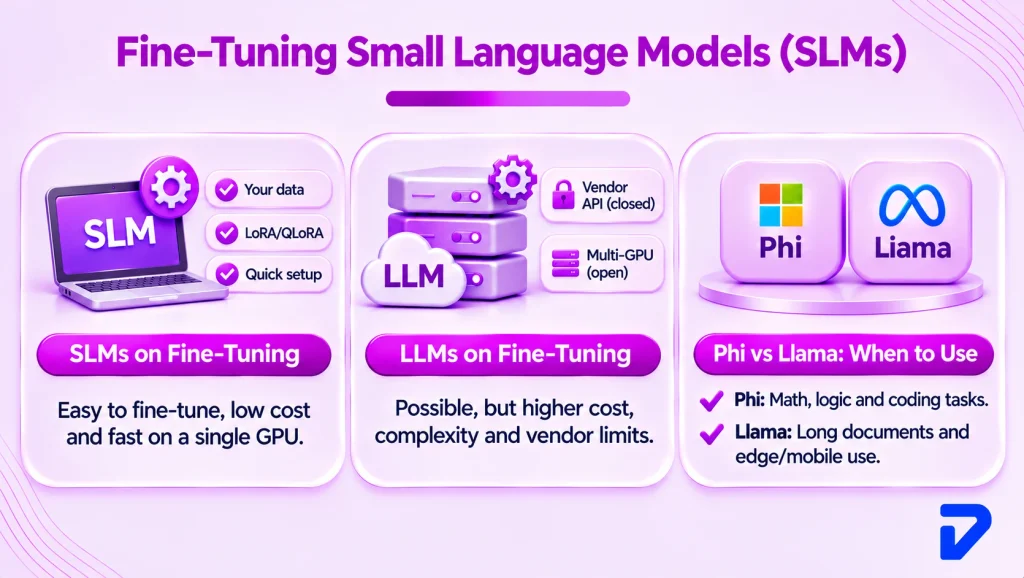
Fine-tuning favors small models, since LoRA (low-rank adaptation, which trains a thin layer of new weights) keeps their training cheap and fast. For scale, researchers showed that QLoRA can fine-tune a 65B model on a single 48GB GPU, down from more than 780GB of GPU memory. A 3B to 8B model needs only a fraction of that hardware. Still undecided? Compare fine-tuning versus RAG before collecting any training data.
SLMs on Fine-Tuning
Small language models can be fine-tuned, and the setup is surprisingly short. A typical adapter configuration with Hugging Face’s PEFT library looks like this:
from peft import LoraConfig
config = LoraConfig(r=16, lora_alpha=32, lora_dropout=0.05,
                    target_modules=["q_proj", "v_proj"], task_type="CAUSAL_LM")
Because only the adapter trains, a 3B model can learn your ticket labels or invoice schema overnight on one workstation GPU. Better still, each adapter is small enough to version like code and swap per department.
LLMs on Fine-Tuning
Fine-tuning a frontier LLM is possible, although the terms differ sharply. Closed models are usually tuned through the vendor’s API, so your adapted weights stay on their servers and become unusable if the contract ends. Open giants such as Llama 3.1 405B can be tuned privately, yet that requires a multi-GPU cluster and specialist engineers. For most mid-market teams, retrieval and careful prompt design deliver similar gains with far less risk.
Phi vs Llama: Which Small Model Family Should You Fine-Tune?
The Phi vs Llama choice usually comes down to task type and target device. Microsoft’s Phi-4 packs 14B parameters, leans toward math, logic, and code, and offers a 16K-token context window. Meanwhile, Meta built its Llama 3.2 1B and 3B models through pruning and distillation, with a 128K-token context and support for Qualcomm and MediaTek chips. Pick Phi for reasoning-heavy back-office tasks, and pick Llama for long documents or phones.
Not sure whether your workload belongs on a small model, a large one, or both?
Pinnasys tests both against your own data, then builds the path that fits your compliance and budget.
Data Privacy and Edge Deployment: Where Can Each Model Run?
In the SLM vs LLM privacy debate, small models win because they can run where your data already lives. The financial stakes are real, since IBM’s 2025 research puts the average US data breach at $10.22 million. Organizations with heavy “shadow AI” use, meaning unsanctioned tools, paid about $670,000 more per breach. A model on your own servers keeps prompts, records, and outputs inside your perimeter, which simplifies HIPAA, GDPR, and SOC 2 reviews.
SLMs on Data Privacy
On-device AI removes the transfer step entirely. A field technician’s tablet can summarize a service visit, or a clinic laptop can draft intake notes, without a single sentence leaving the device. Edge deployment also keeps working when the connection drops, which matters on factory floors, in warehouses, and across remote job sites. For regulated teams, that design turns a long vendor-risk review into a much shorter internal one.
LLMs on Data Privacy
Privacy is possible with an LLM too, but it gets expensive at that model size. The vLLM project recommends running Llama 3.1 405B in FP8 on a full eight-GPU node of A100S or H100S. Cloud providers also offer private endpoints and zero-retention agreements, which suit many teams well. Even so, your data then travels to someone else’s infrastructure, so the contract, rather than the architecture, carries the privacy promise.
Can SLMs Run On Premise or at the Edge?
Yes, and a first test takes only minutes. A tool like Ollama pulls an open model onto a local server or laptop, after which it runs without internet access:
ollama pull llama3.2:3b
ollama run llama3.2:3b "Summarize this service ticket in two lines."
From there, teams usually wrap the model in an internal API, add logging, and connect it to systems such as an ERP or helpdesk. Hardware needs stay modest, since a 3B model at 4-bit precision fits in a few gigabytes of memory.
Which Model Handles More Kinds of Work?
Breadth goes clearly to large models. Meta’s Llama 4 Scout advertises a 10 million token context window, enough to load whole contract libraries or codebases in one prompt. Meta also notes that processing 1.4 million tokens requires eight H100 GPUs. For agentic workflows that plan, call tools, and recover from surprises, that general knowledge is hard to replace in an SLM vs LLM trade.
SLMs on Breadth
A small model is a specialist by design. One tuned for invoice extraction will not suddenly draft a sales email or explain a contract clause with any real skill. As a result, teams end up running a small fleet, with one model for routing, one for extraction, and another for summaries. That works well once tasks are known, but every new job means another dataset, another tuning run, and another model to monitor.
LLMs on Breadth
A single large model can absorb dozens of unrelated jobs from day one with nothing more than a prompt. Even NVIDIA’s pro-SLM paper concedes the point in its MetaGPT case study, where about 60% of model calls could shift to small models. The remaining 40% still leaned on a generalist for open-ended reasoning and conversation. Consequently, most production agent designs keep at least one LLM in the loop.
In-House Skills and Time to Value: What Will Your Team Need to Own?
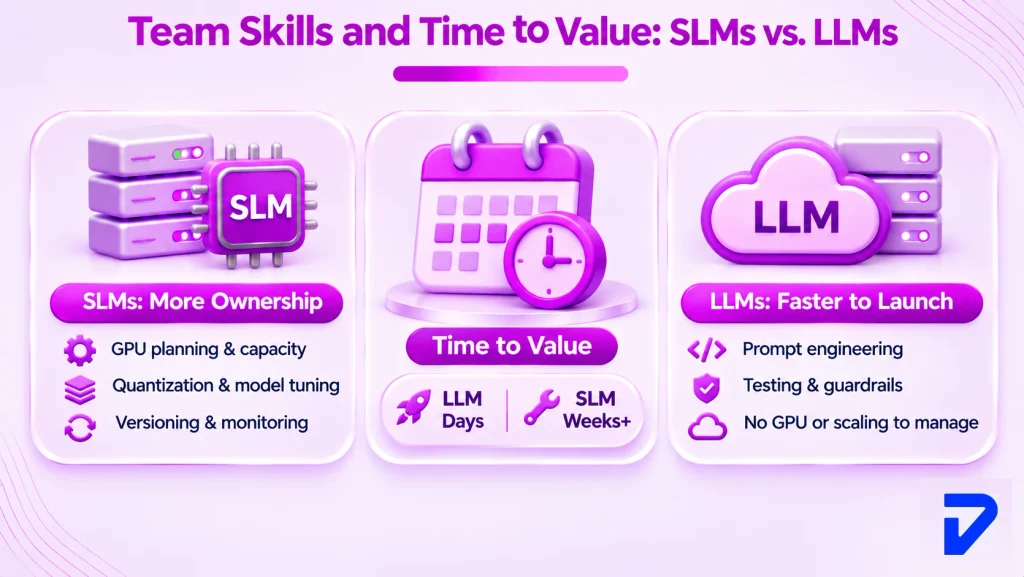
Time to value usually favors large models, because an API key and a well-written prompt can ship a working feature in days. Self-hosting an SLM, by contrast, is closer to a build project. MIT’s NANDA research found that AI tools bought from or built with specialized partners succeed about 67% of the time. Internal builds succeed roughly one-third as often, which makes ownership the hidden cost in the SLM vs LLM equation.
SLMs on Skills and Operations
With your own small model, your team inherits everything the API vendor used to handle. That list covers GPU capacity planning, quantization (shrinking weights so they fit smaller hardware), evaluation datasets, adapter versioning, and drift monitoring. None of it is exotic, yet each piece needs a named owner. Teams without an MLOps engineer often find the model works in testing and then stalls in production.
LLMs on Skills and Operations
An API-based LLM shifts the skill requirement from infrastructure toward prompt engineering and careful evaluation. Your team still needs test sets and guardrails, yet nobody has to manage GPUs, drivers, or scaling. A first integration can be this small:
reply = client.chat.completions.create(
    model="your-frontier-model",
    messages=[{"role": "user", "content": ticket_text}])
The tradeoff is dependence on a vendor’s pricing, model updates, and uptime, all of which can change without your input.
Which Fits You: SLM, LLM, or Both?
When is a small language model better, then? To settle the SLM vs LLM choice, start with five honest questions. How narrow and repetitive is the task? How many requests will it handle each month, and will that number grow? Must the data stay on your servers or devices for legal reasons? Who will run, monitor, and retrain the model after launch? Finally, does the feature need to ship this month or this quarter?
Choose an SLM if:
- Your task is narrow and repeatable, such as extraction, classification, or routing
- You process tens of thousands of requests a month at a steady rate
- Customer, patient, or financial data must stay on-premises or on device
- Users expect near-instant replies, as in voice agents or in-app assistants
- You have, or can borrow, MLOps skills to own the model
Choose an LLM if:
- Inputs are unpredictable, and answers require multi-step reasoning or synthesis
- One assistant must cover many unrelated tasks from day one
- Volume is low or spiky, so paying per token beats paying for idle GPUs
- You need to ship in weeks without hiring infrastructure talent
- Your prompts depend on very long documents or strict multi-part instructions
A genuine hybrid also exists: a lightweight router sends routine requests to an SLM and escalates only the hard cases to an LLM.
The Bottom Line
The SLM vs LLM decision is really a question of scope. Narrow, repetitive, high-volume, or sensitive work runs cheaper, faster, and more privately on a tuned small model. Open-ended reasoning, long documents, and quick experiments still favor a large model, and many production systems end up using both behind a simple router.
That is where Pinnasys fits, helping teams test both options on their own data, choose honestly, and ship the version that survives production. Whichever path you choose, plan the integration, monitoring, and governance work from day one, because that work keeps a model useful after launch. Start with one workflow, measure hours saved and errors reduced, and let those numbers pick the model.
Key Takeaways from the Article
- Small models cost 10 to 30 times less to serve at steady volume.
- Large models still lead on open-ended reasoning and strict instruction following.
- A fine-tuned small model often beats a frontier model on narrow, structured tasks.
- On-device and on-premises deployment keeps sensitive data inside your own perimeter.
- MLOps ownership is the hidden cost of self-hosting, so budget for people too.
Frequently Asked Questions on SLM vs LLM
What is an SLM in simple terms?
An SLM is a compact language model built for specific tasks rather than general conversation. NVIDIA researchers treat most models under 10 billion parameters as SLMs, small enough to run on one GPU, a laptop, or a phone.
What are the most common SLM use cases?
Common SLM use cases include ticket routing, document classification, invoice extraction, short summaries, and on-device assistants. Microsoft already ships Phi Silica inside Windows on Copilot+ PCs, where it powers local rewrite and summarize features without cloud calls.
How much hardware does a small language model need?
Less than most teams expect, because model size shrinks further with quantization. Microsoft’s Phi-3 report shows a 4-bit Phi-3-mini using about 1.8GB of memory while generating over 12 tokens per second on an iPhone.
Can an SLM and an LLM work together in one system?
They can, and routing is how efficient language models and large ones share work. In LMSYS’s RouteLLM tests, a trained router kept 95% of GPT-4’s quality on MT Bench while sending only 26% of queries to GPT-4.
Is a small language model vs. large language model choice permanent?
No, teams can migrate gradually as clear patterns emerge in production. NVIDIA’s researchers outline six steps: log model calls, clean the data, cluster recurring tasks, pick candidate SLMs, fine-tune them, and keep refining.