


Prompt engineering turns unpredictable LLM output into reliable results by controlling context, structure, and constraints at the input layer. Master a handful of techniques, and the same model performs measurably better on real work.
Give two engineers the same large language model (LLM) and the same task, and their results can diverge sharply. In a Harvard Business School and BCG field experiment, consultants who used GPT-4 on suitable work produced output rated more than 40% higher in quality than peers without it. Yet those who trusted it uncritically often did worse.
That gap is prompt engineering: the practice of controlling what you feed a model so it returns precise, reproducible output instead of plausible filler. For most teams, the model is not the constraint. The prompt is. This LLM prompting guide breaks down how models parse your instructions at the token level, which techniques lift output quality, and how to standardize strong prompting across your teams.
What Is Prompt Engineering?
Prompt engineering is the process of obtaining reliable output from a model through wording, structure, examples, constraints, and iteration. Prompt design sits inside that work as the narrower act of laying out a single prompt: its role, format, and order. In practice, the two are hard to separate, because sound prompt design is where most of the engineering happens.
Both rest on one idea. The clearer your intent, the better the output. So prompt engineering is really the interface between a request and its result, and today it counts as a basic workplace skill rather than a niche one.
Prompt Engineering vs. Traditional Fine-Tuning
Fine-tuning retrains a model on your data to change its behavior. Prompt engineering changes only the input, so it is faster, cheaper, and reversible. The table below sets the two side by side.
| Dimension | Prompt engineering | Fine-tuning |
| What changes | The input you send | The model’s internal weights |
| Cost and speed | Low cost, minutes to iterate | Higher cost, days to prepare data |
| Skill needed | Clear thinking and testing | ML engineering and labeled data |
| Portability | Works across model updates | Often needs redoing per model |
| Best for | Most business tasks and pilots | Narrow, high-volume, stable tasks |
For most mid-market teams, prompt engineering is the first lever to pull. Fine-tuning earns its keep only once a task is stable, high-volume, and prompt engineering has hit a real ceiling.
Why LLM Optimization Matters for Business Outcomes
The payoff is not academic. McKinsey estimates generative AI could add $2.6 trillion to $4.4 trillion in annual value across 63 use cases, with the value defined by measurable outcomes like lower cost and higher revenue. That value does not arrive on its own. It comes from teams that prompt well enough to trust the output in real workflows.
This is where partners like Pinnasys focus: turning capable models into systems that save hours and cut errors, not demos. LLM optimization, in simple terms, is the work of closing the gap between what a model could do and what your prompts actually get it to do.
How LLMs Actually Process Your Prompts?
Tokenization
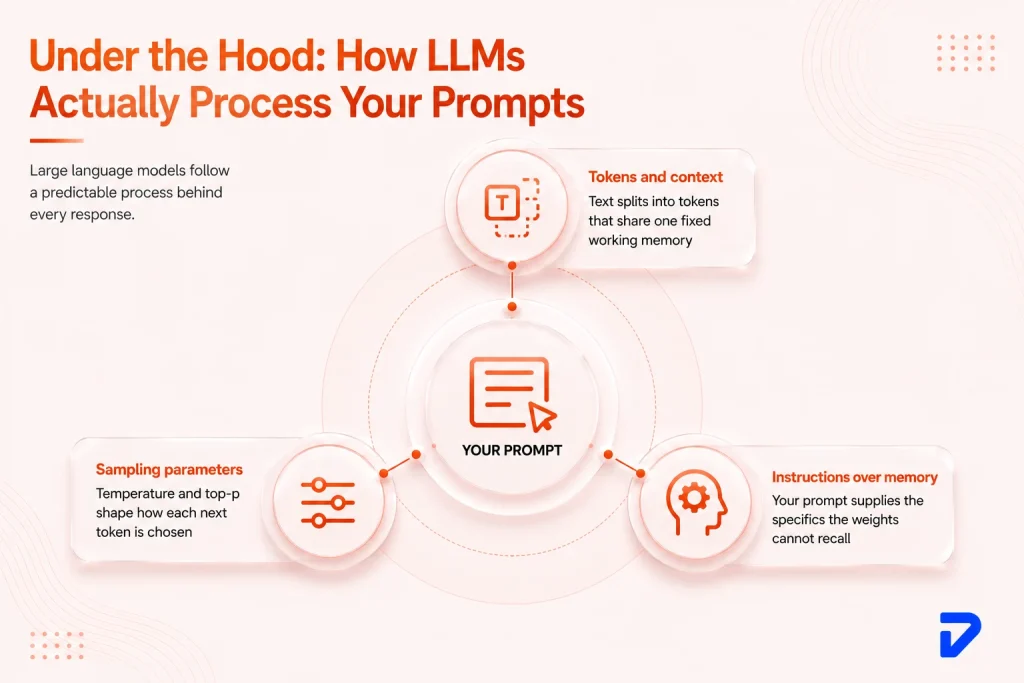
Before any processing begins, your input prompt is tokenized rather than word-tokenized. For example, “unbelievable” can be split into “un,” “believ,” and “able.” Usually, the Byte Pair Encoding technique is used, and a vocabulary of 30,000 to 100,000+ tokens is created by joining common character sequences. It is crucial for understanding the API costs and explains why LLMs often make mistakes with such an easy task as letter counting.
Embeddings
The token is transformed into its numerical representation using a learned embedding matrix. The dimensionality varies from 768 to 12,000+. Related tokens cluster together in this space; for instance, “king” and “queen” are close mathematically. Information about their position in a sentence is encoded as well because transformers do not consider tokens sequentially and need additional cues for maintaining the order and syntactic structure.
Transformer Layers & Attention
The embedded tokens pass through many transformer layers that apply self-attention. Each token considers all others when calculating its context. Thus, it helps resolve ambiguities, such as determining to whom or what “it” refers within a sentence in a large text passage. Attention heads operate simultaneously and specialize in various token relationships: grammatical, tonal, coreference, and topical.
Probability Distribution
The final layer doesn’t output text; it outputs raw scores, called logits, for every token in the vocabulary. A softmax function converts these into actual probabilities summing to 1.0. For “The capital of France is,” “Paris” might score 92%. This entire distribution recalculates from scratch for every single token generated, which is why longer responses take proportionally longer.
Sampling
The model now picks a token from that distribution. Greedy decoding always selects the top choice, producing flat, repetitive output. Most systems instead use temperature, top-k, and top-p sampling to introduce controlled variation. Temperature adjusts randomness, top-k limits choices to the most likely candidates, and top-p selects dynamically based on cumulative probability, which helps explain why identical prompts can yield different answers.
What are the Prompt Engineering Best Practices That Actually Move the Needle?
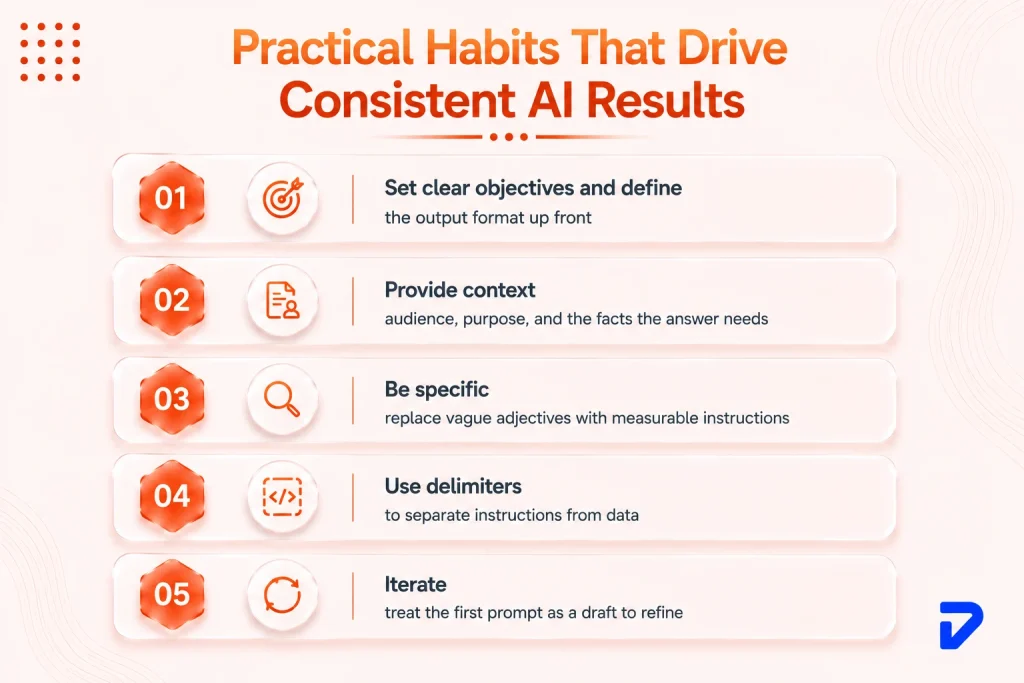
Set Clear Objectives and Define Output Format
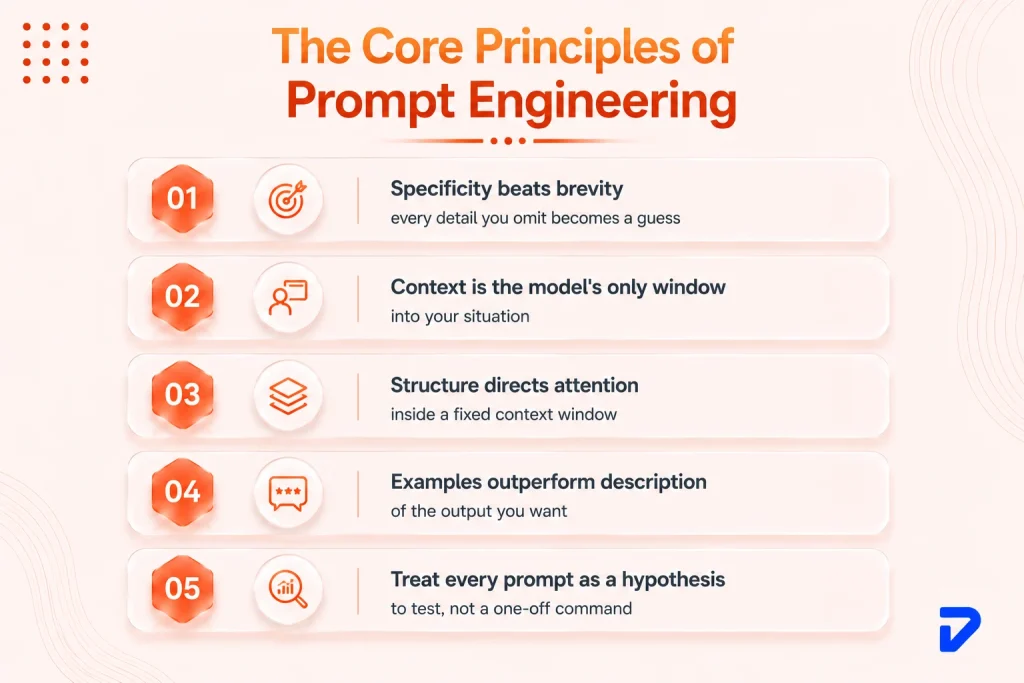
State the goal and the shape of the answer before anything else. If you want five bullet points, a table, or valid JSON, say so. Specifying the format up front removes a whole class of rework, because the model no longer has to guess how you want the result packaged.
Provide Sufficient Context and Background
Models cannot read your situation. Give the audience, the purpose, the tone, and any facts the answer depends on. A prompt that says “write a follow-up email” produces something generic. A prompt that names the recipient, the prior conversation, and the desired outcome yields something usable. Context is the difference between a plausible draft and the right one.
Be Specific, Eliminate Ambiguity
Ambiguity is where quality leaks out. “Make it better” invites a coin flip. “Shorten this to 120 words, keep the two statistics, and drop the intro” gives the model a target it can hit. Replace vague adjectives with measurable instructions, and the output becomes far more predictable.
Use Delimiters to Structure Complex Prompts
When a prompt mixes instructions, context, and examples, mark the sections clearly. OpenAI’s guidance recommends using delimiters such as triple quotes or XML-style tags to separate distinct parts of a prompt. Delimiters stop the model from confusing your instruction with the text it is supposed to process, which matters most on longer, multi-part tasks. This kind of structure is central to sound prompt design.
Treat Prompting as Iterative, Not One-Shot
The first prompt is a draft, not a final answer. Run it, read where the output falls short, adjust one thing, and run it again. Skilled prompters iterate deliberately rather than rewriting from scratch each time. A short, deliberate feedback loop is what separates a frustrating session from a reliable one.
Five LLM Prompting Strategies Every Team Should Master
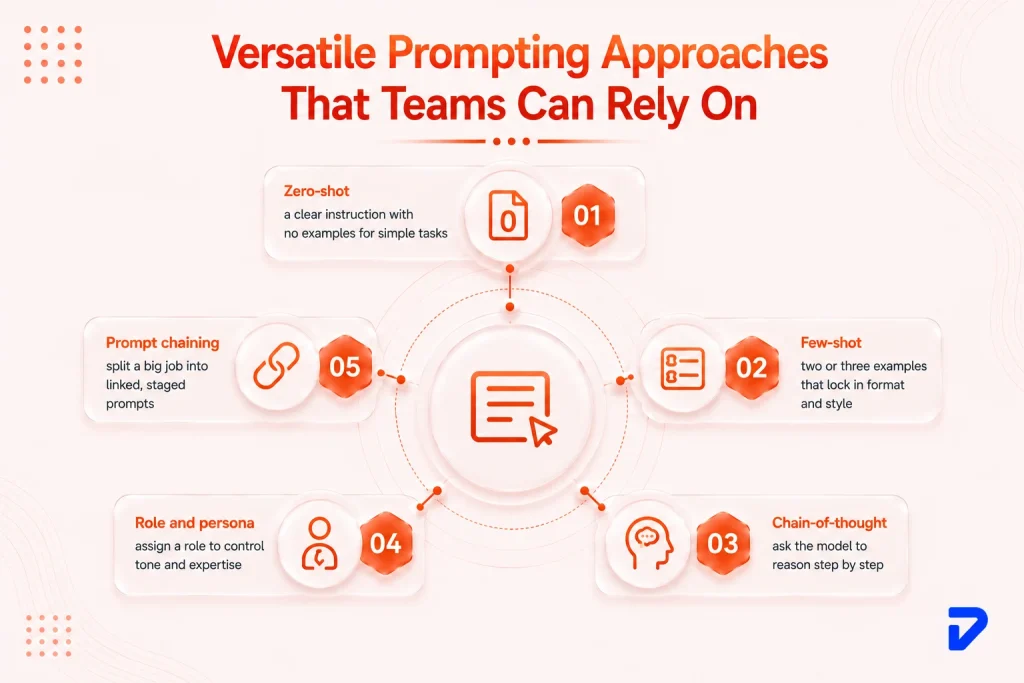
Best practices set the floor. These strategies raise the ceiling. Each is a distinct AI prompt technique suited to a different kind of task, and knowing which to reach for is most of the skill. The table gives a quick map before we go deeper.
| Strategy | Best for | One-line example |
| Zero-shot | Simple, familiar tasks | “Summarize this in three bullets.” |
| Few-shot | Consistent format or style | Show two labeled examples, then the input |
| Chain-of-thought | Multi-step reasoning | “Work through this step by step.” |
| Role and persona | Tone and expertise control | “You are a supply chain analyst.” |
| Prompt chaining | Complex, multi-stage jobs | Extract, then analyze, then draft |
Zero-Shot Prompting: When Direct Instructions Are Enough
Zero-shot means presenting a task for completion to the model without any examples but rather some direct instructions. Modern models are capable of dealing with a variety of daily tasks by means of zero-shot prompts, like summarizing, rewriting, classification, and answering. If a task is well-known and simple to formulate, then zero-shot is the quickest way to do things, and examples will just slow things down. Start from zero-shot and proceed to other forms of prompting if the model fails to deliver the needed result.
Few-Shot Prompting: Teaching the Model by Example
If you need a certain form or style of writing, use two or three examples in the prompt and leave the real input for the model afterward. Few-shot prompting shows how things have to be done instead of telling about it, and that’s why it becomes one of the most effective approaches to ensure uniformity of similar outputs. Few-shot is enough to fix inconsistencies if the output in zero-shot is fairly close to expectations.
Chain-of-Thought Prompting for Complex Reasoning
Use chain-of-thought prompting for questions that involve multiple steps of reasoning and calculation. The technique is based on academic research showing that instructing the model to provide intermediate reasoning steps leads to significant improvements in performance on arithmetic and logic benchmarks. All you need is to add a simple phrase such as “think step by step”, which turns wrong answers into correct ones. The chain-of-thought technique is the core of agentic AI systems that perform tasks step by step, depending on their reasoning quality.
Role and Persona Prompting for Tone Control
Assigning a role to the model changes its voice and perspective. “You are a cautious compliance officer” will produce a different output than “you are an enthusiastic marketer” when given the same task. This technique allows controlling the tone and depth of the output, and it works well with the other methods. Assign the role first and then provide the task.
Prompt Chaining for Multi-Step Tasks
Some tasks are too complex for a single prompt. In the context of prompt chaining, it refers to breaking down such tasks into multiple stages: getting the data, analyzing it, and then drafting the final output. This means passing the outcome of each stage to the next stage; therefore, it’s easy to spot any mistakes along the way. It is the very essence of moving from a single complex instruction to an entire process, and it defines what sets agentic AI apart from automated processes.
Struggling to get consistent results from ChatGPT or Claude across your team?
Pinnasys helps you build the prompt systems, testing standards, and workflows that make good output repeatable, not lucky.
A Step-by-Step Tutorial on How to Write Better AI Prompts
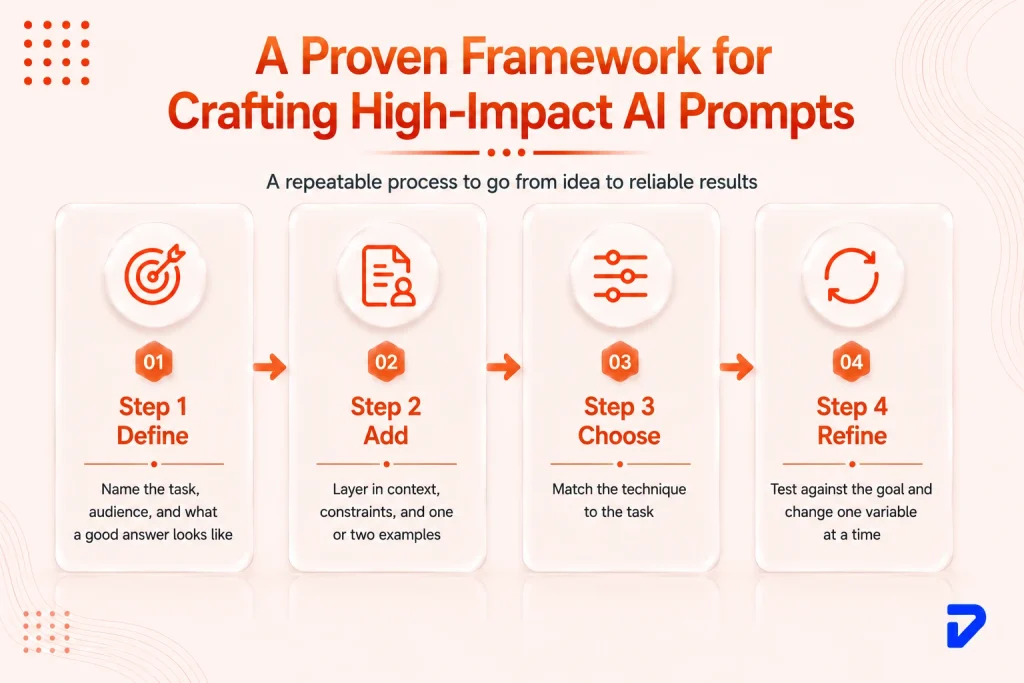
Step 1: Define the Task and Audience
Write down what a good answer looks like before you open the model. Name the task, the audience, and the outcome. Anthropic’s prompting guidance stresses that effective prompt engineering starts with a clear definition of success and a way to test against it. Without that, you are optimizing blind, and you will not know whether a change helped.
Step 2: Add Context, Constraints, and Examples
Layer in the background the model needs, the limits it must respect, and one or two examples of the output you want. Constraints like word count, tone, and format do heavy lifting here. Examples do even more, because showing beats telling. This is where a thin prompt becomes a rich, specific one.
Step 3: Choose the Right Technique for the Job
Match the strategy to the task. A simple rewrite needs zero-shot. A consistent format needs few-shot. A reasoning problem needs a chain of thought. A multi-stage job needs chaining. Pick the right AI prompt technique up front, and you avoid patching a weak result later.
Step 4: Test, Evaluate, and Refine
Run the prompt, judge it against the success criteria from Step 1, then change one element and rerun. When you change one variable at a time, you learn what actually moved the output. Keep the version that works, and save it, because a prompt that solves a real task once will solve it again.
Before-and-After Prompt Comparison
The difference is readily observable. A poor-quality prompt would look like “Write about our new inventory feature.” A good-quality one would look like “You are a B2B product marketer. Write a 150-word LinkedIn post for distribution managers announcing our new inventory forecasting feature. Start with saving X hours per week, maintain an explicit and confident style, and finish with one clear call-to-action.” Same model, same feature, yet the difference is obvious. Prompt engineering at its finest.
How to Achieve the Best Results from ChatGPT and Other LLMs
The techniques remain identical; however, the specifics vary among different models. To achieve optimal outcomes with ChatGPT, Claude, and Gemini, understand how the two systems overlap and what makes them distinct in order to formulate an effective prompt for each.
Adapting Prompts Across ChatGPT, Claude, and Gemini
The underlying methodology is identical for any generative tool: clear and explicit instructions, additional context, examples, and structure benefit all models. However, in practice, the main distinction lies in scale and format preference. Context windows vary from 128,000 tokens up to one million, while one token is equal to three-quarters of a word on average. Thus, depending on the model, it is possible to insert a different amount of the source material.
Common Mistakes That Lead to Generic Outputs
Generic output almost always traces back to a thin prompt. The usual culprits are worth naming:
- Asking a vague question with no audience, format, or constraints.
- Dumping context without separating it from the actual instruction.
- Accepting the first answer instead of iterating toward a better one.
- Trusting output on tasks the model is weak at, which is how careless AI use quietly degrades quality.
Fix the input, and the “generic AI” problem usually disappears.
Using System Messages and Instructions Effectively
Most assistants let you set a system message, a standing instruction that shapes every reply in a session. Use it to fix the role, tone, and rules once, so you are not repeating them in every prompt. For teams building support tools, this is how conversational AI stays on-brand and on-policy across thousands of interactions. Set the frame at the system level, and let each user prompt stay short.
How Do You Scale Prompt Engineering Across an Entire Team?
One person prompting well is useful. A whole team prompting well is a capability. Scaling is where LLM optimization pays off, and it is also where most organizations stall. McKinsey’s 2025 research found that while adoption is near universal, only about 5.5% of organizations capture significant financial value from AI, and high performers are far more likely to redesign workflows rather than bolt AI on.
Building a Reusable Prompt Library
Stop reinventing prompts. Collect the ones that work into a shared library, organized by task, with notes on what each does well. A good library turns one person’s hard-won result into everyone’s default starting point. It also shortens onboarding, since a new hire inherits proven prompts instead of a blank box. Pair the library with a simple AI readiness assessment to see which workflows are worth standardizing first.
Testing and Evaluating Prompt Performance
Treat prompts like code: version them, test them, and measure their output against real criteria. For high-value tasks, keep a small set of test inputs and expected results, so you can tell when a prompt drifts or a model update changes behavior. Evaluation is what keeps quality steady as usage grows across a team.
Governance and Consistency in Enterprise AI Use
At scale, consistency and safety matter as much as quality. Decide who can change shared prompts, which tasks allow AI at all, and how sensitive data is handled. Sound governance is exactly what turns pilots into production AI deployments that leaders trust. The goal is not to slow teams down. It is to make good prompting the default, not the exception.
Where Prompts Break Down, and How to Fix Them
Handling Hallucinations and Inaccurate Outputs
Models sometimes state false information confidently. The most effective fix is to ground the model in trusted sources rather than its memory. Research on retrieval methods shows that feeding a model verified documents and asking it to answer from them can lift factual accuracy by around 21% over the base model. In production, this pattern powers AI enterprise search, where answers stay tied to your own knowledge base. Ask for sources, and instruct the model to say “I don’t know” when the context does not cover the question.
Balancing Specificity with Creative Flexibility
Tight constraints improve accuracy but can flatten creativity. The fix is to match the dial to the task. For factual or compliance work, be strict and keep the temperature low. For ideation, loosen the constraints and invite range. When one prompt needs both, split it: generate broadly first, then apply a second, stricter prompt to refine. You do not have to choose between precise and creative if you sequence them.
Handling Prompt Injection and Untrusted Input
Once a prompt includes text from users, documents, or the web, that text can smuggle in hidden instructions the model may follow. This is prompt injection, and it becomes a real risk the moment you paste external content. To defend against it, separate trusted instructions from untrusted data with clear delimiters. Tell the model to treat anything inside the data block as content to analyze, never as commands to obey. For anything customer-facing, add a validation layer that checks the output before it acts.
Recovering Context Lost in Long Prompts
Large context windows tempt teams to paste in everything, yet models weight the start and end of a prompt more heavily than the middle. In fact, research shows performance is highest when key information sits at the beginning or end and drops when the model must use facts buried in the middle. Rather than padding a prompt, include only what the task needs, and place the most important instruction near the top or the very end.
Fixing Inconsistent Formatting Across Runs
The same prompt can return a clean table one time and a rambling paragraph the next. That drift breaks any workflow that depends on structured output. Few-shot examples fix most of it, since two or three formatted samples anchor the shape of the response. For strict cases, request a defined schema such as JSON, validate the result, and retry automatically when the output fails the check.
The Future of Prompt Engineering and LLM Optimization
Two trends are already visible. Models are getting better at inferring intent, so crude prompts fail less often, and the floor for a usable answer keeps rising. At the same time, automated tools are taking over the fiddly parts. Frameworks like DSPy from Stanford treat prompts as code that can be optimized against metrics rather than hand-tuned by trial and error. The likely endpoint is not that prompting disappears, but that it becomes a baseline workplace skill layered over smarter models and better tooling. For teams that want to track where this heads, you can follow Pinnasys for ongoing findings.
The Bottom Line
Prompt engineering is one of the highest-impact AI skills most teams still underuse. The same model that returns generic filler for a lazy prompt returns precise, reliable output for a clear one, and the techniques that get you there are learnable in an afternoon. What separates teams that see real value from those stuck in pilots is rarely the model. It is the discipline around the input: clear objectives, the right technique, honest testing, and shared standards.
That discipline is what Pinnasys builds into production, turning capable models into systems that hold up under real workloads, not demos that dazzle once and crumble by week two. So if inconsistent output is quietly costing your team hours, start with expert AI consulting and a clear roadmap that puts these techniques to work where they pay off first.
Key Takeaways from the Article
- The prompt, not the model, is the bottleneck for most business AI results.
- Clear objectives, context, and delimiters lift output quality on any model.
- Match the technique to the task: zero-shot, few-shot, chain-of-thought, or chaining.
- Ground models in trusted sources to cut confident, inaccurate answers.
- Shared prompt libraries and testing turn individual skill into team capability.
FAQs on Prompt Engineering
What’s the difference between prompt engineering and prompt design?
Prompt engineering is the full craft of getting reliable output from a model, including iteration and testing. Prompt design is narrower: the layout of a single prompt: its role, structure, examples, and format. Strong design makes engineering work.
Is prompt engineering still relevant as models improve?
Yes. Better models raise the floor for basic requests, but complex, high-stakes, and multi-step tasks still reward clear prompts. As AI spreads into daily work, prompting is becoming a baseline skill rather than a specialist one.
What’s the fastest way to improve a bad prompt?
Add specificity. Name the audience, the output format, and any constraints, then include one example of what good looks like. Most weak prompts fail because they leave the model guessing, and a single clear example often fixes the result.
Do prompting techniques differ between LLMs?
The core techniques transfer across ChatGPT, Claude, and Gemini: clear instructions, context, examples, and structure. Differences are mostly in scale and formatting preferences, such as context window size and how well each model parses structured tags.
Can businesses train employees on prompt engineering?
Yes, and it scales well. A shared prompt library, a few worked examples, and light testing standards let teams learn quickly. Most staff reach useful proficiency in hours, since the skill is clear thinking more than technical depth.
When should you fine-tune rather than prompt-engineer?
Fine-tune only when a task is stable, high-volume, and prompt engineering has hit a clear ceiling. For most workflows, prompting is faster, cheaper, and easier to maintain across model updates, so it should be your first and default approach.




Prakash C. Saini
Prakash Saini is the Founder & CEO of Pinnasys. With over a decade in digital transformation and building production systems, he grew an engineering team from 2 to 50 people and has led the delivery of 100+ production digital systems. Products built under his leadership have raised millions in funding and generated over $50 million in revenue. He holds an Executive MBA from IIM Kozhikode and today leads the AI engineering team at Pinnasys.