


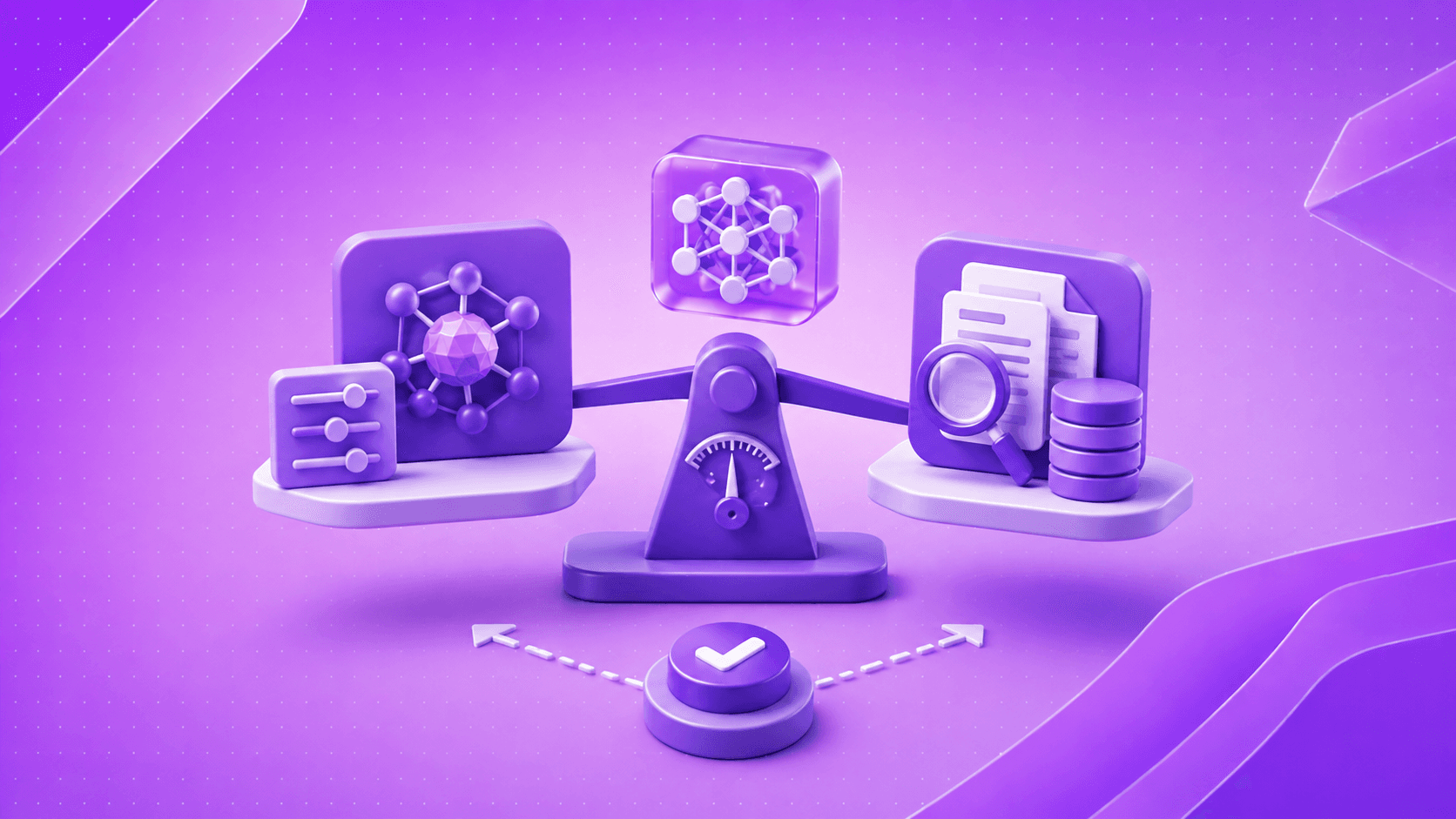
AI fine-tuning vs RAG is a data-architecture decision, not a model choice. Fine-tuning teaches behavior, format, and tone. RAG supplies current knowledge from outside the weights. Most production systems eventually need both.
Enterprise data settles the debate faster than theory does. Across a survey of 600 US IT decision-makers, RAG reached 51% adoption while only 9% of production models were fine-tuned. That gap tells you something useful about AI fine-tuning vs RAG, though it does not tell you what to build. Mid-market teams keep framing this as a contest between two model training strategies, then spend a quarter arguing before anything ships.
The real question is narrower. Does your problem come from the model not knowing your facts, or from the model not behaving the way your business needs? Answer that honestly, and the choice between these two LLM adaptation techniques usually makes itself, often before you write a line of custom AI development code.
What Is AI Fine-Tuning? A Core Model Training Strategy
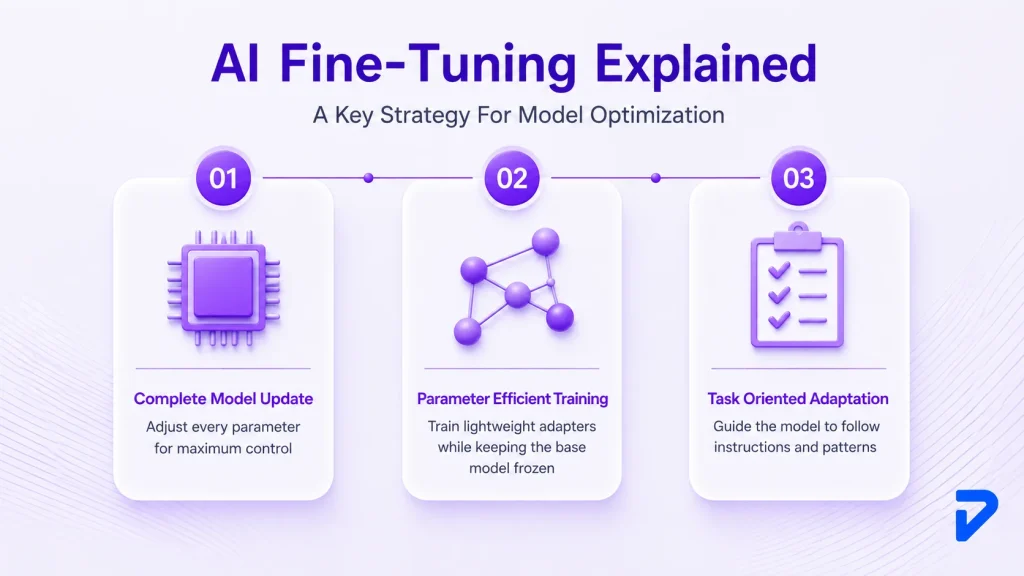
AI fine-tuning is the practice of continuing to train a pretrained model on your own examples, so the new behaviour is stored permanently inside the model weights. The weights are the millions of numbers the model learned during pretraining, and fine-tuning nudges them toward your task. When it comes to model customization, this is the deepest and least reversible option available. You are not giving the model better instructions. You are changing what it is.
How Fine-Tuning Adapts a Pretrained Model to Your Data
The mechanics are simpler than the reputation suggests. You assemble a labelled dataset of input and output pairs, show the model each pair, and let gradient descent adjust the weights so its answers move closer to yours. Repeat that across a few thousand well-chosen examples, and the model absorbs your patterns as instinct rather than instruction. In practice, the result is a model that produces your house style without being asked. The tradeoff is that new facts arrive only when you retrain, and the training data itself becomes a governed asset.
Common Fine-Tuning Techniques (full fine-tuning, LoRA/PEFT, instruction tuning)
Three approaches dominate, and they differ mostly in cost. Full fine-tuning updates every weight, which delivers maximum control at maximum expense. LoRA and the wider PEFT family freeze the base model and train small adapter matrices instead. The original research showed LoRA cutting trainable parameters by 10,000 times with no added inference latency. Instruction tuning teaches a model to follow directions rather than facts, and it punches far above its weight: OpenAI found a 1.3B InstructGPT model preferred over the 175B GPT-3. For most mid-market budgets, LoRA is the sensible default.
What Is RAG? Understanding This LLM Adaptation Technique
RAG, short for retrieval-augmented generation, keeps your knowledge in a searchable store and fetches the relevant passages at question time. The model never memorizes the content. It reads it, cites it, and answers. Microsoft researchers comparing knowledge injection methods found that RAG consistently outperformed unsupervised fine-tuning on both familiar and entirely new information. That result is the practical heart of the fine-tuning vs RAG comparison.
How Retrieval and Generation Work Together
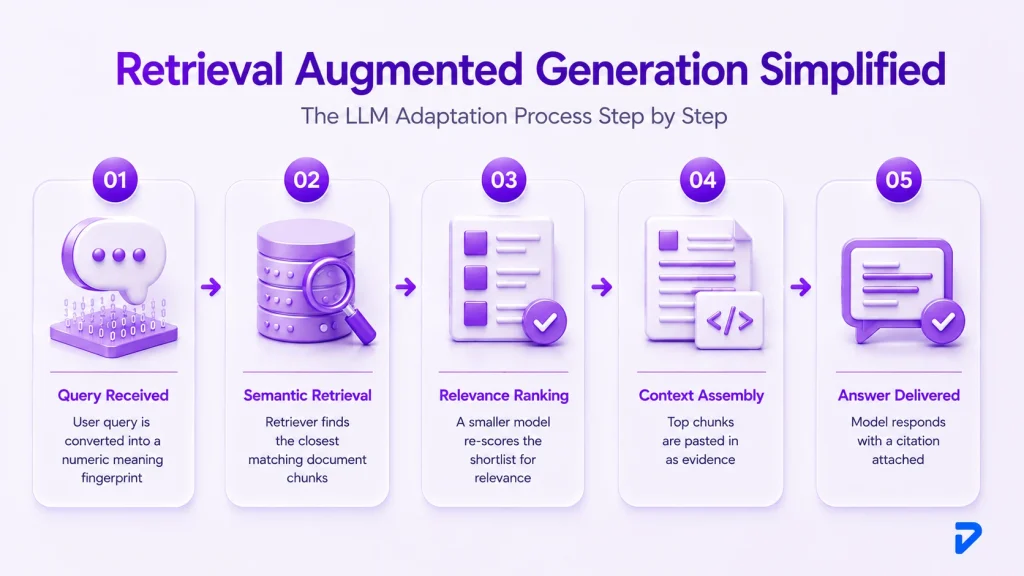
A RAG pipeline runs in two beats. First, a retriever converts the question into a vector, a numeric fingerprint of its meaning, then searches a vector database for the closest matching document chunks. Second, those chunks are pasted into the prompt and the model answers using them as evidence. Good systems add a reranker, which is a smaller model that re-scores the shortlist before the answer is written. This is the same architecture behind serious AI knowledge and enterprise search deployments.
Why RAG Keeps Knowledge Outside the Model Weights
The split between knowledge and behavior buys you three things a fine-tuned model cannot offer. A price-list change becomes a document upload rather than a training run. Every answer carries a citation, so a human can check the source in seconds. Access rules survive, because the retriever can filter by permission before the model sees anything. More importantly, when the next base model arrives, your corpus moves across untouched. Knowledge stored in weights does not migrate. Knowledge stored in a corpus does.
RAG vs Fine-Tuning Comparison: The Core Differences
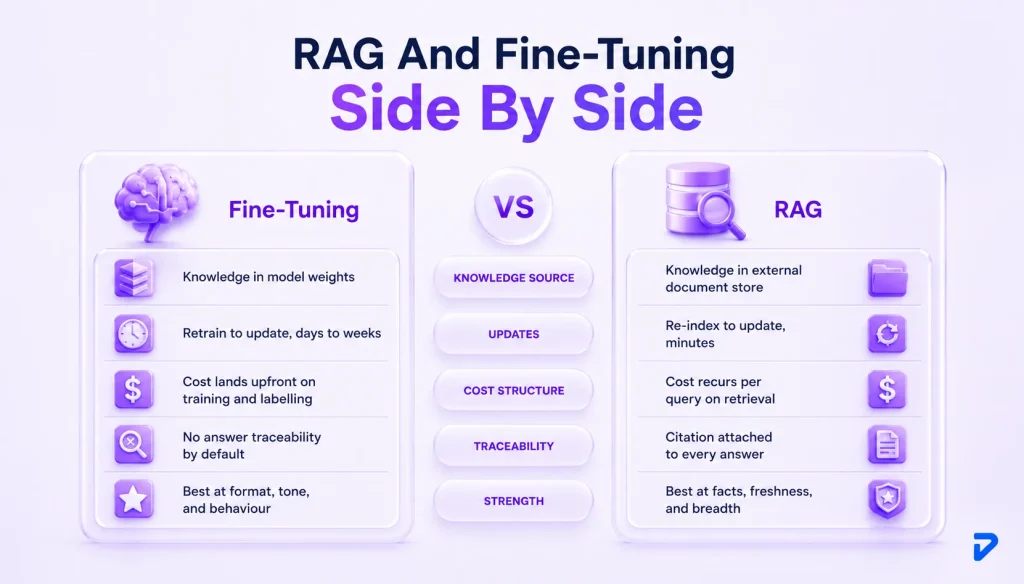
Both methods produce custom AI models, yet they fail in opposite ways. A fine-tuned model is fluent and confidently wrong about last week. A RAG system is current and occasionally clumsy about tone. The table below sets out where each approach genuinely wins, and the sections beneath it explain why the differences matter to an operating budget rather than a benchmark.
| Dimension | Fine-tuning | RAG |
| Knowledge lives in | Model weights | External document store |
| Update cycle | Retrain, days to weeks | Re-index, minutes |
| Main cost | Upfront training and data labeling | Recurring retrieval and longer prompts |
| Answer traceability | None by default | Citation per answer |
| Data control | Baked in permanently | Filtered per user at query time |
| Best at | Format, tone, task behavior | Facts, freshness, breadth |
| Weakest at | New or changing facts | Consistent voice and structure |
Knowledge Source and Data Freshness
This is the difference that decides most projects. A fine-tuned model knows only what it saw during training, so the day you ship it, its knowledge starts aging quietly. RAG reads from a live store, which means a contract amended this morning is answerable this afternoon. The adoption numbers reflect that reality plainly, with RAG at 51% of production architectures against 9% for fine-tuning. Freshness is not a nice-to-have for most operators. It is the whole job.
Cost Structure: Upfront Training vs Recurring Retrieval Costs
The two methods put money in different places, which matters more than the totals. Fine-tuning front-loads spend into data labeling, compute, and evaluation, then runs cheaply because prompts stay short. RAG inverts that: setup is modest, but every query pays for embedding, retrieval, and a prompt stuffed with retrieved context. As a result, RAG feels cheap at pilot scale and grows expensive at volume, while fine-tuning feels expensive early and cheap later. Model your query volume before choosing, not after.
Latency, Accuracy, and Ongoing Maintenance
Retrieval adds a network hop and a reranking pass, so RAG answers typically arrive slower than a fine-tuned model’s. Accuracy is the more interesting split. McKinsey found that more than half of organizations hit at least one negative AI consequence, with inaccuracy the most common at 30%. RAG attacks that directly ground claims in retrievable evidence. Maintenance diverges too: fine-tuning needs retraining discipline, while RAG needs corpus hygiene, chunking reviews, and drift monitoring on retrieval quality.
When to Fine-Tune an AI Model
Stable, Well-Defined Domains
Fine-tuning suits knowledge that does not move. Classification taxonomies, extraction schemas, and domain vocabulary all sit still for years, which makes them safe to bake into weights. A model that must recognize 400 industrial part categories is a good candidate, since the categories change annually at most. Compare that with a pricing engine, where a single retrain would be stale on arrival. The test is simple: if the underlying truth changes monthly, fine-tuning is the wrong tool for it.
Strict Output Formatting, Tone, or Brand Voice
Format compliance is where fine-tuning is genuinely hard to beat. Prompts can request valid JSON, a fixed clause order, or a regulated disclosure format, and models will still drift under load. A fine-tuned model treats the shape as default behavior rather than a rule to remember. The same logic applies to brand voice across thousands of outputs, where prompt-only approaches wobble. When your compliance team reviews the wording, consistency is not cosmetic. It is the deliverable.
Low-Latency, High-Volume Applications
Volume changes the maths. RAG spends tokens on retrieved context with every single call, and at millions of calls, that overhead compounds fast. A fine-tuned smaller model answers from short prompts, which cuts both latency and unit cost. The economics are moving in your favor here, since Stanford’s AI Index recorded inference costs for GPT-3.5-level performance falling more than 280-fold in roughly 18 months. Cheap inference makes small fine-tuned models viable where large ones never were.
When RAG Is the Better AI Personalization Method
Frequently Changing or Large Knowledge Bases
Volatility is RAG’s home turf. Price lists, policy documents, product catalogs, and service manuals all change weekly, and each change would otherwise demand a retraining you cannot afford. A vector index absorbs the update in minutes, and the next query reflects it. Scale helps too, because a corpus of 200,000 documents is trivial to index and impossible to fine-tune cleanly. For anyone weighing RAG or fine-tuning for my use case, update frequency is usually the deciding variable.
Limited Labeled Training Data
Fine-tuning has a hidden entry fee: several thousand high-quality labeled examples that somebody has to write and review. Most mid-market teams do not have them and cannot build them quickly. RAG has no such requirement, since it reads existing documents as they are. Menlo’s latest enterprise survey found prompt design still dominant with RAG next, while fine-tuning stays niche among frontier teams. That ranking tracks labeling effort almost exactly. Data readiness, not ambition, sets the ceiling.
Compliance, Governance, and Data Residency Needs
Regulated work makes the choice for you. Once data enters model weights, you cannot show a regulator which document produced an answer, and you cannot honor a deletion request without retraining. RAG keeps the corpus separate, auditable, and revocable. The EU AI Act’s Article 10 data governance duties for high-risk systems apply to training, validation, and testing sets, so every fine-tune expands your documentation burden. Retrieval also keeps records inside their required jurisdiction, which fine-tuning quietly does not.
Which side of this framework does your workflow actually fall on?
Pinnasys’s AI integration and governance team can map your specific failures to the right approach in one scoping session.
RAG or Fine-Tuning for My Use Case? A Practical Decision Framework
Start with the failure, not the technique. Write down what your current system gets wrong, then classify each error as a knowledge gap or a behavior gap. Knowledge gaps point to RAG. Behavior gaps point to fine-tuning. That single sorting exercise resolves most arguments in an afternoon, and it is the first step any credible AI consulting and roadmap engagement should run before anyone touches a GPU.
Key Questions to Ask Before You Choose
Five questions do most of the work, and the honest answers usually converge. How often does the underlying information change? Do you have thousands of labeled examples, or none? Must every answer cite a source for audit? What is your realistic monthly query volume? Can anyone on your team debug a retrieval pipeline at 2 am? Answer those, and the decision stops being philosophical. Should I fine-tune or use RAG becomes an arithmetic problem with a defensible answer.
Query Volume, Update Frequency, and Team Capability: Quick Comparison
Three variables carry most of the signal, so the grid below maps them to a recommendation. Read it as a starting position rather than a verdict, since edge cases exist in every business. Even so, the pattern holds across the deployments we see: low volume with fast-changing data means RAG, high volume with static data means fine-tuning, and anything in between usually ends up hybrid. Team capability then decides whether you build it or partner on it.
| Your situation | Recommended approach | Why |
| Data changes weekly, volume under 100k queries a month | RAG | Re-indexing beats retraining on speed and cost |
| Data static for a year, volume in the millions | Fine-tuning | Short prompts cut unit cost and latency |
| Strict output format, facts change often | Hybrid | Fine-tune the shape, retrieve the content |
| No labeled data, no ML engineers | RAG | No training set and no training loop required |
| Audit trail required per answer | RAG | Citations come free with retrieval |
| Brand voice across high volume, stable topics | Fine-tuning | Voice becomes default rather than instruction |
The Hybrid Approach: Combining Fine-Tuning and RAG for Custom AI Models
The two techniques are not rivals, and the research is unusually detailed on this. A Microsoft study on an agricultural dataset found fine-tuning adding over 6 percentage points of accuracy, with RAG adding roughly 5 more on top. The gains stacked rather than competed. That is the practical case for treating this as a sequencing question instead of an either-or.
Fine-Tune for Format, RAG for Knowledge
This one line resolves more architecture debates than any framework. Fine-tuning owns the parts of the answer that should never vary: structure, tone, refusal behavior, and the schema your downstream systems parse. RAG owns the parts that must always be up to date: prices, policies, specifications, and case history. Split the responsibilities that way, and each technique does what it is good at. Blur them, and you get a model that hallucinates confidently in perfect JSON, which helps nobody.
Where Hybrid Models Outperform Either Approach Alone
Hybrids earn their complexity in narrow, high-stakes workflows. Claims adjudication needs a fixed decision format and live policy text. Technical quoting needs consistent output structure and a catalog that changes daily. In the same agricultural study, a fine-tuned model pulled knowledge across geographies well enough to lift answer similarity from 47% to 72%. That said, hybrids cost more to run and monitor, so start with a single technique and add the second only when a measured gap demands it.
Model Customization in Practice: Industry Use Cases
Theory settles once you look at real workloads. The pattern across industries is consistent: knowledge changes faster than behavior does, so retrieval carries the load and fine-tuning handles the edges. Below are three sectors where the split plays out differently, and where the same reasoning applies to how agentic AI compares to traditional AI in production settings.
Customer Support and Conversational AI
Support is the clearest hybrid case in the market. Product knowledge changes weekly, so it belongs in retrieval, while escalation rules and tone belong in the weights. Retrieval quality is the lever that matters most: Anthropic reported contextual retrieval cutting failed retrievals by 49%, and by 67% with reranking added. Those numbers decide whether customers trust the bot. Teams building serious conversational AI and support automation should tune retrieval before touching the model.
Regulated Industries (Finance, Healthcare, Legal)
Regulated sectors default to RAG for reasons that have nothing to do with accuracy. Auditors want provenance, and a citation satisfies them in a way a confident sentence never will. Deletion requests, jurisdictional storage rules, and clause-level traceability all favor keeping knowledge outside the weights. Fine-tuning still appears here, though usually for narrow extraction or classification tasks with fixed schemas. Our AI work across financial services follows that same division of labor, and the deployment case studies show it holding up.
Real Estate and Other Dynamic-Data Industries
Dynamic-data sectors barely need a decision framework. Listings, availability, valuations, and lease terms change hourly, which rules fine-tuning out on freshness alone. A model trained on last quarter’s inventory is worse than useless, since it is wrong in a fluent, convincing voice. Retrieval over a live index is the only architecture that keeps pace. Logistics, distribution, and field services sit in the same bucket, where the catalog moves faster than any training cycle could follow.
How Pinnasys Approaches AI Model Customization
Pinnasys starts with the workflow, not the technique. We audit where your current process breaks, classify the failures as knowledge or behavior, then recommend the lightest approach that fixes them. Often that is retrieval alone, and we will say so rather than sell a training project you do not need.
From there, the work is engineering rather than experimentation. Agentic AI systems need retrieval that holds up under real query loads, guardrails that survive edge cases, and drift monitoring that catches quality decay before your customers do. Our AI team builds those pieces to run in production, then stays to run them. We measure success in hours saved and errors reduced, not in demo quality.
The Bottom Line
AI fine-tuning vs RAG is not a technology contest, and treating it as one costs teams a quarter they cannot spare. Fine-tuning changes behavior permanently and suits stable, high-volume, format-critical work. RAG supplies fresh, auditable knowledge and suits almost everything else a mid-market operator faces. The market has largely voted for retrieval first, and the research supports that instinct.
Start with the failure you can measure, choose the lighter technique, and add the second only when the data demands it. If you want that decision made against your workflows rather than a benchmark, our AI integration and governance team can map it with you in a short scoping session.
Key Takeaways from the Article
- RAG holds 51% of production architectures, while fine-tuning sits at 9%.
- Fine-tuning owns format, tone, and behavior; RAG owns facts and freshness.
- Update frequency is the single strongest signal in this decision.
- Regulated work favors RAG because citations and deletions survive audits.
- Hybrid systems stack gains but double the monitoring burden.
Frequently Asked Questions About AI Fine-Tuning vs RAG
Should I fine-tune or use RAG for a customer-facing chatbot?
Start with RAG. Product and policy knowledge changes too fast for retraining, and citations let agents verify answers. Add fine-tuning later if tone or escalation formatting stays inconsistent after retrieval quality is solved.
Can RAG and fine-tuning be used together?
Yes, and the gains stack rather than cancel. Fine-tune the model for output structure, tone, and refusal behavior, then retrieve the facts at query time. Expect higher monitoring overhead in exchange for the accuracy.
Which is more cost-effective long-term?
It depends on query volume. RAG costs little upfront but pays per query forever. Fine-tuning costs heavily upfront, then runs cheaply. High volume plus static data eventually favors fine-tuning on unit economics.
How do I know when to fine-tune an AI model rather than rely on RAG?
Fine-tune when the model already has the facts but behaves wrongly. Persistent format drift, inconsistent tone, or unacceptable latency at scale are the signals. Outdated or absent knowledge is never a fine-tuning problem.
Does RAG require an in-house ML team?
No, though it needs engineering discipline. Chunking, embedding, reranking, and evaluation are software problems more than machine learning ones. Most teams manage with strong backend engineers plus someone owning retrieval quality metrics.




Prakash C. Saini
Prakash Saini is the Founder & CEO of Pinnasys. With over a decade in digital transformation and building production systems, he grew an engineering team from 2 to 50 people and has led the delivery of 100+ production digital systems. Products built under his leadership have raised millions in funding and generated over $50 million in revenue. He holds an Executive MBA from IIM Kozhikode and today leads the AI engineering team at Pinnasys.