


AI model selection comes down to one trade-off: open source LLMs win on cost and control, proprietary AI models win on support and speed to deploy. The right pick depends on your team’s technical depth, not which option sounds more impressive.
Grand View Research valued the global AI market at $390.9 billion by 2025, growing at a 46.2% CAGR from 2019. That growth has pulled mid-market operators into an AI model selection decision they cannot avoid: build on open source LLMs or buy access to proprietary AI models. Neither choice is automatically right. Open source models cost less upfront but demand engineering time. Proprietary models cost more but ship with support and guardrails.
This guide works through the LLM comparison the same way a team that builds and runs production AI systems does, so the decision fits your workflow, not a trend.
What Is the Difference Between Open Source and Proprietary AI Models?
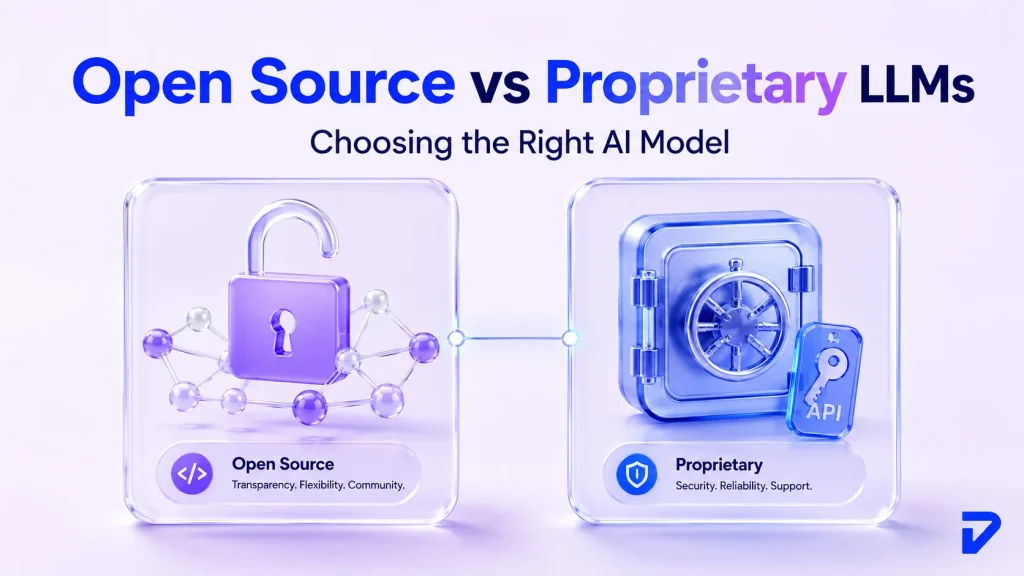
An open source AI model publishes its code, weights, or both, so any team can inspect, modify, and run it. A proprietary AI model stays locked behind a vendor’s API, with usage controlled by license terms and pricing tiers. That single difference shapes the entire AI model selection process, influencing who controls the data, who pays for compute, and who is responsible when the model underperforms or breaks in production.
Open source AI development moved fast because the building blocks are free to extend. Python remains the backbone of that ecosystem. The PYPL index puts Python’s market share at 29.8%, nearly double Java’s 15.35%, largely on the strength of its AI and data science libraries. That tooling advantage is one reason open source AI development outpaces what a single vendor’s roadmap can deliver alone.
Proprietary models, by contrast, bundle the model with infrastructure, monitoring, and a support contract. You are not just buying intelligence. You are buying a system someone else operates and patches.
This is not a binary split in practice. Some vendors release “open weight” models with usage restrictions attached, sitting somewhere between the two categories. Read the license before assuming a free download means unrestricted commercial use. Several widely used models cap revenue thresholds or restrict certain applications, which can quietly turn a “free” model into a compliance problem later.
Who Controls the Model Matters More Than Who Built It
Control determines your risk. With an open source model, you control updates, hosting, and data residency, but you also own every bug. With a proprietary model, the vendor controls the roadmap. A pricing change or a deprecated endpoint can disrupt your workflow without warning.
Why Are Businesses Choosing Open Source AI Models?
Cost is the obvious driver, but it is not the only one. Market research from market.us found that more than half of organizations now use open source components for AI development and deployment. That is not a niche preference anymore. It reflects a structural shift toward models teams can audit, retrain, and own.
Open source AI models also remove licensing friction. There is no per-seat fee, no usage cap negotiated by a procurement team, and no vendor lock-in if a better model ships next quarter. For a mid-market distributor or insurer running thin margins, that flexibility matters as much as the sticker price.
Collaboration compounds the advantage. When thousands of contributors patch bugs and publish fine-tuned variants, a model improves faster than any single vendor’s internal team could manage alone. That is why open source AI development tends to win on innovation speed, even when proprietary models win on polish.
The Real Cost Is Engineering Time, Not Licensing
Open source is not free. Someone has to fine-tune the model, host the inference servers, and monitor for drift. Teams without that capacity often underestimate the hours required, then stall mid-project. This is where naive in-house attempts fail and a partner with production experience earns its fee.
Open Source Fits Teams That Already Run Infrastructure
Companies already running cloud infrastructure for other workloads adapt faster to open source AI. The hosting, monitoring, and security patterns are familiar, even if the model itself is new. Teams starting from zero infrastructure usually find a proprietary API faster to stand up, even if it costs more per query over time.
When Does a Proprietary AI Model Make More Sense?
Proprietary AI models often justify their cost in AI model selection when businesses need vendor accountability, lack in-house ML expertise, or require reliable performance from day one.
| Aspect | Open Source AI Model | Proprietary AI Model |
| Upfront cost | Low to none for the model itself | Licensing and usage fees, sometimes in the millions |
| Customization | Full access to weights and code | Limited to vendor-exposed settings |
| Support | Community forums, optional paid support | Vendor SLA and dedicated support |
| Time to deploy | Slower, requires in-house tuning | Faster, ready through an API |
| Best fit | Teams with AI engineering capacity | Teams that need a working system fast |
Specialized, industry-tuned solutions are where proprietary models still lead. A vendor that has trained a model on years of industry-specific data can outperform a general open source model on niche tasks, at least until your team builds equivalent training data. Licensing fees buy that head start.
How Do Open Source and Proprietary Costs Really Compare?
The open source AI model market itself shows where the money is moving. Market.us projects the segment will grow from $13.4 billion in 2024 to $54.7 billion by 2034, a 15.1% CAGR, as more businesses shift workloads away from per-token vendor pricing. That growth is not proof open source is cheaper in every case. It is proof enough that teams find the trade-off worthwhile to fund an entire market around it.
A proprietary model’s published price covers inference, not the full picture. Factor in rate limits, data residency add-ons, and the cost of switching providers later. An open source model’s “free” license hides its own bill: GPU hosting, fine-tuning labor, and ongoing monitoring once the model is in production.
- Compute costs scale with usage either way, but open source lets you choose cheaper hardware or spot instances.
- Proprietary support contracts reduce downtime risk but lock you into the vendor’s release schedule.
- Open source models avoid recurring per-seat licensing, which matters most at high query volume.
- Proprietary models reduce the hiring burden, since the vendor staffs the ML expertise you would otherwise need.
In practice, the lowest total cost depends on query volume and in-house skill, not on the model’s price tag alone.
Hidden Costs Show Up After Launch, Not Before
AI model selection should account for what happens long after launch, not just during evaluation. A proprietary vendor can raise prices, change rate limits, or deprecate endpoints with little warning, forcing an unplanned migration. Open source carries a different risk: if the engineer who built the fine-tuning pipeline leaves, the team may struggle to maintain it. The real cost of AI model selection often appears later, so both scenarios need to be budgeted for before the first invoice or the first resignation.
Which Industries Are Driving AI Model Adoption?
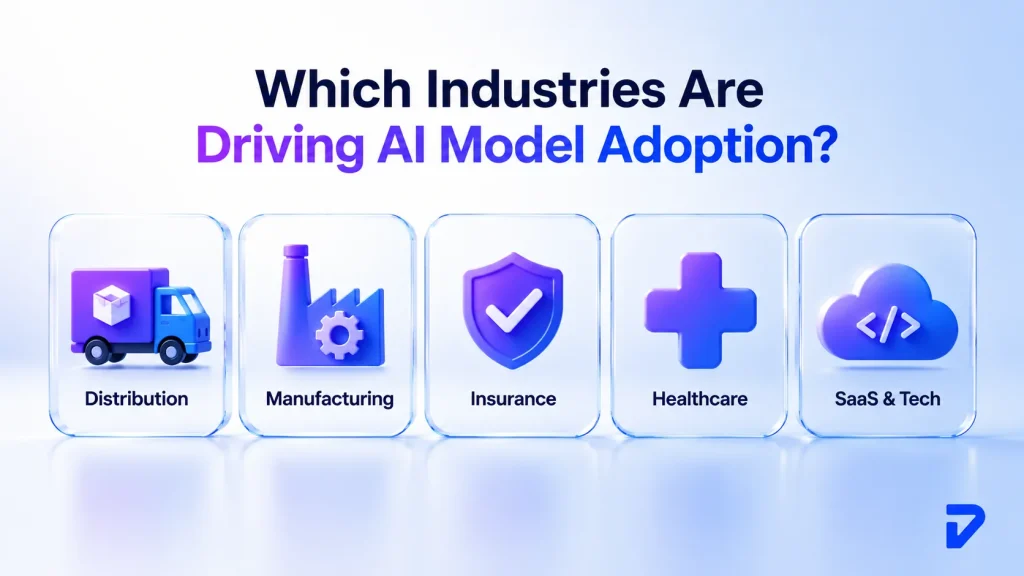
AI model adoption varies by industry, driven by compliance, customization, technical expertise, and business priorities.
1. Distribution and Supply Chain
Distribution and supply chain organizations often adopt open-source AI models to customize product search, inventory management, and logistics while keeping sensitive pricing and supplier data within their own infrastructure.
2. Manufacturing and Field Services
Manufacturers and field-service providers frequently rely on proprietary AI for predictive maintenance and equipment monitoring, benefiting from pretrained models, vendor support, and faster deployment.
3. Insurance
Insurance companies commonly use a hybrid approach, deploying proprietary models for customer service and claims interactions while using open-source models for internal document processing and workflow automation.
4. Healthcare and Other Regulated Industries
Healthcare organizations and other regulated sectors often favor proprietary AI because vendors provide compliance documentation, security certifications, audit trails, and governance features that simplify regulatory requirements.
5. SaaS and Technology Companies
SaaS and technology businesses are among the fastest adopters of open source AI. Their engineering teams can fine-tune models on proprietary data, maintain full control over deployments, and reduce long-term licensing costs as usage grows.
How Should a Mid-Market Operator Choose Between Open Source and Proprietary AI?
Start with the workflow you need to improve, not the model you want to deploy. Poor AI model selection usually happens when teams chase model capability before defining the business problem, and those decisions often need to be rebuilt later. Before signing a contract or committing engineering resources, walk through these five steps.
- Define the workflow and the volume. High query volume favors open source economics. Low, sporadic volume favors a proprietary API with no infrastructure to maintain. Write down the expected monthly query count before comparing prices.
- Audit your engineering capacity. Without ML engineers, an open source deployment stalls before it reaches production. Be honest about whether your team can maintain a model, not just launch one.
- Check the compliance requirements. Regulated data often pushes the decision toward a proprietary vendor’s documented controls. Ask your compliance team what evidence they need before the model touches customer data.
- Pilot both, briefly. A two-week pilot on real data reveals more than any vendor comparison chart. Measure accuracy, latency, and cost against your own workflow, not a published benchmark.
- Production plan, not the demo. Most AI pilots die before they reach production. The model that wins the pilot is not always the one that survives real traffic at scale.
Most teams land on a hybrid: a proprietary model for customer-facing work that needs reliability on day one, and an open source model for internal tools where the team can absorb a learning curve. That split, not a single winner, is usually the production-grade answer.
What Mistakes Do Teams Make When Choosing an AI Model?
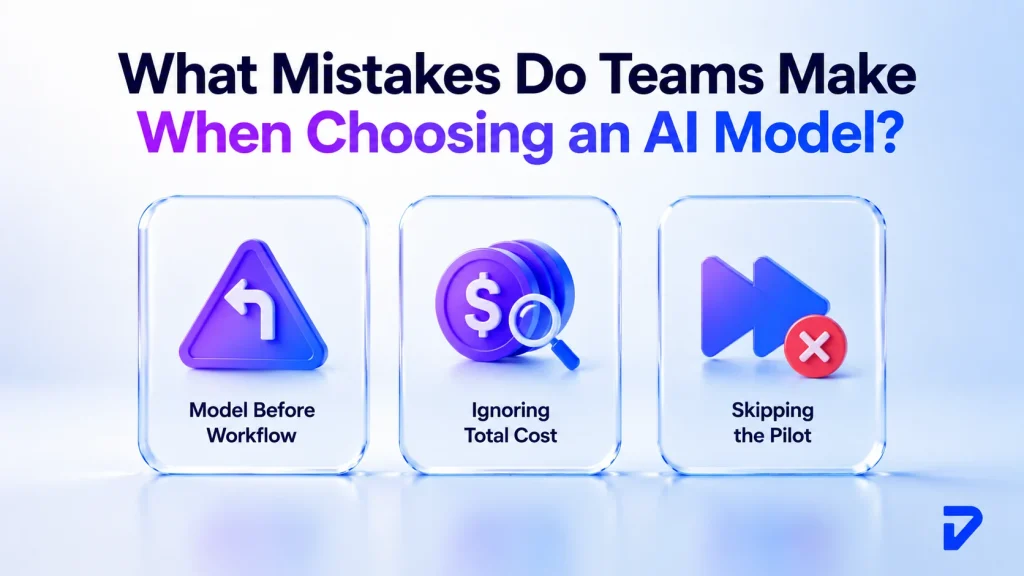
The most common mistake in AI model selection is choosing the model before defining the workflow. Teams follow whatever is trending, then spend months forcing the business problem around the tool. That order should be reversed. The workflow should define the requirements, and the requirements should point to the right model.
A second mistake is ignoring total cost of ownership. A proprietary model’s per-query price may look expensive next to a “free” open source model, until hosting, fine-tuning, infrastructure, and monitoring costs are added back in. Run both estimates against your actual query volume before deciding, not against a vendor’s sample pricing page.
A third mistake is skipping the pilot. Teams that commit to a model based on a polished demo rather than their own data often discover the gap only when real edge cases appear. A short pilot using actual business data reveals the problems a vendor’s marketing page will never show.
- Choosing the model before the workflow is defined.
- Comparing only license cost, not total operating cost.
- Skipping a real-data pilot before committing budget.
- Assuming “open weight” means unrestricted commercial use.
- Underestimating the engineering hours an open source deployment needs.
Avoiding these five mistakes saves most of the rework that shows up after a stalled AI project.
The Bottom Line
Open source and proprietary AI models solve different problems, not the same problem at different prices. The commercial vs open AI debate is really an AI model evaluation exercise: open source wins when your team has the engineering capacity to own the model long term, and proprietary wins when you need a working system now and cannot staff the maintenance.
Choosing AI models well means matching the model to the workflow, then mapping an AI roadmap before you commit budget to either path. The goal is not picking a side. It is picking the system that still runs a year from now, measured in hours saved and errors reduced, not demos.
Key Takeaways from the Article
- Open source AI reduces licensing costs. The tradeoff is that your team becomes responsible for infrastructure, maintenance, updates, and security.
- Proprietary AI supports regulated industries. Vendor-backed compliance, governance, and documentation simplify adoption in highly regulated environments.
- Open source AI adoption is accelerating. More than half of organizations now use open source components in their AI development strategies.
- Total cost goes beyond licensing fees. Query volume, infrastructure requirements, and internal expertise have a greater impact on long-term expenses.
- Hybrid AI strategies are becoming the norm. Many production systems combine proprietary and open source models based on workload, performance, and compliance needs.
Frequently Asked Questions
Is open source AI cheaper than proprietary AI in the long run?
It depends on query volume and team skill. High-volume workloads often save money on open source despite hosting costs. Low-volume or unpredictable workloads usually cost less on a proprietary API.
What is the biggest risk of using an open source AI model?
The biggest risk is underestimating engineering time. Fine-tuning, hosting, and monitoring a model in production take real staff hours that teams without ML engineers often do not budget for.
Can a small business use proprietary AI models without a technical team?
Yes. Proprietary AI models are designed for businesses without in-house AI expertise. The vendor manages infrastructure, maintenance, updates, and security, allowing small teams to integrate the API quickly and deploy AI-powered features without hiring dedicated machine learning engineers.
Do open source AI models perform as well as proprietary ones?
On general tasks, leading open source models now match many proprietary models. On narrow, industry-specific tasks, a proprietary model trained on relevant data can still outperform a general open source model.
Should every company eventually move to open source AI?
No. The decision should follow the workflow, not a trend. Companies with steady, high-volume internal use cases benefit most. Companies needing fast, reliable customer-facing tools often stay proprietary.





Prakash C. Saini
Prakash Saini is the Founder & CEO of Pinnasys. With over a decade in digital transformation and building production systems, he grew an engineering team from 2 to 50 people and has led the delivery of 100+ production digital systems. Products built under his leadership have raised millions in funding and generated over $50 million in revenue. He holds an Executive MBA from IIM Kozhikode and today leads the AI engineering team at Pinnasys.