
HIPAA-compliant AI depends on how a system is deployed, not on a vendor label. It needs a signed BAA for every PHI path, plus encryption, scoped access controls, audit logs, and ongoing vendor review.
A billing coordinator pastes a denial letter into a free chatbot to draft an appeal, and a patient’s record has just left your control. Moments like that are now routine, since 81% of physicians reported using AI in their practices in the AMA’s 2026 survey. Major model vendors now sign BAAs for specific products, yet HIPAA-compliant AI still depends on everything wrapped around the model.
Prompts, embeddings, logs, and agent actions all carry PHI, and each one needs a contract, a control, and an owner. For healthcare AI programs that want to buy or build safely, the real work starts with a single question: where does PHI actually travel?
What Makes AI HIPAA Compliant?
AI is HIPAA compliant when the organization running it applies the Privacy, Security, and Breach Notification Rules everywhere PHI appears. That scope covers the prompt, the retrieved context, the model response, and every log or cache written along the way. Put simply, HIPAA-compliant AI is a property of the deployment, so two hospitals using the same LLM can carry very different risk.
Why “HIPAA Certified” Is a Sales Claim, Not a Status
HHS runs no certification program for software, so a “HIPAA certified” badge reflects marketing rather than federal approval. SOC 2 and HITRUST reports still matter because they show auditors tested a vendor’s controls. Even so, neither replaces the risk analysis that real HIPAA-compliant AI depends on. A scribe vendor with a clean SOC 2 report can still fall outside your BAA.
HIPAA Eligible Is Not the Same as HIPAA Compliant
A HIPAA-eligible vendor will sign a BAA for named services, while compliance depends on how you configure and govern them. AWS, for instance, lists Amazon Bedrock among its HIPAA-eligible services. Yet a team that writes raw prompts to an unencrypted bucket still fails the Security Rule. Eligibility opens the door, and your controls decide what walks through it.
Where PHI Actually Travels in an AI System
PHI rarely stays in the prompt box. In a typical enterprise search setup over clinical records, it first enters a RAG pipeline, the layer that fetches records before the model answers. Next, it flows through vector embeddings, the model call, caches, and monitoring tools. Each hop needs BAA coverage or proof that no PHI reaches it, so map it early.
Where Do Healthcare AI Compliance Programs Break Down?
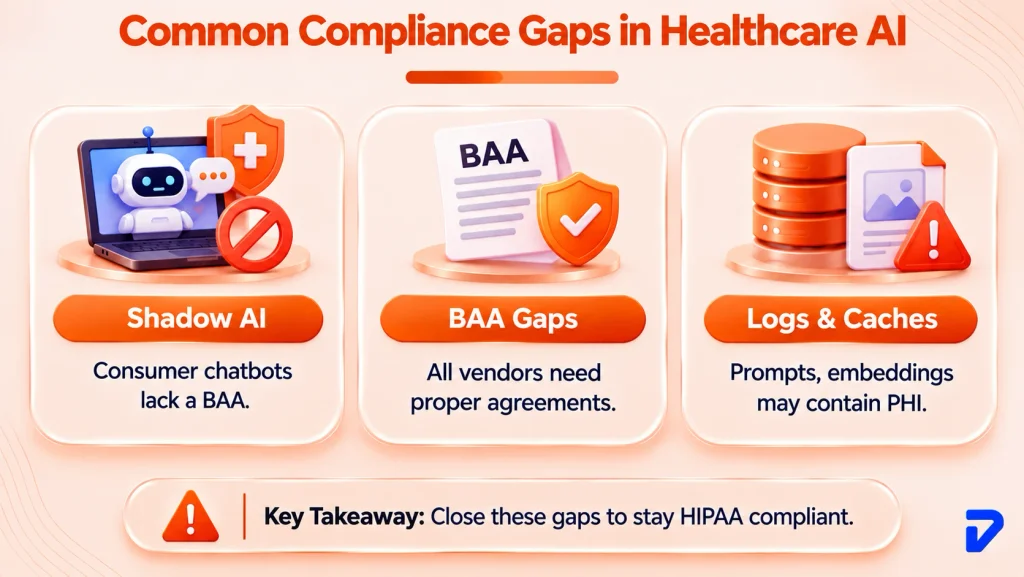
Shadow AI and Consumer Chatbots
Staff reaches for whatever tool answers fastest, and consumer chatbots rarely include a BAA. A nurse who summarizes discharge notes in a personal account has made an impermissible disclosure, even if nothing leaks. Site blocking alone seldom works, because people route around friction. Instead, give teams an approved conversational AI assistant covered by a BAA and genuinely useful.
BAA Gaps Across the Vendor Chain
One signed BAA with your model provider rarely covers the whole system. Vector databases, monitoring tools, transcription services, and integration platforms can each touch PHI. Under HHS guidance on HIPAA and cloud computing, a cloud provider storing ePHI is a business associate, even with encrypted data and no key. Every subprocessor therefore needs equal scrutiny.
Logs, Caches, and Embeddings: Nobody Mapped
Development teams often log full prompts for debugging, then forget that those files hold diagnoses and member IDs. Embeddings and conversation memory raise the same issue, since they derive from PHI and can sometimes be reversed. Treat every derived artifact as PHI by default. In practice, that means encrypting it, setting retention limits, and restricting who can query it.
Is ChatGPT HIPAA Compliant, and Do AI Vendors Need to Sign a BAA?
Consumer ChatGPT is not HIPAA compliant, and any AI vendor that creates, receives, maintains, or transmits PHI for you must sign a BAA first. The answer shifts for enterprise products, though, since each one carries its own contract terms and covered features.
OpenAI, for example, lets eligible healthcare customers apply for a BAA covering ChatGPT for Healthcare and its API. The company also states that ChatGPT for Healthcare content is not used for training, while Free and other plans remain outside that scope.
Similarly, Anthropic’s BAA covers its first-party API and Enterprise plans, although features such as the Batch API are excluded. The table below summarizes where each common option stands.
| AI Surface | BAA Path | What to Verify |
|---|---|---|
| Free or Plus chatbot plans | None available | Keep PHI out entirely |
| ChatGPT for Healthcare or Enterprise | BAA through the sales team | Workspace settings, retention, connectors |
| Model APIs from OpenAI or Anthropic | BAA on approved accounts | Covered features, retention terms |
| Cloud platforms such as Bedrock, Vertex AI, or Azure | Cloud provider BAA | Eligible services list, region |
| Self-hosted open-weight model | No model vendor BAA needed | Hosting provider BAA, egress controls |
Can You Use LLMs With Patient Data?
Yes, provided the model runs under a BAA that names the exact service and features you use. A HIPAA-compliant LLM deployment also applies the minimum necessary standard, sending only the fields a task requires. For example, a prior authorization assistant needs the diagnosis code, the procedure, and the payer policy, not the full chart or a home address.
What a Business Associate Agreement for AI Should Cover
The business associate agreement AI vendors sign should go beyond boilerplate. Look for these terms in writing:
- A ban on using your PHI to train or improve shared models
- Named eligible services, features, and data retention windows
- Breach reporting timelines and subcontractor flow-down terms
- Return or destruction of all PHI when the contract ends
Questions to Ask During AI Vendor Review
A strong vendor review tests commitments rather than demos. Ask where PHI is processed and stored, which subprocessors touch it, and whether vendor staff can ever view prompts. Request a current subprocessor list and a summary of the vendor’s own risk analysis. Finally, confirm that you can export logs and access records, because an OCR investigation will ask for both.
How Do You Protect PHI in AI Systems?
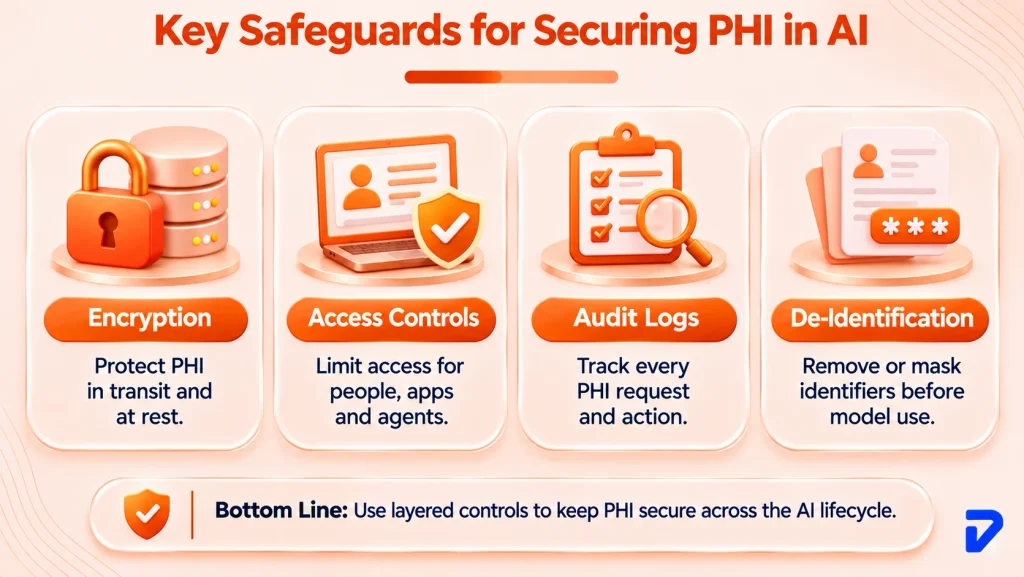
You protect PHI in AI systems by layering four safeguards around the model: encryption, access controls, audit logs, and de-identification. Most of these trace back to the technical safeguards in 45 CFR 164.312, which already require audit controls and unique user identification. AI PHI protection then extends those same rules to prompts, retrieval, and agent actions, forming the core of any HIPAA-compliant AI stack.
Encryption and Key Management
Encrypt PHI in transit with TLS 1.2 or higher and at rest with AES-256, including logs, caches, and vector stores. Encryption is still “addressable” today, but the proposed HIPAA Security Rule update would make it mandatory alongside multi-factor authentication. Manage keys through a service such as AWS KMS, rotate them on schedule, and separate key administrators from data users.
Access Controls for People, Apps, and Agents
Access controls must cover software identities, not just staff logins. Give every integration and each of your agentic AI workflows its own scoped service account, then enforce role-based permissions before retrieval rather than after. A scheduling assistant, for instance, should query open slots without ever reading clinical notes. Pair this design with MFA for people and short-lived tokens for machines.
Audit Logs That Capture Every PHI Call
Audit logs should show who asked, which model answered, what data it saw, and what happened next. Store them in write-once storage, and alert on unusual volume or off-hours access. Keep log access separate from debugging access, since the logs themselves contain PHI. A minimal trace entry for one PHI-touching request might look like this:
{
  "trace_id": "a91f-2c7d",
  "user": "rn.jdoe",
  "agent": "discharge-summary-v3",
  "model": "approved-llm-2026-10",
  "patient_ref": "tok_58321",
  "fields_sent": ["dx_codes", "meds", "follow_up"],
  "policy_result": "allowed",
  "reviewer": "md.asmith",
  "timestamp": "2026-11-12T14:05:22Z"
}
De-Identification Before the Prompt
HHS recognizes two de-identification methods: Safe Harbor, which removes 18 identifiers, and Expert Determination, which relies on a documented statistical assessment. Token-based masking of names and dates before a model call reduces exposure, though free-text notes often hide identifiers that simple pattern matching misses. Test masking against labeled samples, and keep masked text inside the BAA boundary until validation passes.
Before and After: Healthcare AI Workflows With HIPAA Controls
The gap between a risky pilot and a defensible deployment shows up in ordinary daily workflows. These tasks are already live in many organizations, since Menlo Ventures found that 27% of health systems use domain-specific AI tools. The table compares each workflow before and after proper controls, along with the metric each change moves.
| Workflow | Before (uncontrolled) | After (HIPAA controls) | Metric moved |
|---|---|---|---|
| Clinical note drafting | Notes pasted into consumer chatbots | BAA-covered workspace with SSO and retention limits | Unapproved PHI disclosures |
| Prior authorization letters | Full chart sent to the model | Minimum necessary fields plus human approval | PHI fields per request |
| Patient chatbot intake | Transcripts kept in vendor logs indefinitely | Encrypted logs, defined retention, input redaction | Retention policy adherence |
| RAG search over records | Index ignores user permissions | Permission-filtered retrieval for each patient | Unauthorized retrieval rate |
| Agent updates to the EHR | Shared service login with no trace | Scoped identity, trace ID, and read-back check | Audit trail completeness |
| New AI vendor onboarding | Security questionnaire only | BAA scope, subprocessor list, and log export test | Time to vendor approval |
Notice that the model barely changes between the two columns. Instead, the surrounding controls do the heavy lifting, which is what separates HIPAA-compliant AI from a pilot that cannot survive an audit.
Is PHI already flowing through AI tools nobody approved?
Pinnasys builds AI integrations with BAA-mapped data flows, scoped access, and audit-ready logs, so your teams use AI without guessing about compliance. Secure your AI integrations.
Which KPIs Show Your HIPAA-Compliant AI Is Working?
The right KPIs track exposure, control coverage, and response speed rather than generic ROI. That focus pays off, because IBM’s 2025 breach research put the average healthcare breach at $7.42 million, the highest of any industry. The same study found that 97% of organizations reporting AI-related breaches lacked proper AI access controls.
| KPI | What it Measures | Healthy Direction |
|---|---|---|
| BAA coverage rate | Share of PHI-touching components under a signed BAA | 100%, verified every quarter |
| Logging completeness | Share of PHI-touching AI calls with a full audit record | 100%, with alerts on gaps |
| Masking miss rate | Identifiers missed in sampled de-identified outputs | Falling, retested after model changes |
| Access review cadence | Time between permission reviews for AI service accounts | Quarterly or faster |
| Time to revoke | Hours from a role change to access removal | Same business day |
| Shadow AI incidents | PHI found in unapproved AI tools | Trending toward zero |
| Human override rate | Share of AI outputs that reviewers change or reject | Stable, with spikes triggering review |
Report these numbers next to operational wins, such as documentation hours saved, so leadership sees compliance as part of the value story. Model drift deserves a line on the same dashboard, and MLOps best practices show how to catch it before outputs degrade.
How to Build HIPAA-Compliant AI Around Healthcare’s Real Constraints
Healthcare AI has to satisfy regulators, clinicians, and security reviewers at once, so every build starts with constraints, not features. OCR keeps pressing on the basics, too, and its Risk Analysis Initiative reached its 11th enforcement action in February 2026.
Pinnasys approaches these projects as an engineering partner, designing guardrails, audit trails, and human-in-the-loop review into the architecture from day one. Those systems support your compliance program; they do not certify it, and your privacy officer keeps the final determination.
Start With a Risk Analysis OCR Would Accept
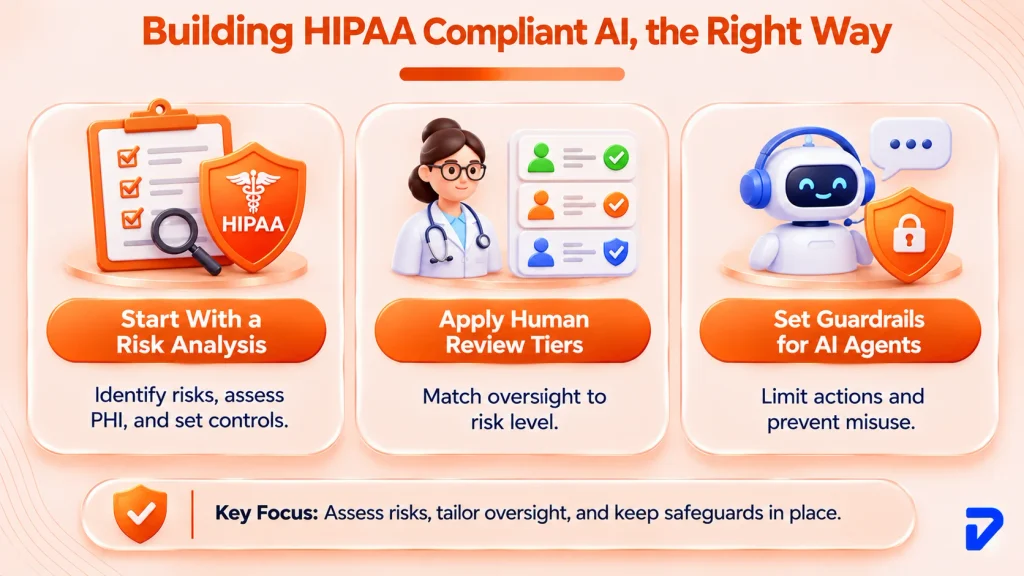
Every AI project should extend your existing Security Rule risk analysis rather than live in a separate document. Inventory each AI component, the PHI it touches, the likely threats, and the controls in place. A new ambient scribe, for example, adds audio files, transcripts, and draft notes. Fold the results into your broader AI governance framework so owners stay consistent.
Human Review Tiers for Clinical and Administrative Work
Not every AI output deserves the same oversight. Reversible administrative tasks, like appointment reminders, can run with sampled audits. Prior authorization letters warrant approval on each output, while anything touching diagnosis or dosing keeps a clinician as the decision-maker. Since May 2025, HHS’s Section 1557 rule has also expected providers to reduce discrimination risk in patient care decision support tools.
Guardrails for Agents and Patient-Facing Chatbots
Agents that call tools and any HIPAA-compliant chatbot facing patients both need limits enforced outside the model itself. Prompt injection tops the OWASP Top 10 for LLM applications, so a patient message saying “ignore prior instructions” must never unlock another record. Scoped tools, patient-match checks before any write, and a tested kill switch keep automated actions contained.
What Should a HIPAA AI Checklist Include?
A HIPAA AI checklist should confirm contracts, data flows, technical safeguards, and ongoing oversight before any PHI reaches a model. Use the same list whether you are buying a product or building one in-house:
- BAA chain: signed agreements naming every service, feature, and subprocessor that touches PHI
- Data flow map: prompts, retrieval, embeddings, logs, and caches traced from end to end
- Encryption: TLS 1.2 or higher in transit and AES-256 at rest, with managed keys
- Access controls: unique IDs, MFA, and a scoped identity for every agent
- Audit logs: immutable records of each PHI call, retained according to policy
- De-identification: validated masking wherever identified PHI is not strictly needed
- Model training terms: written confirmation that PHI never trains shared models
- Human review: defined tiers, escalation paths, and a tested kill switch
When comparing HIPAA-compliant AI tools, score each one against these items in writing rather than accepting a sales deck at face value. Afterward, revisit the list whenever a vendor adds a feature or changes a model, since each update can open a new PHI path.
The Bottom Line
HIPAA-compliant AI is achievable for any healthcare organization that treats compliance as architecture, not paperwork. The model you choose matters far less than the contracts, data flows, and controls surrounding it. Teams that skip this groundwork usually discover the gaps during a security review, when fixes cost the most.
Whether you buy a tool or build one, the same questions apply: where PHI travels, who signed for it, and what logs prove. Pinnasys helps healthcare teams answer those questions before deployment, not during an investigation. For a first project, an AI consulting engagement can map your PHI flows, rank use cases by risk, and set review tiers. Start with one workflow, prove the controls, and scale from there.
Key Takeaways from the Article
- No federal program certifies AI, so compliance always comes down to your deployment.
- Every component touching PHI, including vector stores and logs, needs BAA coverage.
- Consumer chatbots lack BAAs, so approved alternatives must be at least as useful.
- Scoped identities, immutable audit logs, and validated masking form the core technical layer.
- Track BAA coverage, logging completeness, and masking misses as standing compliance KPIs.
Frequently Asked Questions
Do patients have to be told when AI is used in their care?
HIPAA itself does not require that disclosure, but state laws increasingly do. California’s AB 3030, effective January 1, 2025, requires a disclaimer on AI-generated clinical messages to patients unless a licensed provider reviews them first.
How quickly must an AI vendor report a breach of PHI?
A business associate must notify the covered entity without unreasonable delay and no later than 60 days after discovering a breach. Your BAA can set a shorter deadline, and tighter windows give your team more time to respond.
Does HIPAA apply to consumer health apps that use AI?
Only when the app works on behalf of a covered entity or business associate, direct-to-consumer apps usually fall outside HIPAA. However, the FTC’s Health Breach Notification Rule and Washington’s My Health My Data Act may apply.
How long should records about an AI system’s safeguards be kept?
HIPAA requires covered entities and business associates to keep Security Rule documentation for six years from creation or its last effective date. That includes risk analyses, policies, and healthcare AI compliance records such as vendor assessments.
Are HIPAA-compliant AI tools safe for every clinical use?
Not automatically, since a BAA and strong safeguards address privacy and security rather than clinical accuracy. Diagnostic or treatment features may also face FDA oversight as software as a medical device and still require clinician validation.