
A stateless specification, Linux Foundation governance, and support from every major AI platform have turned MCP into shared enterprise infrastructure. Here is what changed in 2026 and how mid-market teams should plan around it.
On July 28, 2026, the Model Context Protocol’s lead maintainers, David Soria Parra and Den Delimarsky, released a stateless specification designed for load-balanced production traffic. The same announcement reported close to half a billion monthly downloads across the protocol’s core SDKs. That release caps a twenty-month run in which model context protocol enterprise adoption moved from developer tooling into the platform roadmaps of Microsoft, AWS, and Google Cloud.
For mid-market operators, the signal is maturity rather than urgency, because integration choices made on a settled standard will age well. The protocol matters because every enterprise AI team hits the same question within months. How do agents reach the CRM, ERP, ticketing, and document systems they need without a custom connector for each pairing? This piece covers what changed, how MCP compares with direct integration, and where agentic AI services fit into a practical plan.
What Is Model Context Protocol Enterprise Adoption and Why It Is Accelerating
Model Context Protocol enterprise adoption describes companies standardizing how their AI models and agents connect to internal tools and data through one open protocol instead of bespoke integrations. It is accelerating because the standard now has neutral governance, production-grade scaling, and native support across the major model providers.
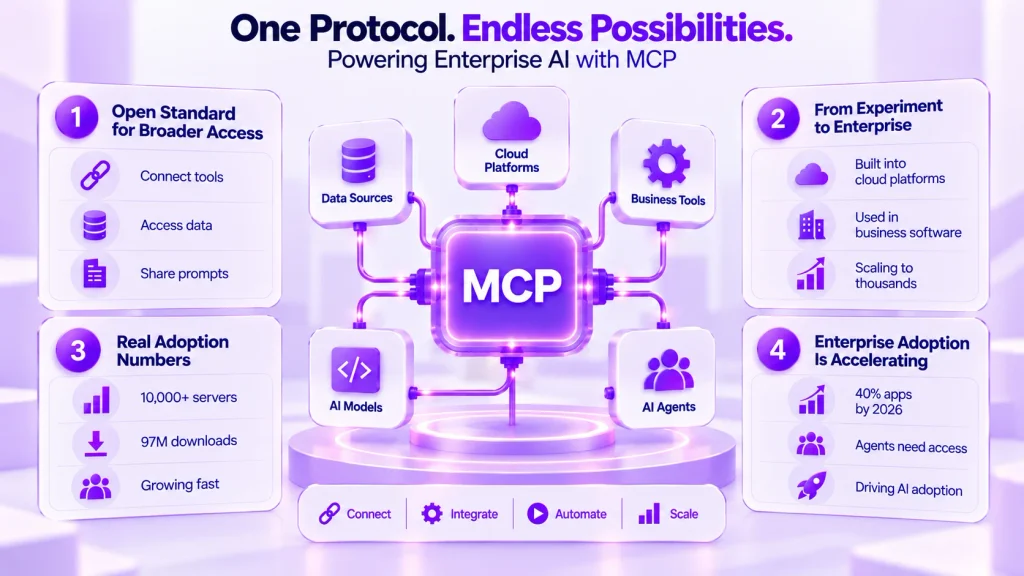
Model Context Protocol (MCP): an open standard that defines how an AI application discovers and calls external tools, data sources, and prompts, so one connector built to the spec works with any compliant model or agent.
From Developer Experiment to Enterprise AI Infrastructure
When Anthropic open-sourced MCP in late 2024, most early servers wrapped local developer tools such as file systems and code repositories. By 2026, the same protocol sits inside cloud platforms and business software. Tina Schuchman, corporate vice president for engineering at Microsoft Foundry, said in the July release announcement that MCP lets Microsoft scale “from dozens of integrations to thousands.”
Key Model Context Protocol Enterprise Adoption Numbers to Know
Reliable adoption figures now come from primary sources. When Anthropic donated the protocol in December 2025, it counted more than 10,000 active public servers and 97 million monthly SDK downloads. Broader AI adoption sets the backdrop, as McKinsey’s 2025 State of AI survey found 88% of organizations use AI in at least one function and 23% are scaling agents somewhere.
Why AI Enterprise Adoption Is Accelerating Alongside MCP
Agents need access to act, and MCP supplies a standard way to grant it. Gartner projects that 40% of enterprise applications will include task-specific AI agents by the end of 2026, up from less than 5% in 2025. Each of those agents needs governed connections into business systems, which is why AI enterprise adoption and protocol adoption now climb together.
What Changed Recently in Agentic AI
What changed recently in agentic AI is that the connective layer matured. MCP gained neutral governance, a stateless core, and formal extensions, while agent deployments shifted from single assistants toward coordinated teams of agents. The dated milestones below show how quickly that happened.
| Milestone | Date | Status |
|---|---|---|
| Anthropic open-sources MCP | November 25, 2024 | Launched |
| Anniversary spec adds server identity | November 25, 2025 | Released |
| MCP joins the Agentic AI Foundation | December 9, 2025 | Complete |
| NIST concept paper on agent identity and authorization | February 5, 2026 | Comments closed April 2, 2026 |
| Maintainers publish a roadmap naming enterprise readiness a priority | March 9, 2026 | Active |
| Stateless 2026-07-28 specification ships | July 28, 2026 | Current version |
The Shift From Single Model Tools to Multi-Agent Orchestration
Early deployments paired one model with a handful of tools. Newer designs split work across specialized agents, with one planning, another retrieving records, and a third executing updates. Multi-agent orchestration only holds together when every agent reaches systems the same way, and MCP gives each agent an identical interface to the same CRM, ERP, or ticketing server.
How Vendor Standardization Accelerated Generative AI Adoption
Standardization removed the platform bet that stalled many generative AI adoption decisions in 2024. Once OpenAI, Google, and Microsoft all shipped MCP support, a connector built for one model worked with the others. Governance under the Linux Foundation, which also stewards Kubernetes and PyTorch, gave procurement teams the vendor-neutral assurance they typically require before approving new infrastructure.
Model Context Protocol vs Direct API Calls
The choice in the MCP vs direct API calls debate is less binary than it looks. MCP standardizes how agents discover and invoke capabilities, while direct API calls remain the fastest route for fixed, deterministic integrations that no model needs to reason about.
| Factor | Model Context Protocol | Direct API Calls |
|---|---|---|
| Best fit | Agents choosing tools at runtime | Fixed, scripted integrations |
| Reuse across models | One server works with any compliant client | Rebuilt per model or framework |
| Discovery | Tools describe themselves to the agent | Developers hardcode endpoints |
| Governance | Gateways can route and audit every tool call | Controls live inside each integration |
| Context overhead | Tool definitions can consume model context | None at the model layer |
Why MCP Vs Direct API Calls Is the Wrong Framing for Most Teams
Most MCP servers are thin wrappers around existing APIs, so the two approaches stack rather than compete. The real decision is who calls the API: a developer writing fixed code, or an agent deciding at runtime. Teams that treat MCP as an adapter layer over current APIs keep their existing security reviews while gaining model portability.
Where Direct API Calls Still Make Sense
Direct calls still win for high-volume, predictable jobs such as nightly syncs or payment posting, where no reasoning is required. Context cost matters as well. Anthropic’s engineers reported that restructuring one agent workflow as code execution cut token use from roughly 150,000 to 2,000, a 98.7% reduction, by keeping bulky intermediate data out of the model.
What Does Model Context Protocol Enterprise Mean for Enterprises
For enterprises, the standard turns AI integration from a series of one-off projects into reusable infrastructure. Connectors built once can serve assistants, internal agents, and third-party tools alike, which changes both the cost and the speed of every new use case.
New Enterprise AI Adoption Use Cases Now Possible
Formal MCP extensions now cover long-running Tasks and interactive MCP Apps, which let servers display approval forms inside the host application. That opens enterprise AI adoption use cases that were awkward before, such as a procurement agent that pauses for sign-off or a support agent running a multi-hour reconciliation that reports back when finished.
Why MCP Alone Does Not Guarantee Enterprise AI Adoption Success
A protocol connects systems, yet it does not fix messy data, unclear ownership, or a workflow nobody has mapped. Agents inherit the quality of the records they touch, so a CRM full of duplicate accounts produces confident mistakes faster. Success still depends on process design, data hygiene, and a named business owner for every agent in production.
Is Model Context Protocol Enterprise Actually Significant for Buyers
Yes, for most buyers it is significant, though for a narrower reason than the hype suggests. The value lies in lower switching costs and reusable connectors, not in MCP making any individual agent smarter.
Separating Genuine Enterprise Readiness From Early Hype
Readiness shows up in unglamorous details such as identity integration, audit logs, and version stability, while hype shows up in demos. Anushree Verma, senior director analyst at Gartner, warned that many agentic projects are “mostly driven by hype and are often misapplied.” Her firm expects over 40% of them to be canceled by the end of 2027.
Questions to Ask Enterprise AI Agent Development Services Providers
Before signing with any provider of enterprise AI agent development services, ask which MCP specification version they build against and how they will migrate when it changes. Ask where tool calls are logged, how agent permissions map to your identity provider, and which production deployments they can show you, with named systems and measured outcomes.
MCP Agents 2026 and the Rise of Autonomous AI Agents
MCP agents in 2026 discover and call enterprise tools through the protocol at runtime, which is what lets autonomous AI agents move beyond chat into operational work. Observability data already shows that shift in real traffic.
How Autonomous AI Agents Use MCP to Reach Enterprise Systems
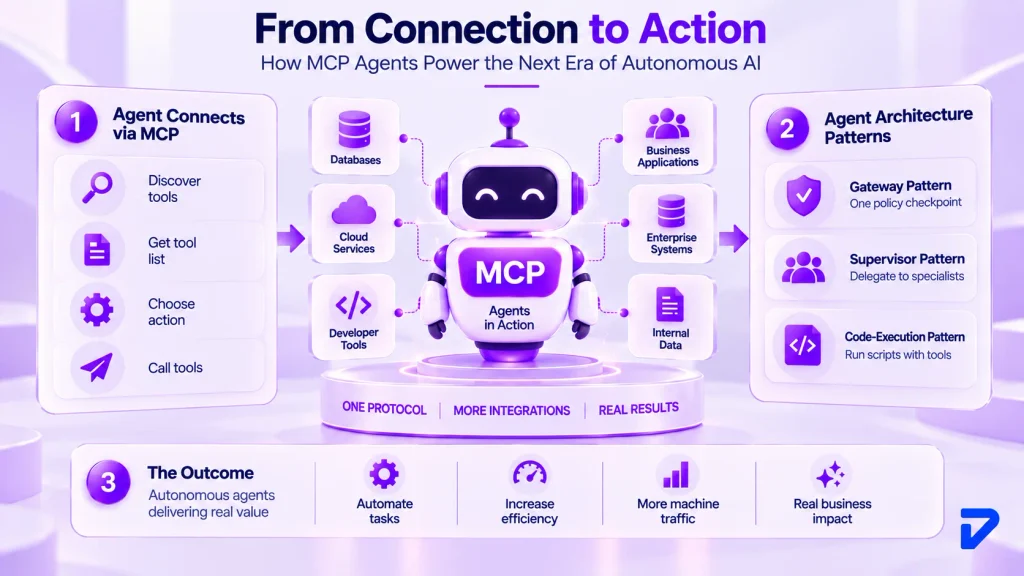
An agent asks each connected server what it can do, receives a list of tools with typed inputs, and chooses which to call based on the task. Honeycomb said in the July announcement that nearly 20% of its monthly interactive queries now come from agents, a sign that machine traffic is becoming a normal share of software use.
Agent Architecture Patterns Built Around Model Context Protocol
Three patterns dominate production agent architecture today, and each suits a different level of risk. A gateway routes every tool call through one policy checkpoint, a supervisor agent delegates to specialists, and a code-execution setup has agents write short scripts against MCP tools. Our guide to agentic AI design patterns covers the tradeoffs of each in depth.
How Does Model Context Protocol Enterprise Affect Your AI Roadmap
It shifts roadmap priorities from building connectors toward governing them. Integration work that once consumed most of a project budget shrinks, so planning attention moves to identity, observability, and deciding which workflows deserve agents at all.
Reprioritizing Your AI Adoption Strategy Around Open Standards
An AI adoption strategy built on proprietary connectors ties every future project to one vendor’s release calendar, and open standards reverse that dependency. The July specification also introduced a formal deprecation policy with a twelve-month minimum window, so teams can schedule upgrades rather than react to breaking changes, which makes multi-year budgeting far more predictable.
Planning for Multi-Agent Orchestration in Future Projects
Even a single-agent pilot should be designed so a second agent can join later without rework. That means shared tool servers, consistent naming, and one audit trail across agents. Gartner expects a third of agentic AI implementations to combine agents with different skills by 2027, and our breakdown of multi-agent systems orchestration explains how to prepare.
How Should Companies Respond to Model Context Protocol Enterprise
Companies should respond by putting controls in place before scaling, covering agent identity, permission scoping, logging, and a review process for every new MCP server. The protocol’s own maintainers have said openly that enterprise needs are where much of the remaining work lies.
Building Governance and Audit Trails Before Scaling Agents
David Soria Parra, the protocol’s lead maintainer, put it plainly in the 2026 MCP roadmap: “Enterprises are deploying MCP and running into a predictable set of problems.” He named audit trails and SSO-integrated authentication first. Teams that log every tool call from day one can answer an auditor’s questions in minutes instead of reconstructing agent behavior after an incident.
Choosing Enterprise Agentic AI Solutions With Security Built In
Enterprise agentic AI solutions should arrive with least-privilege scopes, short-lived credentials, and a gateway that inspects tool calls before they reach production systems. Prompt injection deserves specific attention, because an agent reading a malicious email can be steered into misusing its tools. Ask vendors to demonstrate those controls in a live environment, not in a slide deck.
Is MCP ready for your stack, or still a pilot-stage bet?
Our advisors help mid-market teams decide which workflows belong on the protocol, what controls they need first, and how to sequence the rollout.
The Case for Strategic AI Adoption Over Ad Hoc Integration
Strategic AI adoption wins because each connector, policy, and log pipeline built for the first use case lowers the cost of the next one. Ad hoc integration produces the opposite curve, where every new agent adds maintenance.
Why Strategic AI Adoption Beats One-Off Point Integrations
Point integrations feel fast in month one and slow by month twelve, when ten scripts break after a single CRM field is renamed. A shared MCP layer absorbs that change in one place. At Pinnasys, we measure that difference in hours saved, errors reduced, and revenue unlocked, not in the number of demos delivered.
Aligning Enterprise AI Adoption With Business Outcomes Not Hype
Only 39% of respondents in the McKinsey survey attribute any EBIT impact to AI, and most of them say it accounts for less than 5% of earnings. Enterprise AI earns its budget when each agent is tied to a metric the finance team already tracks, such as days sales outstanding, first-contact resolution, or quote turnaround time.
Model Context Protocol Enterprise Adoption for Mid-Market Companies
Mid-market companies benefit disproportionately because a shared standard lets a small team use connectors that software vendors and the open-source community already built. The gap with large enterprises is real, though, and closing it takes focus.
Why Mid-Market AI Teams Are Adopting MCP Faster Than Expected
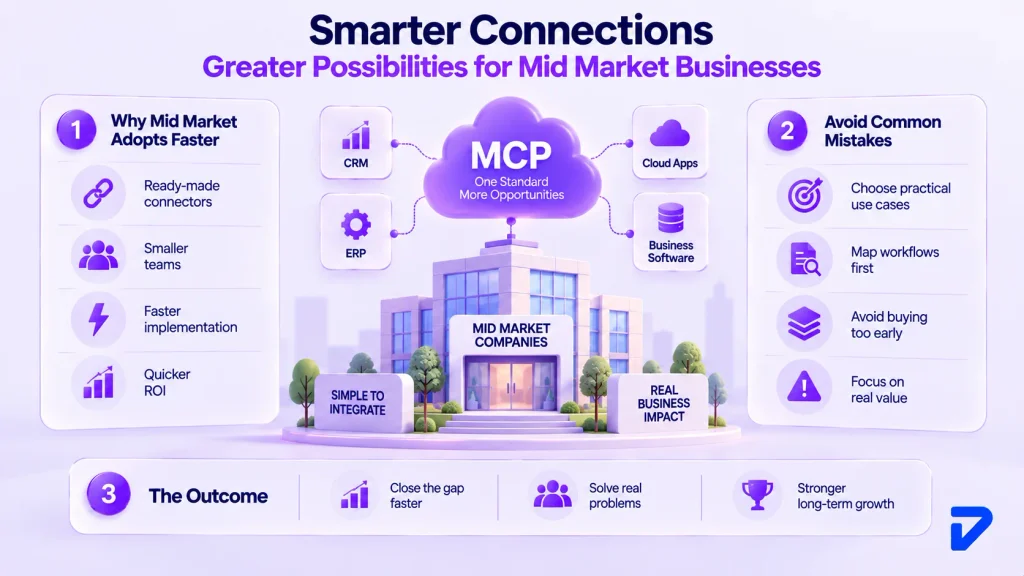
Mid-market AI teams rarely have engineers to spare for custom connectors, so ready-made servers from their existing software vendors change the math. The same McKinsey research found that 29% of companies under $100 million in revenue have reached the AI scaling phase, compared with nearly half of those above $5 billion. Reusable connectors help narrow that distance.
Avoiding Common Mid-Market Enterprise AI Adoption Mistakes
The most expensive mistake is starting with the flashiest use case instead of the most repetitive one. Order entry, invoice matching, and ticket triage usually pay back faster than a customer-facing agent. Another frequent error is buying a platform before mapping the workflow, and our guide to choosing an agentic AI partner covers the selection questions.
Real World Use Cases for Enterprise Agentic AI Solutions
The strongest early use cases share three traits: high volume, clear rules, and data spread across several systems. Customer operations and back-office finance fit that profile better than most functions.
Customer Operations and Multi-Agent Orchestration
The Register reported that Salesforce executives cited 4.5 million MCP calls into Headless 360 after its April 2026 launch, plus 30 to 50 million tool calls on Slack’s MCP server. In customer operations, one agent can classify an inbound request, another can pull order history, and a third can draft the reply for human approval.
Finance IT and Compliance Workflows Built on Model Context Protocol
Finance teams use agents to match invoices against purchase orders and flag exceptions, while IT teams route password resets and access requests through agents that check policy first. Compliance benefits because every tool call can be logged with the requesting identity, which creates the evidence trail auditors expect for SOX controls and vendor risk reviews.
Common Mistakes Companies Make Adopting Model Context Protocol
Skipping Governance and Identity Controls Early
Shadow MCP servers are the new shadow IT, since developers can connect local servers to production data with personal tokens while security has no record of them. The fix is a registry of approved servers, agent identities tied to your identity provider, and a lightweight approval step, all outlined in our agentic AI governance framework.
Treating MCP as a One-Time Integration Instead of Infrastructure
The July specification removed the session handshake entirely, a breaking change for servers that relied on session identifiers. Teams that treated MCP as a finished project now face unplanned migration work. Those with an owner, a version policy, and server test coverage can schedule the upgrade like any other platform change.
What Are the Latest Agentic AI Trends in 2026
The latest agentic AI trends in 2026 center on enterprise readiness, led by standardized agent identity, stateless scaling, and rising demand for outside expertise to run agent programs.
Enterprise Readiness and Standardized Authentication for Agents
Agent identity is becoming a standards question rather than a vendor feature. NIST’s National Cybersecurity Center of Excellence sought comment on how identification, authorization, auditing, and prompt injection controls should apply to AI agents. On the protocol side, the July specification hardened authorization with issuer validation and deprecated dynamic client registration.
Growing Demand for Enterprise AI Agent Development Services
Demand for enterprise AI agent development services is rising because the skills gap sits in the middle of the stack, where few internal teams combine identity engineering, workflow design, and model evaluation. Buyers increasingly want partners who have shipped agents into ERP and CRM environments before, rather than generalists learning on the client’s budget.
The Bottom Line
MCP has crossed from promising experiment to shared infrastructure, backed by neutral governance, a production-ready specification, and support from every major AI platform. The companies that gain most will treat it as a foundation for governed, measurable agents rather than a shortcut to more demos. Start with one high-volume workflow, instrument it, and build the identity and logging layer you will reuse for every agent after it.
For a second opinion on where MCP fits your stack, talk to the Pinnasys team about a scoped assessment. Our AI integration and governance services connect agents to ERP, CRM, and finance systems with the controls auditors expect, so the tenth use case costs less than the first.
Key Takeaways from the Article
- MCP became vendor-neutral infrastructure after its December 2025 move to the Linux Foundation.
- The stateless July 2026 specification removes a major barrier to scaling MCP servers.
- Direct API calls still suit fixed, high-volume jobs where no reasoning is needed.
- Governance, agent identity, and audit logging belong in place before agents scale up.
- Mid-market teams gain most by reusing vendor-built connectors on repetitive workflows first.
Frequently Asked Questions on Model Context Protocol Enterprise Adoption
What Does Model Context Protocol Enterprise Mean for Enterprises
It means one standard connection layer for every AI tool a company uses. Anthropic’s Claude directory alone lists more than 75 MCP-powered connectors, which shows how enterprise AI platforms now plug into business software without custom code for each application.
How Does Model Context Protocol Enterprise Affect My AI Roadmap
It moves budget away from integration and toward governance and use-case selection. Gartner told software leaders in August 2025 that they had three to six months to set an agentic strategy, so waiting on standards now carries real cost.
What Changed Recently in Agentic AI
Agents gained a stateless, gateway-friendly protocol. The July 2026 specification carries method and tool names in HTTP headers. Firewalls and rate limiters can now route and authorize agent traffic without parsing request bodies, which simplifies security operations.
Is Model Context Protocol Enterprise Actually Significant for Buyers
Yes, because it lowers switching costs and vendor risk. Buyers should still screen carefully, since Gartner estimates only about 130 of the thousands of vendors marketing agentic AI offer genuine agentic capabilities rather than rebranded chatbots.
How Should Companies Respond to Model Context Protocol Enterprise
Start with one governed pilot, then scale on shared infrastructure. Workforce readiness matters as much as tooling, and Gartner predicts that by 2029 at least half of knowledge workers will develop skills to work with, govern, or create AI agents.
What Are the Latest Agentic AI Trends in 2026
Standardized agent identity, stateless scaling, and embedded task-specific agents lead the list. Gartner’s best-case projection has agentic AI driving about 30% of enterprise application software revenue by 2035, surpassing $450 billion, which explains the pace of vendor investment.