


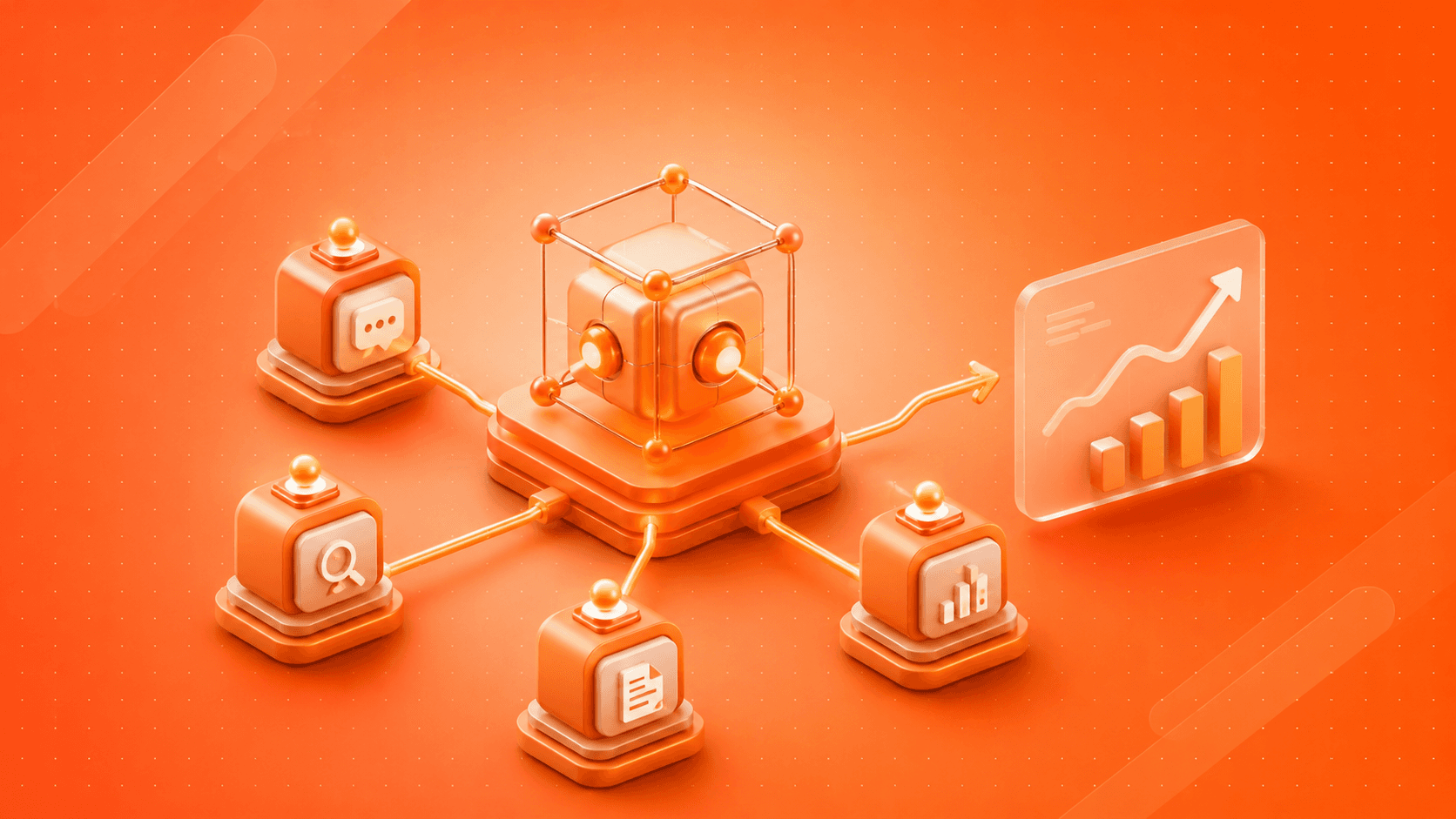
Multi-agent systems split a task across specialized AI agents that work in parallel and hand off to one another. On the right problems, they beat a single agent by a wide margin, at real cost.
Anthropic’s own research system, where a lead agent coordinates several subagents, outperformed a single top model by 90.2 percent on its internal research evaluation. That result reframes a question many operators get wrong. When a task overwhelms one AI model, the fix is often not a bigger model but a better structure.
Multi-agent systems put several specialized agents to work on a single problem, dividing it into parallel threads and assigning defined roles that a single agent cannot cover well. The approach is powerful, and it is not free. It costs more tokens, adds coordination logic, and brings new failure modes.
The sections below explain what these systems are, how they work, the patterns that run them, and the point where coordinated agents earn their place in real workflow automation.
What Is a Multi-Agent System?
A multi-agent system is software in which two or more AI agents, each a language model running in a loop with its own tools and memory, coordinate to complete a task that is too large, varied, or parallel for a single agent to handle well. Rather than a single agent doing everything, specialized agents divide the work, while a coordination layer keeps them aligned.
A simple analogy helps. A single agent is one capable generalist working on a problem end to end. A multi-agent system is a small team with an editor: a lead sets direction, specialists dig into their parts in parallel, and the lead pulls the threads back together.
What Problem Does It Actually Solve?
The core problem is breadth. A single agent has one context window, which is the amount of text it can hold in mind at once, and one chain of reasoning. Once a task needs more information, more parallel effort, or more distinct skills than that, quality drops. An agent collaboration system solves this by giving each agent its own context window and a narrow job, so the system covers ground a single agent cannot reach before it runs out of room to think. Anthropic saw its largest gains on exactly these breadth-first problems.
How Is It Different From a Single AI Agent?
The difference is not only in scale but also in shape. A single agent is simpler, cheaper, and easier to predict. A multi-agent system is more capable across a broader range of work, but it incurs higher costs and offers more ways to fail. The table below sets the two side by side.
| Dimension | Single-Agent System | Multi-Agent System |
| Structure | One model, one context, one chain of reasoning | Several specialized agents, coordinated |
| Best for | Narrow, sequential, latency-sensitive tasks | Broad, parallel, or role-diverse tasks |
| Cost | Lower token and engineering cost | Far higher token use and coordination logic |
| Reliability | Fewer moving parts, easier to predict | More capable, more failure modes to manage |
| Context limit | Bounded by one context window | Scales past it with separate windows |
Most teams should start with a single well-built agent and reach for a team only when the task genuinely outgrows it.
What Are The Key Components Of a Multi-Agent System?
Every multi-agent system, whatever framework runs it, is built from the same five parts: an orchestrator, specialized workers, a way for agents to communicate, shared memory, and a layer that watches the whole thing. Get these right, and the AI distributed systems hold together; skip one, and it drifts.
1. The Orchestrator (Lead Agent)
The orchestrator is the coordinator. It receives the request, works out what needs to happen, decides which agents handle which part, and sequences their work so nothing is duplicated or missed. When agents disagree or overlap, the orchestrator makes the call. In the orchestrator-worker pattern that most production systems use, this is the lead agent that plans the task and synthesizes the result.
2. Specialized Worker Agents
Workers are agents built for one job: one pulls data, one analyses it, one drafts the reply. Each carries only the tools and context it needs. Narrow scope is a feature, not a limitation, because a focused agent makes fewer mistakes than a generalist juggling everything. This is the same reason a specialist team outperforms one person doing five roles.
3. Communication And Handoffs
Agents have to pass work to each other cleanly. Most systems move structured data between agents through defined interfaces, so a result from one agent arrives in a form the next can use. Weak handoffs are where an agent collaboration system breaks, since a dropped or garbled message means work gets lost or repeated. Clear contracts between agents keep the system predictable.
4. Shared Memory And Context
Shared memory lets every agent reach the same facts: the request, the history, the business rules, and the results so far. Without it, agents start from scratch and lose the thread when one hands off to another. With it, a task keeps its context from start to finish, so the agent handling step four still knows what happened at step one.
5. Observability And Governance
Observability is the component that makes it possible to safely deploy an agent in a real-world production environment. Observability captures the decision made by the agent and the reason behind it, measures cost and errors, and triggers an alarm whenever there’s a problem. Combined with human-in-the-loop controls for sensitive decisions, observability transforms a great demo into a dependable system that a company can rely on. Most groups ignore this component, which is why their projects fail.
How Do Multi-Agent Systems Work?
Multi-agent systems work by pairing a coordination layer with agents that each own a piece of the problem, so their separate reasoning adds up to one coherent result. In Anthropic’s published research, a lead agent coordinating subagents outperformed a single top model by 90.2 percent, with the gain closely tied to how the work was split across separate context windows. The flow below is the orchestrator-worker pattern that most production systems follow.
1. The Request Comes in And Gets Planned
The system receives the request via a chat box, an API, or an automated trigger; the lead agent then reads it and forms a plan. It assesses how complex the task is, how many agents it needs, and what each will do. Extended planning at this stage pays off later because a clear plan prevents wasted work downstream.
2. The Lead Agent Breaks The Task Down
The lead splits the goal into subtasks and assigns each to a worker, with clear instructions and the context that worker needs. It also sets the order and any dependencies, so agents that rely on each other run in the correct sequence, while independent agents run at the same time.
3. Workers Run in Parallel
Each worker tackles its subtask with its own tools and its own context window. Parallelism is the core advantage here, since several agents exploring independent threads at once cover far more ground than one agent working in sequence. This is where the extra tokens get spent, and where the quality comes from.
4. Results Are Synthesized
The lead agent gathers the workers’ outputs and combines them into one answer, removing duplication and checking that the pieces fit. In research systems, a separate pass adds citations or verification. Synthesis is where the system earns its keep, turning scattered findings into a single coherent result.
5. Guardrails And Human Checkpoints Apply
Before anything reaches a real system or a customer, the guardrails run: quality checks, limits on cost and tool calls, and human approval on sensitive actions. This step is what keeps autonomy safe. Skip it and a small error early in the chain can compound into a large one by the end.
What Are The Core AI Orchestration Patterns?
The core AI orchestration patterns are the repeatable ways in which agents are coordinated. Most systems use one of six: orchestrator-worker, sequential pipeline, concurrent, hierarchical, group chat, or handoff. Each suits a different kind of work, and the right choice depends on how your task actually flows.
1. Orchestrator-Worker
A lead agent splits the task into subtasks, delegates each to an independent worker, then synthesizes the results into a single output. Workers don’t communicate with each other, keeping the system predictable and traceable. It’s the pattern behind Anthropic’s research agent. Best for parallel, breadth-first work with many independent threads.
2. Sequential Pipeline
Agents run in a fixed order, each processing the previous agent’s output before passing it forward. The chain is cheap to build, easy to follow, and simple to debug, since failures trace back to a single step. Best for staged workflows like document processing, approvals, or onboarding, where the sequence rarely changes.
3. Concurrent (Parallel)
Several agents tackle the same task, each from a different angle, before their outputs merge into one view. Running them in parallel reduces total latency, since the slowest agent sets the pace rather than the sum of all steps. Best where independent perspectives improve the answer, like risk or quality checks.
4. Hierarchical
Manager agents each coordinate their own sub-team and then report to a higher-level agent, mirroring an org chart with tiers of responsibility. This keeps oversight manageable as the agent count grows. Best for large, complex workflows spanning multiple departments or requiring escalation, where one flat layer gets hard to manage.
5. Group Chat
Agents contribute to a shared thread, challenging and building on each other’s ideas until the group converges on a decision. The format is flexible and transparent, but discussions can wander or burn tokens without a moderator setting limits. Best for open-ended problems, debate, or review, where the answer isn’t known.
6. Handoff
Agents assess a task as it unfolds, then hand off to a specialized agent or a human once complexity exceeds their scope. The decision happens based on context rather than a fixed rule. Best for escalation flows like customer service, where most cases are simple but some need an expert.
| Pattern | How It Coordinates | Best Suited To |
| Orchestrator-worker | Lead delegates subtasks, then synthesizes | Breadth-first research, parallel work |
| Sequential pipeline | Agents hand off in a fixed order | Staged workflows with clear steps |
| Concurrent | Agents work in parallel, views combined | Multiple perspectives on one task |
| Hierarchical | Manager agents coordinate sub-teams | Large tasks with nested structure |
| Group chat | Agents discuss in a shared thread | Open-ended problems, debate, review |
| Handoff | Agents escalate to specialists or humans | Customer service, troubleshooting |
Pattern choice is an engineering decision with real consequences for cost and reliability. When it comes to production, the simplest pattern that fits the task almost always wins.
Stuck deciding whether one agent or a coordinated team fits your workflow?
Pinnasys designs the right pattern, builds it, and runs it in production, so you get the result without the trial and error.
When Should You Use a Multi-Agent System, And When Not?
Use a multi-agent system when the task is broad and parallelizable, needs more information than one context window holds, or benefits from specialized roles. For narrow, sequential, or latency-sensitive work, a single well-designed agent is usually cheaper and more reliable. The decision comes down to economics, not enthusiasm.
When a Multi-Agent System Wins
Coordinated agents pay off on high-value, breadth-first, or heavily parallel work: research across many sources, workflows that span several systems, or tasks that need distinct skills at each step. On this kind of problem, the quality gain clears the extra cost, which is why Anthropic accepted a large token bill for a large quality lift.
When a Single Agent Is The Better Call
For a narrow task, a clean sequence, or anything latency-sensitive or cost-sensitive, one well-built agent wins. The coordination overhead of a team buys little when the work does not fan out. Reaching for multiple agents here adds cost and failure modes without a matching return.
The Cost Trade-Off
Multi-agent systems consume roughly 15 times as many tokens as a normal chat, and token usage alone accounts for most of the performance difference Anthropic measured. That trade is worth paying when a better or faster result outweighs the compute and engineering, and a poor trade when it does not. The choice between agentic AI and generative AI matters here too, because not every problem needs an agent at all.
How Do You Build a Multi-Agent System?
You build a multi-agent system by starting with one agent, adding specialized agents only where a single one falls short, then wrapping the whole thing in tools, guardrails, and measurement. The order matters because most of the risk sits in coordination and upkeep, not in the models.
1. Start With One Agent
Build one capable agent for the task first, and give it a genuine chance before assuming you need more. A well-designed single agent, with the right tools and context, handles more scope than most teams expect. Only add complexity once that agent clearly and repeatedly stalls on real tasks, since every added agent adds real overhead you’ll maintain after launch.
2. Find The Real Limit
Pin down exactly why the single agent stalls: too much information for one context window, too many parallel threads to track, or too many distinct skills packed into one brief. That diagnosis tells you precisely how to split the work, so you add agents to solve a proven limit rather than chase a trend or add complexity nobody asked for.
3. Define Roles And Tools
Give each agent one narrow job, the specific tools it needs to do that job, and nothing beyond that scope. Scope creep is where agents start overlapping, duplicating work, or stepping on each other’s outputs. Clear, tightly defined roles keep the system legible, make ownership obvious, and make the whole setup easier to debug once something goes wrong in production.
4. Choose a Pattern, And Connect Tools With MCP And A2A
Pick the coordination pattern that matches the flow: orchestrator-worker for breadth-first work, a pipeline for staged tasks. Connect agents to tools and each other through open standards. The Model Context Protocol gives agents a shared way to reach tools and data, while Agent2Agent lets them talk across frameworks and vendors, removing the brittle custom glue that sinks many early builds.
5. Add Guardrails, Observability, And Measurement
Add human-in-the-loop checkpoints on any action that touches a live system, and wire in observability. Hence, every agent decision stays traceable, and hard limits are set on tokens and tool calls so a runaway loop cannot drain the budget. Measure against a baseline from day one, since “it feels better” isn’t defensible, and who owns these controls decides whether it survives launch.
What Are The Risks, And Why Do Multi-Agent Projects Fail?
The risks are cost, reliability, and security, which is why most agent projects never reach production. Gartner expects over 40 percent of agentic AI projects to be canceled by the end of 2027, citing cost, unclear value, and weak governance rather than model quality. Understanding these failure modes is how you avoid them.
Cost And Token Sprawl
Every agent burns tokens, and every handoff adds more, so a multi-agent system can cost many times what a single agent would. Left unmeasured, that cost balloons quietly until a budget review kills the project. Hard limits and a clear link between spend and value keep it in check.
Coordination Failures
When coordination breaks, agents duplicate work, leave gaps, or pass along a bad result that the next agent treats as fact. Errors compound across steps, so a small mistake early becomes a large one late. Predictable patterns and clean handoffs are the defense.
Security And Prompt Injection
Prompt injection, where hostile text hijacks an agent’s instructions, is the leading security threat for agentic systems. An agent that can act on live systems is only as safe as the guardrails around it. Human approval of sensitive actions, scoped permissions, and observability keep autonomous agent networks from doing damage.
Why Most Agent Projects Never Reach Production
Gartner’s cancellation forecast points to management, not models: escalating cost, no defined value, and inadequate risk controls. The firm also warns of “agent washing,” estimating only about 130 of thousands of self-described agentic vendors are real. The lesson for a multi-agent build is plain. Scope to a measurable outcome, govern it properly, and treat production reliability as the goal, which is the core of sound AI integration and governance.
The Bottom Line
Multi-agent systems are not a bigger hammer; they are a different tool. When a task splits into parallel threads or specialized roles, coordinated agents can beat a single one by a wide margin, as Anthropic’s own numbers show. When a task is narrow or sequential, one well-built agent usually wins on cost and reliability. The skill is not stacking agents; it is choosing the smallest structure that solves the problem, then running it with the governance that keeps it dependable.
The future belongs to organizations that orchestrate intelligence, not just deploy it. If you’re analyzing multi-agent AI, now is the time to architect systems that can scale, develop, and operate reliably in production. Connect with Pinnasys and find out where your first high-impact multi-agent workflow begins. We will respond within 24 hours and show you how multi-agent systems work for your business’s complex tasks.
Key Takeaways from the Article
- Multi-agent systems divide broad tasks across specialized agents coordinated by an orchestration layer.
- Anthropic’s multi-agent research setup outperformed a single top model by 90.2 percent.
- The orchestrator-worker pattern delegates subtasks to independent workers, then synthesizes results.
- Coordinated agents cost roughly fifteen times more tokens, so task value must justify them.
- Gartner expects over 40 percent of agentic AI projects to be canceled by 2027, mostly due to governance.
Frequently Asked Questions on Multi-Agent Systems
Are multi-agent systems worth the cost?
Sometimes, not always. They can sharply improve results on broad or parallel tasks, but they use far more tokens and add coordination complexity. They pay off when a better or faster outcome clearly outweighs the extra compute and engineering.
What is the orchestrator-worker pattern?
A lead agent analyses the task, splits it into subtasks, and delegates each to an independent worker agent, then synthesizes their results into a final answer. Workers do not talk to each other, which keeps the system predictable and easier to debug.
How do large language models power multi-agent systems?
The language model is the reasoning engine inside each agent. Every node interprets its task, chooses which tools to call, and decides what to do with the result. The AI orchestration layer coordinates these model-driven agents into one coherent outcome.
What are MCP and A2A?
The Model Context Protocol is an open standard for connecting agents to tools and data. Agent2Agent is a protocol for agents to coordinate across frameworks and vendors. Together, they form the interoperability layer beneath modern multi-agent systems.
When should you use a multi-agent system instead of one agent?
Use several agents when the task is broad, parallelizable, or needs distinct skills at each step. Stay with one agent for narrow, sequential, or latency-sensitive work, where coordination overhead adds cost without a matching gain.
What are the biggest risks of multi-agent systems?
Cost, reliability, and security. Coordination failures duplicate work or leave gaps, token costs multiply, and prompt injection is a real threat. Most agent projects fail on governance, not models, which is why Gartner expects many cancellations by 2027.





Prakash C. Saini
Prakash Saini is the Founder & CEO of Pinnasys. With over a decade in digital transformation and building production systems, he grew an engineering team from 2 to 50 people and has led the delivery of 100+ production digital systems. Products built under his leadership have raised millions in funding and generated over $50 million in revenue. He holds an Executive MBA from IIM Kozhikode and today leads the AI engineering team at Pinnasys.