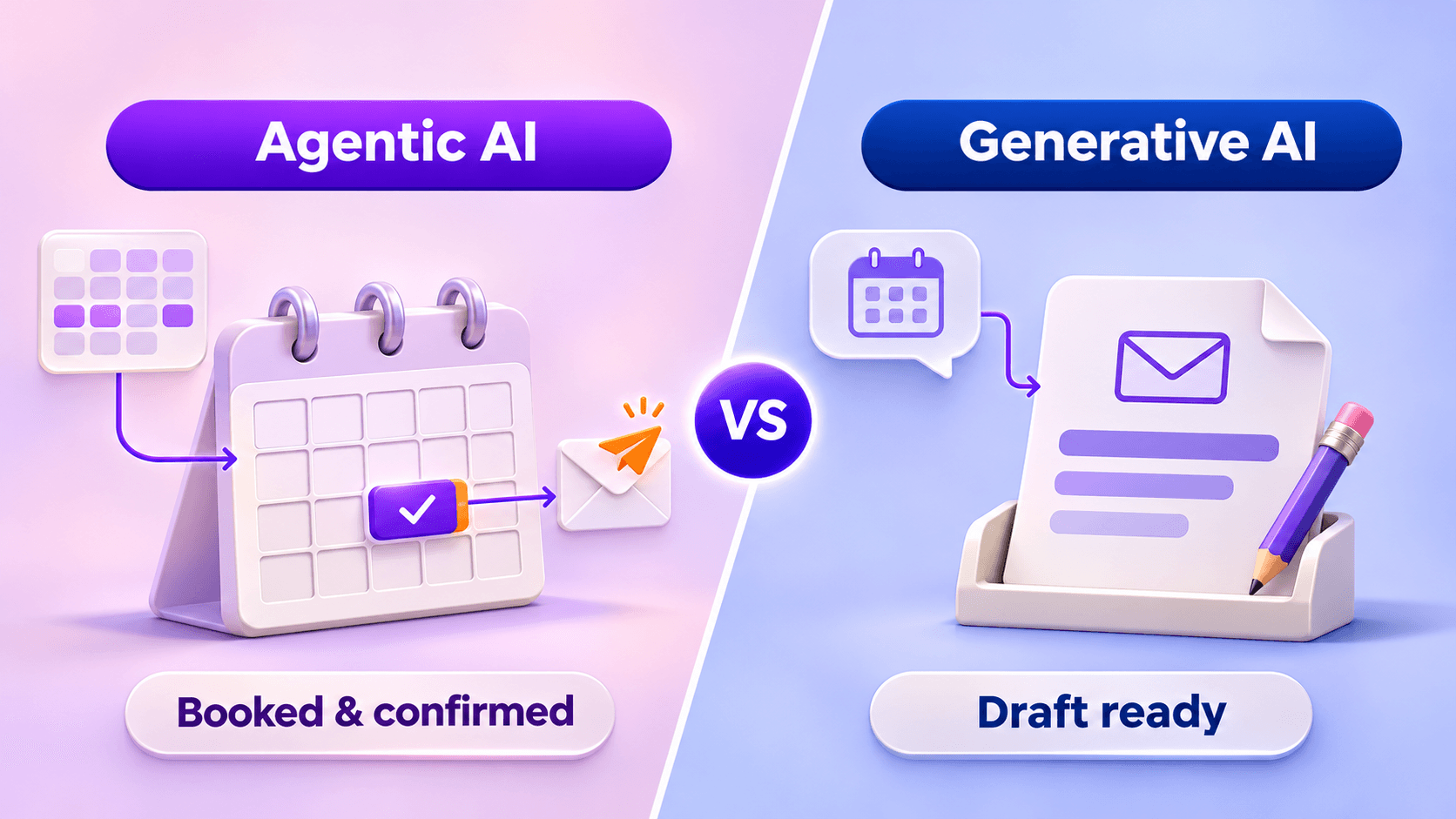
Agentic AI vs. generative AI turns on one question: does the task end in a draft or a finished action? Generative AI wins on cost and simplicity, while agentic AI wins when multistep work must reach completion inside live systems.
Gartner expects 33% of enterprise software applications to include agentic AI by 2028, up from under 1% in 2024. The same firm predicts over 40% of agentic projects will be canceled by 2027, citing rising costs and unclear value. That tension makes agentic AI vs. generative AI one of the hardest calls operators face this year. Generative AI is software that creates new text, images, or code in response to a prompt, powered by large language models. Agentic AI is software that pursues a goal by planning steps, calling tools, and acting inside business systems with limited supervision. The comparison below scores both on six criteria, so you can match each one to the work in front of you.
How We Compare Agentic AI vs Generative AI
If you have ever wondered what generative AI is and what agentic AI is, the real answer sits in what wraps the model. Both run on the same family of models, which is why vendors blur them so often. To keep the comparison honest, we scored each option on six criteria that decide real deployments:
| Criterion | Generative AI | Agentic AI | Verdict |
|---|---|---|---|
| Primary job and output | Drafts, summaries, code | Completed multistep outcomes | Toss-up, different jobs |
| Autonomy and human role | Person drives each step | Person sets goals, approves | Toss-up, depends on task risk |
| Planning, reasoning, memory | Single pass per prompt | Plans, tracks state, adjusts | Agentic AI leads |
| Tool calling and system access | Limited, added by integration | Core design requirement | Agentic AI leads |
| Cost and reliability | Low, predictable per call | Several times the tokens | Generative AI leads |
| Risk and governance | Contained, informational | Operational, wider reach | Generative AI leads |
Primary Job and Output: Does the AI Create or Complete?
On primary job, the verdict is a toss-up because each tool exists for different work. Generative AI hands a person a draft, while agentic AI hands back a finished task. That gap is what agentic AI vs. generative AI really measures in daily operations. Gartner predicts agentic AI will autonomously resolve 80% of common customer service issues by 2029, with operational costs falling 30%.
Generative AI: Drafts That Make People Faster
Generative AI shines when a skilled person stays in charge of the final move. A study of 5,179 customer support agents found that a generative assistant raised issues resolved per hour by 14% on average. Newer and less experienced staff saw the largest lift, at 34%. That figure, however, measures human productivity rather than automated work. The model suggested replies, yet a person still read, edited, and sent each message, so every gain depended on staff time.
Agentic AI: Work That Closes the Loop
Agentic AI changes the unit of value from a draft to a closed loop. Picture a sales follow-up where a CRM rule fires two business days after a demo, and the agent pulls the account history. Next, it drafts the email with a language model, waits for rep approval, sends it, and logs the activity. Nobody copies and pastes anything between screens, which is exactly where workflow automation pays for itself.
What Are Examples of Agentic AI in Business?
Generative AI fits work a person reviews before anything happens, such as proposals and first-draft code. Agentic AI, by contrast, fits work that crosses systems and ends in a change of state:
- Returns processing that checks the order, issues a credit, and notifies buyers
- Inventory monitoring that raises a purchase order when stock runs low
- Sales prospecting agents that research leads, write outreach, and book meetings
- IT tickets that get triaged, fixed, and closed against a runbook
Autonomy and the Human Role: Who Drives the Work?
Autonomy lands as a toss-up, because the right level depends on what a mistake would cost. In practice, companies are extending it carefully rather than all at once. McKinsey’s 2025 survey found 23% of organizations scaling an agentic system somewhere, with 39% still experimenting. Most of those scaling do so in just one or two functions, so autonomy tends to grow one workflow at a time.
Generative AI: The Person Stays in the Driver’s Seat
On the generative side of the generative AI vs agentic AI split, a person directs every turn. A copilot inside a document editor or IDE waits for a prompt, returns an answer, and stops. The user then judges the output and performs each follow-on step, such as pasting a reply into a ticket. That design keeps accountability simple, which is why many conversational AI assistants answer questions yet still hand actions back to staff.
Agentic AI: The Person Becomes a Supervisor
Agentic AI moves the person from operator to supervisor, so autonomy becomes a setting you configure per action. A well-built agent separates low-risk steps it may take alone from steps that need sign-off. The policy below shows how a human-in-the-loop gate often looks in practice:
agent: order-exceptions
autonomy:
  read_orders: auto
  draft_customer_email: auto
  issue_credit_under_100: auto
  issue_credit_over_100: require_approval
  cancel_order: require_approval
escalate_to: ops-team
Approval thresholds can then loosen as the agent proves reliable on each action.
Autonomy Levels: From Suggestion to Self-Direction
Autonomy levels work best as a ladder rather than a switch, and most teams climb one rung at a time:
- Suggest: the AI drafts content, and a person decides whether to act.
- Assist: the AI carries out each step after a person approves it.
- Delegate: the AI acts alone within set limits and escalates exceptions.
- Autonomous: the AI owns the workflow, while people audit results afterward.
Generative AI usually lives on the first rung, whereas autonomous AI agents span the upper three.
Can the System Handle Dependent Steps of Planning, Reasoning, and Memory?
Agentic AI leads on planning and reasoning, since it is built to break a goal into steps and track progress. Even so, multistep work exposes reliability gaps that single prompts never reveal. On the τ-bench retail benchmark, a 2024 GPT-4o agent solved about 61% of tasks once, yet consistency across eight trials dropped below 25%. That gap shows agentic AI vs. generative AI is also a question of engineering discipline.
Generative AI: Strong Reasoning Inside One Response
Generative AI reasons well inside a single response, but it does not carry a plan between prompts by default. Its context is the prompt, the chat history, and its training data. Teams often add retrieval-augmented generation (RAG, which fetches relevant documents before the model answers) to ground replies in company knowledge. A contract summary or policy answer fits this mold well, because the whole job finishes in one pass.
Agentic AI: A Loop That Plans, Acts, and Remembers
Agentic AI runs a loop instead of a single pass. A common pattern is ReAct (reason, then act), where the model thinks, calls a tool, reads the result, and decides again. Memory records what already happened, so the agent avoids repeating work it has finished:
while not goal_met(state):
    plan = llm.reason(goal, state.memory)
    result = tools.call(plan.next_action)
    state.memory.append(result)
The loop is powerful, yet every extra turn adds another chance for the agent to drift off course.
What Is the AI Allowed to Touch?
Tool calling is where agentic AI vs. generative AI splits most sharply, and agentic AI leads by design. Tool calling lets a model request a specific function, such as an API lookup, then use the result. The payoff shows up in testing: with direct spreadsheet editing, OpenAI’s ChatGPT agent scored 45.5% on SpreadsheetBench, against 20.0% for Copilot in Excel.
Generative AI: Access Only Where You Add It
Generative AI reaches outside systems only through whatever integration a team builds around it. Out of the box, a chat model cannot update an ERP record or send an invoice, and that limit is often a feature. Finance teams, for instance, let a model draft vendor emails precisely because it cannot pay anyone. When access is needed later, AI integration services can add it deliberately rather than by default.
Agentic AI: Tools as Core Equipment
Agentic AI treats tools as core equipment, and open standards now make connecting them far less custom. Anthropic open-sourced the Model Context Protocol in November 2024, giving agents one standard way to reach data and actions. A sensible setup exposes only the tools a task needs, as this illustrative allowlist shows:
server: erp-mcp
allowed_tools:
  - get_order
  - update_shipping_status
blocked_tools:
  - delete_customer
  - issue_refund
Anything outside that allowlist stays completely out of the agent’s reach.
Can Generative AI Become Agentic AI?
Yes, a generative model can become agentic, but not on its own. It becomes agentic when a team wraps it with four things: a defined goal, tool access, cross-step memory, and guardrails. In fact, most AI agents still use a large language model as their reasoning engine. The agentic vs generative AI line therefore sits in the architecture around the model, which our agentic AI vs traditional AI guide explores further.
Unsure which of your workflows can safely move from drafts to actions?
Pinnasys builds agents scoped to your systems, approval rules, and compliance needs, so they reach production and stay there.
Cost and Reliability: Which Is Cheaper to Run in Production?
Generative AI leads on cost, because one prompt usually means one model call. Agents multiply calls, and therefore tokens (the chunks of text models bill by), as they plan, check, and retry. Anthropic’s engineering team reports that agents typically use about four times more tokens than chat, and multi-agent systems about fifteen times more. That spread makes agentic AI vs generative AI a budgeting decision as much as a technical one.
Generative AI: Cheap and Predictable per Task
Generative AI has become remarkably cheap per task. The Stanford AI Index 2025 found the inference cost of GPT-3.5-level performance fell more than 280-fold between November 2022 and October 2024. For a team drafting product descriptions or summarizing tickets, the bill per output is now often a rounding error. Predictability matters too, since one call per output makes monthly spend easy to forecast.
Agentic AI: Higher Spend per Finished Outcome
Agentic AI costs more to run, yet the fair comparison is against the human hours it replaces. Consider an accounts payable agent that matches invoices to purchase orders across hundreds of vendors each week. Each invoice may trigger several lookups, a validation pass, and an exception route, so per-task cost rises well above a single draft. Budget for evaluation and monitoring too, because agents need ongoing testing to stay reliable after launch.
Is Agentic AI Riskier Than Generative AI?
Yes, agentic AI carries more operational risk, so generative AI leads on containment because a wrong draft does nothing until someone acts. Agents, by contrast, act on live systems, so their errors travel further. The OWASP Top 10 for LLM Applications now lists excessive agency as a core risk. It describes damaging actions an AI takes after an unexpected, ambiguous, or manipulated output. When deciding between agentic AI and generative AI, security teams usually scrutinize this criterion first.
Generative AI: Informational Risk a Reviewer Can Catch
Generative AI risk is mostly informational: a confident but false answer, biased text, or sensitive data pasted into a prompt. NIST’s Generative AI Profile (AI 600-1) catalogs twelve risks unique to or worsened by generative AI, including confabulation, its term for hallucination. Each one is real, yet a human review step catches most before damage occurs. A marketing draft with a wrong statistic, for example, gets caught during editing.
Agentic AI: Operational Risk That Needs Design Controls
Agentic AI risk is operational, so the question shifts from “Is this accurate?” to “What can it touch?” Imagine a refund agent with write access to payments that misreads a policy and issues hundreds of credits overnight. Controls such as spending caps, audit trails, and rollback plans turn that scenario into a contained incident rather than a crisis. Our agentic AI governance framework lays out those controls in a starter format.
The Three Root Causes of Excessive Agency
OWASP traces excessive agency to three design choices, and each one has a plain fix:
- Excessive functionality: the agent can reach tools its task never needs, so remove them.
- Excessive permissions: a tool runs with broad admin rights, so narrow it to scoped credentials.
- Excessive autonomy: high-impact actions proceed without confirmation, so add approval gates.
Address all three before launch, because retrofitting controls onto a live agent costs far more than designing them in.
When Should a Business Use Agentic AI Instead of Generative AI?
The agentic AI vs generative AI choice usually flips on four questions about your own operation. Does the task end in a draft for review or a change inside a live system? How many steps depend on each other, and does someone currently stitch them together by hand? Can your budget absorb several times the compute per task in exchange for finished work? Finally, how heavy is your compliance load, and who will own approvals?
Choose generative AI if:
- Your output is content that a person reviews before anything happens.
- Tasks finish in a single pass, such as summaries, drafts, or answers.
- Budget predictability matters more to you than end-to-end automation right now.
- Your team wants productivity gains without granting any system write access.
Choose agentic AI if:
- Work spans several systems and ends in an action, such as a refund or reorder.
- Steps depend on each other and need tracking, retries, and adjustment along the way.
- Staff currently spend hours copying data between tools to finish one process.
- You can define permissions, approval rules, and escalation paths before launch.
The hybrid path is real: most production agents call a generative model for drafting inside an agentic workflow. Anthropic’s agent-building guidance also advises starting with the simplest pattern that works and adding autonomy only when results justify it.
The Bottom Line
Agentic AI vs generative AI is less a rivalry than a question of how far you want AI to go. Generative AI creates content cheaply and safely, while agentic AI finishes multi-step work but demands tighter controls and bigger budgets. The strongest roadmaps use both, letting generative models draft while agents carry approved work across systems.
Pinnasys helps teams decide where each approach fits and then builds the chosen path for production. If you are still mapping which workflows deserve autonomy, start with an AI consulting engagement that ranks use cases by value and risk. That way, the first agent you ship solves a real problem and earns the trust needed for the next one.
Key Takeaways from the Article
- Generative AI creates content on request; agentic AI completes goals across live systems.
- Autonomy works best as a ladder, with approvals tied to each action’s consequence.
- Tool access and memory, not a better model, turn generative AI into agentic AI.
- Agents can use several times more tokens, so budget per finished outcome instead.
- Excessive agency is the core agent risk; scope tools, credentials, and approvals early.
Frequently Asked Questions on Agentic AI vs Generative AI
What is the difference between agentic AI and generative AI?
Generative AI produces one output, such as text or code, per prompt. Agentic AI takes actions toward a goal through repeated reasoning steps. Anthropic notes that even simple agent research tasks need three to ten tool calls.
Is ChatGPT generative AI or agentic AI?
ChatGPT began as generative AI, answering prompts with text. In July 2025, OpenAI added agent mode, which browses websites, runs code, and completes tasks on its own virtual computer. ChatGPT can now work in either mode, depending on the selected mode.
Are AI agents the same as agentic AI?
Not always, because many products labeled agentic are simply rebranded chatbots or assistants. Gartner estimates only about 130 of the thousands of agentic AI vendors are real. Genuine AI agents plan, call tools, and act inside enterprise AI workflows.
Where are businesses using agentic AI most today?
McKinsey’s 2025 survey found agent use most often reported in IT and knowledge management functions. By industry, respondents in technology, media and telecommunications, and healthcare report the highest use of autonomous AI agents so far.
Will agentic AI replace generative AI?
Unlikely, since the two solve different problems and grow together rather than compete. Gartner expects agentic AI to make at least 15% of day-to-day work decisions autonomously by 2028, while generative tools continue to handle drafting and summarizing.