


Hire an agentic AI development company on evidence, not demos. Judge the sourcing trail, discovery work, permission design, approval gates, observability plan, and code ownership terms before price enters the conversation.
Deloitte’s 2026 State of AI in the Enterprise found that only one in five companies has a mature model for governing autonomous AI agents. That gap explains why so many agent projects stall after launch. The choice of an agentic AI development company is a governance decision as much as a technical one. Yet most buyers run it backward: watch a polished demo, compare hourly rates, sign.
The vendor you pick largely decides whether your agent reaches production or quietly dies in a review meeting. This checklist covers where to find credible vendors and how to evaluate them. It also walks through the five questions worth asking in every meeting, the red flags that should end a conversation, and what each person on your side of the table should watch.
The Short Answer: What to Verify Before You Sign
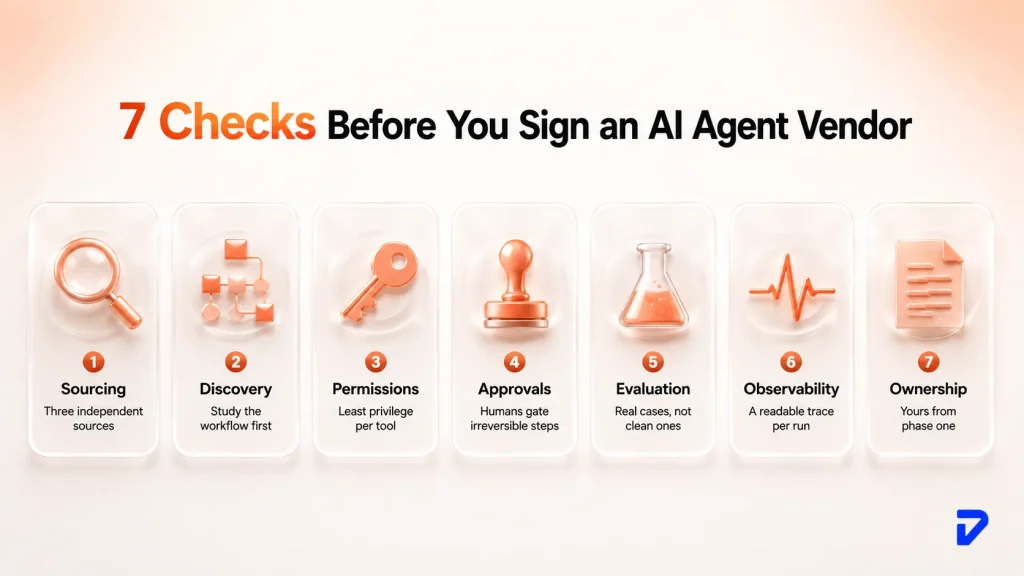
Short on time? These seven checks separate a builder from a demo shop, and each is expanded further down the page.
- Sourcing: The vendor appears consistently across at least three independent sources, not just their own site
- Discovery: They insist on studying your workflow before quoting a build
- Permissions: They scope credentials per tool and default to least privilege
- Approvals: Irreversible actions require a human confirmation step by design
- Evaluation: A written test set exists, and exception cases outnumber clean ones
- Observability: Every agent run produces a readable trace your own team can audit
- Ownership: Source code, prompts, and evaluation data are contractually yours from phase one
A vendor who cannot speak to all seven inside a single hour-long call has not run one of these systems in production.
What is Agentic AI Development?
Terminology confusion is expensive here, because it lets the wrong vendor look qualified. In PwC’s AI Agent Survey, 79% of executives said AI agents are already being adopted in their companies, which means almost every vendor now claims the label. The buyer’s first job is definitional. An agent plans a sequence of steps, calls tools, and changes the state of your systems, whereas a chatbot returns text. Pinnasys treats that gap as the starting line of every evaluation, not a footnote.
Chatbots and Prompt Wrappers vs. True Agentic Systems
A prompt wrapper sends your question to a model and formats the reply. An agent decides the next step, calls your CRM or ERP, then writes a record. The difference shows up in failure cost. A wrapper produces a bad paragraph you can ignore, while an agent issues a refund or updates a customer file that finance must later unwind.
| Signal | Prompt Wrapper or Chatbot | True Agentic System |
| Core behavior | Returns text on request | Plans and executes multi-step work |
| System access | None, or read-only lookup | Scoped write access to live APIs |
| Failure cost | An unhelpful answer | A wrong record, refund, or shipment |
| Oversight need | Minimal | Approval gates on irreversible steps |
| What to test | Answer quality | Recovery after a mid-sequence failure |
Why This Distinction Should Shape Your Vendor Search
Ask what an agentic AI development company is, and you get two honest answers. One builds conversational interfaces, and the other builds systems with permissions, audit trails, and rollback paths. Both call themselves agentic. Only the second survives contact with your accounts payable process, so only the second should quote on work that touches money or customer records.
Where to Find and Shortlist an Agentic AI Development Company
Most buyers start with a search and a referral, then stop. That produces a shortlist of three vendors who are good at marketing rather than three who are good at shipping. Gartner reports that 67% of B2B buyers now prefer a rep-free experience, which means your sourcing happens mostly in the open, before any sales call. Treat that research as its own task, and the later stages get far easier.
B2B Review Directories and Verified Buyer Ratings
Independent directories verify reviewers and publish project size, industry, and engagement length alongside each rating. Filter for reviews under 18 months old, in your revenue band, and mentioning production deployment rather than a proof of concept. A vendor with 40 glowing reviews and none describing a live system is selling pilots instead of products.
Public Engineering Evidence and Technical Writing
Good engineering teams leave a public trail. Review their repositories, conference talks, and technical posts, then ask whether the writing explains failure modes or only celebrates wins. A team publishing on evaluation harnesses, retry logic, or agent tracing is doing the unglamorous work. Marketing-led firms tend to publish trend roundups and little else.
Referrals From Operators in Your Own Industry
The strongest signal comes from an operator who ran the same workflow you are automating. Ask peers in your trade association or vertical community who actually shipped, then ask what broke. Referrals from your own sector also surface integration knowledge, since a vendor who has fought your ERP before will quote it far more accurately.
Cross-Check Every Shortlist Across Three Sources
No single source is reliable on its own. A vendor who ranks well on a directory, publishes credible engineering work, and comes recommended by an operator you trust has cleared three independent filters. When a name looks strong in one place and stays invisible everywhere else, treat that silence as the finding rather than an oversight.
The Core Evaluation Framework: What a Real Partner Should Show You First
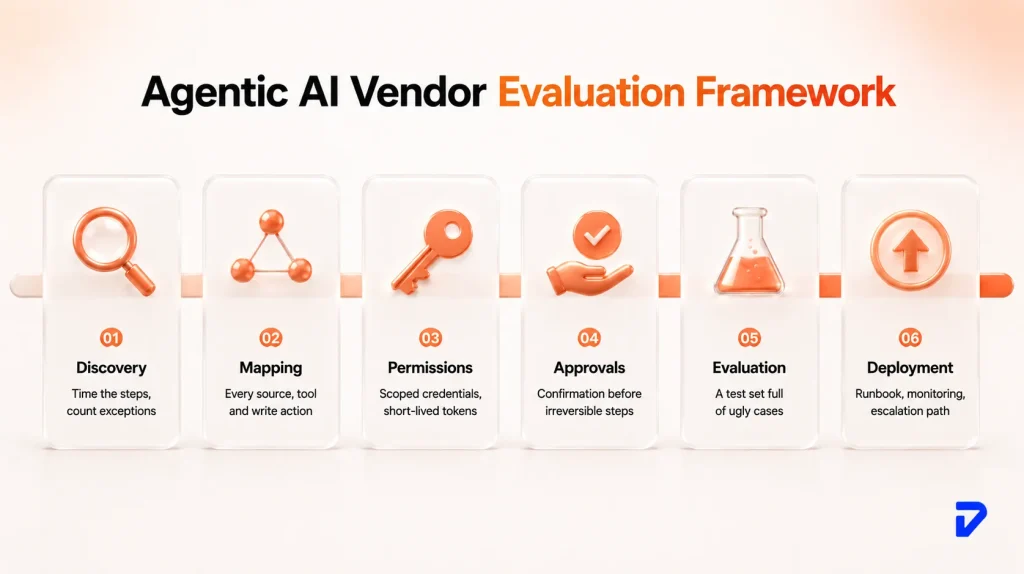
Vendor capability is easiest to read from sequence, not slides. Ask how an agentic AI development company works before the build starts, and the strong ones describe the same six-stage arc every time: discovery, mapping, permissions, approvals, evaluation, then deployment and support. IDC expects agentic AI to exceed 26% of worldwide IT spending and reach $1.3 trillion by 2029, so the money is arriving fast. A disciplined arc is what separates the buyers who capture that value from the ones who fund a stalled pilot.
Workflow Discovery Before Any Build Begins
Discovery decides whether the project is worth doing. A serious partner sits with the people doing the work, times the steps, and counts the exceptions before writing code. One distributor learned that 70% of its quote delays came from a single pricing approval, not from quote generation. That finding reshaped the build and cut the budget substantially.
Data, Tool, and API Mapping
Agents are only as capable as the systems they can reach. A proper map lists every source the agent must read, every tool it must call, and every write action it needs, with rate limits and auth method noted. Skip this step, and surprises land in week six, when your ERP exposes no write endpoint at all.
Permission Design and Least-Privilege Access
Permissions are where agent projects quietly become security projects. A capable partner scopes credentials per tool, issues short-lived tokens, and keeps the agent off any system it does not strictly need. When it comes to autonomous software touching live records, least privilege is the single design choice that limits how much damage a confused agent can do.
Human-in-the-Loop Approval for High-Stakes Actions
Approval gates are a design requirement, not a policy memo. Anything irreversible, expensive, or customer-facing should route through a human confirmation step before the agent commits it. A good partner will map which actions need a gate and which can run unattended, then build the interface that lets your team approve, edit, or halt a step in seconds.
Evaluation, Observability, and Logging
Evaluation tells you the agent works; observability tells you it still does. Strong partners build a test set of real cases, including the ugly ones, and score every release against it. They also ship traces showing each step, tool call, and decision. Pinnasys covers this ground in its guide to AI agent observability practices.
Deployment, Ownership, and Post-Launch Support
Launch is the midpoint, not the finish. Ask who monitors the agent at 2 a.m., who fixes it when a vendor API changes, and what the handover package contains. The answer should include a runbook, monitoring dashboards, and a named escalation path. AI integration and governance work is where most of the multi-year cost actually sits.
The Five Questions to Ask Every Vendor in the Room
Five questions separate a builder from a demo shop, and none require technical fluency to judge. In Carnegie Mellon’s TheAgentCompany benchmark, the strongest agent completed only about 30% of realistic office tasks on its own, which is a useful reminder that autonomy is still uneven. A good agentic AI development company will raise that limitation before you do, while a weak one talks only about the tasks that work.
How Do You Test Beyond the Happy Path?
Demos run the clean case. Production runs the customer who orders a discontinued part with a lapsed credit line. Ask for the test set, then ask how many cases in it are exceptions. A partner who has thought about this describes timeouts, malformed responses, partial failures, and what the agent does when a tool simply stops answering.
What Guardrails Exist Before the AI Agent Can Act?
Guardrails are the rules that constrain what an agent may do, regardless of what it decides. Look for spending ceilings, step budgets, allowlists of permitted tools, and validation on every argument passed to a write action. A vendor who answers this with “the model is well prompted” has told you the guardrails do not exist yet.
How Will I See What the AI Agent Did?
Auditability is non-negotiable once agents touch records. You want a trace per run showing the input, the plan, each tool call with its parameters, and the final action. Your operations lead should answer “why did it do that?” in under two minutes without calling the vendor. Anything slower becomes a support burden you inherit.
Who Reviews the Code Before It Ships?
Ask about the human review process, not the tooling. Strong shops describe pull request review by a second engineer, automated tests in the pipeline, and a staging environment that mirrors production data shape. Weak shops describe a lead developer who checks everything alone. That answer signals both a single point of failure and a delivery bottleneck.
Who Owns the Code, Prompts, and Integrations When We’re Done?
Ownership should be plain in the contract, covering source code, prompts, evaluation sets, and integration configuration. Prompts matter more than buyers expect, since they encode months of tuning against your specific edge cases. Whether a vendor treats prompts as your asset or as its proprietary method tells you if you are buying a system or renting one.
Not sure whether your workflow needs a true agent or simpler automation?
Pinnasys runs a scoped discovery before any build, so you leave with a written recommendation and a real cost picture rather than a demo.
Red Flags That Should End the Conversation
Some answers are disqualifying on their own. The OECD tracks real-world AI incidents and hazards precisely because autonomous systems cause measurable harm as adoption widens, and every red flag below traces back to that risk surface. When you hire an agentic AI developer or engage a full team, treat these as stop conditions rather than negotiating points.
A Quote That’s Suspiciously Lower Than Everyone Else’s
Price gaps of 60% or more usually mean scope gaps, not efficiency. The cheap quote has typically dropped discovery, evaluation, observability, and post-launch support, which together are most of the real work. Ask the low bidder to price those four items separately. The revised number often lands close to the quotes you thought were expensive.
No Human Oversight on Irreversible Actions
Full autonomy sounds impressive in a sales meeting and reads as negligence in an incident report. If a vendor proposes an agent that issues payments, deletes records, or emails customers with no confirmation step, they have not run one of these systems in a regulated environment. Push back once, then walk if the position holds.
No Monitoring or Observability Plan
A vendor without alerting thresholds, error dashboards, and a defined on-call path is asking you to discover failures through customer complaints. That is a slow, expensive detection system, and it erodes trust before anyone files a ticket. Insist on seeing the monitoring dashboard they would hand you, not a promise that one exists somewhere.
Vague Answers on Code Ownership and Lock-In
Ambiguity here is rarely accidental. Watch for phrases like “shared IP,” “platform licensing,” or “our framework” offered without a definition. Ask one concrete question: if we ended this contract next quarter, what exactly could another team pick up and run? A partner comfortable with the answer gives it in a sentence.
A Vendor Who Never Tells You Not to Build
Roughly half of proposed agent use cases should be simpler automation, a better report, or a fixed process. A partner who agrees with every idea is optimizing for contract value rather than outcomes. The most useful vendor conversation you will have this year is the one where somebody talks you out of a project.
How to Understand Engagement Models and Pricing Structures?
Contract structure shapes incentives more than the headline number does. Most work with an agentic AI development company falls into three shapes, and the right one depends on how clearly you can describe the problem today. Pinnasys has published a typical mid-size agentic build range of $30,000 to $150,000 for initial build and integration, which gives you an anchor when a quote lands far outside it.
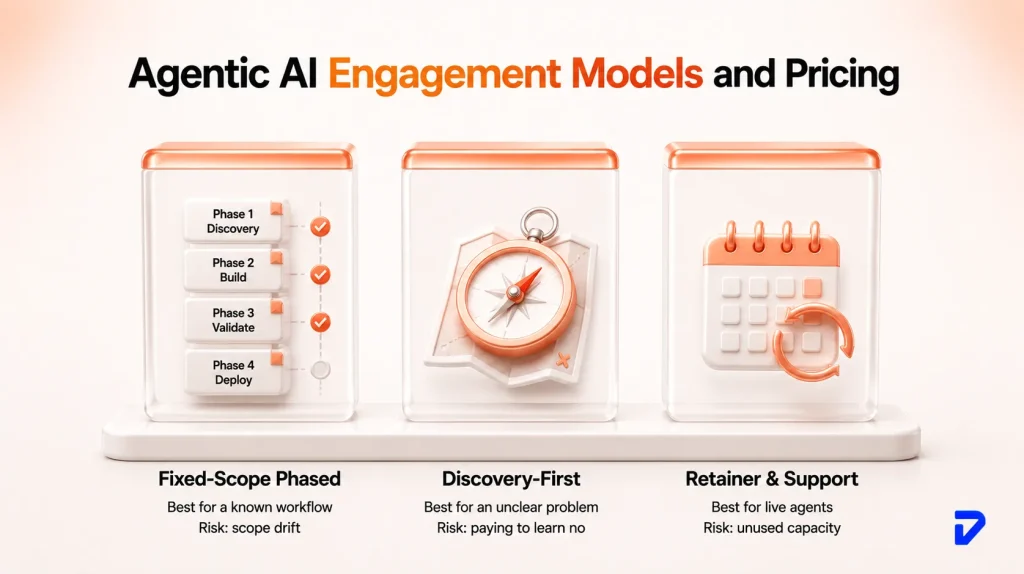
| Model | Best Fit | What You Commit To | Main Risk |
| Fixed-scope phased build | A defined workflow with known rules | A priced phase, gated at each stage | Scope drift when discovery was thin |
| Discovery-first engagement | An unclear problem or messy data | A short paid assessment | Paying to learn the answer is no |
| Retainer and managed support | Live agents in daily operation | A monthly capacity block | Paying for capacity you do not use |
Fixed-Scope, Phased Builds
Phased pricing works when the workflow is already understood. Each phase carries its own price, deliverable, and go/no-go gate, so you can stop after phase one without losing the work. Insist that phase one ends with something testable rather than a document, because a slide deck is not a deliverable you can evaluate against a baseline.
Discovery-First Engagements for Undefined Problems
Paid discovery suits messy starting points, and it costs far less than a wrong build. Two to four weeks typically yields a workflow map, a data readiness view, a recommended architecture, and a build estimate. The output should be portable, meaning you could hand it to a different vendor. That portability tests whether the discovery was honest.
Retainer and Managed Support Models
Retainers cover the ongoing reality of running agents: model updates, API changes, prompt drift, and new edge cases. Expect monthly costs in the range of 15% to 25% of the original build for an actively used system. Ask what the retainer includes by hours and by response time, since “support” on its own means very little in a contract.
What This Checklist Means for Each Person in the Room
Agent purchases are buying-committee decisions. Forrester’s 2026 State of Business Buying found that a typical purchase now involves 13 internal stakeholders and 9 external influencers, each arriving with a different priority and a different veto. The checklist reads differently depending on which seat you occupy, so the section below splits it by role. Alignment across these four views is usually what unblocks a stalled evaluation.
For the Operations Leader Who Owns the Workflow
You care whether the agent handles the exceptions your team handles today. Bring your ugliest three cases to the vendor meeting and ask how each one would flow. Insist on joining discovery sessions personally, since a workflow described secondhand always looks cleaner than the real thing. Your baseline number decides whether the pilot succeeded.
For IT and Security
Your questions are about blast radius. Ask which systems the agent touches, what credentials it holds, how long those tokens live, and what happens when a tool call fails midway. Request the permission matrix in writing before signature. Treat any agent with standing admin access as a finding, no matter how the vendor justifies it.
For Finance and Procurement
Two-year total cost matters more than the build quote. Model inference usage, hosting, monitoring tooling, and the support retainer together often exceed the initial build by the second year. Push for phase gates with genuine exit rights instead of a single lump sum. Ownership language belongs in the first contract, not a later amendment.
For the Executive Signing Off
Your job is to confirm the problem is worth solving, and the measure is honest. Ask what the workflow costs today in hours or errors, and what number would count as success. Then ask the vendor what would make them recommend against the project. A partner with no such answer is telling you something worth hearing.
How to De-Risk Your First Hire?
First engagements are as much a vendor test as a build. The US Government Accountability Office frames AI oversight around governance, data, performance, and monitoring, and a small project lets you check all four cheaply. You learn how to hire an agentic AI developer far faster when stakes are contained, the metric is agreed in advance, and the exit stays clean.
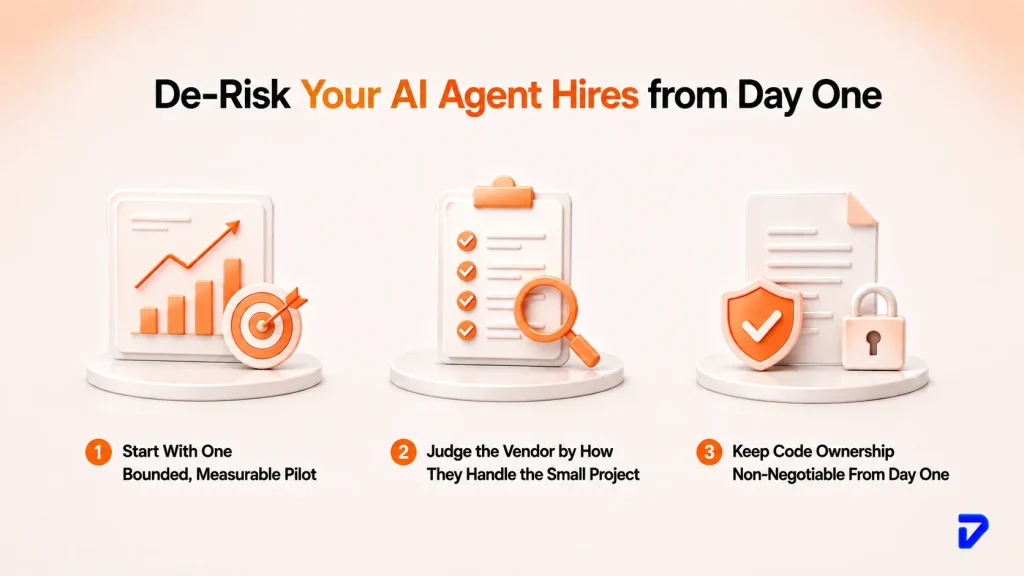
Start With One Bounded, Measurable Pilot
Pick a workflow with a clear baseline number: hours spent, error rate, or cycle time. Keep it to one department and one system boundary. Agree the success threshold before kickoff, in writing. A pilot without a pre-agreed number becomes a debate about whether it worked, and those debates rarely end in a second phase.
Judge the Vendor by How They Handle the Small Project
Small projects reveal working habits that sales calls hide. Watch how they handle the first surprise, whether estimates hold, and how quickly bad news reaches you. A partner who flags a problem in week two is worth more than one who reports green status right up to the deadline. That behavior predicts the larger engagement accurately.
Keep Code Ownership Non-Negotiable From Day One
Ownership terms are easiest to secure before any code exists. Put source, prompts, evaluation data, and integration configuration in the first contract, not the renewal. Vendors who intend to keep you will resist early and concede late, once switching costs have grown. The negotiation only gets harder from the day work begins.
What Sets Pinnasys Apart as an Agentic AI Development Partner
Claims are cheap, so this section is written to be checked. Pinnasys has shipped production systems since 2016 and works as an agentic AI development company for mid-market operators who need working systems rather than experiments. Its stated measure is hours saved, errors reduced, and revenue unlocked. The Pinnasys team applies the same evaluation framework described above to its own work, which is the only fair standard to hold a vendor to.
A Governance-First Build Process, Not a Demo-First One
Every engagement starts with permissions, approval gates, and evaluation criteria rather than a prototype. That order feels slower in week one and much faster by month three, because the rework loop never opens. The team’s comparison of agentic AI and traditional AI sets out where autonomy genuinely earns its cost and where it does not.
A Transparent, Phased Engagement Model
Work is scoped in gated phases with a price, a deliverable, and a stop point attached to each. Clients own the source, prompts, and integration configuration from the first phase onward. Where the problem is still fuzzy, an AI consulting and roadmap engagement precedes any build, so the decision to proceed rests on evidence.
Proof Measured in Hours Saved, Not Demo Applause
[DRAFT: CONFIRM CLIENT NAME, WORKFLOW, AND VERIFIED METRICS BEFORE PUBLISHING] One mid-market client moved a manual, multi-system workflow onto a governed agent, with human approval required on every high-value action. Total handling time fell sharply, and each step left an audit trail the operations lead could read without help. Comparable engagements sit in the Pinnasys case studies library, with metrics supplied by the clients themselves.
The Bottom Line
Vendor selection carries more weight than any other choice in an agent program, and it turns on process rather than on price. An agentic AI development company worth hiring will show you its sourcing credibility, discovery method, permission model, approval gates, observability plan, and ownership terms before it shows you a prototype.
Build the shortlist from three independent sources, judge those six things, run one bounded pilot, and keep the code in your name from day one. Pinnasys builds and runs these systems for mid-market operators, and its AI development services page sets out how engagements are structured.
Key Takeaways
- A shortlist confirmed by only one source is a marketing result, not research.
- Agent washing is common, so verify write access and tool use before believing claims.
- Discovery quality predicts project outcomes better than hourly rate or team size.
- Least-privilege permissions and approval gates belong in the architecture, not a memo.
- Code, prompts, and evaluation sets should be contractually yours from phase one.
Frequently Asked Questions on Agentic AI Development
How long does a typical agentic AI project take from kickoff to production?
Most single-workflow builds run 8 to 16 weeks, split across discovery, build, evaluation, and a supervised rollout. Multi-agent orchestration across several systems commonly extends past six months, largely because of integration and access approvals.
Where should we start looking for a credible vendor?
Budget one to two weeks for sourcing before any outreach. Aim for six to eight candidate firms, then narrow to three for calls. Filter directory reviews to the last 18 months and to companies inside your revenue band.
Do we need an in-house AI or engineering team to work with a development partner?
No, though you need a workflow owner who can answer process questions and approve exceptions. Expect to commit roughly four to six hours weekly during discovery. IT involvement is required for credentials, API access, and security review.
What’s the real difference between buying an AI agent platform and hiring a custom development partner?
Platforms give faster setup with fixed workflow assumptions and recurring license fees. A custom partner fits your exceptions and legacy systems, costs more upfront, and leaves you owning the code. Many mid-market teams run both.
What ongoing costs should we budget for after the initial build ships?
Plan for model inference usage, hosting, monitoring tooling, and a support retainer, typically 15% to 25% of build cost annually. Retrieval-augmented generation systems add data refresh costs. Vendor API changes drive most unplanned maintenance work.
How do we know if our use case actually needs an agent, versus simpler automation or a chatbot?
Agents earn their cost when work is variable, spans several tools, and needs judgment on exceptions. Stable, rule-based tasks suit deterministic automation. A question-answering job with no write actions is a conversational AI problem.





Prakash C. Saini
Prakash Saini is the Founder & CEO of Pinnasys. With over a decade in digital transformation and building production systems, he grew an engineering team from 2 to 50 people and has led the delivery of 100+ production digital systems. Products built under his leadership have raised millions in funding and generated over $50 million in revenue. He holds an Executive MBA from IIM Kozhikode and today leads the AI engineering team at Pinnasys.