


RPA has been helping businesses automate repetitive work for years. From processing invoices to moving data between systems, it became a reliable way to improve efficiency and reduce manual effort. Yet modern business processes rarely stay the same for long.
Agentic AI is now changing the conversation around enterprise automation. Systems that can reason, adapt, and make decisions on their own have led many organizations to ask a pressing question: Is RPA dead, or is automation simply evolving?
The truth is that the answer falls somewhere in the middle. RPA is still incredibly powerful for structured, rules-based work, and Agentic Process Automation injects the intelligence into processes where context and judgment are key. And when you combine them, you get the future of automation, working as it should be.
How Did Automation Evolve in Enterprise Environments?
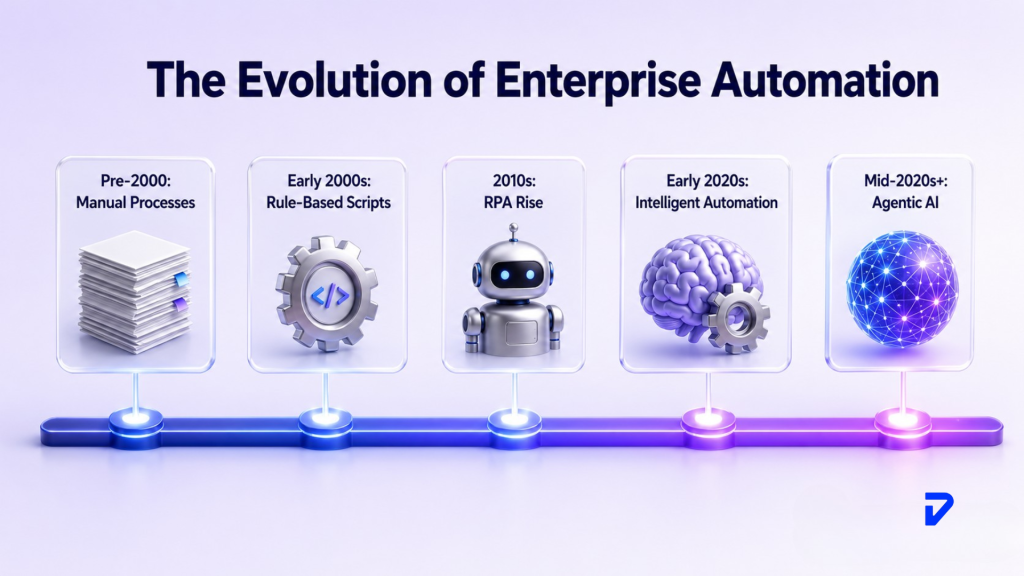
Before 2000: Manual Processes
Most business operations relied on employees to enter data, process paperwork, and move information between systems manually. As companies grew, these repetitive tasks became increasingly difficult to manage at scale.
Early 2000s: Rule-Based Automation
Organizations began using scripts, macros, and workflow tools to automate simple, repetitive actions. These solutions reduced manual effort but lacked flexibility and could only handle predictable tasks.
2010s: The Rise of RPA
Robotic Process Automation (RPA) became a popular choice for automating structured workflows. Software bots could log into applications, transfer data, process invoices, and complete repetitive tasks much faster than humans.
Early 2020s: Intelligent Process Automation
Businesses started combining RPA with AI technologies such as machine learning, natural language processing, and document intelligence. This enabled automation of workflows involving emails, documents, and other unstructured data.
Mid-2020s and Beyond: Agentic Process Automation
Modern enterprises are now exploring Agentic AI systems that can reason, plan, adapt, and make decisions independently. Rather than following predefined instructions, these systems focus on achieving business goals while adjusting to changing conditions.
What is RPA (Robotic Process Automation)?
Robotic Process Automation (RPA) is a technology that uses software bots to automate repetitive, rule-based tasks that humans typically perform on digital systems. These bots can log into applications, extract data, move information between platforms, generate reports, and complete workflows without manual intervention.
Key Characteristics of RPA
- Works with Existing Systems – The bots are able to work with and communicate between applications the same way employees do, generally without needing complex integrations.
- Follows a Rule-Based Process – All of the actions that are performed by a bot follow a pre-written set of instructions.
- Provides Reliable and Consistent Outputs – Processes are performed with 100 percent consistency to minimize the chances of human errors.
- Can Work in Bulk – RPA is effective for processes that involve a great deal of repetitive work.
- Runs Continuously – Bots do not require breaks, so can continue to operate on your processes around the clock.
- Scales Quickly – Additional bots can be deployed easily as the volume of work increases.
RPA Limitations
RPA is ideal when the processes you are looking to automate are structured and consistent. It’s when processes become much more dynamic, requiring judgment and adaptability and subject to change, that things get more challenging. Some of the limitations of RPA are:
- Changes Can Break Automations – Even a small interface update can disrupt a bot’s workflow.
- Limited Ability to Handle Exceptions – Unexpected scenarios often require human intervention.
- Relies on Structured Inputs – Emails, conversations, images, and documents can be difficult for traditional bots to interpret.
- Requires Ongoing Maintenance – Bots must be updated whenever business rules or applications change.
- Cannot Learn from Experience – Improvements typically require manual adjustments by developers.
- Struggles with Context – Bots can follow instructions, but they cannot understand the intent behind a task.
What is Replacing RPA?
The short answer is that nothing is completely replacing RPA. Instead, enterprise automation is evolving beyond rule-based workflows. Another popular trend is to adopt agentic process automation, in which autonomous agents driven by AI analyze information and make intelligent choices.
Instead of being driven by specific directions, these agents act toward the end result.
That change has a lot to do with the real world in which we work. Businesses make changes all the time, conversations with customers are unstructured, and processes often involve judgments and actions that can’t be programmed using rigid rules.
This does not mean the death of RPA. Many of those primarily focused on RPA will continue to use their robots to do their work for routine, rule-based, structured jobs and let the agentic AI do the work that requires human intervention, handle the exceptions, apply judgment, and orchestrate workflows.
Agentic Process Automation Explained – The Future of Enterprise Automation
APA uses AI agents and automation capabilities within business workflows for higher autonomy and responsiveness. Instead of following explicit rules, they understand intentions, decide actions, and adapt them as circumstances evolve. The result is that organizations can now automate complex business processes that always depended on human judgment and interaction.
Key Characteristics of Agentic Automation
- Agentic systems work toward a defined goal and determine the most effective way to achieve it.
- They can adjust their actions when business rules, workflows, or external conditions change.
- Information from emails, documents, customer conversations, and other unstructured sources can be used to support decisions.
- Multiple applications and business systems can be coordinated within a single workflow without constant human oversight.
- Unexpected scenarios can often be handled automatically, reducing the number of manual interventions required.
- Human teams remain involved for approvals, governance, and high-impact decisions where oversight is important.
- Performance improves over time as the system learns from feedback, outcomes, and previous interactions.
How Does Intelligent Process Automation Work?
According to IBM Research, intelligent automation combines AI capabilities with process automation to help organizations manage increasingly complex business operations. Rather than simply following instructions, these systems can evaluate information, make decisions, and take action based on a business objective.
It Starts With a Business Goal
Every workflow begins with an objective, such as processing an insurance claim, approving a loan application, or responding to a customer request.
Relevant Information Is Gathered
The system collects data from multiple sources, including documents, emails, databases, business applications, and customer interactions.
The Context Is Evaluated
AI models analyze the available information, identify patterns, and determine the most appropriate next step based on the situation.
Actions Are Taken
Tasks such as updating records, sending notifications, generating reports, or triggering additional workflows are completed automatically.
Exceptions Are Managed
When unusual situations arise, the system can either resolve them using available context or route them to a human reviewer for further assessment.
The Process Continues to Improve
Feedback from completed workflows helps improve future decisions, making automation more accurate and effective over time.
Real-Life Case Studies of Agentic Automation
Sintra AI
Sintra AI illustrates how AI agents may contribute to daily business workflows without strict pre-determined processes. Its AI agents handle daily work such as creating content, marketing tasks, user outreach, and business planning, providing an example of how agent-centric platforms can handle multi-step actions and also adapt to user aims and fluctuating tasks.
BookingBee
BookingBee applies agentic automation to appointment scheduling and customer interactions. Instead of simply booking meetings, the platform can engage with customers, qualify inquiries, coordinate availability, and manage scheduling workflows automatically, reducing the amount of manual effort required from staff.
Step-by-Step Process to Transition From RPA to Agentic AI
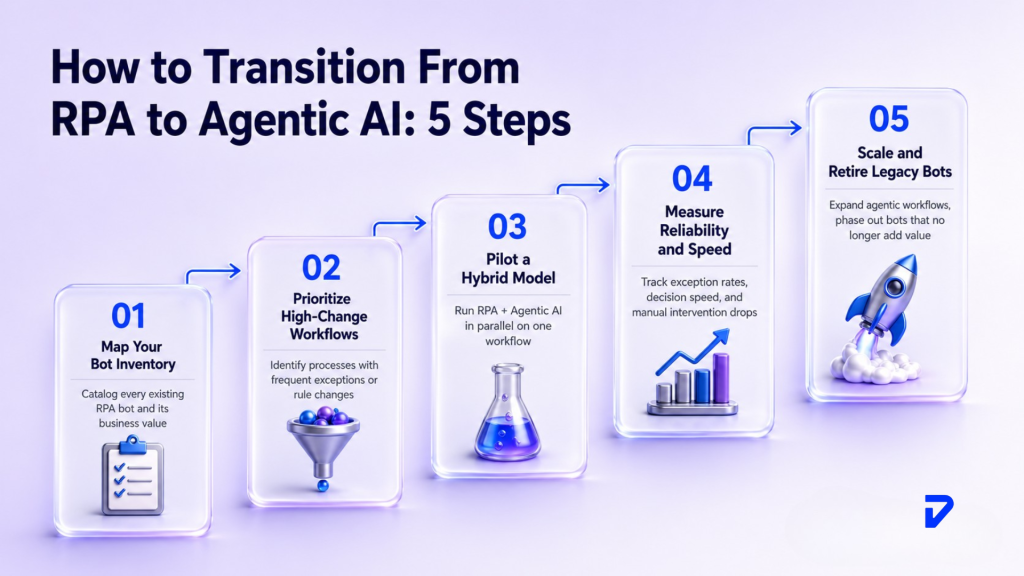
Moving from RPA to Agentic AI is not about replacing every bot overnight. The most successful organizations take a gradual approach, building on their existing automation investments while introducing more intelligent capabilities where they create the most value.
1. Map Existing Bot Inventory
First, understand what you currently possess. Catalog every RPA bot, which business process it supports, and the value it provides to the business. This identifies the automations that run without a hitch and those that often need hands-on intervention or support.
2. Prioritize High-Change Workflows
Once the inventory is mapped, look for processes that change frequently or generate a high number of exceptions. These are often the workflows where traditional bots struggle the most. Customer support, claims processing, document-heavy operations, and approval workflows are common starting points because they require more flexibility than rule-based automation can provide.
3. Pilot Hybrid Agentic RPA
Rather than replacing existing bots, begin with a hybrid model. Let RPA continue handling repetitive, structured tasks while AI agents manage decision-making, exception handling, and unstructured data. This approach minimizes risk while allowing teams to see how agentic capabilities perform in real business scenarios.
4. Measure Reliability and Speed Gains
After the pilot is running, compare the results against the previous process. Are fewer workflows breaking when systems change? Has manual intervention decreased? Are decisions being made faster without sacrificing accuracy? Measuring these improvements helps build confidence and creates a clear business case for wider adoption.
5. Scale and Retire Legacy Bots
Since agentic workflows demonstrate their effectiveness, successful implementations can be rolled out in multiple business units and functional areas of a company. This can mean that at some point the need for certain legacy bots will eventually be obsolete, while other existing bots have a continued place in the hybrid automation paradigm.
What is the Difference Between RPA and Agentic AI?
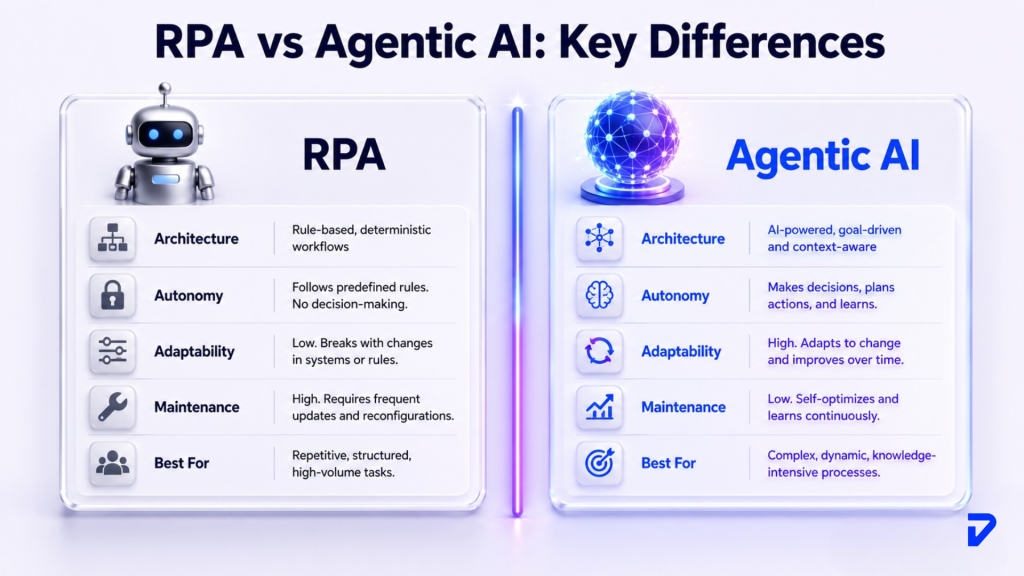
| Area | RPA | Agentic AI |
| Architecture | Built around predefined rules, workflows, and scripts. | Built around goals, reasoning, and autonomous decision-making. |
| Autonomy and Decision Making | Follows instructions exactly as programmed. | Evaluates context and determines the best action to achieve an objective. |
| System Integration | Connects well with structured applications and legacy systems. | Works across multiple systems, data sources, APIs, and digital tools. |
| Adaptability to Systems | May require updates when applications, interfaces, or workflows change. | Can adapt more effectively to changing environments and business conditions. |
| Maintenance Required | Often requires ongoing monitoring and bot updates. | Generally requires less workflow-specific maintenance but depends on governance and model oversight. |
| Cost & ROI | Lower upfront investment and faster returns for repetitive tasks. | Higher initial investment but greater long-term value for complex and dynamic workflows. |
When to Use RPA vs Agentic AI
So, although RPA’s agentive capabilities are exciting, not all workflows require an agent. Some processes benefit from the predictability of an RPA agent, and some processes may take advantage of the flexibility of AI agent reasoning abilities.
A simple way to think about it is this:
- Use RPA when the process is stable and predictable.
- Use Agentic AI when the process involves change, context, or decision-making.
Use Cases of RPA
RPA remains an excellent choice for repetitive, rules-driven processes where the same actions are performed repeatedly.
- Processing invoices and purchase orders
- Payroll administration and employee record updates
- Data entry between business applications
- Customer onboarding workflows
- Report generation and distribution
- Bank account reconciliation
- Compliance checks based on predefined rules
- Inventory and order status updates
- Form validation and data extraction from structured sources
- Routine system maintenance tasks
Use Cases of Agentic Process Automation
Agentic automation is better suited to workflows where decisions, exceptions, and changing conditions are part of everyday operations.
- Resolving customer service requests across multiple channels
- Reviewing and processing complex insurance claims
- Detecting and responding to potential fraud in real time
- Managing IT incidents and recommending solutions
- Screening job applicants and coordinating hiring workflows
- Processing contracts and identifying risks or missing information
- Handling document-heavy approval processes
- Coordinating supply chain disruptions and vendor communications
- Personalizing customer interactions based on context and history
- Managing end-to-end workflows that span multiple departments
The Best Approach May Be Both
In many organizations, the most effective solution is not choosing one over the other. RPA can handle repetitive execution, while Agentic AI manages decisions, exceptions, and workflow orchestration.
For example, an RPA bot might collect data from multiple systems, while an AI agent analyzes that information, determines the next action, and coordinates the remaining steps. This combination allows businesses to achieve both efficiency and adaptability within the same workflow.
Ready to modernize your automation strategy?
Contact Pinnasys and discover how intelligent automation can create measurable business impact.
Is RPA Dead?
Not at all. RPA continues to be a trusted automation tool for handling repetitive, rule-based processes across finance, HR, operations, and customer service. Industry analysts at Gartner still view RPA as an important part of modern automation strategies.
What is changing is how RPA is being used. Instead of working alone, it is increasingly paired with agentic AI to handle complex decisions, exceptions, and unstructured data. The future of automation is not about replacing RPA; it’s about making it smarter.
Hybrid Automation Setups – RPA + Agentic AI
The future of automation isn’t about choosing between RPA and Agentic AI. Most organizations are discovering that the greatest value comes from combining the strengths of both technologies within the same workflow.
RPA is highly effective at handling repetitive, rules-based tasks such as data entry, document processing, and system updates. Agentic AI adds another layer of intelligence by evaluating context, managing exceptions, and making decisions when a process doesn’t follow a predictable path.
Consider a loan application workflow. An RPA bot can collect customer information and validate documents, while an AI agent assesses risk factors, identifies missing details, and recommends the next course of action. This hybrid approach helps businesses improve efficiency without sacrificing the flexibility needed to handle real-world complexity.
Key Takeaways:
- RPA remains highly effective for repetitive, rule-based processes that require speed, accuracy, and consistency.
- Agentic AI goes beyond task automation by making decisions, adapting to change, and handling complex workflows.
- Modern enterprises are increasingly adopting hybrid automation models that combine RPA with Agentic AI.
- High-change processes involving unstructured data and frequent exceptions are often better suited for agentic automation.
- The future of enterprise automation is not about replacing RPA; it’s about augmenting it with intelligent, goal-driven AI capabilities.
The Bottom Line
RPA helped businesses automate repetitive work and remains a valuable part of many enterprise operations today. As workflows become more dynamic and data becomes less structured, Agentic AI is helping organizations move beyond task automation toward systems that can reason, adapt, and make decisions in real time.
At Pinnasys, we believe the future of automation lies in combining operational efficiency with intelligent decision-making. Through our Agentic AI Services, we help businesses build AI-powered workflows that automate complex processes, improve productivity, and scale with changing business needs.
Frequently Asked Questions About Agentic Process Automation and RPA
Can Agentic AI Handle MFA and CAPTCHA Reliably?
Agentic AI can work with multi-factor authentication (MFA) workflows when proper integrations and security controls are in place. CAPTCHA remains more challenging because it is specifically designed to prevent automated access, which often requires human verification or approved third-party authentication methods.
How Does Credential Security Work with Agentic AI?
Most enterprise-grade agentic systems use secure credential vaults, role-based access controls, encryption, and audit trails to protect sensitive information. Access permissions can be configured to ensure AI agents only interact with systems and data necessary for their assigned tasks.
Will Agentic AI Replace RPA Completely?
Not likely. RPA remains highly effective for structured, repetitive tasks that follow predictable rules. Many organizations are adopting a hybrid approach where RPA handles routine execution while Agentic AI manages decision-making, exceptions, and complex workflows.
What are the Examples of Agentic Automation and RPA?
Examples of Agentic Automation
- Sintra AI – AI-powered business assistants that support marketing, content creation, and operational tasks.
- BookingBee – AI-driven appointment scheduling and customer engagement workflows.
- AI-powered fraud detection systems used by financial institutions to identify and respond to suspicious activity in real time.
- Intelligent customer support agents that can resolve requests across multiple channels.
Examples of RPA
- Invoice and purchase order processing.
- Employee onboarding and payroll administration.
- Data migration between business applications.
- Report generation and compliance documentation.
- Customer record updates across CRM and ERP systems.
Is Agentic AI More Difficult to Regulate Compared to RPA?
In many cases, yes. RPA follows predefined rules, making its actions easier to track and audit. Agentic AI can make context-based decisions, which introduces additional governance considerations around transparency, accountability, security, and compliance. Strong oversight frameworks and human review processes help organizations maintain control while benefiting from greater automation.




Prakash C. Saini
Prakash Saini is the Founder & CEO of Pinnasys. With over a decade in digital transformation and building production systems, he grew an engineering team from 2 to 50 people and has led the delivery of 100+ production digital systems. Products built under his leadership have raised millions in funding and generated over $50 million in revenue. He holds an Executive MBA from IIM Kozhikode and today leads the AI engineering team at Pinnasys.