


Agentic AI market trends in 2026 show rapid adoption of autonomous multi-agent systems across enterprises. This article explores key growth drivers, leading industries, ROI trends, and what distinguishes successful production deployments from failed AI pilots.
The enterprise approach to artificial intelligence is shifting fast. As agentic AI market trends accelerate, organizations are moving away from prompt-dependent tools toward autonomous, multi-agent systems. These systems plan, act, and adapt across business workflows without constant human intervention. For leadership teams, the window to act is narrowing. Organisations that move agentic frameworks from pilot into production this year will secure a real operational edge.
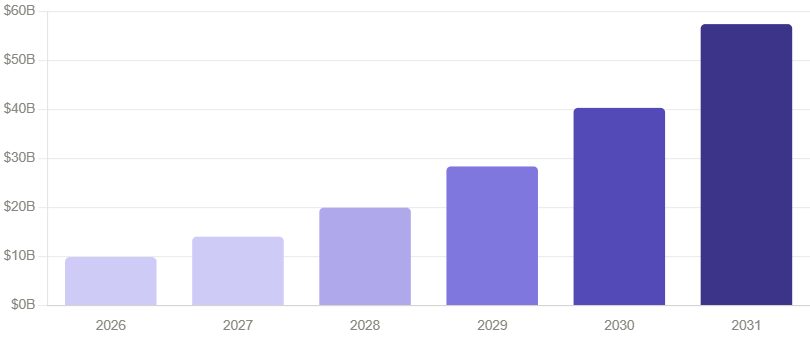
The market data reflects this urgency. According to Mordor Intelligence, the agentic AI market is valued at USD 9.89 billion in 2026 and is projected to reach USD 57.42 billion by 2031, at a CAGR of 42.14%.
This article covers the forces driving that growth, where organisations are seeing the strongest ROI, which industries are leading adoption, and what separates production-ready agents from stalled pilots.
Where the Agentic AI Market Stands Right Now
The agentic AI market is still in an early maturity phase, where enterprises are actively experimenting but struggling to scale deployments into production-grade systems. According to ServiceNow’s Enterprise AI Maturity Index 2025, AI innovation is advancing faster than organizations’ ability to operationalize it across workflows and governance structures.
Despite significant AI investment and growing interest in agentic AI, most organizations remain in early adoption stages, revealing an execution and implementation gap rather than a technology constraint.
As a result, the key challenge in 2026 is not building AI agents, but embedding them into secure, governed, and scalable enterprise systems that can reliably deliver measurable business value.
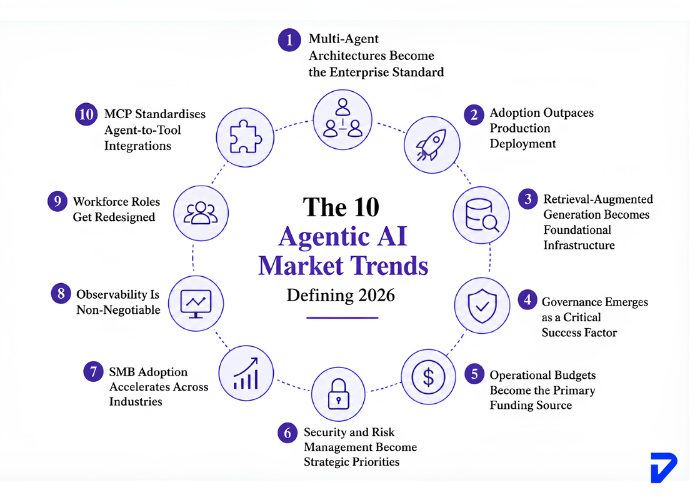
The 10 Agentic AI Market Trends Defining 2026
Agentic AI in 2026 is shifting to enterprise-scale adoption driven by multi-agent systems and orchestration, with the following 10 agentic AI market trends defining how it is built and deployed.
Trend 1: Multi-Agent Architectures Become the Enterprise Standard
Multi-agent architectures are becoming the enterprise standard. Single LLM deployments are no longer the target. Enterprises are wiring together networks of specialist agents, each responsible for one function, connected by an orchestration layer.
What that architecture looks like in practice:
- One agent handles document extraction and classification
- A second runs compliance cross-referencing against live regulatory databases
- A third route of exceptions to the right human reviewer
- An orchestration layer manages memory, tool calls, and handoffs across all three
Frameworks like LangGraph, AutoGen, and CrewAI now ship these capabilities out of the box.
Trend 2: Adoption Outpaces Production Deployment
Adoption is outpacing production deployment, and the gap is widening. Most deployments never make it past the pilot stage. Gartner’s 2026 hype cycle for Agentic AI found that only 17% of organisations have deployed AI agents to date, yet more than 60% expect to do so within two years. The gap is not a capability problem. It is an execution and architecture problem.
Three patterns explain why most deployments stall before production:
- Data access: Agents cannot operate reliably on fragmented or ungoverned internal data
- Integration complexity: Connecting agents to live systems consistently takes longer than model work
- Accountability gaps: Organisations without clear AI output ownership stall at the approval stage
The organisations that close this gap in 2026 will capture disproportionate competitive advantage.
Trend 3: Retrieval-Augmented Generation Becomes Foundational Infrastructure
Retrieval-augmented generation (RAG) has moved from an advanced technique to table stakes. Enterprises are no longer asking whether to use RAG. They are asking how to build a grounding infrastructure robust enough for production.
IDC research found that companies failing to build AI-ready data foundations risk a 20% productivity loss by 2027.
The checklist for a production-grade grounding strategy:
- A vector database storing embeddings of internal knowledge
- A retrieval pipeline that fetches relevant documents at query time
- Source validation logic that filters out stale or unauthorised data
- Output attribution so every agent response can be traced back to a source
Teams skipping RAG are not running production agents. They are running expensive demos.
Trend 4: Governance Emerges as a Critical Success Factor
Governance is emerging as the critical success factor separating sustainable deployments from ones that stall or fail. Many organizations still lack mature governance models for autonomous agents. This creates a gap between rapid deployment and the ability to safely manage, monitor, and control agent behavior at scale, especially when failures or unexpected outcomes occur.
A production governance framework covers three areas:
- Guardrail architecture: Defined limits on agent actions, with escalation paths and hard stops
- Audit logging: Every tool call, decision branch, and escalation recorded and queryable
- Accountability ownership: A named internal owner for every agent pipeline in production
Without all three, no governance team will approve the system for scale.
Trend 5: Operational Budgets Become the Primary Funding Source
Operational budgets are becoming the primary funding source for agentic AI. Investment is moving out of R&D and into the hands of COOs and Heads of Operations.
PwC’s May 2025 survey of 300 senior executives found that 88% plan to increase AI-related budgets in the next 12 months, with agentic AI’s impact on operational throughput cited as the primary driver.
What does that mean for deployment priorities:
- Agents must show measurable output against an operational KPI before they scale
- Infrastructure costs and integration work must be in the business case from day one
- Pilots without a defined path to production get cut faster than before
Operations sponsorship accelerates deployment when the business case is clear. It kills projects faster when it is not.
Trend 6: Security and Risk Management Become Strategic Priorities
Security is rapidly becoming a strategic priority for agentic AI. Cybersecurity teams increasingly view autonomous systems as a significant emerging attack surface, alongside risks like deepfakes and vulnerable APIs. Unlike traditional models, agentic systems take actions rather than just generating responses, meaning that a compromised agent can execute harmful operations at machine speed.
What a production security architecture must include:
- Identity governance for every non-human agent accessing business systems
- Prompt injection defences built into retrieval pipelines, not bolted on after deployment
- A tool called sandboxing so agents cannot access systems outside their defined scope
- Anomaly detection that flags unusual action patterns before they cause damage
Only 29% of organisations reported being prepared to secure their agentic AI deployments.
Trend 7: SMB Adoption Accelerates Across Industries
SMBs are closing the agentic AI adoption gap with enterprises faster than expected. Smaller and mid-market organizations are increasingly adopting agentic AI due to the availability of turnkey platforms that reduce implementation complexity. Platforms like Salesforce Agentforce and Microsoft Copilot Studio have significantly compressed deployment timelines from months to weeks, accelerating adoption at the SMB level.
What SMBs are deploying agents for first:
- Customer service and tier-one query resolution
- Lead qualification and CRM data enrichment
- Invoice processing and accounts payable automation
- Onboarding document collection and HR query handling
Most SMBs that succeed start with one narrow, high-volume workflow and measure ROI against a single KPI before expanding.
Trend 8: Observability Is Non-Negotiable
Observability is becoming a non-negotiable requirement for any agentic AI system moving toward production. As agentic AI market trends shift from experimentation to deployment, organisations treating agent deployment as an engineering discipline with defined inputs, outputs, and failure modes are achieving stronger ROI. Without observability, three things break:
- Improvement loops fail: You cannot identify where agents are making errors
- Governance approvals stall: No compliance team signs off on a system they cannot audit
- Incident response is blind: When something goes wrong, you have no data to diagnose it
Observability is not instrumentation added at the end of a build. It is designed in from the start, alongside the agent pipeline itself.
Trend 9: Workforce Roles Get Redesigned
Agentic AI is not eliminating jobs wholesale. It is restructuring them. A Gartner survey of 509 supply chain leaders found that 55% anticipate a decline in entry-level hiring, as agentic AI absorbs the structured, rule-based tasks those roles have historically covered.
At the same time, new roles are emerging that did not exist two years ago:
- Agent product managers who define what agents are allowed to do and how they escalate
- AI evaluation writers who build test suites that verify agent behaviour before deployment
- Human-in-the-loop validators who review escalated edge cases and improve guardrails
- AI governance leads who own accountability for agent pipelines across business functions
Trend 10: MCP Standardises Agent-to-Tool Integrations
A protocol standard for agent-to-tool connections is taking hold. The Model Context Protocol (MCP), released by Anthropic and now supported across major platforms, is replacing the fragile, custom-built integration logic that defined early multi-agent deployments. MCP server registrations grew 3.2 times year-on-year between 2025 and 2026, according to industry research tracking protocol adoption.
This shift is becoming one of the most important agentic AI market trends because it removes a major barrier to enterprise-scale deployment: integration complexity.
What MCP standardisation means in practice:
- Agent-to-tool integrations that previously required weeks of engineering now connect in hours
- Integration testing becomes reproducible rather than custom-built for each deployment
- Multi-vendor agent ecosystems become viable because tools speak a common interface language
- Security boundaries are enforced at the protocol layer, not patched in per-tool
For new tool connections and modern SaaS platforms, MCP has become the default starting point.
Why let repetitive workflows slow you down?
Pick one process, set one KPI, and go live in weeks. Pinnasys makes it happen.
The Sectors Showing the Strongest Agentic AI ROI
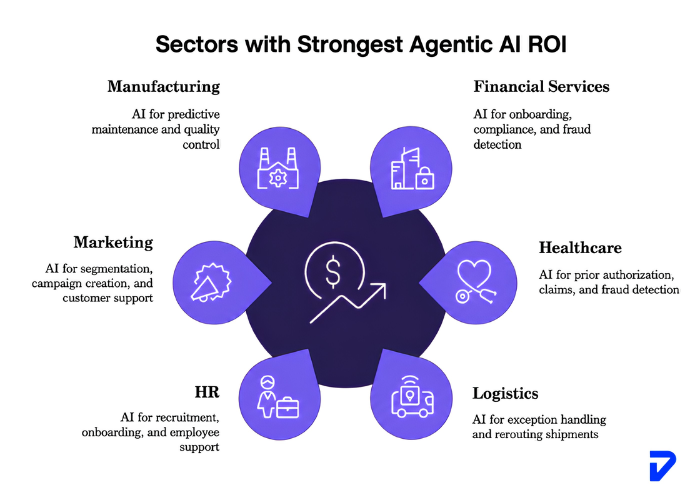
Not every industry is at the same point in the adoption curve. The following sectors have the clearest documented returns.
1. Financial Services
Banks and wealth management firms use agentic AI for onboarding, compliance checks, and fraud detection. Multi-agent workflows reduce document processing time by 40–65%, improving efficiency while maintaining strict regulatory oversight.
2. Healthcare and Insurance
Agentic systems automate prior authorization, claims processing, and fraud detection. In healthcare, turnaround times drop from days to hours, while insurers benefit from faster claims resolution and reduced administrative overhead.
3. Logistics and Supply Chain
Beyond route optimization, agentic AI manages real-time exception handling, rerouting shipments, updating systems, and communicating with carriers autonomously. This reduces operational escalations and improves delivery reliability across large-scale supply networks.
4. HR and Talent Operations
AI agents streamline recruitment, onboarding, and employee support. Tasks like resume screening, document collection, and benefits queries are automated, cutting recruiter admin workload by 30–50% and improving hiring speed during peak demand.
5. Marketing and Customer Operations
Agentic AI handles segmentation, campaign creation, and customer support workflows. It compresses research and planning time by up to 76%, enabling faster campaign cycles and more responsive, data-driven customer engagement.
6. Manufacturing and Industrial Operations
In manufacturing, agentic AI supports predictive maintenance, quality control, and production scheduling. Systems coordinate machine data, detect anomalies, and trigger corrective actions, reducing downtime and improving operational efficiency across production lines.
The Bottom Line
The agentic AI market in 2026 is defined by one central tension: near-universal experimentation and very thin production depth. The 93% of business leaders who expect agents to determine competitive advantage are right. Advantage does not come from adopting agents. It comes from running them reliably in production, at scale, with the grounding, guardrails, and observability that real business operations require. Pinnasys builds and deploys production-ready agentic AI services for ambitious SMBs and scaling businesses, end-to-end, from architecture through to live deployment and ongoing operations. If your team is still in pilot mode, the gap to production-ready competitors compounds every quarter.
Key Takeaways from the Article
- Agentic AI in 2026 is shifting from experimentation to production, but most enterprises are still stuck in pilot-stage deployments with limited scale.
- The biggest barrier to adoption is not model capability, but execution challenges such as integration complexity, governance gaps, and data readiness.
- Multi-agent architectures, RAG infrastructure, and standardized tool protocols like MCP are becoming the core foundation of production-grade agentic systems.
- Industries such as financial services, healthcare, logistics, HR, and marketing are seeing the strongest measurable ROI from agentic AI deployments.
- The competitive advantage is shifting from “using AI agents” to successfully operating them at scale with strong governance, observability, and security frameworks.
Frequently Asked Questions
How much does it cost to deploy agentic AI for a mid-size business?
Most mid-size production agentic systems run between $30,000 and $150,000 for initial build and integration, depending on pipeline complexity and the number of systems the agents need to connect with. Ongoing costs depend on model usage volume and infrastructure choices.
Can agentic AI replace RPA tools my business already uses?
Not entirely, and not immediately. RPA suits stable, rule-based, high-volume tasks. Agentic AI suits variable, judgment-intensive workflows. Most organisations run both in parallel, with RPA handling structured data and agents handling multi-step reasoning and exception management.
How long does it take to move from an agentic AI pilot to production?
Most organisations take three to nine months from pilot to production. Teams with clean internal data and existing API infrastructure move faster. The most common delay is integration work, not model configuration or training.
Is agentic AI safe to use in regulated industries like healthcare or finance?
Yes, with the right architecture. Regulated deployments require full audit logs, configurable human-in-the-loop escalation paths, output validation layers, and data governance policies. Agents deployed without these controls are not suitable for regulated production environments.
What is the difference between an AI agent and an AI chatbot?
A chatbot responds to queries within a single conversation turn. An AI agent plans and executes multi-step tasks autonomously, uses external tools and APIs, retains memory across sessions, and takes actions inside connected business systems. The scope and autonomy differ fundamentally.




Prakash C. Saini
Prakash Saini is the Founder & CEO of Pinnasys. With over a decade in digital transformation and building production systems, he grew an engineering team from 2 to 50 people and has led the delivery of 100+ production digital systems. Products built under his leadership have raised millions in funding and generated over $50 million in revenue. He holds an Executive MBA from IIM Kozhikode and today leads the AI engineering team at Pinnasys.