
Customer service leaders raised AI spending by 38% this year while their overall budgets barely moved, and voice agents are absorbing a growing share of that money. Here is what changed and what it means for your roadmap.
On August 26, 2026, Gartner reported that AI spending among customer service leaders has climbed 38% while total service budgets grew just 2%, according to a survey of 199 leaders. The same research ranks GenAI voicebots among the channels expected to deliver the most value within two years. Together, those signals explain why voice AI production deployments in 2026 have moved from pilot budgets into operating plans. For mid-market operators, the lesson is to fund one well-integrated voice workflow, not to chase every conversational AI demo on the market.
What Changed Recently in Conversational AI
Three constraints that kept voice agents in the lab gave way within the same short window: rigid menu logic, slow and error-prone speech handling, and unclear rules for AI calling. Each shift matters on its own, although their combined effect is what changed the buying math.
Voice AI production deployment: a voice agent that answers or places real customer calls at live volume, connected to business systems, measured against service targets, and governed like any other customer-facing channel.
From Rule-Based IVR to Natural Language Understanding
Legacy interactive voice response (IVR) systems pushed callers through keypad menus, so any request outside the script ended in a transfer. Natural language understanding, the ability to extract meaning from free-form speech, removes that ceiling. A caller can now say “move Thursday’s delivery to Monday,” and the system captures the intent, the date, and the order in one pass.
Why Latency and Speech Accuracy Finally Crossed the Production Threshold
Older voice stacks chained speech-to-text, a language model, and text-to-speech, and every hop added a pause callers could hear. OpenAI’s Realtime API reached general availability on August 28, 2025, with a single speech-to-speech model and native SIP phone calling. Accuracy improved alongside speed, as the new model scored 82.8% on a spoken reasoning benchmark versus 65.6% previously.
How Compliance Infrastructure Stopped Being a Blocker
Voice projects once stalled in legal review because no one knew which calling rules applied. In February 2024, the FCC ruled that AI-generated voices are “artificial” under the Telephone Consumer Protection Act. Then-Chairwoman Jessica Rosenworcel said scammers used them “to extort vulnerable family members, imitate celebrities, and misinform voters.” Clear consent rules gave compliance teams something concrete to build against.
Voice AI milestones: what to expect and when
| Milestone | Date | Status |
|---|---|---|
| FCC confirms TCPA rules cover AI-generated voices | February 8, 2024 | In force |
| OpenAI Realtime API reaches general availability with SIP calling | August 28, 2025 | Live |
| EU AI Act Article 50 AI interaction disclosure duties apply | August 2, 2026 | In force |
| Content-marking deadline for generative systems already on the market | December 2, 2026 | Upcoming |
| Gartner forecast of 80% autonomous resolution for common service issues | 2029 | Forecast |
Voice AI Adoption Stats Enterprises Should Know
The voice AI adoption stats worth tracking show broad experimentation, rising budgets, and a much narrower group that has scaled. Read together, they keep expectations grounded without understating the momentum.
How Fast Voice AI Production Deployments 2026 Are Scaling
Adoption is wide but shallow. The McKinsey State of AI survey found 88% of organizations use AI in at least one function, up from 78% a year earlier. Only 23% are scaling an agentic system, another 39% are experimenting, and no single function shows more than 10% scaling agents. Voice sits squarely inside that gap between trial and scale.
Where Investment and Contact Center Spending Are Heading
Money is moving from headcount to software. Gartner’s August survey found leaders are redirecting budget away from labor and overhead toward technology, even though phone and live chat still rank as their most valuable channels today. That combination explains why contact center cost savings from conversational AI now anchor so many business cases for voice automation.
How Conversational AI Chatbot Deployments Compare to Voice Channels
Chat adoption has stalled in a way voice has not. A Gartner survey of 3,566 customers found people three times more likely to use third-party GenAI than a company chatbot. Gartner analyst Eric Keller urged support teams to rebuild “around conversational, action-oriented experiences, rather than treating GenAI as a standalone chatbot.” Phone callers, by contrast, arrive needing account-specific action.
| Factor | Conversational AI chatbot | AI voice chatbot on the phone |
|---|---|---|
| Typical request | Quick answers, browsing, order lookups | Urgent, account-specific, higher-stakes issues |
| Latency tolerance | A few seconds feels normal | Long pauses sound like a dropped call |
| Identity checks | Logged-in web or app session | Voice verification or knowledge-based questions |
| Compliance triggers | On-screen AI disclosure | TCPA consent for outbound calls, recording notices |
What Does Voice AI Production Deployments 2026 Mean for Enterprises
It means the phone channel is shifting from a cost center that deflects calls to a service layer that finishes work. Enterprises planning for that shift will judge voice by outcomes delivered rather than minutes handled.
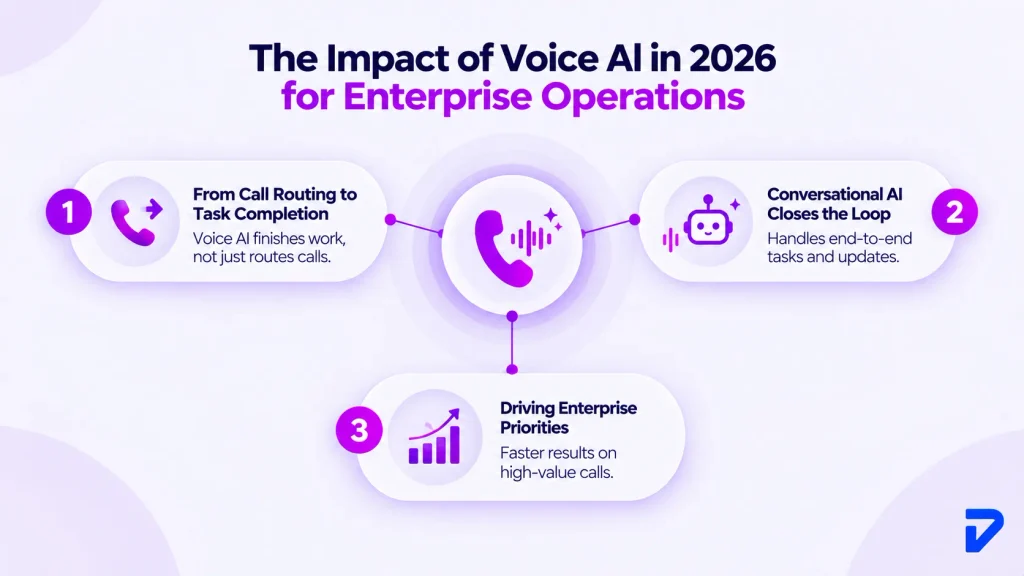
From Call Routing to Autonomous Task Completion
Traditional routing asked one question: which human should take this call? Autonomous agents ask whether the request can be finished right now. Gartner predicts agentic AI will resolve 80% of common service issues without human help by 2029. Voice is where that shift becomes visible first, since phone contacts carry the most expensive handling time.
Why a Conversational AI Assistant Now Closes the Loop, Not Just Answers
Consider a customer calling a distributor about a late shipment. A modern conversational AI assistant checks the order in the ERP, offers a new delivery window, rebooks the carrier slot, texts a confirmation, and logs the outcome in the CRM. That chain of actions is what agentic AI services make possible, turning an answer into a completed transaction.
Why Enterprise AI Leaders Are Prioritizing Voice Channels Now
Pressure from the top is real. A Gartner survey of 321 service leaders found 91% feel pushed to implement AI in 2026, and Gartner’s Kim Hedlin described a period “where AI and human expertise must work in tandem.” For enterprise AI leaders, voice offers the fastest proof, because gains on costly calls show up quickly.
Not sure where voice AI belongs on your 2026 roadmap?
Our AI advisors help mid-market teams test vendor claims, size the integration work, and choose the one call type worth piloting first.
The Five Capabilities Behind a Modern Conversational AI Agent
A production voice agent listens, reasons, acts, verifies, and learns, and a weak link in any one of those breaks the call. The first two decide whether the agent understands the caller; the last three decide whether it can be trusted with real work.
Listening With Intent Recognition and Sentiment Detection
Intent recognition maps what a caller says to the task they actually want done, even when the wording is indirect. Sentiment detection runs in parallel, flagging frustration from tone and phrasing. A caller who says “this is my third call about this” should trigger a faster path or a human handoff, never the same opening script.
Reasoning Through Dialogue Management Grounded in Enterprise Data
Dialogue management tracks what has been said, what information is still missing, and what to ask next. The grounding layer keeps answers tied to the caller’s own records through retrieval from policies, order history, and account data. An insurance caller asking about a deductible should hear the figure from their policy, not a generic range.
Acting, Verifying, and Learning From Every Conversation
Action happens through tool calls into CRM, ERP, and scheduling systems. Before committing anything, a well-built agent reads back critical details such as dates, amounts, and account digits for confirmation. The learning step comes afterward, when teams review failed intents, transfers, and low-rated calls each week, then update prompts and knowledge sources to close the gaps.
Is Voice AI Production Deployments 2026 Actually Significant for Buyers
Yes, though the significance sits in a smaller set of well-run deployments rather than in the headline volume of pilots. Buyers who can tell the two apart will reach the same results for far less money.
Separating Real Production Results From Pilot Stage Demos
Demos run on clean audio with scripted callers who follow the happy path. Live traffic brings accents, speakerphones, background noise, interruptions, and people who change their minds mid-sentence. Ask vendors for evidence from real calls instead: transfer rates by intent, response delay on actual phone lines, months in production, and a sample of failed conversations.
The ROI Metrics That Matter Beyond Containment Rate
Containment tells you how many calls the agent kept, not whether callers got what they needed. Stronger measures include first-contact resolution, cost per resolved contact, satisfaction scores on AI-handled calls, and revenue recovered through collections or retention saves. After-hours bookings count too, since those calls previously went to voicemail and often never converted.
Which Industries Are Leading Voice AI Adoption in 2026
Sectors with heavy call volume, repeatable transactions, and strict record-keeping lead, because every resolved call is easy to price. Financial services has the longest track record, while the McKinsey survey cited earlier found agent use most widely reported in telecom, media, technology, and healthcare.
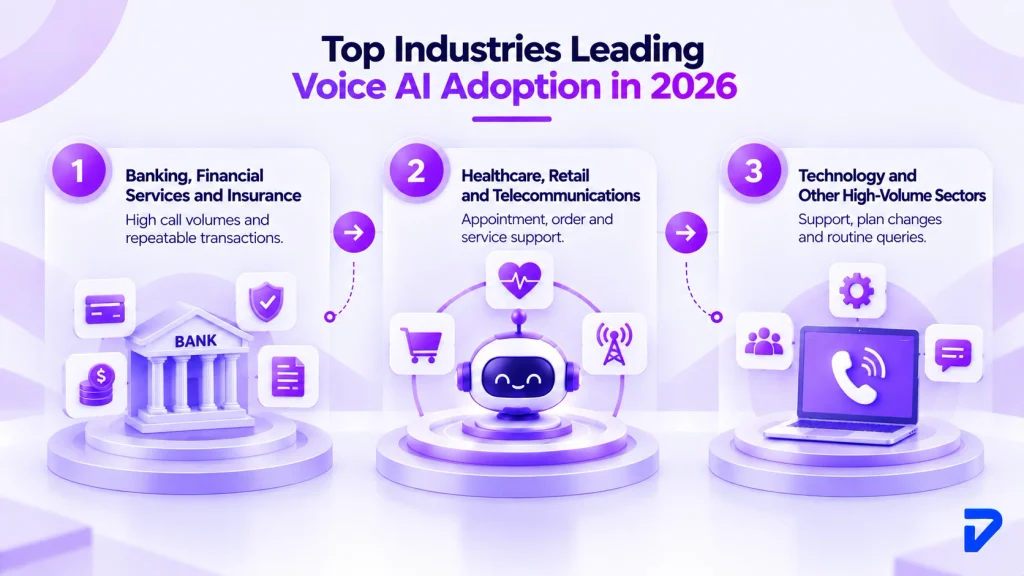
Banking, Financial Services, and Insurance Use Cases
Banks proved the model at scale years ago. Bank of America reported that Erica interactions exceeded 3.2 billion, spanning voice and text requests. Common voice workloads now include balance and payment questions, card replacement, and fraud alert confirmation. Insurers apply the same pattern to first notice of loss, claims status updates, and routine policy changes.
Healthcare Retail and Telecommunications Deployments
Healthcare providers use voice agents for appointment scheduling, prescription refill requests, and visit reminders, with a HIPAA business associate agreement required from every vendor touching patient data. Retailers use agents for order status, returns, and holiday call spikes. Telecom carriers handle outage updates, plan changes, and bill explanations, all high-volume calls with predictable resolution steps.
How Does Voice AI Production Deployments 2026 Affect Your AI Roadmap
Reprioritizing Contact Center Projects Around Agentic Voice
Planned work such as an IVR menu refresh, a chatbot FAQ expansion, or an agent-assist rollout deserves a fresh ranking. The test is simple: can a voice agent complete this task end to end? A distributor might defer a costly IVR rebuild and instead automate order-status and delivery-change calls, which often dominate inbound volume.
Planning for a Conversational AI Platform, Not a Point Tool
Point solutions solve one intent on one channel, and each new one adds integration debt. A platform approach shares knowledge sources, system connections, analytics, and guardrails across voice, SMS, and chat. A separate set of conversational AI tools for every channel usually means maintaining the same order lookup three times, with three different failure modes.
How Should Companies Respond to Voice AI Production Deployments 2026
Respond with a disciplined sequence: judge vendors on integration depth, demand governance documentation, and prove value in a contained pilot before expanding. A skipped step tends to resurface later as expensive rework.
How to Evaluate a Conversational AI Platform on Integration Depth
Integration depth is the clearest predictor of whether an agent can finish work. Ask whether the platform writes to your CRM, ERP, ticketing, and scheduling systems in real time, handles caller authentication, and passes full context on a warm transfer. A read-only webhook looks fine in a demo but fails the moment a caller needs something changed.
Requiring Governance Documentation Before You Deploy
Governance paperwork should exist before the first live call, not after the first complaint. Request data flow maps, recording retention and redaction policies, AI disclosure scripts, outbound consent records, escalation rules, and a model change log. Controls mapped to the NIST AI Risk Management Framework give auditors a familiar structure to review.
Piloting Conversational AI Agents for Businesses Before Scaling
Good pilots are narrow by design: one intent, one phone line, a measured baseline, and a success threshold agreed before launch. Six to eight weeks of live traffic usually exposes the edge cases that matter. Our guide to building an AI voice agent for production covers the testing and monitoring of conversational AI agents for businesses’ needs before wider rollout.
Voice AI and AI Voice Chatbot Adoption for Mid-Market Companies
Mid-market companies can now run the same class of voice technology large banks use, because the cost barrier shifted from licenses to usage. The constraint that remains is integration skill rather than budget.
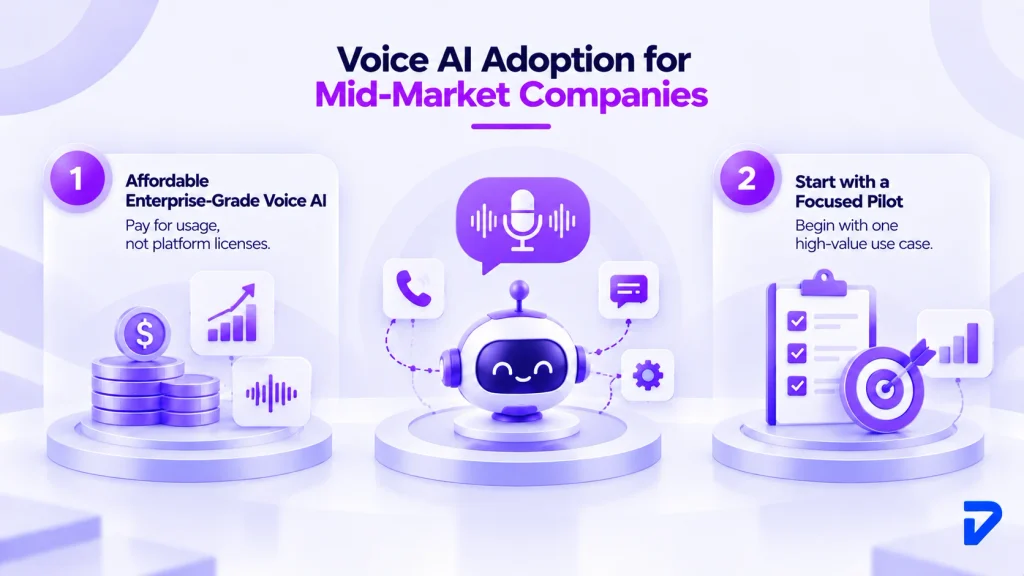
Why Mid-Market AI Buyers Can Now Afford Enterprise-Grade Voice AI
Usage-based pricing has replaced many six-figure platform licenses, so mid-market AI buyers pay for calls handled instead of seats reserved. OpenAI also cut real-time model pricing by 20% at general availability. A 200-person distributor can therefore run an AI voice chatbot on after-hours lines without committing to an enterprise contract first.
Starting With a Focused Pilot Instead of a Full Rollout
Smaller teams rarely have spare staff to babysit a broad launch. Pinnasys advises mid-market clients to begin where missed calls already cost money, such as after-hours overflow or a single high-volume request type. One accountable owner, weekly call reviews, and humans kept on complex cases make early results easier to trust.
Common Mistakes When Deploying Conversational AI Tools
Most failed rollouts trace back to measurement and infrastructure rather than the language model itself. Beyond the two major errors below, watch for these smaller ones:
- No evaluation set built from real recorded calls before launch.
- A hidden path to a human agent for callers who clearly need one.
- A missing AI disclosure line at the start of each conversation.
- After-hours callers left on the old IVR with no follow-up.
Treating Containment Rate as the Only Success Metric
Teams that chase containment often tune agents to avoid transfers at any cost. Callers then loop through the same questions, hang up, and call back or switch to email. The dashboard shows impressive containment while repeat contacts climb and satisfaction falls, which quietly shifts cost into other channels instead of removing it.
Underestimating Voice Infrastructure and Latency Requirements
People expect near-instant replies: a cross-language study in PNAS found most conversational responses begin within about 200 milliseconds. Carrier routing, audio codecs, and jitter all add delay before any model runs. Production voice needs SIP trunk capacity, regional hosting, barge-in handling for interruptions, and load tests at peak call volume.
What Are the Latest Conversational AI Trends in 2026?
The clearest trends point toward deeper system access and continuity across channels, so a conversation can start on the phone and finish anywhere. Both favor buyers who invest in integration over polished synthetic voices.
Deeper CRM and Back Office System Integrations
Agents are moving from reading CRM fields to writing orders, issuing credits, and updating claims. The Model Context Protocol (MCP), an open standard for connecting AI models to business tools, speeds this up, and OpenAI’s Realtime API now supports remote MCP servers. Fewer custom connectors mean faster deployment and simpler maintenance.
Multichannel Handoffs Across Voice, SMS, and Live Voice Chat
A caller can now start on the phone, receive an SMS link to upload a photo, and finish in AI live voice chat inside an app without repeating anything. Context follows the customer across every step. A well-built conversational AI chatbot paired with voice lets conversational AI assistants share one memory across channels.
The Bottom Line
Voice AI has crossed from promising to practical because the models, the telephony, and the rules matured in the same window. Companies seeing returns treat voice as a connected service layer with honest metrics, documented controls, and a clear route to a human. They do not bolt a new voice onto an old phone tree. For mid-market operators, the smartest move is one high-volume workflow, measured carefully, then expanded on evidence. Pinnasys’s AI integration and governance team helps operators wire voice agents into existing systems and document the controls buyers and regulators expect. Pick the call type that costs you most today, and start there.
Key Takeaways from the Article
- Faster speech models and clearer calling rules moved voice agents into live production.
- Most enterprises experiment with AI agents, yet few have scaled them beyond one function.
- Containment alone hides failure; track resolution, cost per contact, and customer satisfaction.
- Integration depth with CRM and ERP systems separates working agents from polished demos.
- A focused pilot on one high-volume call type beats a broad, unmeasured rollout.
Frequently Asked Questions on Voice AI Production Deployments 2026
What Does Voice AI Production Deployments 2026 Mean for Enterprises?
It means voice agents are now budgeted as operating infrastructure rather than experiments. Gartner links agentic service automation to a 30% cut in operating costs by 2029, so enterprise plans increasingly treat voice as a cost and revenue lever.
How Does Voice AI Production Deployments 2026 Affect My AI Roadmap?
It pulls voice automation into the next 12 to 18 months of planning. In a December 2025 Gartner survey, over 80% of organizations expected to reduce agent headcount within 18 months, mostly through attrition or hiring pauses.
What Changed Recently in Conversational AI?
Speech models, telephony access, and calling rules matured together. OpenAI’s Realtime API spent roughly ten months in public beta after launching in October 2024, and thousands of developers shaped it before production release.
Is Voice AI Production Deployments 2026 Actually Significant for Buyers?
Yes, for buyers with high call volume and well-defined request types. McKinsey found only about one-third of companies have begun scaling AI programs, so disciplined buyers can still gain ground on slower competitors.
How Should Companies Respond to Voice AI Production Deployments 2026?
Start with governance and one measurable use case. The NIST framework organizes AI risk work into four functions: govern, map, measure, and manage, which gives new voice deployments a documented control baseline before scale.
What Are the Latest Conversational AI Trends in 2026?
Agent platforms and identity controls lead the list. Gartner’s August 2026 survey named no-code agent builders, communications platforms as a service, and customer identity and access management as the technologies expected to add the most value.