


Build AI voice agent systems for production by combining the right architecture, speech technologies, enterprise integrations, security, and continuous monitoring. A production-ready voice agent must deliver low-latency performance, handle real-world conversations, and scale reliably across business workflows.
Most AI voice agents never reach real users. The gap between an impressive demo and a reliable production system costs organizations months of time and significant budget, not because the technology fails, but because it isn’t built for enterprise infrastructure, real-time performance, and unpredictable human conversations.
Production-ready AI voice agents require far more than impressive demos. They need scalable architecture, low-latency processing, seamless integrations, enterprise-grade security, and continuous monitoring to deliver reliable performance across thousands of live customer conversations.
This guide covers the complete AI voice agent development process, from identifying the right use case and choosing the technology stack to designing scalable architectures.
What It Takes to Move from Prototype to Production
A production voice agent answers that question simply: it handles real users, at real volume, with real consequences, without falling over. When it comes to the gap between prototypes and live systems, three differences matter most.
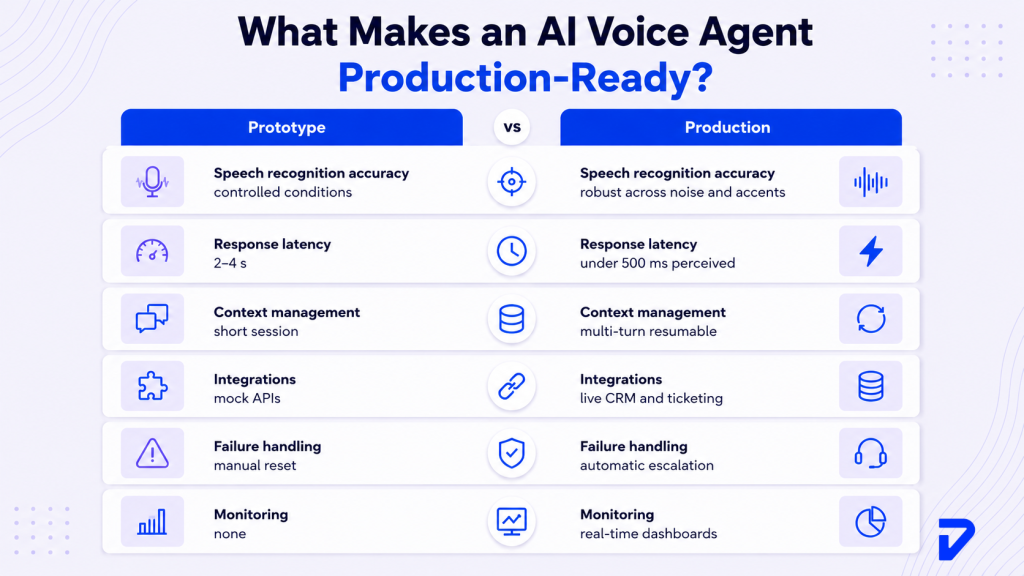
Prototype vs. Production AI Voice Agents
Prototype voice agents perform well in controlled environments, while production systems must handle noisy audio, diverse accents, interruptions, and unstable networks. OpenAI’s Whisper was trained on 680,000 hours of multilingual audio, demonstrating how large-scale, diverse datasets significantly improve speech recognition robustness in real-world conditions
Core Capabilities of a Production System
A production voice agent requires capabilities that go beyond basic conversation handling. The comparison below shows the key differences.
| Capability | Prototype | Production |
| Speech recognition accuracy | High in controlled conditions | Robust across noise, accents, low-bandwidth audio |
| Response latency | Acceptable (2–4 s) | Near-human (under 500 ms perceived) |
| Context management | Short session | Multi-turn, resumable after interruption |
| Integrations | Mock APIs | Live CRM, scheduling, ticketing, billing |
| Failure handling | Manual reset | Automatic escalation to human agent |
| Monitoring | None | Real-time dashboards, alert thresholds |
These decisions determine whether a voice agent in production can deliver reliable performance under real-world conditions.
Design the Right Use Case Before You Build
The most common reason a voice agent fails in production is not a technology problem: it is a use-case problem. The system was built before anyone mapped what it actually needed to do.
Define Business Goals
Start with a measurable outcome, not a vague objective. Clear goals define supported intents, required integrations, escalation rules, and success metrics, ensuring the AI voice agent is designed to solve specific business problems instead of simply answering calls.
Map Conversation Flows
Before building, draw every conversation path the agent will handle. Map the happy path, the edge cases, and the failure modes. Every branch should terminate in either a resolved intent or a graceful hand-off. Voice agents with unmapped flows produce awkward silences, repeated prompts, and frustrated users.
Plan Human Escalation
No voice agent handles every call. Build the escalation path first, not last. Define the trigger conditions, caller frustration signals, unrecognized intents, compliance-sensitive topics, and the hand-off mechanism: live transfer, callback scheduling, or ticket creation. A voice agent without a reliable escalation path is a liability.
Choose the Right AI Voice Technology Stack
A production build requires careful selection across five technology layers. Getting any one wrong compounds the problems in every layer above it.
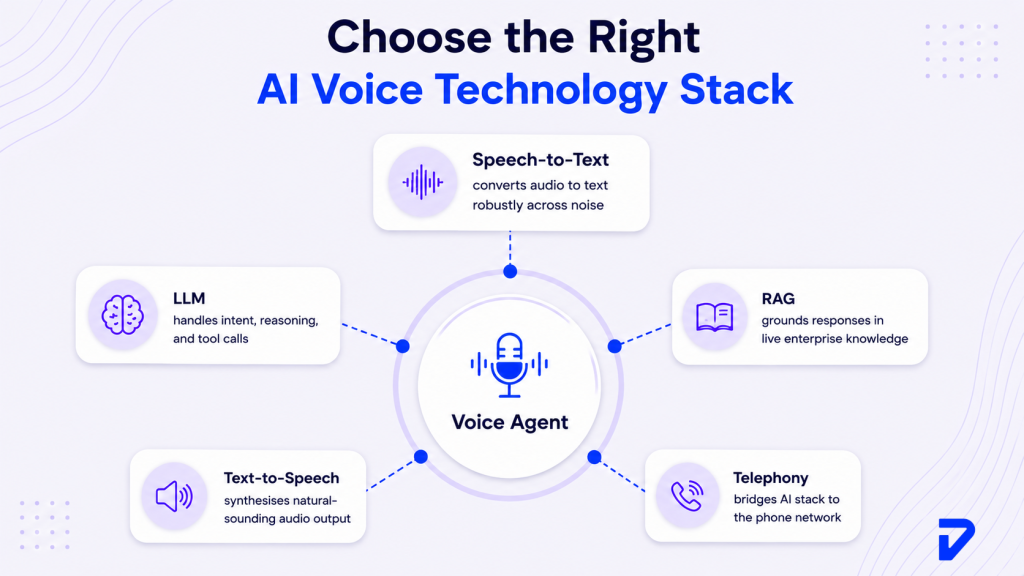
Speech-to-Text (STT)
STT is where audio becomes text the LLM can reason over. Whisper’s large-scale weak-supervision training set a new benchmark for robustness across languages, accents, and noisy environments. For most mid-market deployments, a managed STT service, Microsoft Azure AI Speech or equivalent, offers the right balance of accuracy, latency, and compliance controls without requiring a custom model.
Large Language Model (LLM)
The LLM powers intent classification, dialogue management, entity extraction, and tool-calling. OpenAI’s GPT-4 research showed that advanced large language models outperform smaller alternatives in complex, multi-turn conversations. Choose a model with sufficient context length to process full call transcripts alongside relevant customer history.
Retrieval-Augmented Generation (RAG)
RAG (retrieval-augmented generation) is a technique that grounds the LLM’s responses in a live knowledge base rather than purely in training data, is what allows a voice agent to answer product questions, policy queries, or account-specific questions accurately, without hallucinating details. Without RAG, a voice agent is limited to what its model was trained on. With it, the agent has access to real-time enterprise knowledge.
Text-to-Speech (TTS)
TTS converts the LLM’s response into natural-sounding speech. Google DeepMind’s SoundStorm generates high-quality audio with sub-second latency, making real-time conversations feel smooth and responsive. Choosing a fast, natural TTS engine is essential for delivering production-ready AI voice experiences.
Telephony and Communication APIs
The telephony layer connects AI voice agents to the phone network, handling call routing, transfers, DTMF inputs, and recordings. Reliable APIs such as Twilio or carrier-native platforms ensure stable connectivity, while Meta’s Seamless M4T highlights the growing importance of multilingual voice capabilities for global deployments.
Build the Voice Agent Architecture
Architecture is where the technology choices become a system. The way components connect determines performance, reliability, and how easy the agent is to operate after launch.
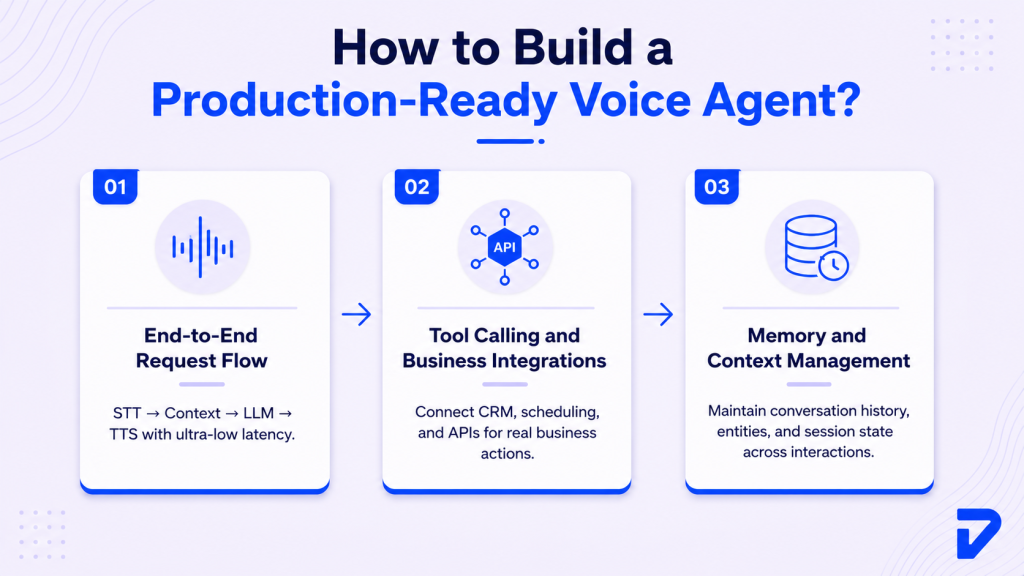
End-to-End Request Flow
A production voice agent processes every caller turn through STT, context retrieval, LLM reasoning, and TTS. Research by Stephen C. Levinson and Francisco Torreira on human conversational turn-taking found that pauses of around 200 milliseconds feel natural, making low latency essential for seamless voice interactions.
Tool Calling and Business Integrations
Tool calling enables AI voice agents to perform real business actions, such as checking account balances or booking appointments. Anthropic’s Model Context Protocol (MCP) standardizes connections between LLMs, tools, and data sources, while idempotent tool design prevents duplicate transactions during retries.
Memory and Context Management
A production voice agent must maintain context throughout the entire conversation. It stores transcripts, extracted entities, confirmed intents, and conversation state with every LLM request. For multi-call workflows, this session data must persist in a database and be retrieved when the customer reconnects.
Optimize for Real-Time Performance
Latency is the single biggest usability factor in a voice agent. A technically accurate response that arrives two seconds too late is still a broken conversation.
Reduce Response Latency
Profile the entire pipeline to identify latency bottlenecks, typically STT and TTS. NVIDIA Riva delivers GPU-accelerated speech processing with sub-100 ms latency, while using smaller fine-tuned models for intent classification reduces LLM response time without compromising overall accuracy.
Enable Streaming Conversations
Streaming, where the LLM begins generating output before the full input is processed, and TTS begins synthesizing before the full LLM response is complete, is the architectural change that delivers the most dramatic latency improvement. Microsoft’s GPT Realtime API for speech and audio implements this pipeline natively, allowing audio-in to audio-out round trips that feel immediate rather than transactional.
Handle Interruptions and Conversation Recovery
Production voice agents must support barge-in, allowing callers to interrupt naturally without losing conversation context. The system should instantly stop audio playback, process new input, and respond seamlessly. Effective barge-in detection belongs in the telephony and audio layer, not the LLM.
Build AI voice agent systems that perform reliably in production?
Partner with Pinnasys to design, develop, integrate, and optimize enterprise-ready voice AI solutions.
Connect the Voice Agent to Enterprise Systems
An isolated voice agent that cannot look up information or take action has limited value. Organizations build AI voice agent solutions to automate real business workflows, making the integration layer essential.
CRM and Customer Data
CTI connects incoming calls to the CRM, retrieving customer records before conversations begin. Account details, support history, and open tickets are passed to the LLM, enabling personalized responses and eliminating the need for callers to repeat previously shared information.
Scheduling and Ticketing Platforms
Voice agents automate appointment booking, ticket creation, and case updates through API integrations. Every action should include a confirmation step before execution, reducing errors and ensuring business records remain accurate across downstream systems.
Custom APIs and Business Workflows
Production voice agents integrate with custom ERP, inventory, and internal systems through AI integration services. These connections require secure authentication, error handling, retries, and fallback mechanisms, ensuring reliable workflows while enabling seamless escalation to human agents whenever integrations fail or time out.
Secure and Scale for Production
A production voice agent must be secure, compliant, and scalable to handle real customer interactions without compromising performance.
Authentication and Data Protection
Production voice agents handle sensitive customer information, making security essential. Encrypt calls using TLS 1.2+, implement secure caller authentication before accessing account data, and manage recordings according to regulations to protect personal information and maintain trust.
Compliance Requirements
Voice agents must comply with regulations such as PCI-DSS, HIPAA, GDPR, or CCPA, depending on the industry. Building compliance into the architecture from the start simplifies recording, consent, data retention, and audit requirements while avoiding costly redesigns.
High Availability and Scalability
Production voice agents require horizontally scalable, highly available infrastructure across speech, LLM, telephony, and integration layers. NVIDIA Riva’s production deployment architecture demonstrates scalable GPU-accelerated speech services, while graceful failover ensures uninterrupted customer experiences during outages or traffic spikes.
Test, Monitor, and Improve
Building a reliable voice agent doesn’t end at deployment. Continuous testing, monitoring, and optimization keep production systems performing at their best.
Conversation Testing
Testing AI voice agents requires real-world audio, not just text scenarios. Validate performance across background noise, accents, and varying network conditions by replaying real call recordings and running end-to-end simulations for every conversation flow before deployment.
Performance Monitoring
Continuously monitor STT confidence, LLM latency, TTS synthesis, and end-to-end call performance after deployment. Business metrics such as call completion rate, escalation rate, and intent recognition accuracy help identify issues early and ensure production voice agents remain reliable at scale.
Analytics and Continuous Optimization
Every customer interaction provides valuable insights for improvement. With proper consent, review call transcripts to identify failed intents, escalation patterns, and integration gaps. Pinnasys’s agentic AI engineering team builds analytics pipelines that continuously optimize voice agents, ensuring performance improves as customer expectations evolve.
Common Production Mistakes to Avoid
If you want to build AI voice agent systems that succeed in production, avoiding common mistakes is just as important as choosing the right technology. Here are the issues that most often affect production deployments.
| Mistake | Production impact | Fix |
| Skipping barge-in handling | Callers feel ignored; conversation breaks | Implement barge-in at the telephony layer |
| Building integrations after the agent | Reveals architectural mismatches late | Design integration contracts before coding |
| Using a single large model for everything | High latency on simple intents | Route simple intents to a fast, smaller model |
| No escalation path | Stuck callers; damaged brand reputation | Build escalation as the first thing, not last |
| Testing only on clean audio | STT accuracy collapses in the field | Include noisy, accented, and low-bandwidth test audio |
| Hardcoding conversation flows | Any business change requires a rebuild | Use intent-based dialogue management with configurable flows |
The Bottom Line
Building an AI voice agent for production requires far more than connecting an LLM to a phone line. Success depends on low-latency architecture, accurate speech recognition, reliable telephony, secure enterprise integrations, and continuous monitoring to deliver natural, dependable conversations at scale under real-world conditions.
Pinnasys helps organizations design, build, and optimize production-ready AI voice agent solutions that integrate seamlessly with existing business systems. From architecture and deployment to post-launch improvements, our AI engineering team delivers scalable voice AI systems that reduce handle times, improve customer experiences, and generate measurable business outcomes.
Key Takeaways from the Article
- Production voice agents require barge-in handling, streaming pipelines, and real-time integrations from day one.
- STT robustness across noise and accents determines real-world accuracy more than lab benchmarks.
- Tool calling with idempotent operations prevents integration errors from reaching downstream systems.
- Latency below 500 ms perceived end-to-end is the threshold that separates natural-feeling voice AI from mechanical.
- Continuous optimization from real call transcripts is what keeps a live voice agent improving after launch.
Frequently Asked Questions
How long does it take to build a production AI voice agent?
A production-ready voice agent with three to five intents, two to three live integrations, and a tested escalation path typically takes eight to sixteen weeks to build, depending on the complexity of existing enterprise systems and data availability. Pilots can be faster but should not be confused with production.
What is the most common failure point in AI voice agent deployments?
Integration failures are the most common root cause of production outages. When a CRM, scheduling system, or ERP does not respond within the expected timeout, a poorly designed voice agent stalls the call rather than escalating gracefully. Build integration fallbacks before anything else.
Do AI voice agents need custom speech models or do managed services suffice?
For most mid-market deployments, managed STT and TTS services, such as Azure AI Speech, provide sufficient accuracy and latency without the cost and maintenance overhead of custom model training. Custom models become worthwhile when the domain has highly specialized vocabulary (medical, legal, industrial) or when multilingual accuracy on low-resource languages is required.
How do you handle compliance in a voice AI system?
Compliance begins at design time. Consent language, call recording notices, data-retention schedules, and opt-out mechanisms must be specified in the conversation flow and implemented in the telephony and data layers before the system handles a live caller. Retrofitting compliance onto a live system is significantly more expensive than building it in from the start.
What metrics should you track for a production voice agent?
The five most important metrics are end-to-end call latency, intent recognition accuracy, call completion rate (calls resolved without escalation), escalation rate (calls transferred to a human), and post-call customer satisfaction where it can be captured. Together, these metrics reveal whether the system is performing technically and whether it is actually serving callers well.





Prakash C. Saini
Prakash Saini is the Founder & CEO of Pinnasys. With over a decade in digital transformation and building production systems, he grew an engineering team from 2 to 50 people and has led the delivery of 100+ production digital systems. Products built under his leadership have raised millions in funding and generated over $50 million in revenue. He holds an Executive MBA from IIM Kozhikode and today leads the AI engineering team at Pinnasys.