


Gartner projects conversational AI will cut $80 billion from contact center labor costs in 2026, yet only one in ten interactions runs fully automated. Here is what those conversational AI cost savings mean for mid-market operators, and what to do.
Gartner projects that conversational AI deployments inside contact centers will reduce agent labor costs by $80 billion in 2026. That is the clearest sign yet that conversational AI cost savings in 2026 have moved from pilot decks into board budgets. The same forecast carries a quieter figure. Only about one in ten agent interactions will run fully automated this year, up from roughly 1.6 percent. For a mid-market operator, the honest read is measured optimism rather than headcount panic. What follows is what actually changed, who it affects, where the money comes from, and how to sequence a rollout that holds up.
The contact center has become the proving ground for enterprise AI, because it is where automation meets a customer who has zero patience for a bad answer. Two forces are colliding in 2026. Language models are now good enough to hold a real conversation, and labor still represents up to 95 percent of contact center cost, according to Gartner. That combination is why Pinnasys and every serious operator now treat conversational AI support systems as core infrastructure, not a chat widget bolted onto a website.
How Is AI Reshaping Contact Center Operations in 2026?
AI is shifting the contact center from a script-driven cost center into a system where software resolves the routine and humans handle the hard. The change is structural, not cosmetic. Interactions now flow through models that interpret language, decide next steps, and hand off cleanly when a person is needed.
From Scripted Bots to Agentic AI
Old bots followed a decision tree and broke the moment a caller went off-script. Agentic AI reasons across steps, calls tools, checks a system of record, and completes a task rather than reciting an FAQ. The shift mirrors the broader move from rule-based automation to autonomous agents, a distinction covered in agentic AI vs traditional AI. In practice, that means resolving a refund end to end, not just explaining the policy.
Real-Time Agent Assist as the New Baseline
The larger 2026 effect is assistive rather than autonomous. AI now listens alongside the human, surfaces the right knowledge article, drafts the reply, and writes the call summary. Daniel O’Connell, VP analyst at Gartner, says conversational AI “makes agents more efficient and effective” while improving the customer experience. Handle time drops, after-call work shrinks, and quality rises without the caller ever knowing a model was in the loop.
What Are the Most Powerful AI Contact Center Use Cases in 2026?
Intelligent Self-Service and Virtual Agents
A modern conversational AI chatbot resolves password resets, order tracking, and billing questions without a queue. The economics are stark. Forrester principal analyst Max Ball notes that a self-service conversation costs roughly one-tenth of an agent-assisted call. Well-built virtual agents now resolve a real share of Tier-1 volume, which is why conversational AI tools are the first line item most operators fund.
Agentic AI Orchestration
Single bots are giving way to orchestrated systems where specialized agents collaborate on a task. One retrieves the account, another checks eligibility, a third executes the change, and a supervisor agent enforces policy. This orchestration is the backbone of production agentic AI deployments. It is also where governance matters most, because a chain of agents can compound a small error into a costly one without the right guardrails in place.
Predictive and Smart Routing
Smart routing has moved from menu trees to models that read intent, sentiment, and history, then send the caller to the agent or bot most likely to resolve it fast. Decision intelligence sits underneath this, scoring each interaction in real time. Smart routing lifts first contact resolution because the right skill meets the right issue on the first try, rather than after two transfers and a repeated explanation.
Real-Time Sentiment Analysis
Sentiment models score tone as a conversation unfolds, flagging frustration before it becomes a churn event or a supervisor escalation. Natural language understanding drives this, reading not just words but emotional signal. When a caller’s frustration spikes, the system can prompt the agent, offer a retention path, or route to a specialist. The point is intervention while the outcome is still recoverable, not a post-mortem survey a week later.
Voice Biometrics and Authentication
Voice AI can now authenticate a caller by their voiceprint in seconds, cutting the security questions that pad handle time and annoy customers. The efficiency is real, and so is the risk. Biometric data is sensitive, regulated differently across states, and a target for spoofing. Any authentication rollout needs consent handling, fallback methods, and clear retention limits, which puts it squarely inside the governance conversation later in this piece.
Automated Quality Assurance
Traditional QA scored a random 2 percent of calls. AI scores 100 percent, flagging compliance misses, coaching moments, and script drift across every interaction. This is contact center automation applied to oversight itself. Managers stop guessing which calls to review and start acting on full-coverage data. It is one of the most reliable sources of savings, because it improves the humans and the bots at once.
Workforce Optimization Forecasting
Staff levels are the single largest cost, and getting either direction wrong is expensive. AI forecasting models read historical volume, seasonality, and live signals to predict demand and build schedules that match it. Better forecasts mean fewer idle agents on a quiet Tuesday and fewer abandoned calls during a Monday spike. For most operators, tightening forecast accuracy pays back faster than any front-end bot.
Not sure which of these use cases will actually pay back in 2026?
Pinnasys helps mid-market teams separate real conversational AI cost savings from vendor math, then sequence the rollout so the numbers hold.
Inbound vs Outbound: Where AI Automation Applies Differently
Inbound Automation
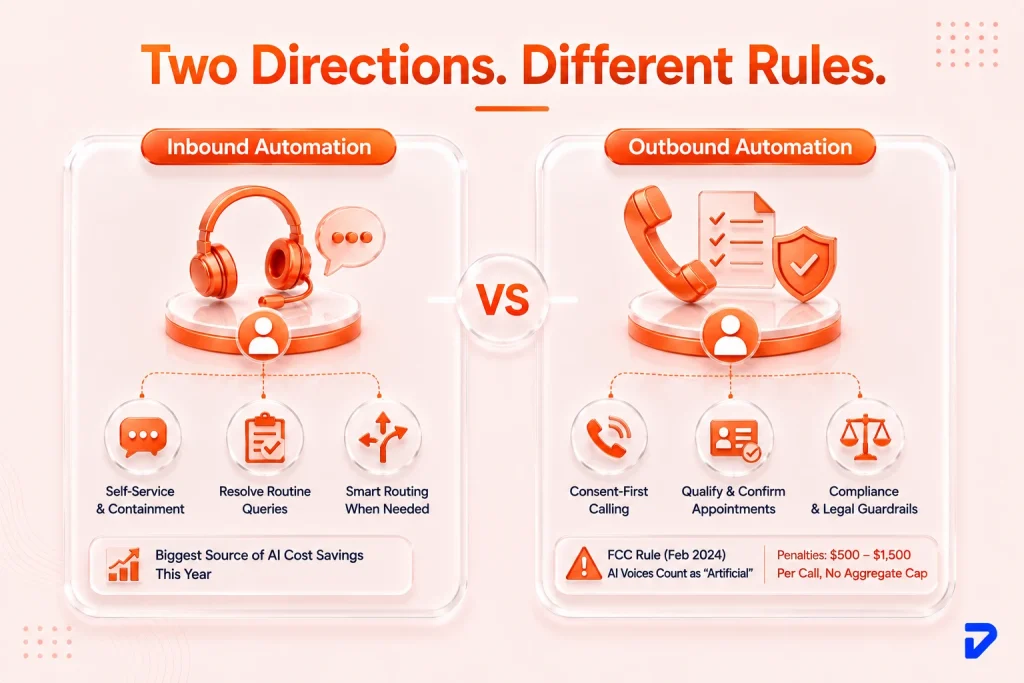
Inbound is where self-service and containment live. A caller wants an answer, and the goal is to resolve it without a human when the intent is routine and to route cleanly when it is not. Conversational AI assistants shine here because the customer initiated contact and consented to the channel. Most conversational AI cost savings this year come from the inbound side, where deflection and assisted resolution reduce the cost per interaction directly.
Outbound Automation
Outbound carries a compliance burden that inbound does not. In February 2024, the FCC ruled that AI-generated voices count as “artificial” under the Telephone Consumer Protection Act, so outbound AI voice calls to mobile phones generally require prior express consent. Penalties run $500 to $1,500 per call with no aggregate cap. Voice AI can dial, qualify, and confirm appointments efficiently, but only inside a consent framework that legal has signed off on first.
What Are the Real Cost and Efficiency Benefits?
Cost Per Interaction
The cleanest metric is cost per interaction, and the gap between channels is wide. Simple self-service resolutions can drop under a dollar, while a complex agent-handled call runs well into the double digits. The cost savings from conversational AI compound because deflection removes labor from the highest-volume, lowest-complexity intents first. The catch is that a deflected call that returns tomorrow saved nothing, so measure resolution, not just deflection.
Productivity and After-Call Work
Full automation is the smallest slice of the savings. The bigger lever is assisted productivity: AI that summarizes the call, drafts the disposition, and updates the record while the agent moves to the next customer. After-call work often eats several minutes per interaction, and automating it recovers capacity without cutting a single role. This is process automation applied to the seconds that no dashboard used to count.
Scalability During Demand Spikes
Human staffing cannot flex fast enough for a product recall, a weather event, or a Black Friday surge. AI can absorb the first wave, handling routine questions at volume while humans concentrate on the exceptions. That elasticity turns a staffing crisis into a routing decision. The operators who weather spikes best in 2026 are not the ones with the most agents; they are the ones whose automation carries the overflow gracefully.
How Does Agentic AI Change the Role of Human Agents?
From Task Executor to Experience Manager
The generalist who reads a script is fading. Forrester models one company moving from 1,000 representatives toward 40 over four years, while adding new roles like relationship managers and subject-matter experts. Kate Leggett, principal analyst at Forrester, describes AI transforming service from a “reactive, cost-heavy” function into a proactive one. The survivors manage experiences and supervise agents, human and digital alike.
What Agents Still Do Best
Humans keep the work that AI handles poorly: the emotionally charged complaint, the ambiguous edge case, the high-value save, the moment a customer needs to feel heard rather than resolved. These interactions carry the most revenue and reputational weight, which is why routing them to skilled people is a design choice, not a fallback. The best contact centers in 2026 use AI to buy their humans time for exactly this.
Contact Center vs Call Center: What’s Actually Different
The terms get used interchangeably, but they describe different operating models, and AI widens the gap. A call center handles voice; a contact center handles the whole relationship across every channel a customer chooses. The table below shows where the two diverge and why the distinction matters for an AI strategy.
| Dimension | Call Center | Contact Center |
| Channels | Voice only | Voice, chat, email, social, messaging, in-app |
| Interaction model | Sequential, one call at a time | Omnichannel, context carried across channels |
| Best AI fit | IVR and basic call routing | Conversational AI, agentic orchestration, sentiment, smart routing |
| Data available | Call logs and recordings | Unified interaction data across every touchpoint |
| Primary metrics | Average handle time, service level | Containment, first contact resolution, CSAT, customer effort |
| Staffing model | Agents on phones | Blended human and AI agents |
The practical takeaway is simple. Conversational AI platforms are built for the contact center model, where resolving an issue means carrying context across channels without making the customer repeat themselves.
Metrics That Actually Matter When Measuring AI ROI
Containment Rate
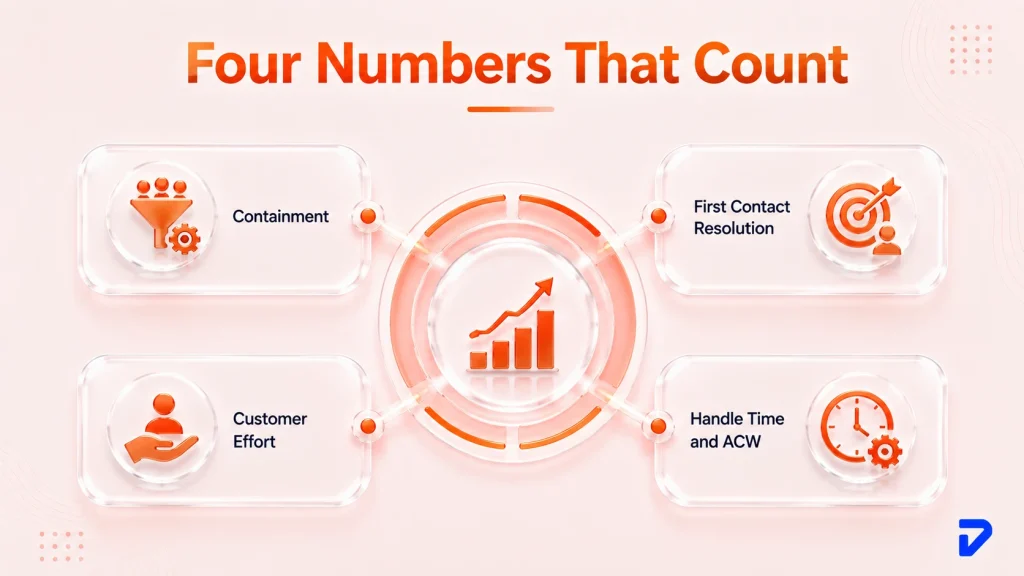
Containment is the share of interactions fully resolved by automation without a human. It is the primary lever for cost at scale, but it is easy to fake. A caller who abandons a broken bot looks “contained” until they call back angry. Real containment counts only resolved issues, tracked against callbacks within 24 hours. Measured honestly, it tells you how much demand your automation genuinely carries.
First Contact Resolution
First contact resolution measures whether the issue was fixed on the first try, and it correlates almost one-to-one with satisfaction. SQM Group benchmarks put the cross-industry average near 70 percent, with top performers reaching the low-to-mid 80s. AI raises FCR when it resolves cleanly and lowers it when it deflects and defers. Track both autonomous and human-assisted resolution, because blending them hides where the system actually fails.
Customer Effort Score
Customer effort score captures how hard the customer had to work to get resolved, and effort predicts churn better than satisfaction does. Gartner research has long found that the large majority of customers who hit a high-effort experience grow less loyal afterward. AI can cut effort by removing menus and repetition, or add to it by trapping people in loops. The metric keeps automation honest about the human on the other end.
Average Handle Time and After-Call Work
Average handle time and after-call work are the classic productivity pair, and AI moves both. Assisted summarization and disposition automation can shave meaningful time off every interaction, which is where much of the $80 billion actually lives. A word of caution: cutting handle time by rushing customers backfires on effort and resolution. The goal is faster because it is easier, not faster because it is abrupt.
Risks and Governance Considerations
The savings are real, and so is the downside when governance lags the rollout. Enterprise AI in the contact center touches regulated data, consent law, and the customer relationship itself. Controls built as code, not as a policy nobody reads, are what separate a deployment that scales from one that gets pulled after an incident. Pinnasys treats this as an AI integration and governance discipline from day one.
Compliance and Data Privacy
Contact center AI sits on top of several overlapping rules, and the AI-specific layer is the one most teams have not covered. The FCC’s voice ruling, the NIST framework, state AI laws, and the EU AI Act all apply depending on where and how you operate.
| Milestone | Date | Status |
| FCC classifies AI voice as “artificial” under TCPA | February 2024 | In force |
| NIST AI Risk Management Framework generative AI profile published | July 2024 | In force |
| Colorado AI Act obligations begin | 2026 | New |
| EU AI Act transparency duties apply for EU-facing teams | August 2026 | New |
The NIST AI Risk Management Framework gives US operators a practical methodology for managing these risks, and it is fast becoming the baseline enterprise buyers expect in a vendor.
Avoiding Over-Automation
The most common failure is automating too much, too fast, under cost pressure. Forrester expects that among AI self-service rollouts this year, slightly more will fail than succeed, usually because teams pushed bots into intents they could not resolve. Forrester’s own analysis of agentic AI warns that orchestration must come before adding agents. Automate the intents you can prove, measure recontact, and expand from evidence rather than ambition.
Human Escalation Paths
Every automated flow needs a clean exit to a human, and the handoff is where trust is won or lost. A customer who has explained their problem to a bot should never have to repeat it to the agent who inherits the case. Good escalation carries full context, transcript, and intent to the person, and it triggers early enough that the customer is not already furious. Design the escape hatch first, then the automation around it.
What Should Contact Center Leaders Prioritize in 2026?
The honest answer to how companies should respond to conversational AI cost savings in 2026 is sequencing, not shopping. The technology is ready; the discipline usually is not. Leaders who get return this year tend to move in this order:
- Fix the knowledge base first, because AI answers from whatever you feed it, and stale content becomes automated errors.
- Start with assisted productivity, where the savings are most reliable, before chasing full call automation.
- Pilot one bounded, high-volume intent with clear exit criteria, and measure recontact, not just deflection.
- Instrument governance as code from the first deployment, not after the first incident.
- Redesign the human roles deliberately, moving agents toward the judgment-heavy work AI cannot do.
Mid-market AI programs win by proving one use case, banking the savings, and reinvesting. That beats a broad rollout that stalls when the business case does not hold.
How Pinnasys Helps Contact Centers Deploy AI That Actually Works
Most contact center AI stalls between a promising pilot and a production system that survives real volume, compliance review, and a bad Monday. Pinnasys builds and runs conversational AI agents for businesses that need the outcome, not a demo, and measures success in hours saved, errors reduced, and revenue protected.
The work usually starts with the knowledge layer, because a bot is only as good as what it can retrieve. A well-structured AI knowledge and search backbone is where that starts. From there, the sequence is pragmatic: model the conversational AI cost savings honestly, automate what holds up, and wire in governance. The aim is a system that keeps performing after the launch call ends.
The Bottom Line
Conversational AI cost savings in 2026 are real, large, and mostly assistive rather than autonomous. Gartner’s $80 billion signals a genuine shift in contact center economics, but the money comes from shorter calls, automated after-call work, full-coverage quality assurance, and cleaner routing, not from bots handling everything.
The operators who benefit treat this as a workforce and governance redesign, not a software purchase. They fix knowledge, prove one use case, measure resolution over deflection, and expand from evidence. Teams weighing where to start can map the rollout with our team before committing budget, so the plan clears governance and the savings actually land.
Key Takeaways from the Article
- Gartner ties $80 billion in 2026 savings mostly to assisted productivity, not full automation.
- Only about one in ten contact center interactions will run fully automated this year.
- Measure resolution and recontact, because deflection alone flatters a broken bot.
- Outbound AI voice needs consent under the TCPA, with steep per-call penalties.
- Human agents shift toward judgment, empathy, and supervising blended teams.
FAQs on AI & Automation
How does AI improve contact center productivity?
AI improves productivity mostly through assistance: summarizing calls, drafting replies, automating after-call work, and scoring 100 percent of interactions. That assisted lift, not full automation, delivers the bulk of Gartner’s projected $80 billion in 2026 savings.
What is agentic AI in a contact center?
Agentic AI uses reasoning models and tools to complete multi-step tasks, such as processing a refund end to end, rather than reciting an FAQ. Orchestration and guardrails matter most, since a chain of agents can compound errors without proper policy control.
What’s the difference between a contact center and a call center?
A call center handles voice only; a contact center handles voice, chat, email, social, and messaging with shared context. Conversational AI platforms are built for the contact center model, carrying a customer’s history across channels without forcing repetition.
What metrics should be tracked when deploying AI in a contact center?
Track containment, first contact resolution, customer effort score, average handle time, and after-call work. SQM Group puts cross-industry FCR near 70 percent, and effort predicts churn, so resolution quality beats raw deflection every time.
Does AI in the contact center replace human agents?
Not wholesale. Gartner expects roughly one in ten interactions fully automated in 2026, and half of firms planning deep cuts are expected to reverse by 2027. Agents shift toward complex, high-value, judgment-heavy work.
What is CCaaS and how does it relate to AI adoption?
CCaaS, contact center as a service, is cloud contact center software delivered by subscription. The market reached about $8.4 billion in 2025, and its AI-driven routing and analytics are how most mid-market AI adoption reaches production.




Prakash C. Saini
Prakash Saini is the Founder & CEO of Pinnasys. With over a decade in digital transformation and building production systems, he grew an engineering team from 2 to 50 people and has led the delivery of 100+ production digital systems. Products built under his leadership have raised millions in funding and generated over $50 million in revenue. He holds an Executive MBA from IIM Kozhikode and today leads the AI engineering team at Pinnasys.