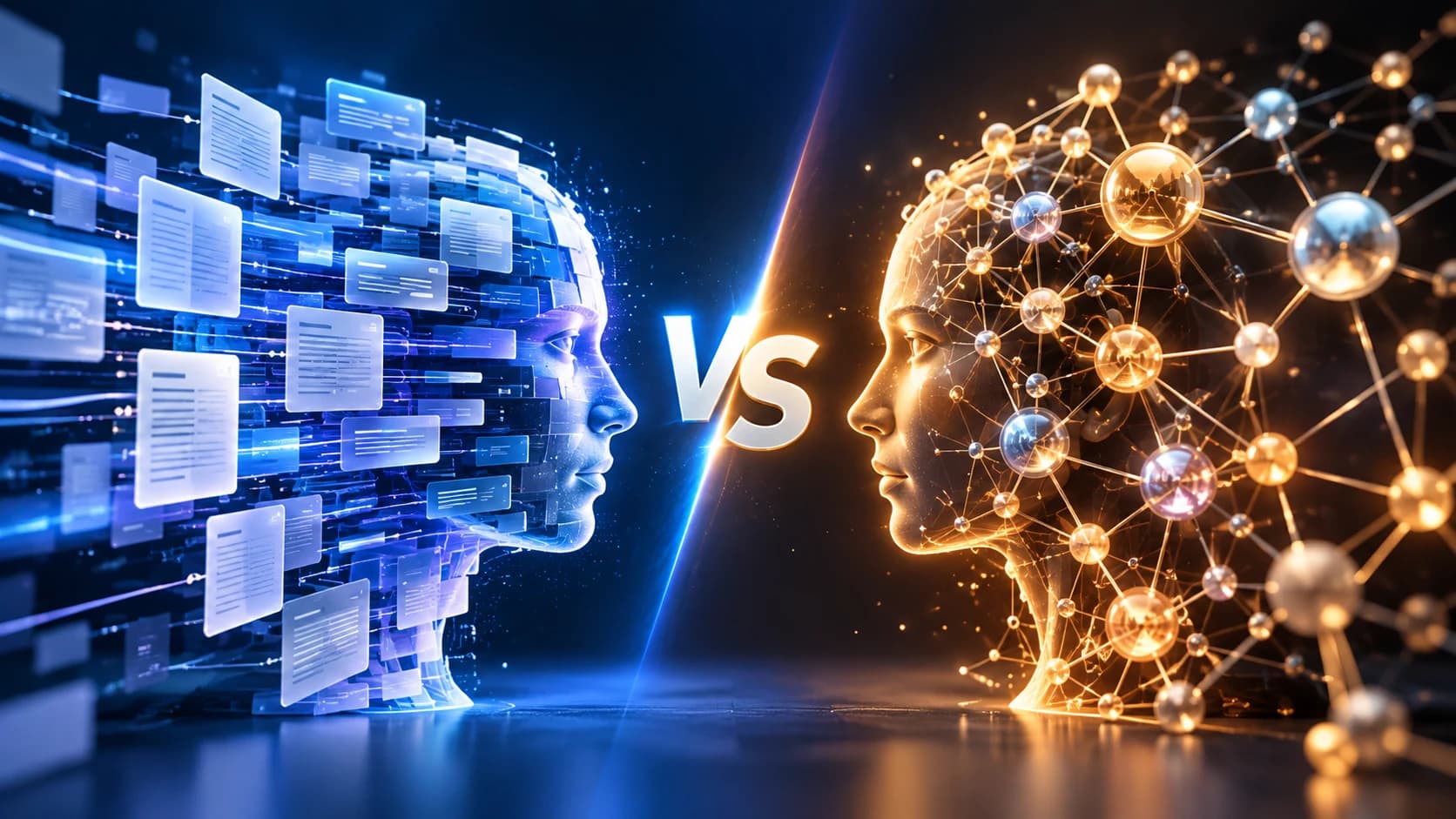
RAG vs. knowledge graphs comes down to the shape of your questions. Retrieval-augmented generation wins on speed, cost, and fast setup over documents; knowledge graphs win on multi-hop reasoning and audit trails.
Retrieval became the default way enterprises ground language models, and Menlo Ventures found RAG at 51% adoption in 2024 across enterprise AI deployments, up from 31% a year earlier. Popularity has not settled the RAG vs knowledge graphs question, though. Once an assistant must explain why a claim was flagged or which supplier sits behind a late shipment, similarity search alone often loses the chain of facts.
Retrieval-augmented generation (RAG) fetches the most relevant passages from your documents and hands them to a language model before it answers. A knowledge graph stores business entities and the explicit relationships between them so software can reason across those links. Anyone scoping a RAG implementation should weigh both against seven criteria:
How is RAG Different from Knowledge Graph?
| Criterion | RAG | Knowledge Graph | Verdict |
|---|---|---|---|
| Speed and latency | Millisecond vector lookups | Slower global queries | RAG leads |
| Setup cost and time to value | Weeks on existing documents | Months of modeling | RAG leads |
| Multi-hop reasoning | Weak across documents | Native traversal | Knowledge graph leads |
| Accuracy on business questions | Strong on text lookups | Strong on structured metrics | Toss-up, depends on question type |
| Explainability | Cites source passages | Shows the reasoning path | Knowledge graph leads |
| Governance and compliance | Document-level controls | Entity-level lineage | Knowledge graph leads |
| Maintenance at scale | Re-embed changed files | Schema and entity upkeep | RAG leads |
What Is Retrieval-Augmented Generation in Enterprise AI
Retrieval-augmented generation grounds a language model in private company content without retraining it. The system searches your data at question time and passes the best matches into the prompt, so answers reflect current documents rather than stale training data.
How a RAG Pipeline Works With Vector Databases
A RAG pipeline splits documents into chunks, converts each chunk into an embedding (a list of numbers that captures meaning), and stores the results in a vector database. Each question is embedded the same way and matched against stored chunks by distance. In Postgres with the pgvector extension, retrieval is one query.
SELECT content FROM chunks
ORDER BY embedding <=> $1
LIMIT 5;
Those five nearest chunks become the context the model answers from.
Common Use Cases for RAG in Enterprise Search Software
RAG fits wherever answers live in prose and most questions map to one or two passages. HR handbooks, runbooks, and product documentation all qualify, and the same Menlo survey ranked support chatbots and enterprise search among the most adopted use cases. Help desks are the classic starting point, because conversational AI for support teams can answer from release notes the day they publish.
What Is a Knowledge Graph in Enterprise Knowledge Management
A knowledge graph models the business as nodes, such as customers, parts, and suppliers, joined by edges like insures or supplies. An ontology (the agreed schema of entity types and permitted relationships) keeps that model consistent, which lets software answer by following links instead of guessing from text.
How Entities and Relationships Power Structured Reasoning
Because relationships are stored explicitly, a graph query can match patterns that keyword or vector search would never surface. Here is Cipher, the query language used by Neo4j, listing every product exposed to a supplier in a sanctioned country.
MATCH (c:Country {sanctioned: true})<-[:LOCATED_IN]-(s:Supplier)
MATCH (s)-[:SUPPLIES_TO*1..3]->(p:Product)
RETURN DISTINCT p.name;
The result is an exact list rather than a ranked guess, and a reviewer can inspect every hop behind it.
Common Use Cases for Knowledge Graphs in Regulated Industries
Insurance, banking, healthcare, and pharma lean on graphs because their questions depend on defined terms and traceable lineage. In one insurance benchmark, GPT-4 accuracy rose from 16% to 54% when enterprise questions ran against a knowledge graph instead of raw SQL tables. Anti-money-laundering, claims review, and regulatory reporting follow the same logic, since relationships carry as much meaning as the records.
What Is the Difference Between RAG and Knowledge Graphs
The core difference in RAG vs. knowledge graphs is what each system treats as knowledge. RAG treats it as passages ranked by semantic closeness, whereas a knowledge graph treats it as facts with named relationships. That one design choice shapes search, reasoning depth, and trust.
Semantic Search Vs Graph Traversal
Semantic search matches meaning, so a question about parental leave still finds a policy titled family absence benefits. Graph traversal matches structure instead, answering which distributors buy from a single-source supplier by following edges between accounts and vendors. Loose wording favors vectors, while questions whose answer is a set of connected records favor traversal, and many production systems route each question accordingly.
Single Step Queries Versus Multi-Hop Reasoning
A single-step query needs one passage, such as the refund window. Multi-hop reasoning chains facts, linking a delayed part to its supplier and that supplier to a port closure. In Microsoft Research’s evaluation of corpus-wide questions, graph-based retrieval was judged more complete than vector RAG in 72% to 83% of podcast comparisons, though vector RAG still gave the most direct answers.
Explainability and Trust in AI Knowledge Systems
RAG cites its passages, yet a citation proves where text came from, not that the reasoning holds. Stanford RegLab’s audit of RAG-based legal research tools caught one tool describing a bankruptcy rule paragraph that does not exist, with hallucination rates from 17% to 33%. A knowledge graph exposes the actual path from question to answer, so auditors can check each relationship.
RAG vs Knowledge Graphs Comparison on Speed, Accuracy, and Governance
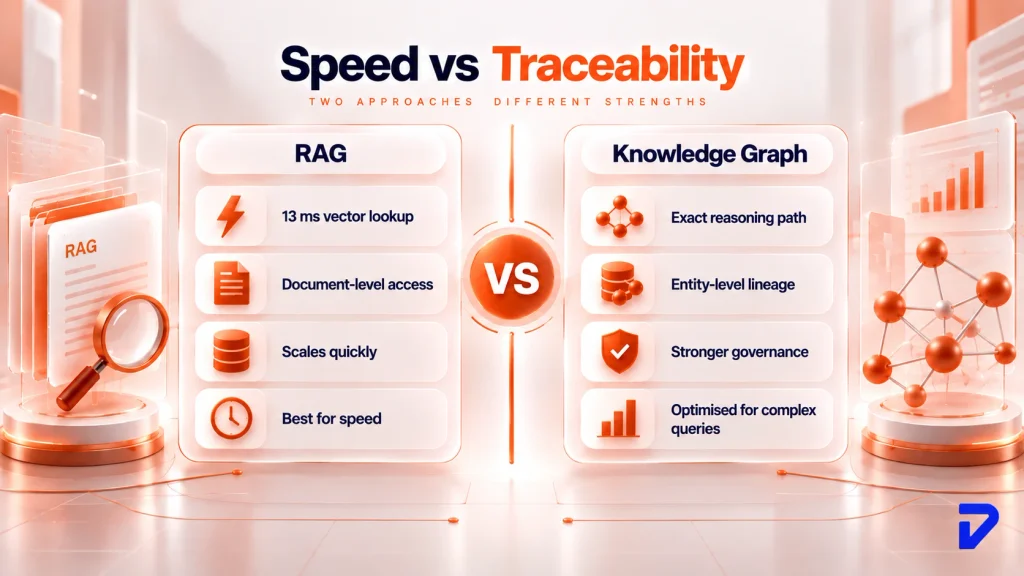
On the three criteria buyers raise most often, the scorecard splits. RAG wins on speed, knowledge graphs lead on governance, and accuracy depends on the type of question asked.
Speed and Latency in AI-Powered Enterprise Search
Vector lookups rarely dominate response time. In an AWS benchmark of pgvector 0.8.0 on Aurora PostgreSQL, a top-10 similarity search across 10 million product embeddings returned in 13.1 milliseconds at the 99th percentile. Graphs answer local lookups quickly too. Corpus-wide graph summarization, however, calls the language model many times per question, which can stretch global queries to several seconds.
Accuracy and Scalability for Enterprise AI Search
RAG accuracy on document lookups responds well to retrieval engineering. Anthropic’s contextual retrieval method cut failed retrievals from 5.7% to 1.9% by adding document context to each chunk and reranking results. On metric and relationship questions, the insurance benchmark shows graphs ahead. Vector indexes scale by adding rows, while graphs need entity resolution (merging duplicate records of one customer or supplier) as they grow.
Governance and Compliance for Enterprise Knowledge Management
Regulated deployments must show who saw what and why. Under Article 86 of the EU AI Act, people affected by decisions from listed high-risk systems, such as credit scoring, can request a clear explanation of the AI’s role. Graphs can carry permissions, lineage, and approval status on each node. RAG usually enforces access per document, which is adequate for internal search but too coarse for audits.
Weighing vector search against a knowledge graph for your own data?
Pinnasys builds enterprise search around your documents, compliance rules, and team capacity, whichever architecture fits best
Is RAG Better Than Knowledge Graphs for Enterprise Use
Neither side of the RAG vs. knowledge graphs debate wins across the board. RAG is the better default for document-heavy knowledge and fast delivery, while a knowledge graph is better where decisions rest on connected facts that must be exact and defensible.
Strengths of RAG as an AI-Driven Enterprise Search Solution
Time to first value is the headline strength. A team can index a SharePoint or Confluence export, test real employee questions within a few weeks, and improve results through chunk sizing and reranking rather than data modeling. The weak point sits in retrieval itself, so study the retrieval-layer failures behind stalled RAG pilots before blaming the model.
Strengths of Knowledge Graphs for AI Enterprise Search
Graphs shine when correctness is non-negotiable, because the schema can enforce business rules. This constraint stops one supplier from existing twice under different spellings.
CREATE CONSTRAINT supplier_duns IF NOT EXISTS
FOR (s: Supplier) REQUIRE s.duns IS UNIQUE;
Answers inherit that discipline, so counts, totals, and relationship chains stay exact and repeatable. That matters for regulatory reporting, fraud investigation, and any question where two runs must agree.
When Should You Choose RAG Over Knowledge Graphs
Data Signals That Favor Vector Database Retrieval
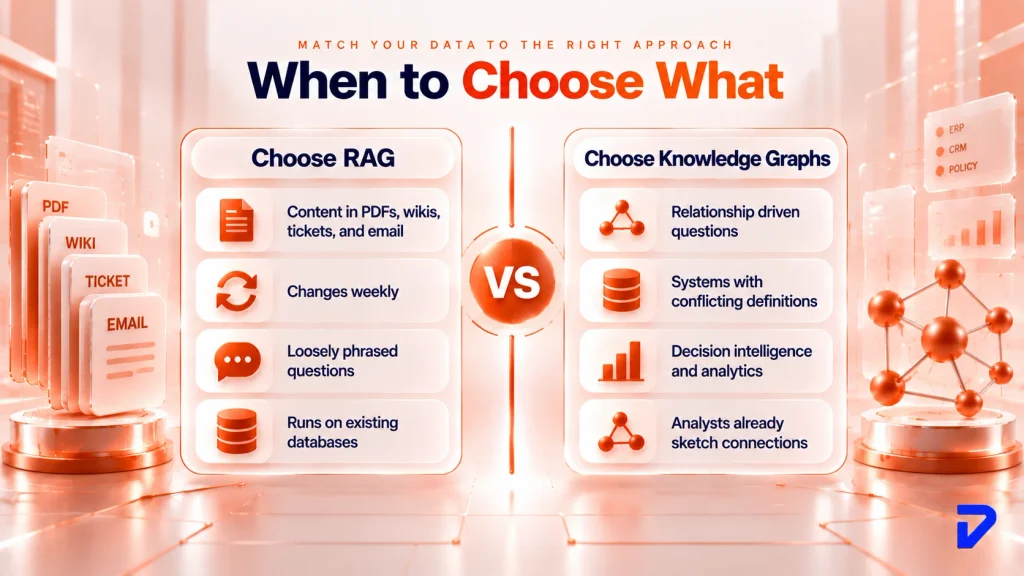
Retrieval is the right first move when content lives in PDFs, wikis, tickets, and email, changes weekly, and draws loosely phrased questions. Infrastructure rarely blocks it: the same Menlo survey found Postgres behind 15% of enterprise RAG storage and MongoDB behind 14%, so many teams add vector search to a database they already run.
Data Signals That Favor a Knowledge Graph Investment
A graph earns its build cost when your hardest questions concern relationships: who owns whom, which parts depend on which suppliers, and which accounts share devices. Other signals include ERP, CRM, and policy systems that disagree on definitions, plus decision intelligence and analytics work where numbers must reconcile. If analysts already sketch these connections on whiteboards, an informal graph exists.
RAG vs Knowledge Graphs for Mid-Market Companies
For firms with 50 to 1,000 employees and no AI team, the RAG vs knowledge graphs choice is as much about budget and staffing as architecture. The path Pinnasys follows with mid-market clients is to start narrow and add structure only where questions demand it.
Budget and Speed Considerations for Mid-Market AI
Graph construction used to break budgets, because extracting entities meant running a language model over every page. That gap is closing, and Microsoft Research reports that LazyGraphRAG indexing costs match vector RAG, at 0.1% of the cost of full GraphRAG. A hand-modeled enterprise ontology, however, still needs weeks of analyst time.
Building Enterprise Search AI Without Enterprise-Sized Budgets
The cheapest credible stack reuses what you already pay for. Postgres, a managed embedding API, and a hosted model can power a first release with no new database license.
CREATE EXTENSION IF NOT EXISTS vector;
ALTER TABLE documents ADD COLUMN embedding vector(1024);
From there, add a small graph only for the domain, such as supplier relationships or part compatibility, where users keep asking questions the index cannot answer.
Which Do You Actually Need: RAG or Knowledge Graphs or Both
How GraphRAG Combines RAG and Knowledge Graphs?
GraphRAG uses a knowledge graph to decide what to retrieve, then passes text and facts to the model. The system spots entities in the question, pulls their neighborhood from the graph, and fetches passages linked to them. A question about a delayed order can therefore return the contract clause, supplier record, and shipping notice at once, instead of three chunks that merely sound similar.
How to Choose Your Enterprise AI Search Architecture?
Four questions settle most cases. Who maintains the system after launch, can the budget carry a run cost, will anyone audit individual answers, and how soon do users need a first release? Small teams on tight timelines with light audit needs lean toward RAG, while larger teams facing regulators lean toward a graph.
Choose RAG if:
- Your knowledge lives mostly in documents, tickets, and wikis that change weekly
- You need a working release within one quarter from a small team
- Most questions resolve to one or two passages
- Document-level access control satisfies your auditors
Choose a knowledge graph if:
- Key questions span three or more linked records
- Answers must be exact, repeatable, and traceable for regulators
- ERP, CRM, and policy systems need one shared definition layer
- Fraud, risk, or dependency analysis sits at the center of the use case
A genuine hybrid exists: launch RAG first, then add a graph for the domain where relationship questions keep failing.
Real World Applications of RAG and Knowledge Graphs in Enterprise AI
Production deployments show both patterns earning their place. Support teams lean on retrieval, while fraud and supply chain teams rely on graphs to expose hidden relationships.
Customer Support and Enterprise Search Software
LinkedIn’s support team published one of the clearest results. They turned historical issue tickets into a knowledge graph that preserved links between related problems, then used it to steer retrieval for a language model. After about six months in production, the approach cut median per-issue resolution time by 28.6% against a group working the traditional way.
Fraud Detection and Supply Chain Knowledge Graphs
Fraud work depends on connections. For the Panama Papers, ICIJ reporters explored 11.5 million leaked files in Neo4j, surfacing people who shared addresses tied to suspicious accounts.
Supply chains follow the same pattern. Siemens researchers modeled their supply network as a knowledge graph spanning more than 61,000 suppliers down to tier 3, then flagged 988 potentially critical suppliers for expert review.
How to Implement an AI-Driven Enterprise Search Solution
Assessing Data Readiness for RAG or Knowledge Graphs
Many projects quietly fail on readiness, and Gartner predicts that through 2026, organizations will abandon 60% of AI projects unsupported by AI-ready data. For RAG, check document quality, duplication, permissions, and freshness. For a graph, confirm that core entities have stable identifiers and that source systems agree on terms like active customer.
An Incremental Roadmap Toward Hybrid Enterprise AI Search
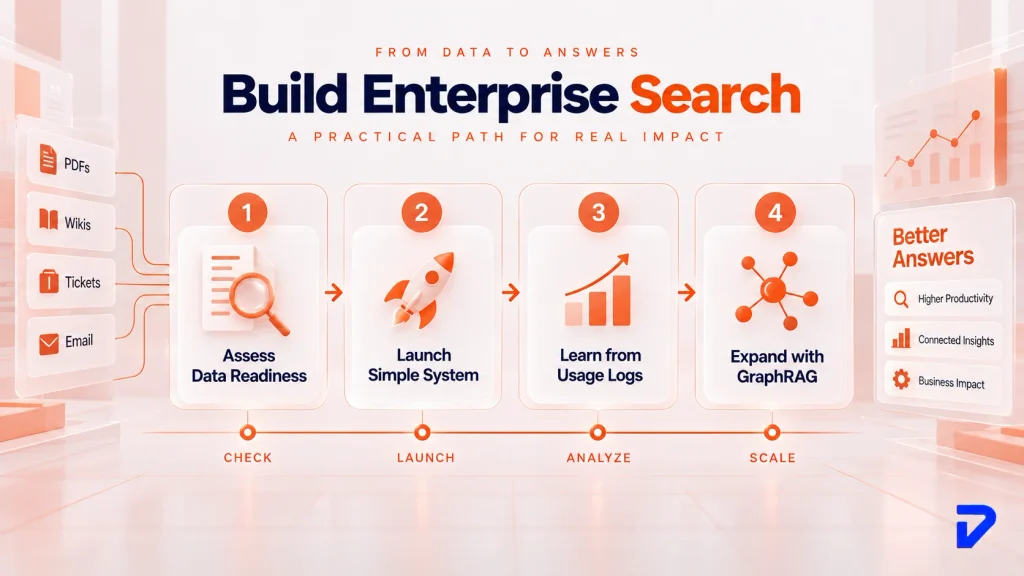
A staged roadmap keeps risk contained. Launch RAG on one high-volume domain, log every question, and after a month tag the failures that needed relationships. Model a small graph for that domain alone, then route relationship questions through GraphRAG while simple lookups stay on vector search. Teams wanting outside input can bring in AI consulting for architecture decisions before building.
What Are The Common Mistakes in the RAG vs Knowledge Graphs Comparison?
Ignoring Governance Needs in AI Knowledge Management
A RAG index that ignores source permissions will happily surface a salary spreadsheet to anyone who asks the right question. The fix is to carry access rules from each source into every chunk, filter at query time, and log the passages behind each answer. Graphs face the same exposure at the entity level, so build AI safety and compliance controls into the first release.
Over-Engineering a Knowledge Graph Too Early
The opposite mistake is designing an enterprise-wide ontology before proving demand. Teams can spend months debating whether a distributor counts as a customer or a partner, while users wait for an assistant that documents alone could have powered. A better sequence models only entities that failed questions actually reference, so every node exists because someone needed it.
The Bottom Line
The RAG vs knowledge graphs decision rarely has a permanent answer. Retrieval delivers value quickly on existing documents, while a knowledge graph pays off when exact, traceable answers across connected records matter more than launch speed. For most organizations, the right strategy starts with retrieval and grows into a graph layer, often through custom AI development, only where real questions prove the need.
Once the architecture is clear, execution decides the outcome. Pinnasys works as the partner that builds whichever path fits your compliance and data requirements, from a first retrieval release to production GraphRAG. Start with one domain, measure what users ask, and let that evidence choose your next step.
Key Takeaways from the Article
- RAG reaches production faster and retrieves document answers in milliseconds at enterprise scale.
- Knowledge graphs answer multi-hop questions that similarity search cannot reliably assemble alone.
- Structured business questions become markedly more accurate when data sits behind a graph.
- Explanation duties under rules like the EU AI Act favor traceable graph reasoning.
- Launch retrieval first, then add a graph where logged questions keep failing.
Frequently Asked Questions on RAG vs Knowledge Graphs
What Is the Difference Between RAG and Knowledge Graphs
RAG retrieves text passages by semantic similarity, while a knowledge graph stores entities as nodes and typed relationships as edges. The Siemens supply chain graph, for example, holds 311,676 edges across 11 relationship types.
Should I Use RAG or Knowledge Graphs
Start with RAG if most knowledge sits in documents, and choose a graph if answers depend on linked records. For collections under roughly 200,000 tokens, Anthropic suggests placing everything in a long context prompt instead.
Is RAG Better Than Knowledge Graphs for Enterprise Use
RAG is better for speed and unstructured content, while graphs suit exact, auditable answers. In the insurance benchmark, graph-backed questions on low-complexity schemas reached 66.9% to 71.1% accuracy using GPT-4-generated SPARQL queries.
When Should I Choose RAG Over Knowledge Graphs
Choose RAG when content changes often, questions are loosely worded, and speed matters most. Hybrid search, blending BM25 keyword matching with vectors, strengthens it further; Anthropic’s tests cut failed retrievals by 49% before reranking.
How Does RAG vs Knowledge Graphs Compare for Mid-Market Companies
Mid-market firms usually reach production faster with RAG and add a graph later. Data management is the bigger constraint, since Gartner found 63% of organizations lack, or are unsure they have, AI-ready data practices.
Which Do I Actually Need RAG or Knowledge Graphs
Most enterprises eventually need both, joined through GraphRAG. LinkedIn’s graph-guided retrieval improved mean reciprocal rank, a measure of how high the correct answer ranks, by 77.6% over a plain retrieval baseline.