


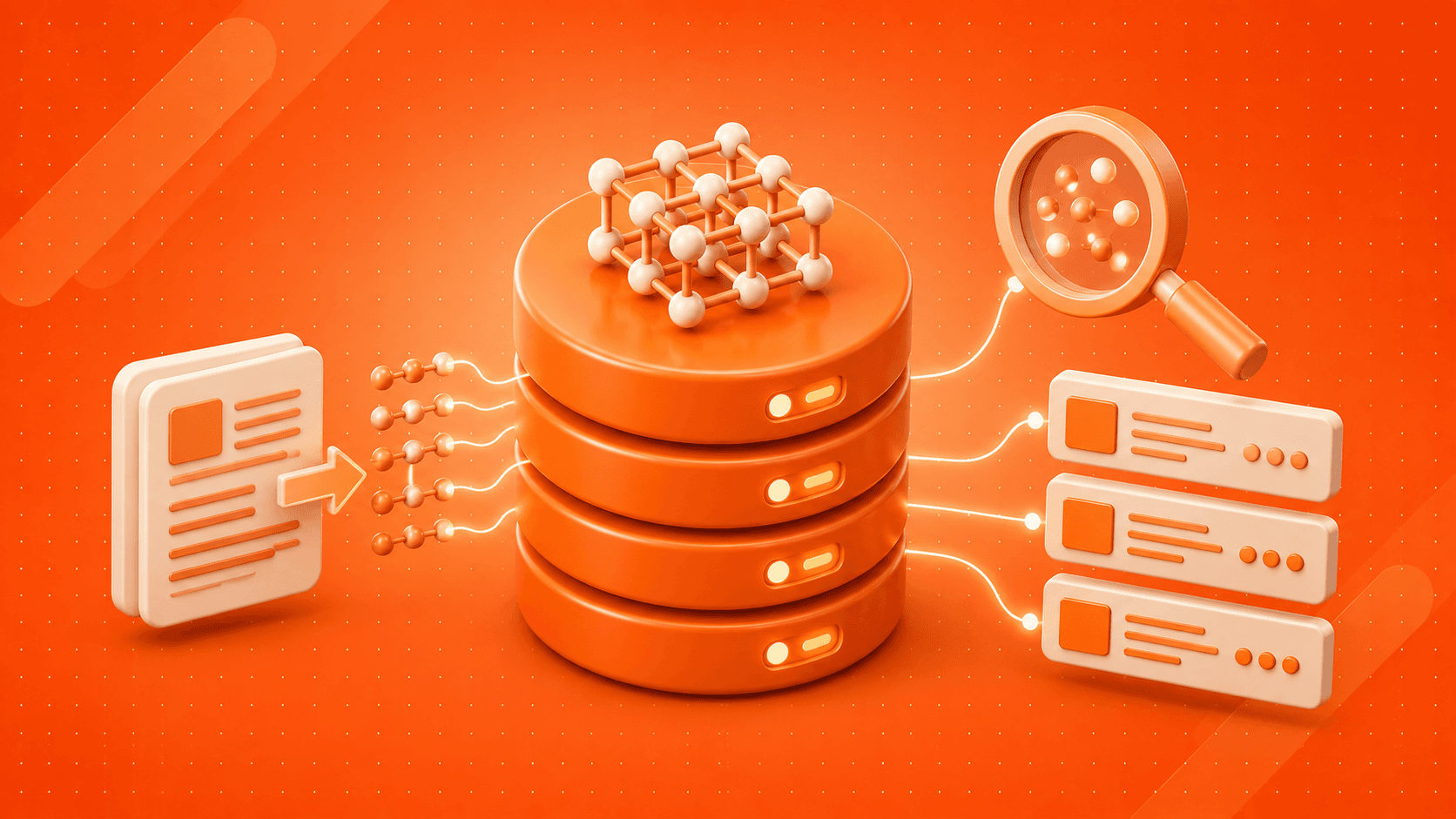
Vector databases help AI systems retrieve information from vast datasets based on meaning and context. This technology enables semantic search, RAG, chatbots, and recommendation engines to deliver faster and more accurate results. With the growing use of modern AI applications, vector databases have become a crucial component of data retrieval.
Consider how Netflix suggests movies you might like or how Google finds answers to your queries even when you don’t use the same words. While these experiences may seem simple, they are powered by technology that understands meaning and context, not just keywords.
Modern AI applications leverage this type of technology to deliver fast and relevant results. This is where vector databases play a crucial role. They store information in a numerical format known as “embeddings,” enabling AI systems to grasp relationships between different data points and rapidly retrieve similar information from vast datasets.
What is a Vector Database?
A vector database is a special type of database designed to store data in the form of vector embeddings. Vector embeddings are numerical representations of data such as text, images, audio, video, and many other types of data. However, where traditional databases are used for precise keyword searches, vector databases are used to search for semantic similarity with meaning. Due to this capability, vector databases are employed extensively in AI applications, which include semantic search, chatbots, recommendation systems, and Retrieval Augmented Generation (RAG).
Popular Vector Database Examples
- FAISS: FAISS (Facebook AI Similarity Search) is an open-source tool developed by Meta. It is designed for fast similarity search and clustering within large-scale vector datasets. It is widely used in research and AI projects.
- Milvus: Milvus is an open-source vector database designed to serve massive AI workloads. It is able to handle billions of vectors and is optimised for searching images, semantic search, and recommendation systems.
- Pinecone: Pinecone is an entirely managed vector database, making storing, indexing, and searching vector data very straightforward. Its automatic scalability and low latency make it suitable for production AI applications.
- Weaviate: Weaviate is an open-source vector database that combines vector search with structured data filtering. It integrates easily with machine learning models and supports hybrid search capabilities.
- OpenSearch: OpenSearch is an open-source search and analytics tool with built-in vector search functionality. Keywords and semantics can be combined in the search queries for more effective AI application responses.
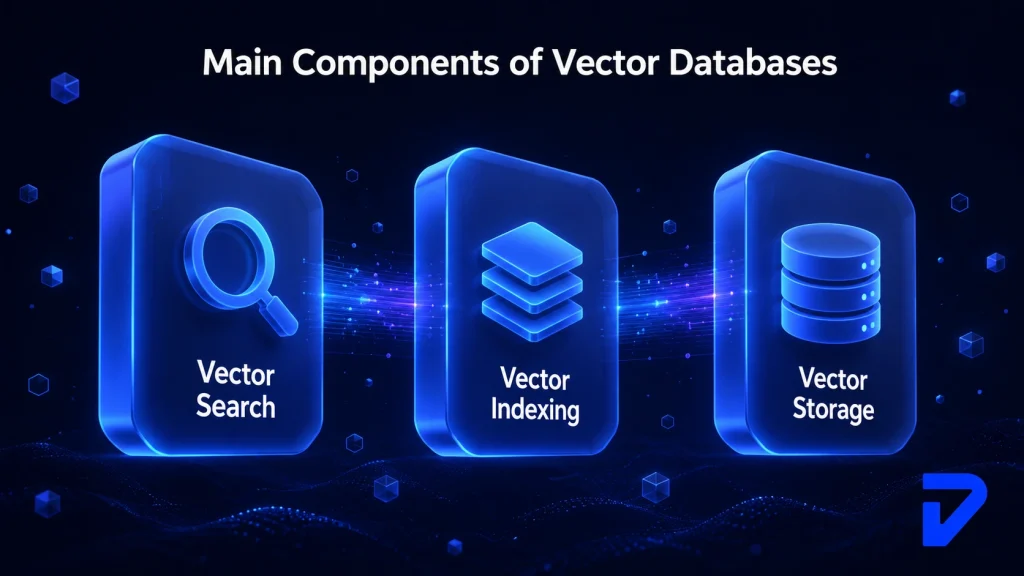
Main Components of Vector Databases
Vector Search
Vector Search is the single most important functionality within any vector database. When a user puts in a query, the system is not just finding keywords that match but rather the vectors that mean or contextually fit the query. This ability to find such vectors powers AI chatbots, semantic search engines, and recommendation engines with incredible accuracy.
Vector Indexing
When your database contains millions or billions of vector embeddings, you cannot afford to scan each vector for every query. Vector indexing offers a solution to this problem by organizing vectors into particular structures that allow quick retrieval of top results. The methods commonly used to do this are HNSW, IVF, and flat index.
Vector Storage
A vector store is the building block for the database of embeddings and corresponding metadata. A well-designed storage layer not only provides data protection but also acts as a key for fast retrieval, scalability, and high-volume AI applications, especially as data size becomes very large.
Vector Database Comparison with Traditional Databases and NoSQL Databases
| Feature | Traditional Databases | NoSQL Databases | Vector Databases |
| Data Type | Structured Data | Semi-structured & Unstructured Data | Vector Embeddings |
| Search Method | Exact Match Search | Flexible Queries | Semantic & Similarity Search |
| Indexing | B-Tree, Hash Indexes | Inverted Indexes | HNSW, IVF, PQ |
| Best Use Cases | CRM, ERP, Transactions | Web Apps, Content Management | RAG, AI Search, Recommendations |
| Scalability | Moderate | High | High |
| Context Understanding | No | Limited | Yes |
How Do Vector Search and Databases Work?
When a user asks an AI chatbot a question, searches for information in a document, or seeks a product recommendation, a vector database finds the most relevant results through a series of steps. This process does not rely merely on keyword matching; instead, it operates by understanding the meaning and context of the information.
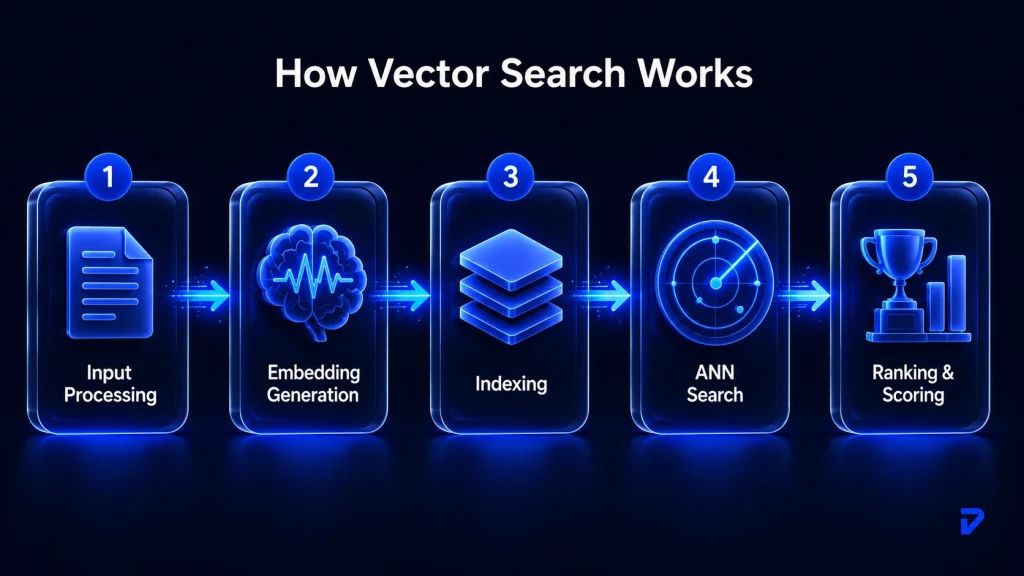
Step 1: Input Processing
The process begins with user input. This input can be text, images, audio, or any other type of data. The system first comprehends the input and prepares it in a format suitable for analysis by the AI model. During this stage, extraneous elements are removed, and the data is organized to ensure that subsequent processing is carried out with greater accuracy and effectiveness.
Step 2: Embedding Generation
Next, the AI model converts the input into a numerical representation known as an “embedding.” This embedding captures the data’s meaning, context, and relationships. For instance, while “Mobile phone” and “smartphone” are distinct terms, their embeddings may be quite close to each other because they share the same meaning.
Step 3: Indexing
All embeddings stored in the database are organized into specialized index structures to facilitate rapid searching. The goal of indexing is to ensure the system does not have to scan the entire database for every query. This maintains high search speeds even within large datasets. It also improves retrieval efficiency at scale.
Step 4: Approximate Nearest Neighbor (ANN) Search
When the new query is vectorized, the vector database will then be used to locate similar vectors through Approximate Nearest Neighbor (ANN) search. In comparison to looking through all records, the system will be checking only the probable ones and thus accelerating retrieval significantly. Reducing search times and computational costs.
Step 5: Ranking & Scoring
In the final stage, the retrieved results are assigned scores based on their similarity. Data points whose meaning and context align most closely with the user’s query are displayed at the top. This is why vector search can often uncover results that do not contain the exact keywords used but are semantically relevant to the user’s search.
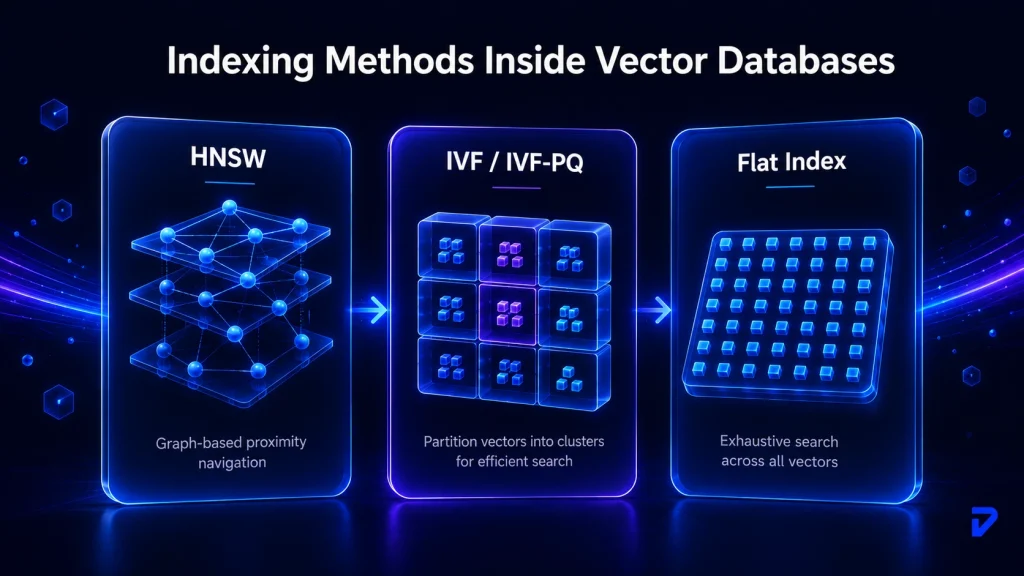
Indexing Methods Inside Vector Databases
HNSW (Hierarchical Navigable Small World)
HNSW is one of the most popular index methods in the vector database world nowadays. HNSW stores the vectors into a multi-layer graph, where each node stores neighbor vectors in its proximity. When we want to search, it will first search in a large range and then zoom to a smaller scope. Its low latency and recall rates make it well-suited for AI applications.
IVF / IVF-PQ (Inverted File + Product Quantization)
IVF indexing divides vectors into multiple clusters, eliminating the need to scan the entire dataset during a search. The query searches only within the most relevant clusters. Product Quantization (PQ) reduces memory consumption by compressing the vectors. Consequently, IVF-PQ is considered a popular choice for handling large-scale vector data.
Flat Index
The Flat Index is the simplest indexing approach. It compares the query vector against every vector present in the database. Since this method does not rely on approximation, it offers the highest accuracy. However, search time increases as the dataset grows. For this reason, flat indexes are typically used for smaller datasets, testing environments, and benchmarking.
Disk-Based / Hybrid Storage Indexes
Disk-based and hybrid storage indexes play a crucial role when the volume of vector data exceeds available memory. Here, the commonly used vectors are kept in memory, and the rest of the data is kept on disk. This design makes it capable of supporting large AI workloads, provides better scalability, and uses less RAM.
Need help building AI-powered search and knowledge solutions?
Contact the experts at Pinnasys to discuss your requirements and find the right approach for your business.
6 Best Use Cases of Vector Databases
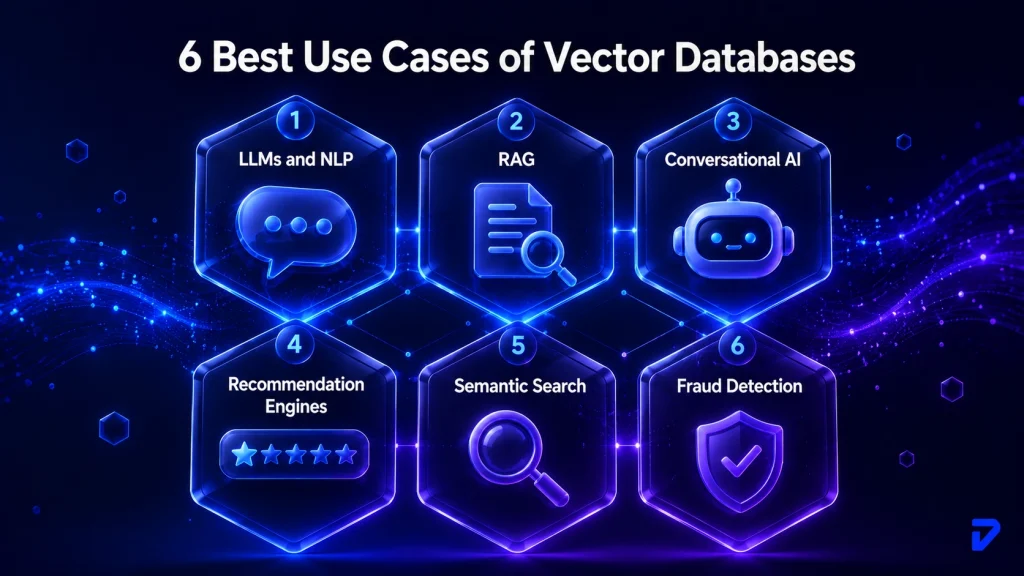
LLMs and NLP
LLM and NLP systems leverage vector embeddings for handling enormous amounts of text. The vector database retrieves and stores the vector embeddings to accelerate AI in searching for the most relevant text information. A vector database could accelerate many AI applications, such as an AI assistant (ChatGPT), text classification, and sentiment analysis.
Retrieval-Augmented Generation (RAG)
Vector databases play an important role in RAG frameworks. When a user asks a question, the system first retrieves relevant information from the vector database, and the LLM then generates an answer based on that information. This allows AI models to provide more accurate, up-to-date, and reliable responses.
Conversational AI
Current chatbots and virtual assistants do more than respond to simple keywords; they attempt to understand the context of the user’s questions. Vector databases enable conversational AI to quickly access historical conversations and knowledge bases, supporting the growing adoption of generative AI across enterprises.
Recommendation Engines
E-commerce platforms, streaming services, and social media applications use recommendation engines to deliver personalized content and product suggestions. Vector databases work on user preferences, behavior, and history to recommend similar items like products, videos, articles, etc. This improves user engagement and experience.
Semantic Search
Semantic search is one of the primary reasons organizations adopt vector databases, as it helps users find relevant information based on meaning rather than exact keywords. While traditional search systems rely solely on keyword matching, vector search attempts to comprehend the actual meaning behind a user’s query.
Fraud and Anomaly Detection
In fields like banking, fintech, and cybersecurity, unusual activity is found through vector databases. These vector databases contain embeddings representing normal behavior patterns. By flagging deviations from these normal behavior patterns, an anomaly can be detected as possible fraud.
The Bottom Line
Vector databases have become the foundation of modern AI systems. In applications such as semantic search, recommendation systems, RAG frameworks, and conversational AI, they are used not only to store but also to understand information by recognizing meaning and context, thus providing more relevant results.
If your organization aims to develop AI-powered search, intelligent automation, or enterprise AI solutions, selecting the right technology partner is equally important. Pinnasys’s AI knowledge enterprise search services enable businesses to retrieve fast, accurate, and context-aware information from vast data sources.
Key Takeaways
- Vector databases can return data not based on keywords but on meaning and context.
- Vector search, vector indexing, and vector storage are the three fundamental parts of any vector database.
- Algorithms such as HNSW, IVF-PQ, and Flat Index help in speed and relevance for searches.
- Vector databases have become commonplace in modern AI applications that are being implemented in current systems such as RAG, semantic search, conversational AI, and recommendation engines.
- Vector databases provide a strong and scalable toolset for any AI that deals with large amounts of unstructured data.
Frequently Asked Questions About Vector Databases
Is a Vector Database and Vector Search the Same Thing?
No, they aren’t exactly the same. The vector database is where you store, maintain, and index vector data, and the vector search is how you search within that database for information with a similar meaning or context. Think of vector search as a tool/function and the vector database as the location for it.
Who Would Use Vector Databases in a Business?
Vector databases can be used by AI developers, data scientists, machine learning engineers, and business teams. They are particularly useful for companies developing chatbots, recommendation systems, smart search tools, customer support solutions, or AI-based applications.
What is the Best Vector Database for AI?
The best vector database for AI depends on your specific needs. Pinecone is popular for its ease of management and scalability, while Milvus and Weaviate offer open-source options. FAISS is considered excellent for research and experimentation, whereas OpenSearch is suitable for hybrid search capabilities.
When to Use Vector Databases Over Relational Databases?
A vector database is the better choice when you need to search unstructured data such as text, images, or audio based on meaning and context. If your data is primarily in a structured format, such as tables, records, and transactions, a traditional relational database would be more suitable.





Prakash C. Saini
Prakash Saini is the Founder & CEO of Pinnasys. With over a decade in digital transformation and building production systems, he grew an engineering team from 2 to 50 people and has led the delivery of 100+ production digital systems. Products built under his leadership have raised millions in funding and generated over $50 million in revenue. He holds an Executive MBA from IIM Kozhikode and today leads the AI engineering team at Pinnasys.