


New benchmark evidence published in August 2026 pins stalled enterprise retrieval projects on the search layer rather than model quality. Here is what the numbers show and what mid-market teams should fix first.0
On August 12, 2026, researchers at Jiutian Research, part of China Mobile, released EnterpriseRAG, a benchmark that tests language models under realistic enterprise retrieval conditions. Across 13 leading models, individual instructions were satisfied roughly 80% of the time, yet only 26.8% of complete responses met every requirement at once.
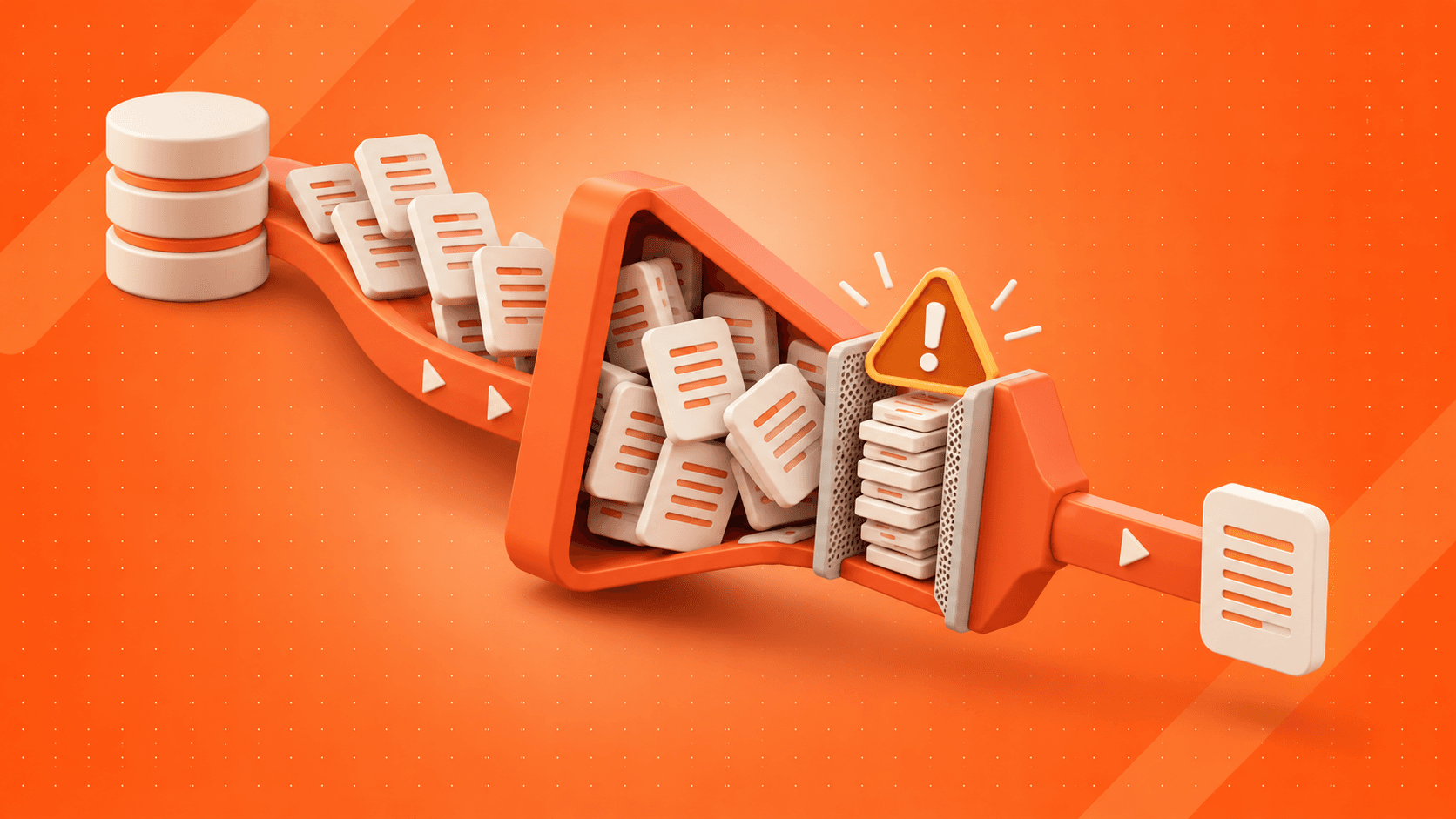
That 57-point gap sharpens the pattern behind a rising RAG pilot failure rate: enterprise projects rarely collapse at the model. They collapse upstream, where the documents get found. In this article, we will explain how the RAG pilot failure rate is climbing and how should companies respond to it. Let’s get started!
What the RAG Pilot Failure Rate Actually Measures
The RAG pilot failure rate describes the share of enterprise retrieval projects that never make the jump from demo to production, and published estimates cluster between 70% and 80%. Berlin-based engineer Gabriel Anhaia traced that band to a cluster of consultancy and industry reports, each describing teams that ran a pilot and stalled before rollout. Those figures measure abandonment, not accuracy, which is why they get misquoted so often.
Retrieval-augmented generation (RAG): A design where a system searches a company’s own documents for relevant passages, then hands those passages to a language model so the answer is grounded in source material rather than training data.
The distinction matters for anyone budgeting AI work. In the projects Pinnasys reviews, a pilot reporting strong accuracy on a curated test set and then failing on live queries has not hit a model ceiling. It has hit a corpus nobody evaluated it against.
Where Does the 80% Figure Come From?
No single audited survey produced the number, so the range deserves to be read as directional. Academic work points the same way. A peer-reviewed study of RAG deployment decisions cites industry failure estimates of 72% to 80% in enterprise settings, and what stays constant across every source is not the percentage but the shape of the failure.
Why Retrieval, Not the Model, Decides the Outcome
Retrieval decides what the model ever sees, so a search miss becomes an answer error that no amount of model capability can repair. The same research team found that the recall threshold needed for RAG to beat a plain language model ranges from 0.2 to 1.0 depending on the task. More striking, RAG systems failed on questions the base model answered correctly in up to 12.6% of samples, even when every retrieved document was a perfect match.
Four of the seven failure points catalogued by Scott Barnett’s team at Deakin University’s Applied Artificial Intelligence Institute sit upstream of generation: missing content, top-ranked documents that never surface, answers dropped during consolidation, and answers present in context but never extracted. Their CAIN 2024 experience report draws a conclusion most pilot plans ignore, namely that “validation of a RAG system is only feasible during operation”.
That single line explains a lot of RAG retrieval layer problems in 2026. A team validates against a clean question set at build time, ships, and then meets queries nobody wrote a gold answer for. Meanwhile the corpus keeps moving. Policies get republished, contracts get amended, and the vector database still holds last quarter’s chunks because nothing in the pipeline scores recency alongside similarity.
Component choices compound the effect. An April 2026 benchmark across 23,088 queries found that BM25 keyword search beat dense retrieval on financial documents, a result that undercuts the assumption that a newer embedding model automatically retrieves better. Swapping in a stronger generator touches none of it.
What Changed in Enterprise AI Search Through 2026
Evidence on the RAG pilot failure rate accumulated steadily rather than arriving in one headline. The dated record below is worth keeping in front of a steering committee, because it shows a research consensus forming while vendor messaging stayed focused on model benchmarks.
| Milestone | Date | Status | Source |
| Barnett and colleagues catalogue seven RAG failure points across three live systems | January 11, 2024 | Peer reviewed at CAIN 2024 | ACM Digital Library |
| MIT Project NANDA finds only 5% of custom enterprise AI tools reach production | July 2025 | Working paper, not peer reviewed | The Register |
| Gartner reports at least 50% of GenAI projects abandoned after proof of concept | Year end 2025 | Observed, revised up from a 30% forecast | Gartner |
| T²-RAGBench study puts hybrid retrieval plus reranking at Recall@5 of 0.816 | April 2026 | Published benchmark | arXiv 2604.01733 |
| EnterpriseRAG-Bench releases a 500,000 document synthetic enterprise corpus | May 2026 | Public dataset and leaderboard | arXiv 2605.05253 |
| EnterpriseRAG ships 983 expert-validated samples simulating real retrieval noise | August 12, 2026 | Newest, preprint | arXiv 2608.11584 |
Wondering whether your own retrieval pilot is heading for the same wall?
Pinnasys helps mid-market teams audit the search layer, measure recall against a real gold set, and decide what to rebuild before budget season closes.
What the RAG Pilot Failure Rate Means for Mid-Market Operators
For a mid-market buyer, the practical read is that RAG development budgets are misallocated rather than insufficient. Money flows to model selection and interface polish while the ingestion, chunking, and ranking work that decides the answer goes unowned.
MIT’s Project NANDA reached a parallel conclusion about generative AI, reporting that roughly 95% of pilots produced no measurable profit impact and that the shortfall traced to integration rather than model quality. Lead author Aditya Challapally attributed the exceptions to teams that “pick one pain point, execute well”.
Here is how the research maps onto symptoms an operator actually reports.
| Failure point | Where it lives | What the business sees | First correction |
| Stale index | Ingestion and refresh schedule | Bot cites a policy replaced months ago | Carry an indexed timestamp and score recency |
| Structure loss | Document parsing | Answers miss the table on page 14 | Use a structure-aware parser for tables and figures |
| Weak ranking | Embedding model and retriever | Plausible but irrelevant passages win | Add hybrid search plus a reranking pass |
| Boundary loss | Chunking strategy | Clauses returned without their definitions | Match small, return the parent section |
| No eval rig | Measurement | Dashboard stays green while quality drops | Build a gold question set and rerun it on every change |
None of those corrections requires a frontier model. All of them require someone to own enterprise AI search and knowledge retrieval as a system with measurable stages, which is precisely the ownership gap that separates a stalled pilot from a shipped one. Teams building customer-facing assistants face the same constraint, so the best RAG solutions for conversational AI are the ones that instrument retrieval before they tune the prompt.
How Should Companies Respond to the RAG Pilot Failure Rate?
Companies should audit the retrieval layer before commissioning any further model work, because that is where the measurable gains sit. Gartner’s Rita Sallam warned in 2024 that “executives are impatient to see returns on GenAI investments” while organizations struggled to prove value, and two years of benchmarks have since located where that value leaks. Four moves change the odds.
- Build a gold set before anything else: Two hundred real questions with verified answers, drawn from actual user logs rather than invented by the build team, give every later decision a scoreboard.
- Measure context recall and context precision separately: End-to-end answer scoring hides a retriever regression. Splitting the metrics exposes whether the right passage was found or simply misused.
- Fix ingestion before tuning the retriever: Structure-aware parsing, sensible chunk boundaries, and a refresh timestamp on every chunk resolve more RAG software development defects than any embedding swap.
- Instrument production traffic: The same discipline behind AI agent observability practices applies here, since retrieval quality drifts as the corpus grows.
An honest AI readiness assessment usually reveals that the corpus, not the model, sets the ceiling. Custom RAG development services earn their fee at that layer, as does the AI integration and governance work that keeps a shipped system accurate into its second year. Weighing a build against a packaged tool comes down to one question: which option shows you what was retrieved and why?
The Bottom Line
The rising RAG pilot failure rate is not evidence that retrieval-augmented generation was a bad bet. It is evidence that the industry priced the model as the hard part and the search layer as plumbing. Benchmarks published through 2026 point the other way, showing that recall thresholds, ranking quality, and corpus freshness govern whether a system earns trust.
Mid-market AI programs that reallocate attention accordingly tend to ship. Teams weighing what this evidence means for a stalled project can speak with the Pinnasys advisory team about auditing the retrieval layer first, then deciding what deserves rebuilding. As a Claude Service Partner, we can audit, discover and help you implement RAG in your daily operations.
Key Takeaways from the Article
- Published estimates put enterprise retrieval project abandonment between 70% and 80%.
- Enterprise RAG found only 26.8% of model responses satisfied every enterprise constraint simultaneously.
- Perfect documents still produce wrong answers in up to 12.6% of tested cases.
- Keyword search beat a leading embedding model on financial documents in 2026 testing.
- Validation only becomes meaningful once a retrieval system meets live production queries.
Frequently Asked Questions About RAG Pilot Failure Rate
Is the RAG pilot failure rate actually significant for buyers?
Yes, though the exact percentage matters less than its cause. The 70% to 80% range comes from consultancy reporting rather than one audited survey, so treat it as directional evidence that RAG development services and solutions should be scoped around retrieval quality.
What exactly does the retrieval layer include?
It covers document ingestion, chunking, the embedding model that converts text into vectors, the vector database that stores them, semantic search or hybrid ranking, and any reranking pass. Each stage can lose or misprioritize evidence before generation begins.
Do million-token context windows remove the need for retrieval?
Not for enterprise AI at scale. You pay for every token sent, access control is enforced at the retrieval layer, and a 500,000 document corpus like EnterpriseRAG-Bench exceeds any context window currently available.
What are the latest enterprise AI search trends in 2026?
Hybrid retrieval has become the default, reranking now carries more weight than model size, and evaluation has shifted from clean test sets toward noisy production conditions. Benchmarks increasingly simulate knowledge gaps and conflicting sources.
How long does fixing a retrieval layer usually take?
Most of the work is measurement and ingestion, not modeling. Assembling a 200-question gold set, adding structure-aware parsing, and layering a reranker typically runs in weeks rather than the quarters a full RAG AI development rebuild would consume.





Prakash C. Saini
Prakash Saini is the Founder & CEO of Pinnasys. With over a decade in digital transformation and building production systems, he grew an engineering team from 2 to 50 people and has led the delivery of 100+ production digital systems. Products built under his leadership have raised millions in funding and generated over $50 million in revenue. He holds an Executive MBA from IIM Kozhikode and today leads the AI engineering team at Pinnasys.