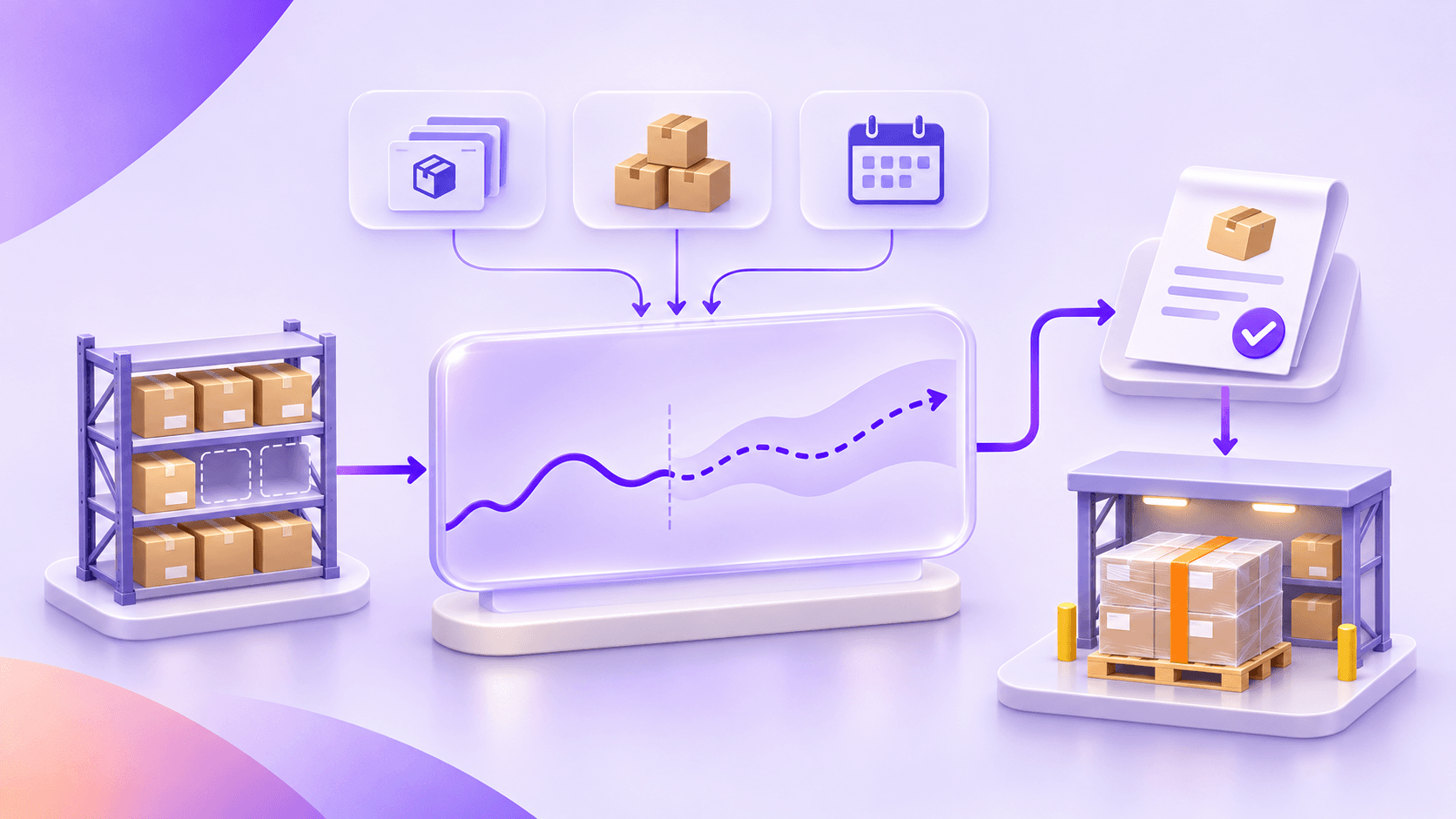
AI inventory management for distributors turns sales history, lead times, and supplier data into SKU-level forecasts and dynamic reorder points. Buyers approve smarter purchase orders, so stockouts fall while overstock and tied-up cash shrink.
Wholesale distribution runs on purchase orders, and each one is a bet on future demand. Yet most mid-market distributors still place those bets from spreadsheets and static ERP min/max fields. Across the wider industry, just 23% of supply chain organizations report a formal AI strategy. That gap is exactly where AI inventory management for distributors earns its place.
Today, the technology can automate most routine forecasting and replenishment math, while buyers keep the final say on every order. Even so, adoption remains shallow across logistics and distribution AI programs, since many teams stop at dashboards. Before fixing that, it helps to see where current planning breaks down.
Why Do Distributors Still Struggle With Stockouts and Overstock?
Distributors struggle because their reorder rules stay fixed while demand, supplier behavior, and catalogs keep shifting underneath them. Census figures show how quickly the ground moves. The merchant wholesaler inventories-to-sales ratio fell to 1.21 in September 2026, down from 1.34 a year earlier. That aggregate swing hides SKUs that ran dry and others that sat untouched, and AI inventory management for distributors targets both problems at once.
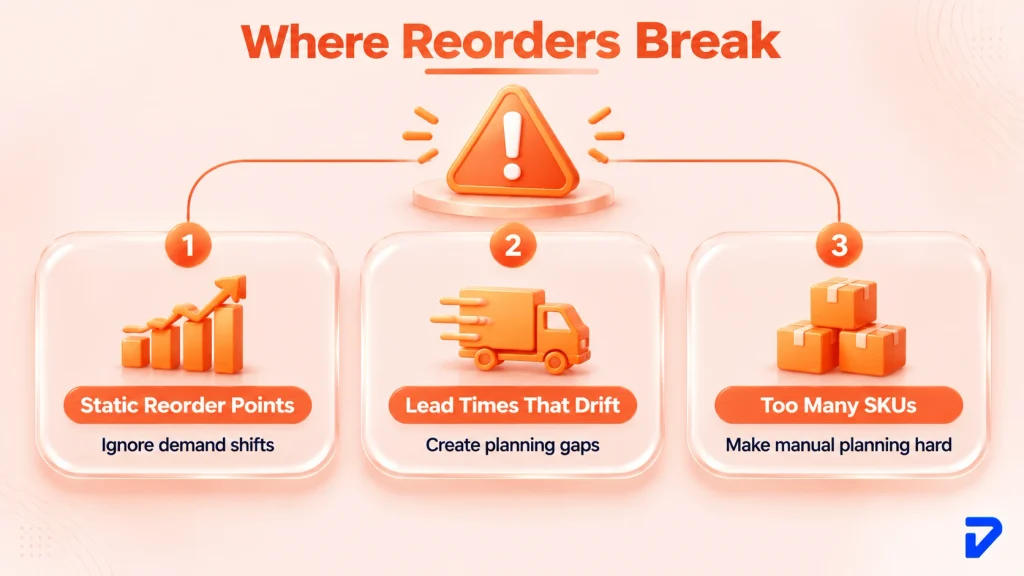
Static Reorder Points That Ignore Volatility
Most ERP systems use a reorder point set years ago and never revisited. When a contractor customer doubles orders before spring, that fixed trigger fires too late, and stockouts follow. The reverse happens once a demand spike fades, because the same rule keeps buying stock nobody needs. Static settings quietly treat every week as an average week.
Lead Times That Drift Without Warning
Supplier lead times rarely match the vendor master. A fastener importer quoted at three weeks may average five during port congestion, yet the buying math still assumes three. As a result, safety stock covers the wrong window, and buyers pay for expedited freight to close the gap. Few teams compare promised and actual receipt dates, so the drift stays invisible.
Too Many SKUs for Manual Planning
A typical industrial or foodservice distributor carries tens of thousands of active SKUs across several branches. No buyer can review each item weekly, so teams fall back on broad ABC classes and gut feel. Slow movers collect dust while critical C items, such as a specialty valve a key account needs, quietly stock out.
How Does AI Improve Inventory Management for Distributors?
AI Demand Forecasting at the SKU and Branch Level
SKU forecasting with machine learning (models that learn patterns from data rather than following hand-written rules) predicts demand for each item at each branch. In the M5 forecasting competition, machine learning methods outperformed statistical benchmarks across tens of thousands of Walmart sales series. For a distributor, that means one forecast per SKU reflecting price, seasonality, and customer mix.
Dynamic Safety Stock Tied to Service Levels
Safety stock is the buffer covering demand and lead time uncertainty between orders. AI sizes that buffer per item, using forecast error and supplier variability instead of a flat “two weeks of cover.” An A-class item with a reliable supplier may need less stock, while an erratic import line earns more. That way, working capital follows actual risk.
Can AI Set Reorder Points Automatically?
Yes, AI can calculate reorder points automatically, and most teams let it propose changes that buyers approve in bulk. What changes is the frequency, since AI reorder points refresh weekly or even daily instead of once a year? From there, an AI agent can draft the matching purchase order for buyer review.
# Core logic an AI reorder engine recalculates for every SKU and branch
reorder_point = avg_daily_demand * lead_time_days + safety_stock
safety_stock  = z_score(service_level) * sqrt(
    lead_time_days * demand_variance + avg_daily_demand**2 * lead_time_variance
)
What Data Does AI Inventory Management Need?
AI inventory management needs clean transaction history, supplier performance records, and a clear view of open orders. Fortunately, McKinsey notes that most organizations already hold enough data to gain value from AI-driven forecasting. For AI inventory management for distributors, the usual gaps sit in data definitions rather than data volume.
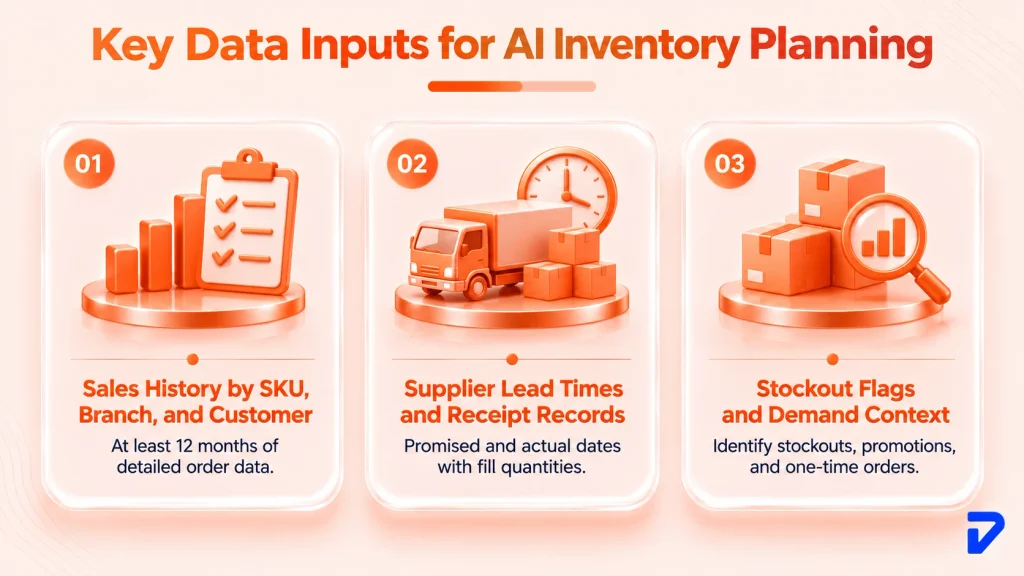
Sales History by SKU, Branch, and Customer
Models need at least 12 months of order lines, and two years captures seasonality far better. Each line should carry the date, SKU, branch, customer, quantity, and price, because price changes shift demand. A plumbing distributor that logs only invoice dates, not original order dates, will blur the real timing of demand.
Supplier Lead Times and Receipt Records
Promised dates, actual receipt dates, and fill quantities per purchase order let the model learn real lead times. Those records usually sit in the ERP but rarely get cleaned. Teams that already pull ERP, WMS, and EDI data together start faster, since receipt history arrives structured and ready to model.
Stockout Flags and Demand Context
Zero sales during a stockout does not mean zero demand, so the model must know when an item was unavailable. Without that flag, it learns to under-buy. Promotions, one-time project orders, and new customer wins also need tags, which keeps a single 500-unit contractor job from inflating next quarter’s forecast.
Before and After AI Inventory Management for Distributors
The clearest way to judge the shift is to compare daily buying work before and after AI arrives. McKinsey found that early AI supply chain adopters improved inventory levels by 35% and service levels by 65% versus slower competitors.
| Workflow step | Before (manual) | After (with AI) | Metric moved |
|---|---|---|---|
| Demand forecast | Spreadsheet averages, updated quarterly | SKU forecasting by branch, refreshed weekly | Forecast accuracy |
| Safety stock | Flat weeks of cover for every item | Buffer sized to variability and service target | Inventory turns |
| Reorder points | Static ERP min/max values | AI reorder points recalculated automatically | Stockout rate |
| Lead times | Vendor master estimate | Learned from actual receipt dates | Fill rate |
| Purchase orders | Buyer builds each PO by hand | Drafted PO queued for buyer approval | Buyer hours per week |
| Exceptions | Found after a customer complains | Early alerts on at-risk SKUs | Lost sales |
| Excess stock | Caught in the annual review | Flagged monthly for transfer or return | Overstock value |
In practice, buyers move from data entry to judgment calls, which is where their experience matters most. The change also shortens order cycles, because purchase order workflow automation sends approved POs to suppliers the same day.
Still reordering from min/max levels set years ago?
Pinnasys builds AI demand forecasting and reorder engines around your ERP, so buyers approve smarter purchase orders, and stockouts drop.
Which Distribution KPIs Does AI Inventory Optimization Move?
AI inventory optimization moves the handful of metrics distributors already report to owners and lenders. McKinsey’s distribution research links AI in operations to 20 to 30 percent lower inventory and 5 to 15 percent lower procurement spend. It also describes a building products distributor that lifted fill rates 5 to 8 percent with an AI-enabled control tower. Here is how AI inventory management for distributors shows up in each number.
| KPI | What it measures | How AI moves it |
|---|---|---|
| Fill rate | Share of order lines shipped complete from stock | Better forecasts keep fast movers available |
| Inventory turns | How often inventory sells through per year | Right-sized safety stock trims idle units |
| Inventories-to-sales ratio | Stock on hand relative to monthly sales | Less overstock without starving A items |
| Forecast accuracy | Average percentage gap between forecast and actual | SKU-level models track demand shifts faster |
| Order-cycle time | Days from customer order to shipment | Fewer backorders and split shipments |
| Expedite spend | Premium freight paid to recover shortages | Early alerts replace emergency buys |
Forecast accuracy usually appears as MAPE (mean absolute percentage error), the average percentage miss between forecast and actual demand. Track every KPI monthly against a pre-AI baseline, since a sharper forecast only counts when fill rate and turns improve together. For a wider view of these metrics across the network, see how AI in supply chain management connects planning to logistics.
How Should Distributors Pilot and Connect AI Inventory Forecasting Software?
Start with a narrow, measurable pilot, then connect the winning model to the ERP where buyers already work. Gartner expects autonomy to arrive slowly, predicting only 5% of organizations will make 10% of planning decisions autonomously by 2030. That pace suits distribution inventory planning, where AI inventory management for distributors earns trust one SKU family at a time.
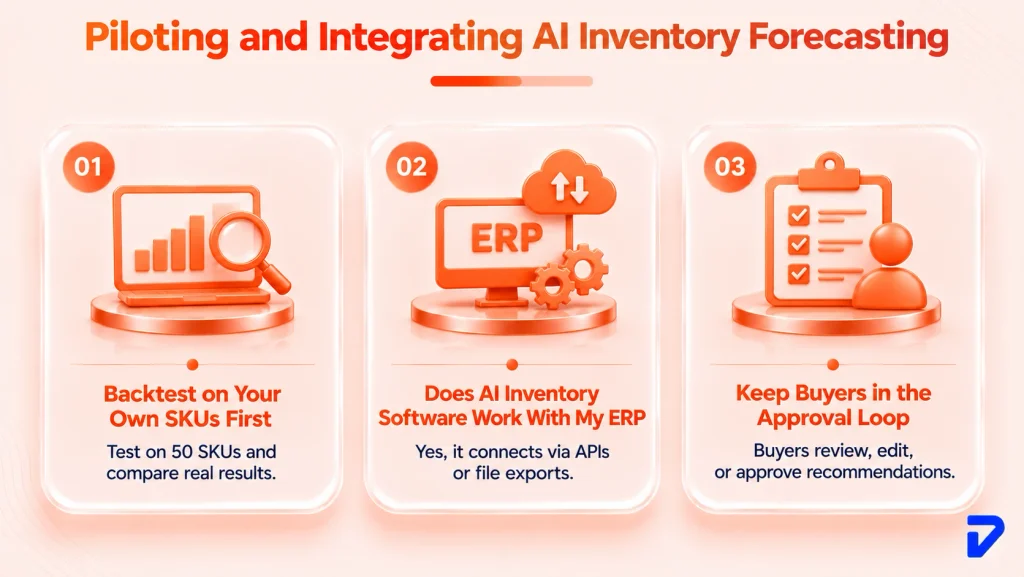
Backtest on Your Own SKUs First
Before signing, ask any vendor of inventory forecasting software to backtest on 50 of your own SKUs. Hide the last eight to twelve weeks of sales, let the model forecast them, then compare against actuals and your buyers’ orders. This test exposes weak handling of stockouts and lumpy demand within days, not months.
Does AI Inventory Software Work With My ERP?
Yes, most tools connect to ERPs such as NetSuite, Epicor, Infor, or Microsoft Dynamics. ERP integration usually runs through APIs, the standard interfaces software uses to exchange data, or through nightly file exports. A well-built AI integration layer writes approved reorder points back into the ERP, so the system of record stays authoritative.
Keep Buyers in the Approval Loop
Human-in-the-loop review means a buyer approves, edits, or rejects each AI recommendation before it reaches a supplier. Start in recommend-only mode, then allow auto-approval for low-risk C items under a set dollar limit. Every override gets logged with a reason, which teaches the model and builds the audit trail finance expects.
Building AI Stock Replenishment to Distribution Compliance Requirements
AI stock replenishment must respect the rules that govern what a distributor sells, not only how much it buys. Pinnasys engineers each system around those constraints, with guardrails, audit trails, and human review built into the replenishment flow. Requirements vary by sub-segment:
- Pharmaceutical and medical distribution: The Drug Supply Chain Security Act requires interoperable, electronic product tracing, so replenishment logic must respect lot, serial, and expiration data.
- Food and foodservice distribution: The FSMA 204 food traceability rule requires lot-linked key data elements, with compliance now proposed for July 20, 2028. Reorder quantities should also honor first-expired, first-out rotation.
- Every distributor: Inventory valuation feeds the financial statements, so reorder policy changes need role-based approvals and a change log auditors can review.
- AI governance: The NIST AI Risk Management Framework organizes oversight into Govern, Map, Measure, and Manage, which makes a practical checklist for model monitoring.
Drift monitoring, which alerts the team when forecast error creeps above an agreed threshold, keeps models honest after launch. Pinnasys builds systems that support these obligations, while certification and legal sign-off stay with your quality and compliance teams. That discipline separates production-grade AI inventory management for distributors from a demo that ignores lot rules.
The Bottom Line
Distributors rarely lose margin on one bad forecast; they lose it on thousands of stale decisions repeated every week. AI inventory management for distributors fixes that by continuously refreshing forecasts, safety stock, and reorder points, while buyers keep approval authority. The strongest programs begin with clean data, a backtested pilot, and tight ERP integration, then widen automation as trust grows.
Pinnasys works with mid-market distributors along that path, from data audit to production models that keep running after launch. If you are weighing where to begin, an AI consulting and roadmap engagement can rank your SKUs, data gaps, and quick wins. Pick the product lines that trigger the most expedites, and measure fill rate from week one.
Key Takeaways from the Article
- Static min/max settings cause both stockouts and overstock when demand and lead times shift.
- Machine learning SKU forecasts beat statistical benchmarks in the large-scale M5 competition.
- Accurate stockout flags matter more than raw data volume for trustworthy demand forecasts.
- Fill rate, inventory turns, and expedite spend reveal whether AI inventory optimization works.
- Recommend-only pilots with buyer approval build the trust that wider automation requires.
Frequently Asked Questions on AI Inventory Management
How accurate is AI demand forecasting?
AI forecasts typically run far tighter than spreadsheet averages, though results vary by item type. One BCG X client gained 15% forecasting accuracy alongside a $100 million inventory reduction in its first year. Intermittent SKUs improve the least.
What ROI do distributors see from AI inventory tools?
BCG reports 15 to 30 percent working capital reduction and 5 to 15 percent higher service levels from AI-enabled supply chains. Most wholesale distribution teams measure payback through freed cash and fewer expedited orders.
How long does an AI inventory forecasting pilot take?
A focused pilot usually runs 8 to 12 weeks, covering data cleanup, backtesting, and a recommend-only phase. Rollout across additional branches commonly follows within six months once fill rate and turns hold steady.
Will supply chain AI replace inventory buyers?
No. Supply chain AI handles routine calculations, while buyers own supplier negotiations, exceptions, and new product decisions. Most distributors redirect the hours buyers once spent keying purchase orders toward vendor management, pricing, and margin work.
How does AI forecast new SKUs with no sales history?
AI uses like-item modeling, borrowing demand patterns from similar SKUs in the same category, brand, or price band. Planners usually review these forecasts for the first 8 to 12 weeks while real sales history accumulates.
Can AI reduce overstock without causing more stockouts?
It can, because AI sizes safety stock per item instead of applying flat cover everywhere. Excess shrinks on predictable SKUs, volatile items keep protection, and lead times learned from receipts prevent orders from landing early or late.