


AI integration for distribution systems connects ERP, WMS, and EDI data with AI models and operational workflows. Effective integration enables systems to exchange information, automate decisions, and trigger actions across core distribution processes.
Distribution runs on connected systems. Your ERP holds financial data and order records. WMS controls warehouse operations. Your EDI network links you to trading partners. Each system generates data constantly, yet most distributors still process that data through manual steps, batch exports, and staff who reconcile discrepancies between platforms.
AI integration for distribution closes that gap. Rather than treating ERP, WMS, and EDI as separate silos, AI connects them into a shared layer where data flows in real time and decisions happen automatically. According to IBM research, organizations with higher investment in AI-driven supply-chain operations report 61% greater revenue growth than their peers. The gap between companies that connect AI to their core systems and those that do not is widening.
This guide explains how that connection works, what it takes to build it, and where the biggest gains tend to appear first.
Where Does AI Integration for Distribution Actually Begin?
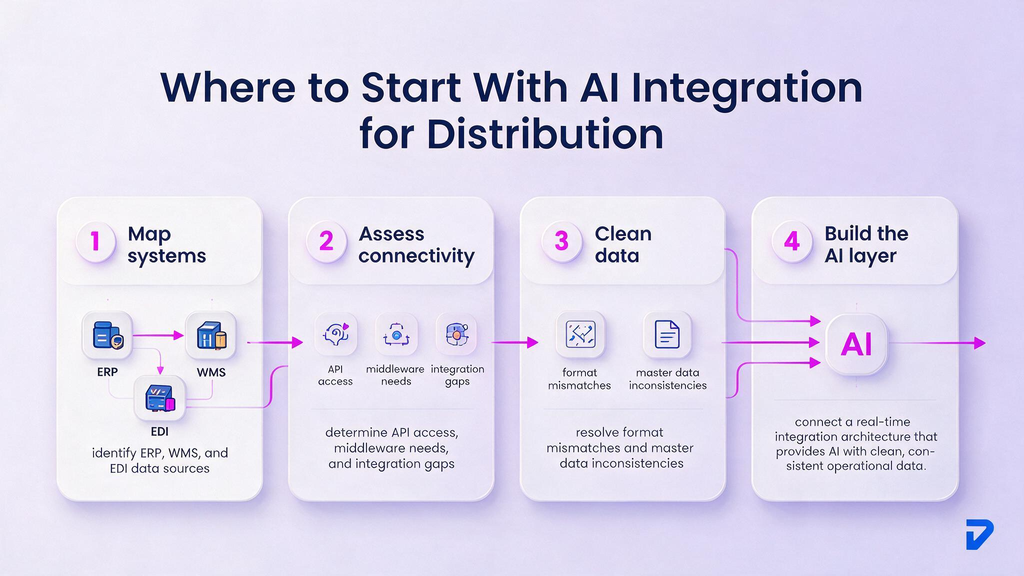
The answer is rarely in the AI model. It starts in the data. Before any AI system can forecast demand, flag exceptions, or automate order processing, it needs reliable, structured access to the operational data that lives inside your ERP, WMS, and EDI platforms.
Most mid-market distributors have at least some of this data. The problem is that it is scattered, inconsistently formatted, and trapped in systems that were not built to share. A purchase order might live in SAP, inventory counts in a WMS like Manhattan Associates or Blue Yonder, and inbound partner transactions in an EDI network running ANSI X12 standards.
AI integration for distribution does not begin with choosing a model. It begins with mapping which systems hold which data, identifying how they currently connect (or fail to connect), and designing an architecture that gives AI the clean, consistent inputs it needs.
Understanding What AI Needs From Your Systems
AI models work on data, not screens. They need structured access to records, events, and transactions through APIs (Application Programming Interfaces, the connections that let software systems communicate) or middleware (a layer that translates between systems with different data formats). Reliable access allows AI to work with live operational information, identify exceptions as they occur, and connect decisions directly to execution.
Identifying the Systems AI Needs to Connect
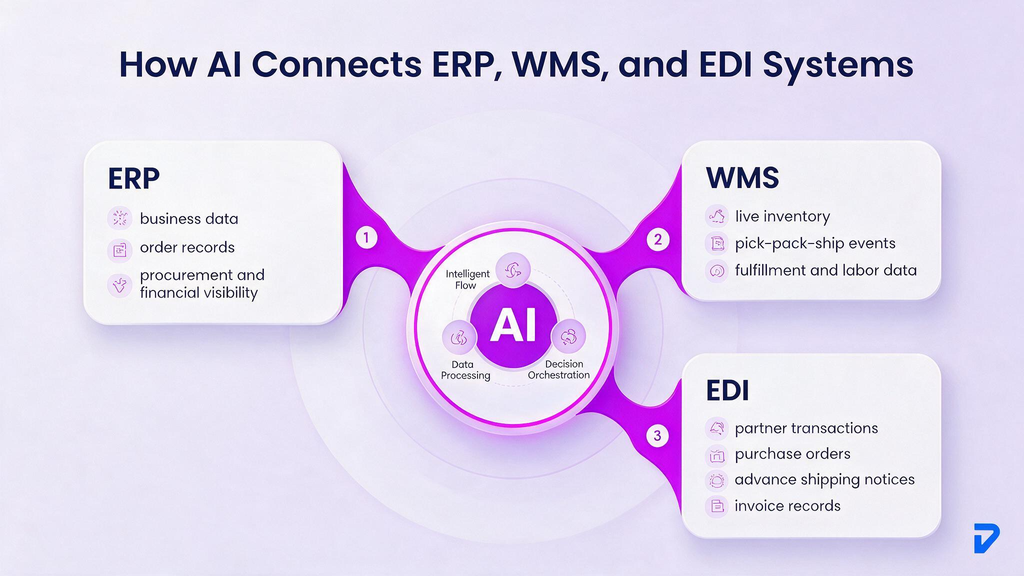
For most distributors, the core systems are the ERP for business and financial data, the WMS for warehouse and inventory operations, and the EDI network for trading-partner transactions. ERP data supports forecasting and procurement, WMS data informs inventory and fulfillment, while EDI data enables order processing and exception detection. Connecting these systems gives AI the context needed to operate across the full distribution workflow rather than within a single function.
How AI Integrates With ERP, WMS, and EDI Systems
The technical approach to connecting AI with your core systems depends on how those systems are built. Modern cloud platforms expose APIs that AI can query or subscribe to directly. Legacy on-premise systems often require middleware or custom connectors. EDI adds another layer, because its data arrives in standardized document formats (ANSI X12, EDIFACT) that must be parsed and translated before AI can read them.
ERP Integration for Business and Operational Data
Your ERP is the financial and operational record of your distribution business. It holds purchase orders, sales orders, supplier contracts, invoice history, and inventory valuations. When AI connects to your ERP through a REST API or an integration platform like MuleSoft or Boomi, it gains read and write access to this data in real time.
That access changes what AI can do. Demand forecasting models can pull current order volumes and historical sales data directly rather than waiting for weekly exports. Procurement automation can check supplier lead times and on-hand stock before triggering a replenishment order. Exception workflows can flag overdue invoices or mismatched quantities and route them for human review, all without manual data entry.
WMS Integration for Warehouse Intelligence
Your WMS manages the physical reality of your warehouse: what is on the shelf, where it is located, what is being picked, packed, and shipped. Microsoft research on AI-powered logistics estimates that connecting AI to warehouse operations could optimize inventory levels by 35%. That number reflects what becomes possible when AI can act on live pick-and-pack data rather than end-of-day reports.
When AI integrates with your WMS, it can monitor put-away rates, detect slotting inefficiencies, predict labor shortfalls based on inbound volume, and automatically adjust fulfillment priorities when stock falls below reorder thresholds. The integration layer pulls event streams from the WMS and translates them into inputs that AI can process and act on in near real time.
EDI Integration for Partner Transactions
EDI is where external transaction data enters your systems. A purchase order from a retailer, an advance shipping notice from a supplier, or an invoice acknowledgment from a carrier all arrive as structured EDI documents. These documents follow rigid format standards (810 for invoices, 856 for ASNs, 850 for purchase orders) that must be parsed before any downstream system can use them.
AI integration adds an intelligence layer on top of this parsing. Rather than simply ingesting and routing EDI documents, AI can detect anomalies, flag compliance gaps, predict which partner transactions are likely to generate exceptions, and trigger automated resolution workflows. EDI data that used to require manual review becomes a source of real-time operational signals.
Building an AI Integration Architecture for Production
Architecture is where most distribution AI pilots fail to become production systems. A proof of concept might connect AI to a single data export or a test environment. A production system needs reliable connectivity, clean data, real-time synchronization, and the ability to handle exceptions without human intervention for every routine case.
Connecting AI Through APIs and Middleware
Modern ERPs like SAP S/4HANA, Oracle NetSuite, and Microsoft Dynamics expose REST APIs that AI systems can call directly. Older platforms, including JD Edwards or Epicor installations, may require middleware to translate native data formats into structured inputs AI can process.
Integration platforms such as MuleSoft, Boomi, or Azure Integration Services handle authentication, data transformation, and error management between your systems and AI layer. The choice depends on your system landscape: cloud platforms often favor direct APIs, while legacy or on-premise systems typically need middleware. Many distributors use both.
Creating a Reliable AI Data Integration Layer
A reliable AI data integration layer does three things well: it moves data without loss, it transforms inconsistent formats into clean structured inputs, and it handles failures gracefully when a system is unavailable. Each of these is harder than it sounds in a live distribution environment with high transaction volumes, multiple shifts, and operational windows that leave little room for downtime.
AWS and the Kearney Supply Chain Institute report that more than 80% of today’s actionable supply chain data originates outside the business, from suppliers, vendors, and trading partners. That means the integration layer cannot just connect internal systems. It must pull in external data streams, validate them, and make them available alongside internal records without introducing latency that undermines time-sensitive decisions.
Managing Data Across Distribution Systems
Master data management (MDM) keeps key records for products, customers, and suppliers consistent across systems. Without it, mismatched ERP and WMS product codes can distort inventory data, while inconsistent EDI partner IDs can cause automated order processing failures.
Data mapping, deduplication, and validation should happen before AI processes production data. This requires ongoing governance as SKUs, suppliers, and trading-partner requirements change. Maintaining consistency early reduces integration failures and makes AI workflows easier to scale across distribution operations.
Can AI connect with your existing distribution systems?
Pinnasys integrates AI with ERP, WMS, EDI, and core platforms to automate workflows and improve operations.
AI Integration Use Cases in Distribution
Theory matters less than outcomes. These are the areas where distribution companies see the clearest return from connecting AI to their core systems, ranked by where integration value tends to compound fastest.
1. Demand Forecasting
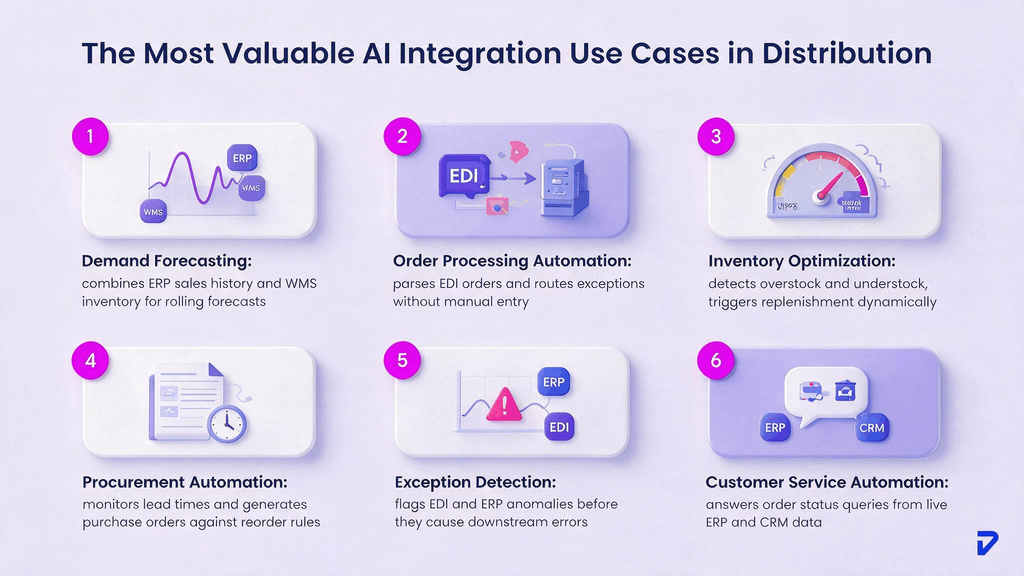
Connecting ERP and WMS data gives AI access to sales history, current inventory levels, order patterns, and other relevant signals. This supports AI in sales by enabling rolling forecasts that update as new information becomes available, helping distributors respond to changing demand and potentially reduce forecast error by 20–50%.
2. Order Processing Automation
ERP and EDI integration allows AI to process inbound orders, validate transaction data, identify missing information, and route exceptions for review. Routine orders can move through the workflow with less manual entry, reducing processing time from hours to minutes.
3. Inventory Optimization
WMS integration gives AI visibility into stock levels, movement patterns, and replenishment requirements. It can identify overstock and understock positions, recommend replenishment actions, and support dynamic safety-stock adjustments based on changing demand and operating conditions.
4. Procurement Automation
With access to ERP and EDI data, AI can monitor supplier lead times, identify upcoming purchasing requirements, and flag supplier compliance gaps. It can also support purchase-order generation against defined rules, reducing repetitive procurement work and helping teams respond faster to inventory requirements.
5. Exception Detection
AI can monitor ERP and EDI transactions for anomalies such as invoice mismatches, missing information, unusual order activity, and shipping discrepancies. Instead of reviewing every transaction manually, teams can focus their attention on exceptions that require investigation or intervention.
6. Customer Service Automation
Connecting ERP and CRM data allows AI to provide accurate order-status information, fulfillment updates, and responses to routine customer requests. Complex issues can be escalated to service teams with the relevant context already attached, reducing repetitive work and improving response times.
Common Challenges and How to Work Through Them
Every distribution AI integration project faces technical and operational challenges. Addressing them early helps teams avoid costly rework and build an integration that can scale.
| Challenge | Solution |
| Legacy ERP and WMS | Use middleware, APIs, or custom connectors to connect older systems with AI. |
| Inconsistent Data | Standardize key records, fix critical data gaps, and establish validation rules. |
| Multiple Locations | Start with one site, document the architecture, and reuse it across locations. |
| Complex EDI Setups | Use an integration layer to standardize partner data and transaction formats. |
| Scaling AI | Build reusable connectors and workflows that support additional use cases. |
| Unclear Roadmap | Prioritize use cases based on business value, data readiness, and integration complexity. |
Measuring the ROI of AI Integration for Distribution
Return from AI integration typically appears first through lower manual effort, fewer errors, and faster processing. As integration expands, distributors can also measure improvements in inventory efficiency, procurement costs, and customer service capacity.
Key Metrics to Track
- Operational Efficiency: Hours saved on manual data entry, reconciliation, order processing, and exception handling.
- Accuracy: Changes in order accuracy, inventory discrepancies, and EDI compliance.
- Cycle Time: Time required for order confirmation, exception resolution, and purchase-order generation.
- Cost per Transaction: Total cost of processing each order, shipment, or procurement event, including labor and error-related costs.
IBM reported $3.5 billion in productivity savings over two years from its broader AI transformation program across more than 70 business areas.
The scale will differ for a mid-sized distributor, but the underlying principle remains relevant. Connecting AI to systems that already contain operational data can create measurable returns without requiring the business to rebuild its technology stack from scratch.
For distribution companies, the key question is which systems and workflows to connect first and how to govern those integrations so the gains continue after deployment.
The Bottom Line
Pinnasys helps distribution companies move from AI planning to production deployment and ongoing operations. The critical decisions are architectural: which systems to connect first, how to build an integration layer that handles real operating conditions, and how to govern data for reliable AI outputs.
AI integration for distribution is not speculative. The data already exists, and the systems are already running. The opportunity is connecting them so AI can access live information, act on it, and feed outcomes back into core platforms. A well-designed integration layer makes future AI workflows faster to deploy, easier to manage, and more reliable in production.\
Key Takeaways from the Article
- AI integration connects ERP, WMS, and EDI into workflows where data flows and decisions happen automatically.
- Clean, consistently formatted data is the prerequisite that determines whether AI integration succeeds or fails.
- Demand forecasting, order processing, and exception detection deliver the fastest measurable ROI from distribution AI.
- Legacy systems can integrate with AI through middleware and message queues, even without native APIs.
- Generative AI adds operational intelligence on top of automation, answering queries and drafting communications from live ERP and WMS data.
FAQs About AI Integration for Distribution Systems
How do distribution companies use AI integration?
Distribution companies connect AI to their ERP, WMS, and EDI systems to automate order processing, optimize inventory, and detect transaction exceptions without manual review. Most start with demand forecasting or order routing, where live data connections produce measurable time savings within the first 60 to 90 days.
What are the best AI integration use cases in distribution?
Demand forecasting, automated order processing, inventory optimization, procurement automation, and EDI exception detection are the highest-return use cases. Microsoft research estimates AI-powered logistics innovations could boost service levels by 65% and reduce logistics costs by 15%, with the largest gains coming from systems connected to live operational data.
How do I get started with AI integration for distribution?
Start with a readiness assessment: document which systems hold which data, how they currently connect, and where manual steps create the most friction. Most distributors prioritize one use case, build the integration layer properly for that workflow, then expand. Rushing past data quality and architecture decisions is the leading cause of failed distribution AI projects.
Is AI integration worth it for a mid-sized distribution business?
Yes. Mid-sized distributors often see stronger relative returns than larger ones because their systems are less fragmented and their data volumes are manageable. The investment in AI integration services, system integration for legacy platforms, and AI data integration architecture is offset by reductions in manual labor, error correction, and inventory carrying costs within the first year for most well-scoped implementations.
How does generative AI integration work with ERP, WMS, and EDI systems?
Generative AI connects to ERP and WMS data through RAG pipelines (systems that retrieve live records before generating a response), so answers and recommendations reflect current operational data rather than static training knowledge. For EDI, generative AI can parse exception messages, draft supplier communications, and generate exception summaries for operations teams.





Prakash C. Saini
Prakash Saini is the Founder & CEO of Pinnasys. With over a decade in digital transformation and building production systems, he grew an engineering team from 2 to 50 people and has led the delivery of 100+ production digital systems. Products built under his leadership have raised millions in funding and generated over $50 million in revenue. He holds an Executive MBA from IIM Kozhikode and today leads the AI engineering team at Pinnasys.