


AI in the supply chain uses machine learning, agent-based systems, and digital twins to forecast demand, optimize logistics, and automate decision-making. According to studies by McKinsey and EY, AI forecasting and supply chain management will reduce lost sales and overall expenditure while improving customer experience.
Global trade is more volatile than ever before. Disruptions, cost pressure, and rising customer expectations have exposed the limits of manual planning. Modern supply chains now run on data, prediction, and increasingly, autonomous decisions. As explained by McKinsey research, AI-driven demand forecasting cuts forecast errors by 20 to 50 percent.
That single shift can reduce lost sales by up to 65 percent. Numbers like these explain why AI in supply chain has moved from pilot projects to core strategy. This guide breaks down the real applications, the underlying technologies, and a clear path to adoption. It also covers the tradeoffs, costs, and challenges that determine whether AI works in production.
What Is AI in Supply Chain Management?
AI in supply chain management is the use of machine learning, predictive analytics, and autonomous systems to plan, predict, and run supply chain operations. It reads data from sales, inventory, suppliers, and logistics to drive faster, more accurate decisions. In practice, it moves teams from reactive firefighting to proactive planning.
How AI Works Across the Supply Chain
AI follows a clear loop: ingest data, predict, decide, and act. First, models read historical and live data from many sources. Next, they forecast demand, risk, or delays. Then they recommend or trigger an action. Each result feeds back and sharpens the next prediction, so accuracy compounds over time.
The Forces Driving Adoption
Several pressures are pushing supply chains toward AI at once. The biggest ones include:
- Volatile demand and frequent disruptions, from weather to geopolitics.
- Rising customer expectations for faster, cheaper delivery.
- Growing network complexity across omnichannel retail and global trade.
- Margin pressure that rewards lower inventory and waste.
For instance, the COVID-19 pandemic exposed how fragile manual, linear planning really is. AI offers a way to anticipate shocks rather than react to them.
The Market Opportunity
AI adoption across supply chains is rising sharply heading into 2026. Most large retail, manufacturing, and logistics firms now run AI in at least one core process. More importantly, the value is measurable. Companies report lower costs, fewer stockouts, and faster decisions, not just better dashboards or slide-deck promises.
Traditional vs. AI-Driven Supply Chain
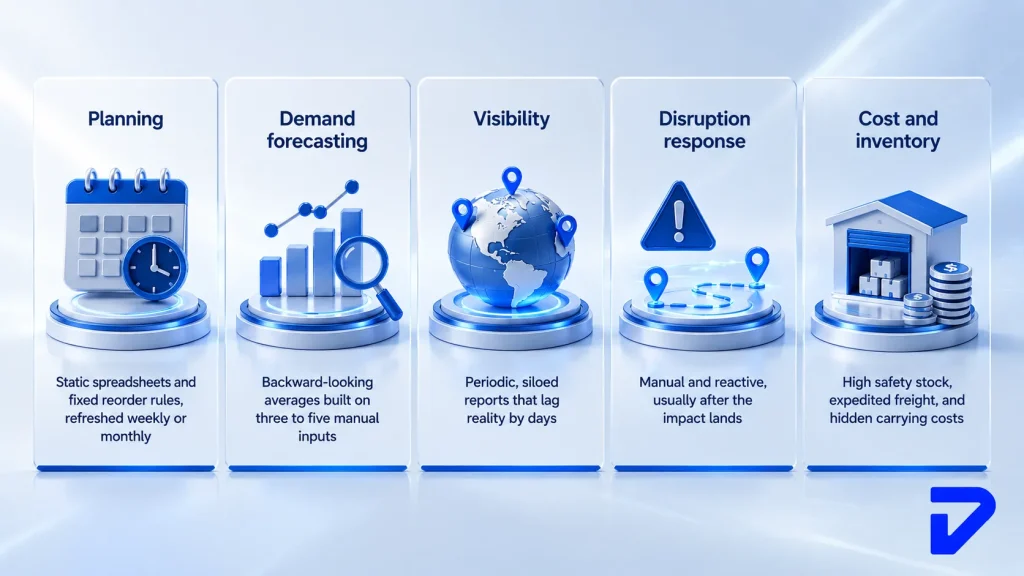
The shift is best understood as a move from reactive to predictive operations. The table below contrasts the two models across the dimensions that matter most.
| Dimension | Traditional Supply Chain | AI-Driven Supply Chain |
| Planning | Static spreadsheets and fixed reorder rules, refreshed weekly or monthly | Self-improving models that re-forecast continuously as new data arrives |
| Demand forecasting | Backward-looking averages built on three to five manual inputs | Real-time forecasts weighing dozens of signals like weather and promotions |
| Visibility | Periodic, siloed reports that lag reality by days | End-to-end, real-time tracking across suppliers, sites, and routes |
| Disruption response | Manual and reactive, usually after the impact lands | Predictive alerts with automated or agent-driven rerouting |
| Cost and inventory | High safety stock, expedited freight, and hidden carrying costs | Lower inventory and warehousing costs with service levels maintained |
AI Across the 5 Supply Chain Stages
AI adds value at every stage of the supply chain, from planning to returns. The clearest way to map supply chain AI use cases is along the flow itself: plan, source, make, deliver, and return. Each stage carries its own high-impact applications.
Plan
Planning is where AI delivers its fastest, clearest returns. AI demand forecasting reads sales history, weather, events, and market signals to predict demand far more accurately. As a result, it cuts forecast errors by 20 to 50 percent. On top of that, AI-driven inventory optimization sets the right stock levels for each product and location. That reduces both stockouts and excess safety stock.
Source
Sourcing decisions carry a hidden risk that AI can surface early. Models score suppliers on reliability, cost, and disruption exposure using live data. For instance, they can flag a supplier in a flood zone before a shipment is booked. AI also automates procurement and purchase order tasks. That cuts manual data entry, reduces errors, and frees buyers for negotiation.
Make
On the factory floor, AI keeps machines running and products consistent. Predictive maintenance analyzes sensor data to detect wear before a breakdown occurs. In practice, that prevents costly unplanned downtime. Computer vision adds automated quality control on the line. Cameras catch defects faster and more reliably than manual checks.
Deliver
Delivery is the stage that customers feel most directly. AI route optimization reads traffic, weather, and capacity to plan the fastest, cheapest routes. End-to-end supply chain visibility tracks every order and flags delays in real time. Inside the warehouse, AI-driven robotics speed up picking, packing, and sorting. For last-mile delivery, models predict accurate arrival times and reroute on the fly.
Return
Returns and reverse logistics are often ignored, yet they drain margin. AI predicts return volumes and routes items to the best disposition: restock, refurbish, or recycle. More importantly, AI also supports sustainability goals. Models optimize routes and loads to cut fuel use, emissions, and waste across the network.
4 Types of Supply Chain AI
Predictive AI and ML
Predictive AI is the workhorse of the modern supply chain. Machine learning in supply chain operations powers demand forecasting, inventory planning, and predictive maintenance. These models read patterns in past and live data, then predict what comes next. They are mature, well understood, and already deliver strong, repeatable returns at scale.
Generative AI
Generative AI handles language and unstructured data better than older models. In supply chains, it powers control-tower copilots that answer questions in plain language. It also drafts supplier emails, summarizes contracts, and processes invoices. As a result, planners spend less time on documents and more on decisions.
Agentic AI
Agentic AI is the fastest-moving category for 2026. Unlike rule-based automation, an agent plans and executes a full sequence of actions. BCG notes that agents break supply chain tradeoffs; human workflows cannot. Pairing them with expert oversight, as Pinnasys’s agentic AI services do, keeps results production-ready.
Digital Twins (The Simulation Layer)
A digital twin is a live virtual replica of your physical supply chain. It mirrors every supplier, warehouse, and route using real data. Teams test decisions in simulation before acting in the real world. That cuts risk and avoids expensive mistakes. As per EY, the digital twin market is projected to grow from $9 billion in 2022 to $137 billion by 2030.
Wondering which supply chain use case will pay off first?
Pinnasys builds and runs these systems in production, not just demos. See how our AI automation services turn forecasting and visibility into measurable results.
Wondering which supply chain use case will pay off first? Pinnasys builds and runs these systems in production, not just demos. See how our AI automation services turn forecasting and visibility into measurable results.
Real-World Case Studies on AI in Supply Chain
Amazon (Warehouse Robotics & Fulfillment)
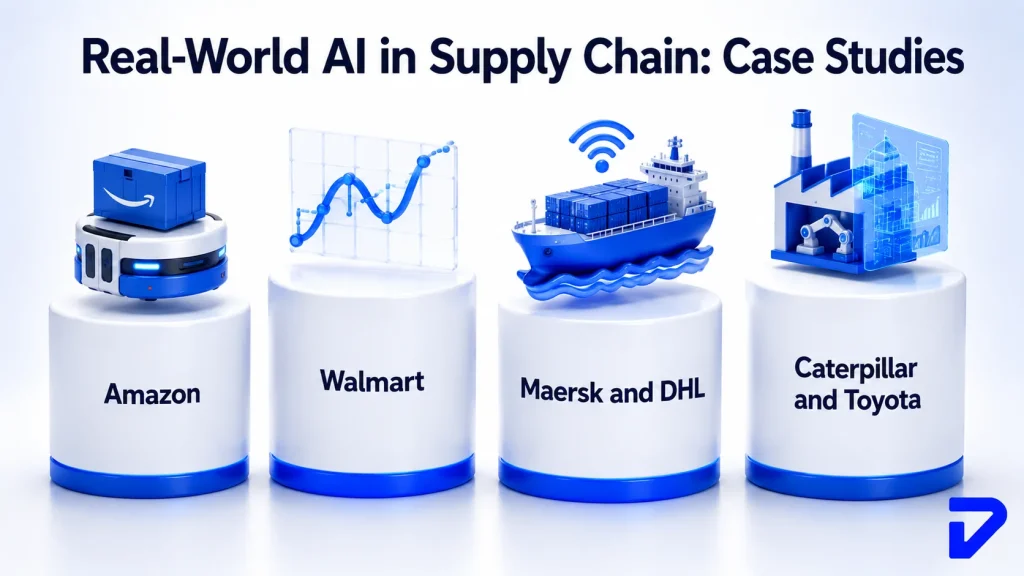
Amazon runs one of the most automated fulfillment networks in the world. It operates hundreds of thousands of mobile robots that work alongside warehouse staff. These robots move shelves, sort parcels, and speed up picking. As a result, the network fulfills enormous order volumes around the clock with fewer errors.
Walmart (Demand Forecasting & Inventory)
Walmart built its demand forecasting engine in-house, using a multi-horizon neural network across stores and time frames, per Supply Chain Dive. When Hurricane Ian struck, the system automatically rerouted shipments based on learned disruption patterns. Walmart also targets automation, with roughly 65% of its stores served by fiscal 2026.
Maersk & DHL (Logistics & Visibility)
Logistics leaders demonstrate the payoff of AI in logistics. DHL uses RAPTOR, its self-developed routing algorithm, to speed up delivery scheduling and dispatch decisions. Maersk applies machine learning predictive maintenance across its fleet of more than 700 vessels. The models catch engine faults early and cut unplanned downtime at sea.
Caterpillar & Toyota (Digital Twins in Manufacturing)
Heavy industry now builds digital twins at scale. Caterpillar models its factories and supply chains in NVIDIA Omniverse for predictive maintenance and dynamic scheduling. Toyota builds twins of its plants to plan complex automation virtually first. In short, both test changes in simulation before implementing them in real operations.
What Industries Can Benefit from Supply Chain AI?
Retail & E-commerce
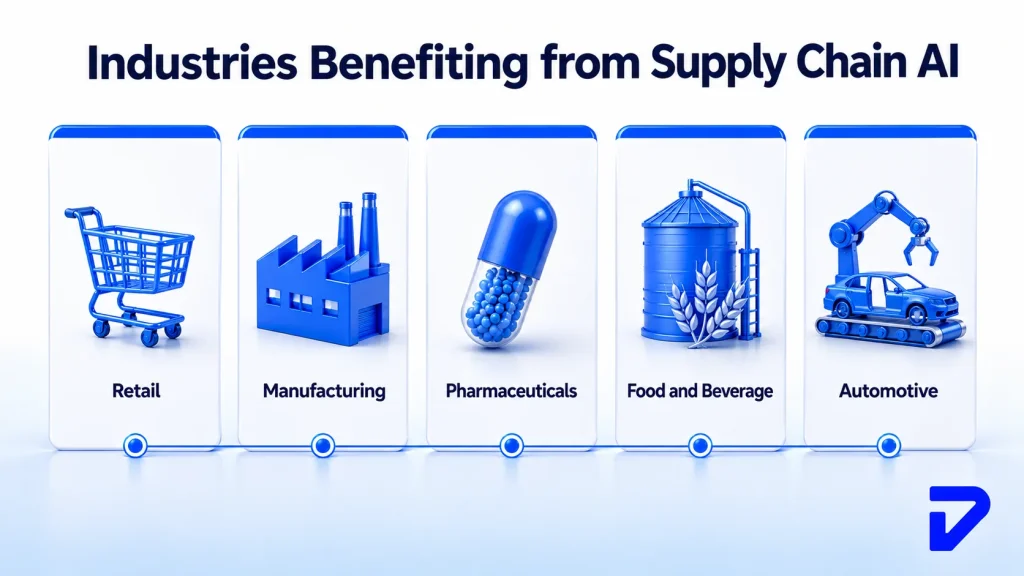
Retail and e-commerce run on accurate forecasting and fast fulfillment. AI predicts demand at the SKU and store level, optimizes inventory flow, and powers last-mile delivery AI. As a result, retailers cut stockouts, reduce markdowns, and deliver faster across both online and in-store channels without holding excess stock.
Manufacturing
Manufacturers depend on uptime and consistent quality. Predictive maintenance in supply chain operations reads sensor data to prevent unplanned downtime. Computer vision inspects products on the line and catches defects early. AI also schedules production dynamically, which increases throughput and yield while reducing scrap, rework, and material waste.
Pharmaceuticals & Cold Chain
Pharmaceuticals demand tight control and full traceability. Cold chain monitoring AI tracks temperature and humidity in real time across every shipment. Models flag excursions before products spoil. AI also supports serialization and compliance, creating audit-ready records that protect patients and reduce costly losses from damaged or expired stock.
Food & Beverage
Food and beverage supply chains fight short shelf lives and waste. AI forecasts demand for perishable goods and tracks freshness across the network. It also optimizes routing to move products faster. As a result, producers cut spoilage, protect thin margins, and keep shelves stocked with fresh, sellable inventory.
Automotive
Automotive supply chains rely on precise, just-in-time coordination. AI forecasts parts demand and scores supplier risk across complex global networks. It flags shortages before they halt a line. More importantly, AI keeps just-in-time flows steady, which prevents expensive production stoppages and avoidable emergency freight costs.
The Supply Chain Tradeoffs AI Breaks
Supply chain management has always meant hard tradeoffs. Cost fought speed. Lean inventory fought service levels. AI changes that math by finding options humans miss. Here is the shift in each long-standing tension.
Cutting Costs Without Slowing Delivery
Old logic forced a choice between cheap and fast. AI route and load optimization now finds plans that lower costs and speed up delivery. It weighs traffic, capacity, and fuel in real time. As a result, carriers cut planning effort and emissions while still hitting tighter delivery windows for customers.
Carrying Less Inventory While Raising Service Levels
Teams once held extra safety stock to avoid stockouts. AI forecasting predicts demand precisely enough to carry less inventory while still keeping shelves full. McKinsey ties better forecasting to up to 65 percent fewer lost sales. So, carrying costs fall while product availability actually improves.
Staying Lean and Resilient at the Same Time
Lean networks once meant fragile networks. AI changes that by spotting risk early and rerouting fast when conditions shift. It monitors suppliers, weather, and demand for warning signs. Walmart’s automatic rerouting during storms shows lean operations that bend under pressure rather than break outright.
Scaling Globally Without Losing Visibility
Growth used to blur visibility across regions and partners. AI-driven visibility now tracks every node in real time, at any scale. It pulls signals from sensors, systems, and carriers into one view. More importantly, leaders see problems while there is still time to fix them, not afterward.
The AI Supply Chain Maturity Model
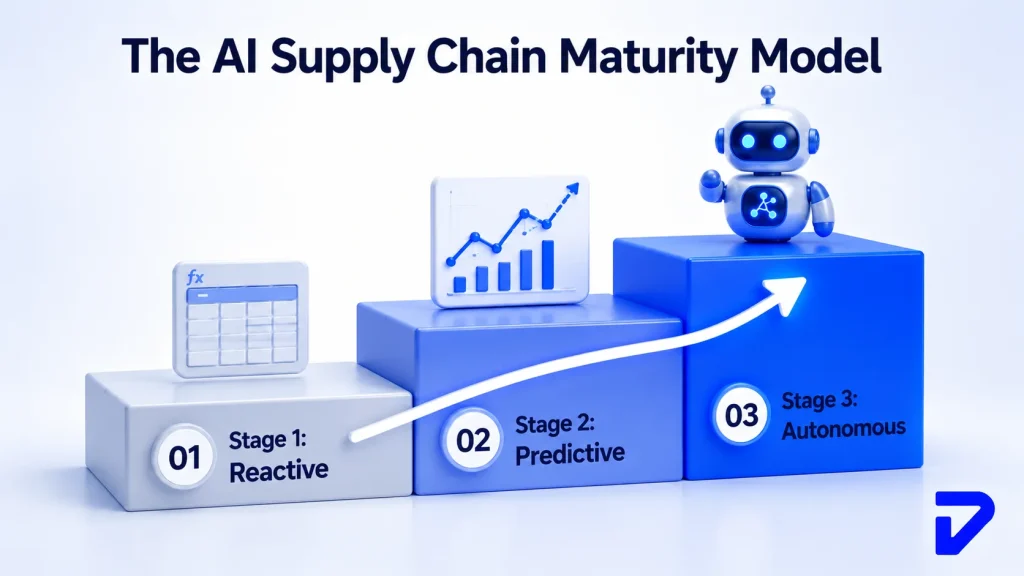
Most organizations sit somewhere on a clear maturity path. Knowing your stage helps you plan the next move. The journey toward an autonomous supply chain has three stages, from reactive to self-healing.
Stage 1: Reactive
Reactive supply chains run on spreadsheets and gut feel. Teams respond to problems only after they happen. Data sits in disconnected silos, and planning lags reality by days. Firefighting becomes the daily norm. Most organizations still operate here, paying a steep reactive tax in the form of expedited freight.
Stage 2: Predictive
Predictive supply chains use machine learning to see ahead. Models forecast demand, flag supplier risk, and schedule maintenance before failures occur. Planning grows calmer and more accurate. As a result, teams prevent many disruptions instead of reacting to them. Most measurable AI value today is captured at this stage.
Stage 3: Autonomous
Autonomous supply chains close the decision loop. Agentic AI systems detect issues, decide on a fix, and act, while humans handle exceptions. This is the self-healing supply chain in practice. Industry analysts expect these systems to scale across planning and sourcing through 2026 and beyond.
How to Implement AI in Supply Chain?
Most teams launch supply chain AI with one model and a dashboard. That works in a demo. It breaks the moment a task needs decisions across ERP, WMS, and TMS systems. A production-grade AI supply chain implementation roadmap needs clean data, real integration, and guardrails. Use these seven steps to get there.
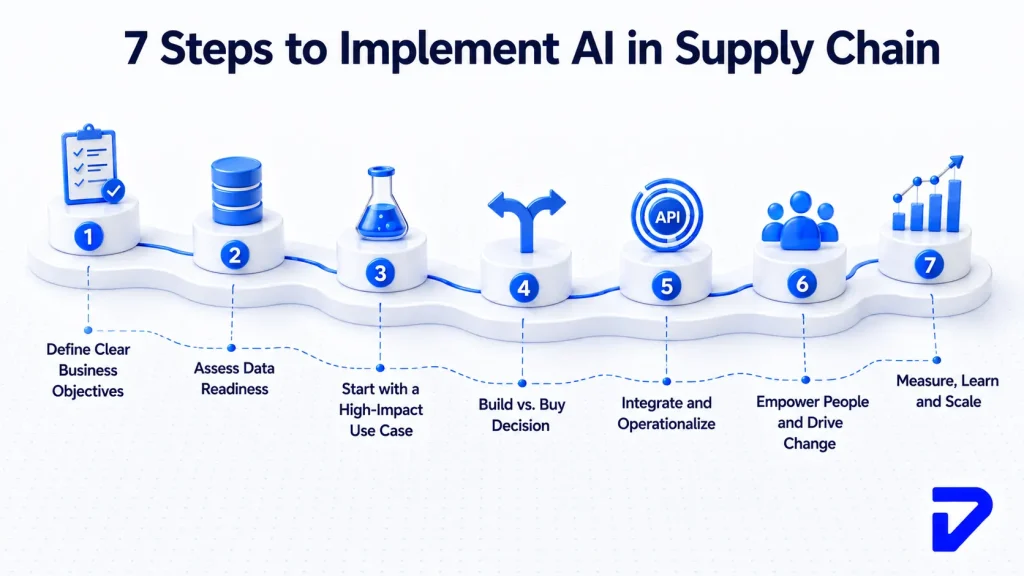
Step 1: Assess Readiness & Prioritize Use Cases
Start with an honest readiness check. Score each opportunity by business impact and data readiness. Then prioritize the use cases that rank high on both. Demand forecasting and predictive maintenance often top that list. This focus prevents wasted spend on flashy projects that never reach production.
Step 2: Build a Strong Data Foundation
AI is only as good as its data. Clean, unify, and govern data across your ERP, WMS, and TMS systems first. Remove duplicates and fill obvious gaps. Set clear ownership and quality standards early. Without this foundation, even strong models produce unreliable forecasts and poor decisions.
Step 3: Run High-Impact Pilots
Prove value in a single narrow use case before scaling. Define a clear baseline and target metric upfront. Run the pilot against real operations, not a sandbox. Then measure results honestly. A focused pilot that hits its numbers builds the internal trust needed to expand further.
Step 4: Build vs. Buy: Choosing Solutions & Partners
Decide where to build and where to buy. Buy mature, commodity capabilities, such as forecasting platforms. Build only where unique data or processes give you a real edge. Many growing firms lack in-house AI teams, so the right partner often speeds delivery and lowers project risk.
Step 5: Integrate with ERP, WMS & TMS
AI delivers value only when connected to core systems. Integrate models with your ERP, WMS, and TMS through APIs and middleware. Add an intelligence layer on top, rather than ripping out systems that already work. This approach speeds adoption and avoids costly, disruptive replacement projects.
Step 6: Upskill Teams & Manage Change
Technology rarely fails on its own; adoption does. Train planners and operators to read and trust AI outputs. Start with assistive tools that support human decisions. Then show early wins to build confidence. People who understand the system use it, while skeptical teams quietly route around it.
Step 7: Measure, Govern & Scale
Track ROI against the baselines you set earlier. Add governance for model monitoring, drift, and accountability. Keep humans in the loop for high-stakes calls. Then scale what works and retire what does not. Governance turns isolated pilots into a durable, trusted operating capability.
Challenges Faced By Companies While Implementing AI in Supply Chain
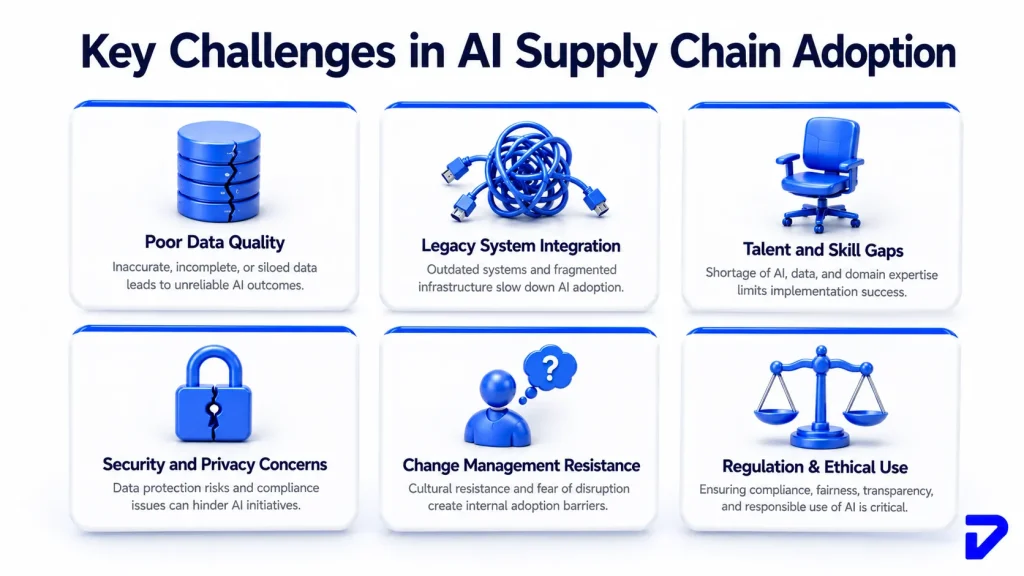
Data Quality & Silos
Poor data is the top barrier to AI in supply chain. Models trained on incomplete or inconsistent data produce unreliable output. Many firms also keep data trapped in disconnected systems. The fix is to clean, unify, and govern data before any model goes into production.
Legacy System Integration
Older ERP, WMS, and TMS platforms were not built for AI. They often lock valuable data away from modern models. Rather than rip and replace, connect them through APIs and middleware. This adds an intelligence layer on top, reducing costs and shortening time to value.
Talent & Skills Gap
Many growing businesses lack in-house AI engineering talent. Building and running production models requires scarce, expensive skills. The practical answer combines two moves. Partner with external specialists for delivery, and upskill internal teams over time. This blend keeps projects moving without overextending the budget.
Data Security & IP Protection
Supply chain AI touches sensitive supplier, pricing, and customer data. Weak controls expose trade secrets and invite compliance trouble. Strong programs apply access controls, encryption, and clear data-use policies. They also vet third-party tools carefully. Security cannot be an afterthought once models reach production.
Change Management & Trust
AI fails when people ignore its output. Planners distrust recommendations they do not understand. The fix is gradual and human-centered. Start with assistive tools, explain how models reach conclusions, and show early wins. Trust grows when the system proves itself on real decisions, not slides.
Regulation & Ethical Use
Opaque AI models create real compliance and ethical risk. Automated decisions can hide bias or break rules. Keep humans in the loop for high-stakes calls. Document how models reach decisions and monitor them over time. Clear governance protects both your customers and the business.
The Bottom Line
AI in supply chain has moved past hype into measurable results. The leaders are not just buying tools. They are building production systems that forecast demand, automate decisions, and recover from disruption faster. The path is clear. Clean your data, start with high-impact pilots, integrate with your core systems, then scale what works.
Predictive AI delivers value today. Agentic AI and digital twins define the next stage. Pinnasys helps growing businesses build and run these systems in production, not just in demos. Explore our decision intelligence solutions to see where forecasting and automation fit your operation. Book a discovery call to map your roadmap.
Key Takeaways from the Article
- AI in supply chain spans planning, sourcing, making, delivering, and returns.
- Predictive AI is mature; agentic AI and digital twins are scaling fast.
- Clean, unified data decides whether AI succeeds in production.
- Start with high-impact pilots, then integrate with core systems and scale.
- Leaders like Walmart and Maersk show documented, measurable results.
Frequently Asked Questions
How does AI improve supply chain efficiency?
AI analyzes demand, inventory, and logistics data in real time. It forecasts more accurately, automates routine decisions, and flags disruptions early. The result is fewer stockouts, lower costs, faster delivery, and far less manual firefighting across daily operations.
What is a supply chain digital twin?
A supply chain digital twin is a live virtual replica of your network. It mirrors suppliers, warehouses, and routes using real data. Teams test decisions in simulation before acting, reducing risk and avoiding costly real-world mistakes.
What’s the ROI of AI in supply chain, and how is it measured?
ROI shows up as lower inventory costs, fewer stockouts, reduced downtime, and faster delivery. Measure it by comparing key metrics before and after deployment. Forecast accuracy, carrying cost, and on-time delivery are common, reliable benchmarks.
How much does it cost to implement AI in a supply chain?
Costs vary with scope and data readiness. A single-use-case pilot typically runs from tens of thousands to a few hundred thousand dollars. Enterprise-wide programs reach the millions. Cloud platforms let smaller firms start small and scale affordably.
Do I need to replace my existing ERP or WMS to adopt AI?
No, most AI tools connect to existing ERP, WMS, and TMS systems through APIs and middleware. You add an intelligence layer on top. Replacing core systems is rarely necessary and usually slows adoption down.





Prakash C. Saini
Prakash Saini is the Founder & CEO of Pinnasys. With over a decade in digital transformation and building production systems, he grew an engineering team from 2 to 50 people and has led the delivery of 100+ production digital systems. Products built under his leadership have raised millions in funding and generated over $50 million in revenue. He holds an Executive MBA from IIM Kozhikode and today leads the AI engineering team at Pinnasys.