
McKinsey’s 2026 State of AI survey shows just 6 percent of organizations earning meaningful profit from AI. Here is what that small group does differently and what it means for any company hiring outside AI help this year.
On August 25, 2026, McKinsey released The State of AI in 2026: On the Road to ROI, a survey of 1,719 leaders across 97 nations. Its AI high performers McKinsey 2026 finding is sobering, since only about 6 percent of respondents tie at least 5 percent of EBIT to AI, unchanged from 2025. Adoption keeps climbing while earnings impact stays flat. For mid-market operators, the result points to how AI gets run, not how much of it gets bought.
That distinction matters because the gap between the 6 percent and everyone else comes from management choices a mid-sized company can copy. The sections below unpack the data, the habits behind it, and what to ask of any partner offering AI strategy consulting before another budget cycle closes.
What Is the AI High Performers McKinsey 2026 Report and Why It Matters
It is McKinsey’s annual global survey on how organizations use AI, and the 2026 edition matters because it measures profit rather than usage alone. Fieldwork ran from May 4 to June 8, 2026. The authors, including QuantumBlack leaders Dan Tinkoff and Lieven Van der Veken, now have nearly a decade of comparable data behind their conclusions.
AI high performer: McKinsey’s label for an organization whose respondents attribute at least 5 percent of EBIT (earnings before interest and taxes) to AI use and describe the value it creates as significant.
Key Findings Behind AI High Performers: McKinsey 2026 Data
Usage is broad, but its financial footprint is thin. Nearly nine in ten respondents report regular AI use in at least one business function, and 80 percent say AI has improved their own productivity. Those personal gains have not rolled up into the profit line, which is the central tension the survey documents and why the high performers deserve close study.
How the 6 Percent of AI High Performers Compare to Everyone Else
High performers run AI more broadly, redesign more work, and hold leaders accountable for results. The contrast grows sharper against US firms overall, since a Census Bureau AI supplement studied by NBER researchers found that 57 percent of adopting firms use AI in three or fewer functions. The table below summarizes where the two groups split.
| Dimension | AI High Performers | Everyone Else |
|---|---|---|
| Ambition | Growth and innovation alongside efficiency | Mostly efficiency and cost cuts |
| Workflows | Rebuilt around AI | AI inserted into existing steps |
| Leadership | Senior leaders own and measure outcomes | Leaders fund and delegate |
| AI agents | Scaled across many functions | Piloted in one corner of the business |
| Risk | Actively managed as deployment grows | Managed less actively |
What Changed Recently in AI Consulting
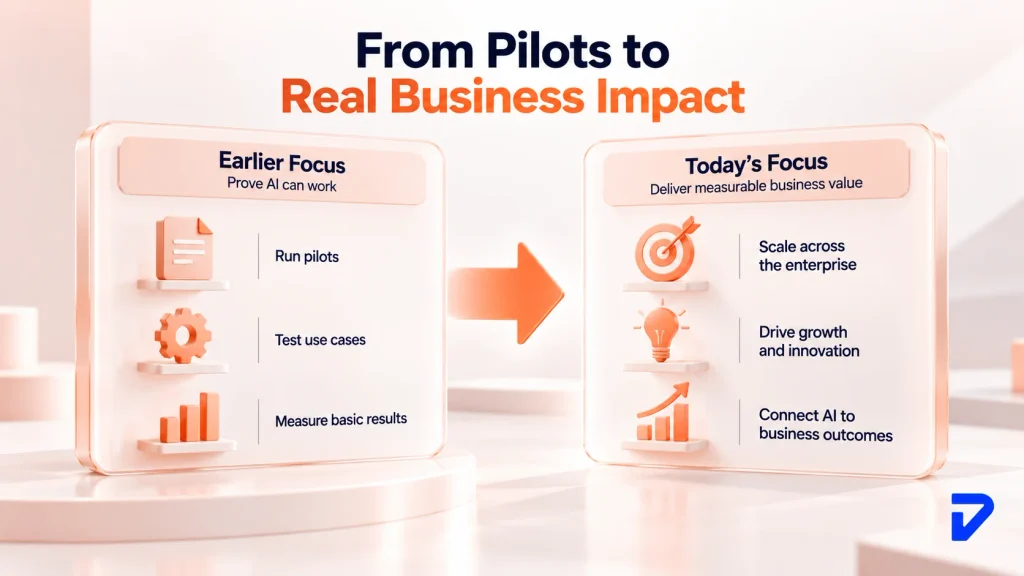
The buyer’s question moved from whether AI can work to why it is not paying off, and that shift changes what AI consulting engagements are hired to fix. Clients now expect advisors to own the path from a working pilot to a measurable business result.
From Pilots to Enterprise-Wide AI Operating Models
The share of respondents scaling AI across the enterprise rose to 44 percent from 38 percent a year earlier. Wider deployment rarely brings structural change, and a separate McKinsey analysis of AI operating models found only 21 percent of companies had fundamentally redesigned theirs around AI. Any plan to take an AI pilot to production now depends on that redesign.
The Shift From Efficiency Gains to Growth and Innovation
About 80 percent of high performers and other respondents alike pursue efficiency from AI, so cost cutting no longer separates anyone. The real difference is that most high performers also chase growth or innovation. A distributor that uses AI to quote faster saves labor, while one that uses the same capability to win more bids grows revenue.
What Makes AI Successful Companies Different From the Rest
The answer to what makes AI successful companies different comes down to two operating choices the survey links most closely to profit. One is rebuilding workflows around AI, and the other is scaling agents well beyond a single team.
Redesigning Workflows Instead of Adding AI on Top
Nearly three-quarters of high performers report fundamentally redesigning workflows because of AI, up from 55 percent last year, against one-quarter of other respondents. Redesign means removing steps, changing handoffs, and moving people to review points. In accounts payable, AI workflow automation bolted onto invoice matching speeds one step, whereas redesign removes the manual match entirely.
Scaling AI Agents Across Multiple Business Functions
High performers are more than three times as likely as others to scale AI agents in most business functions, and 2.7 times as likely to scale agentic AI beyond coding tools. Because agents plan and act across several steps with limited human input, their value compounds when they span sales, service, and operations together.
What Does AI High Performers McKinsey 2026 Mean for Enterprises
It means enterprise AI programs are now judged on earnings, and most still cannot show any. Broader scale has not moved the number, which puts pressure on every sponsor who promised returns from last year’s rollout.
The Gap Between AI Adoption and Measurable EBIT Impact
Just 37 percent of respondents attribute any EBIT impact to AI, essentially the same share as in 2025. Report coauthor Michael Chui, a McKinsey senior fellow, told The Register that some ROI is already arriving, calling it “a journey, not a destination.” Productivity gains still need a deliberate path to the P&L.
Why Enterprise AI Investment Alone Does Not Guarantee Results
High performers are more than twice as likely as others to spend over 15 percent of their ICT budget on AI. Because the survey captures a single moment, it cannot show whether spending produced returns or returns funded the spending. Budget poured into unchanged processes buys faster versions of the same results, which is why redesign comes first.
Is AI High Performers McKinsey 2026 Actually Significant for Buyers of AI Consulting Services
Yes, because it hands buyers of AI consulting services a clear benchmark. Any partner should be able to explain how its work moves EBIT or cost per transaction, not just how many employees logged in last month.
Separating Genuine AI Maturity From AI Theater
AI theater is activity that looks like progress without changing results, such as demos, login dashboards, and rebranded chatbots. Gartner analyst Anushree Verma has described most agentic projects as “mostly driven by hype and are often misapplied,” and the same release counts only about 130 genuine agentic vendors among thousands.
Questions to Ask Before Hiring an AI Consultancy
A credible AI consultancy, Pinnasys included, should answer these with evidence, not slides:
- Which workflow will change, and which steps will disappear?
- Which EBIT or cost metric moves, and how will we measure it?
- Who owns governance and model monitoring after launch?
- Is our data ready, and what happens to it during the build?
The Leadership Habits Behind AI High Performers
High performers treat AI as a leadership agenda, and research beyond McKinsey points the same way. BCG’s 2025 value gap study found only 5 percent of companies qualify as future-built for AI while 60 percent report little material value. It also places top-down ambition first among the traits that define leaders.
Why Senior Leaders Must Own AI Initiatives Not Just Fund Them
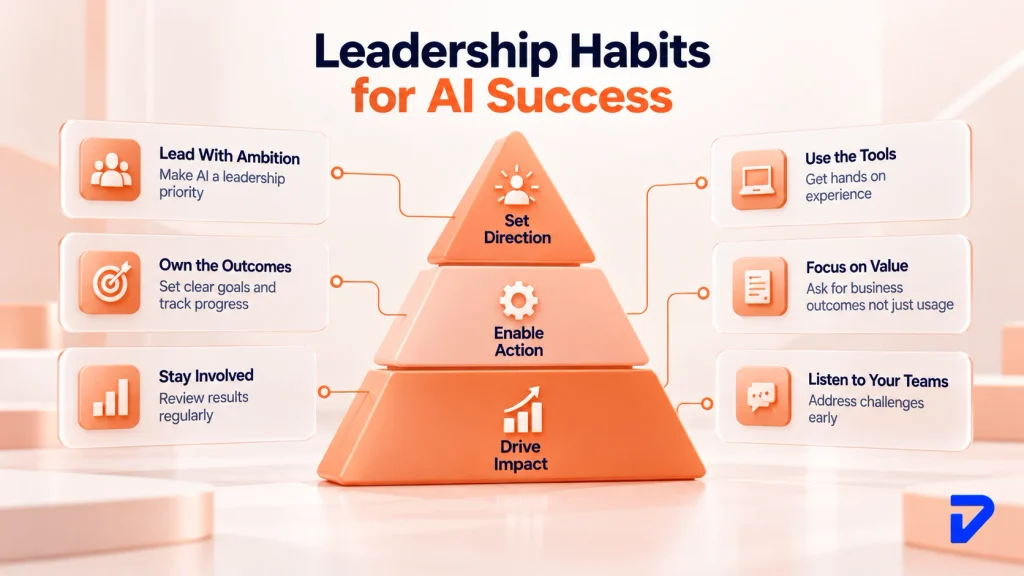
High performers are twice as likely as others to report that senior leaders demonstrate commitment to AI initiatives and that defined processes track their impact. Ownership looks like a COO who signs off on the redesigned process, sets the target metric, and reviews it monthly. Money without that attention leaves projects orphaned once the pilot excitement fades.
Daily Habits That Separate High-Performing AI Leaders
Strong AI leaders use the tools themselves, ask for outcome data rather than adoption counts, and listen for frontline strain. That last habit carries weight, since 47 percent of mid-level managers and individual contributors report negative effects from AI, compared with 31 percent of executives. Leaders who hear that gap early fix workloads before resistance hardens.
How Does AI High Performers McKinsey 2026 Affect Your AI Roadmap
It shifts the roadmap from a list of use cases to a sequence of operating changes. Each change needs a profit metric, a named owner, and a date, so progress can be judged in quarters rather than debated in steering meetings.
Rebuilding Your AI Strategy Roadmap Around Full Stack Practices
A modern AI strategy roadmap covers the full stack of practices McKinsey’s rewiring research describes: strategy, talent, operating model, technology, data, and adoption. Most roadmaps stop at technology. A stronger version names the workflow, the data it needs, the people retrained, and the adoption target, as our enterprise AI strategy guide explains.
Aligning Strategy, Talent, Technology, and Data in One Operating Model
An AI operating model is the set of decisions about who builds, owns, funds, and governs AI work. Alignment means one roadmap directs hiring, platform choices, and data fixes together. A regional insurer, for instance, cannot scale claims triage when its data team reports into a separate budget with different priorities and timelines.
Is your AI program built like the 6 percent, or like everyone else?
Pinnasys helps mid-market teams interpret what the McKinsey data means for their business and scale agents across real workflows with measured results. Plan your agentic AI rollout.
How Should Companies Respond to AI High Performers McKinsey 2026
Companies should check readiness before scaling further and build governance that speeds approvals instead of blocking them. Both moves are cheap compared with a stalled rollout, and both give leadership a factual base for the next budget decision.
Running an AI Readiness Assessment Before Scaling Further
An AI readiness assessment scores data quality, process documentation, skills, and governance against the use cases on the roadmap. It prevents a common error: scaling a pilot whose data only worked in a hand-cleaned demo. Our walkthrough of how to run an AI readiness assessment lays out a scoring model built for mid-sized teams.
Building an AI Governance Framework That Enables Speed
An AI governance framework sets who approves AI use, how risk is tested, and when humans review outputs. High performers are much more likely than peers to mitigate risks such as unauthorized agent actions. The NIST AI Risk Management Framework offers a free structure built on four functions: govern, map, measure, and manage.
The Role of AI Strategy Consulting in Closing the Performance Gap
Good advisors close the gap by doing the unglamorous work of redesign, integration, and measurement that internal teams rarely have time for. The value sits in execution discipline, not in a sharper slide about the future of AI.
What Generative AI Consulting Services Actually Deliver
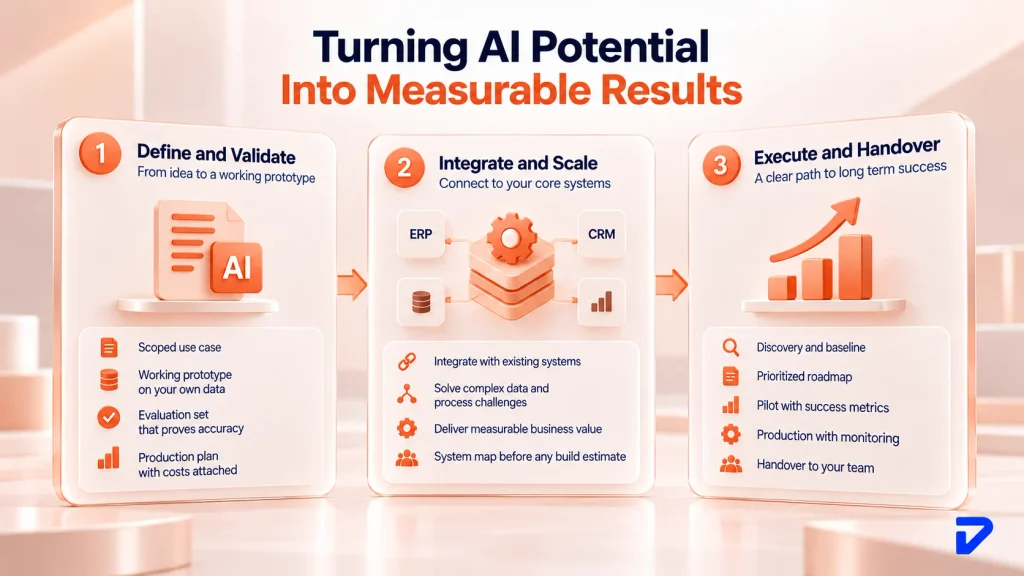
Useful generative AI consulting services deliver a scoped use case, a working prototype on your own data, an evaluation set that proves accuracy, and a production plan with costs attached. They should never end with a slide deck. In a contract review workflow, success means measured turnaround time and error rates rather than a polished demo of summaries.
When AI Integration Consulting Is Worth the Investment
AI integration consulting pays off when value depends on connecting models to ERP, CRM, or warehouse systems your team cannot rewire alone. That describes most mid-market work, where the model is easy, and the plumbing is hard. Teams weighing AI integration services should ask for a system map before accepting any build estimate.
What to Expect From an AI Consulting Service Engagement
A sound AI consulting service engagement runs in phases: discovery and baseline, a prioritized roadmap, a pilot with success metrics, then production with monitoring and handover. Expect weekly visibility into cost and results throughout. A partner worth hiring also defines the exit, meaning your own team can run the system once the engagement ends.
Building an AI Maturity Model for Enterprise and Mid-Market AI
An AI maturity model gives leadership a shared scale for where the company stands today and what the next stage demands. Without one, every department grades itself differently, and budget debates turn into opinion contests.
Stages of AI Maturity From Experimentation to Transformation
McKinsey’s operating model research describes three horizons: enablement, automation, and reinvention. Only 13 percent of organizations have reached reinvention, yet 48 percent of those leaders report meaningful enterprise value, against 24 percent in automation and 13 percent in enablement. The table below maps each stage to its most common signals.
| Stage | What it looks like | Typical signal |
|---|---|---|
| Enablement | General AI tools for individual employees | Productivity anecdotes |
| Automation | AI running cross-functional workflows at scale | Cost savings per process |
| Reinvention | Roles, workflows, and operating model redesigned | Enterprise-level EBIT impact |
Why Mid-Market AI Adoption Looks Different From Enterprise AI
Mid-market AI adoption trails large companies, though by less than many assume. Census Bureau survey data show 37 percent of firms with 250 or more employees using AI, against 32 percent of firms with 100 to 249 employees. Smaller firms run thinner data teams, so they gain most from focused, well-integrated deployments.
What Common Mistakes Companies Make Trying to Become AI High Performers
The costliest mistakes are strategic rather than technical. Most come down to treating AI as a purchase and skipping the foundations it needs to run reliably in production.
Treating AI as a Tool Instead of an Operating Model
A company that buys licenses and waits for results is treating AI as a tool. High performers are 3.3 times more likely than others to intend to fundamentally transform their business with AI within three years, which reflects an operating model mindset. A sales team handed a copilot under unchanged quotas and processes will rarely post different numbers.
Underinvesting in Data and Governance Foundations
Weak data kills AI projects after the demo. A Gartner survey found 63 percent of organizations lack, or are unsure they have, the right data practices for AI. Analyst Roxane Edjlali put it plainly: “If the data has issues, then the data is not ready for AI.” Gartner expects 60 percent of such projects to be abandoned through 2026.
What Are the Latest AI Consulting Trends in 2026
Two trends stand out this year: demand for help beyond pilots, and a move toward agentic systems that need tighter design and oversight. Both reward advisors who can prove results inside a single business function first.
Rising Demand for AI Business Consulting Beyond Pilots
AI business consulting demand is shifting toward function-level results. The survey found cost reductions most often in supply chain, service operations, and manufacturing, with revenue gains led by marketing and sales. A Federal Reserve analysis estimates 78 percent of the US labor force works at firms that have adopted AI, so demand now centers on scaling.
Agentic AI and the Next Phase of AI Strategy Consulting
Agentic AI is pushing strategy work toward orchestration, permissions, and cost control. Chatbots remain the most widely scaled tool, at 47 percent of respondents, while only about two in ten have reached scale with agents. That gap defines the next two years of advisory work: turning agent pilots into governed, measurable systems that finance teams trust.
The Bottom Line
The AI high performers’ McKinsey 2026 data leaves little doubt that the 6 percent win on operating discipline rather than tool choice. They redesign workflows, put senior leaders in charge of results, scale agents with governance attached, and measure EBIT from the start. Everyone else can adopt the same habits, and mid-sized companies often move faster because fewer layers separate a decision from a changed process.
The practical first step is to pick one high-value workflow, baseline its costs, and rebuild it around AI with a named owner. Teams that want a second opinion on where to begin can speak with the AI consulting team at Pinnasys, which helps operators turn research like this into a working AI operating model.
Key Takeaways from the Article
- Only 6 percent of organizations tie at least 5 percent of EBIT to AI.
- Workflow redesign, not tool choice, most clearly separates high performers from their peers.
- Senior leaders at high performers own AI outcomes instead of simply approving budgets.
- Readiness checks on data and governance should come before any further scaling.
- Mid-market firms can copy these habits faster because they carry fewer approval layers.
Frequently Asked Questions on AI High Performers McKinsey 2026
What Does AI High Performers McKinsey 2026 Mean for Enterprises?
The enterprise AI scale advantage keeps widening. Fifty-four percent of respondents at companies above $1 billion in revenue report scaling AI enterprise-wide, against one-third at smaller firms, and 28 percent spend over 10 percent of ICT budgets on AI.
How Does AI High Performers McKinsey 2026 Affect My AI Roadmap?
It forces your roadmap to budget for running costs, not just builds. About 20 percent of respondents say AI operating costs, including token costs, already limit their AI use, so every roadmap item needs a run-cost estimate.
What Changed Recently in AI Consulting?
Build-versus-buy advice changed most. Thirty-two percent of respondents say their organizations skipped buying at least one software product because agentic coding tools let them build it in-house, a shift advisors now weigh in every recommendation.
Is AI High Performers McKinsey 2026 Actually Significant for Buyers?
Yes, because it shows where high performers put their money. More than half expect to raise AI investment by 10 percent or more next year, compared with 36 percent of other respondents, giving buyers a spending benchmark.
How Should Companies Respond to AI High Performers McKinsey 2026?
Respond with measured redesign rather than headcount bets. Only 14 percent of respondents saw AI shrink their workforce over the past year, less than half the 32 percent who predicted cuts, so savings should come from rebuilt workflows.
What Are the Latest AI Consulting Trends in 2026?
Large-company agent adoption leads the 2026 trends. Forty percent of respondents at firms above $1 billion in revenue report scaling AI agents, up from 27 percent a year earlier, while smaller firms stayed flat at 22 percent.