


Agentic AI sales systems research accounts, update CRM records, draft outreach, and route approvals without a rep asking. Most of that work happens quietly between meetings, across the whole selling day.
Revenue teams reached for AI early, yet most still run on assistance rather than autonomy. The U.S. Census Bureau’s Business Trends and Outlook Survey put AI use among American businesses between 17% and 20% through early 2026, climbing to 37% at firms with 250 or more staff. B2B sales sits inside that adoption gap.
Nearly every team has bought a copilot, while far fewer have rebuilt a workflow around one. That difference defines where agentic AI sales stands today. The technology can already run account research, CRM updates, outreach drafting, and approval routing end to end, though only a minority of teams deploy it that way. What follows is the working version, hour by hour.
What Is Agentic AI in Sales?
Agentic AI in sales describes software that plans and executes multi-step selling work on its own, then reports what it did. Rather than waiting for a prompt, the system watches for a trigger, selects a course of action, and operates across your CRM, inbox, and calendar. Unlike traditional sales automation, which typically follows fixed rules, agentic AI can evaluate changing information, determine the next best action, and adapt its workflow based on the context of an account or opportunity. For example, an AI sales agent can identify a new buying signal, research the account, review previous interactions, enrich contact information, prepare personalized outreach, update relevant CRM fields, and route the final message to a salesperson when human approval is required. This allows sales teams to automate repetitive work while keeping people involved in decisions that require judgment, such as pricing, messaging, contracts, and sensitive customer interactions. Stanford’s 2026 AI Index found that AI agent deployment stays in the single digits across nearly every business function, so sales teams that move now gain an early edge as autonomous workflows become more practical and increasingly common across revenue organizations.
How It Differs From Traditional Sales Automation and AI Copilots
Traditional automation fires a fixed rule, so a form submission always triggers email three in the sequence. A copilot waits to be asked, then drafts. An agent does neither. It reads a signal, picks a plan, calls the tools it needs, and checks its own output. Our breakdown of agentic AI vs traditional AI unpacks that architecture in depth.
The Shift From Surfacing Insights to Taking Action
Dashboards have flagged at-risk deals for a decade, and reps ignored them because acting took twenty minutes nobody had. Agents close that gap by finishing the action instead of raising the alert. When a champion changes jobs, the system updates the contact record, drafts a re-introduction at the new company, and queues it for a human read.
What Is an AI Sales Agent Workflow?
An AI sales agent workflow is the defined path an agent follows from trigger to finished output: which data it reads, which tools it may call, and where a person signs off. Gartner expects 40% of enterprise applications to embed task-specific agents by the end of 2026, up from under 5% a year earlier, so most revenue stacks will soon ship with one.
The Three Layers Behind Every Reliable Workflow
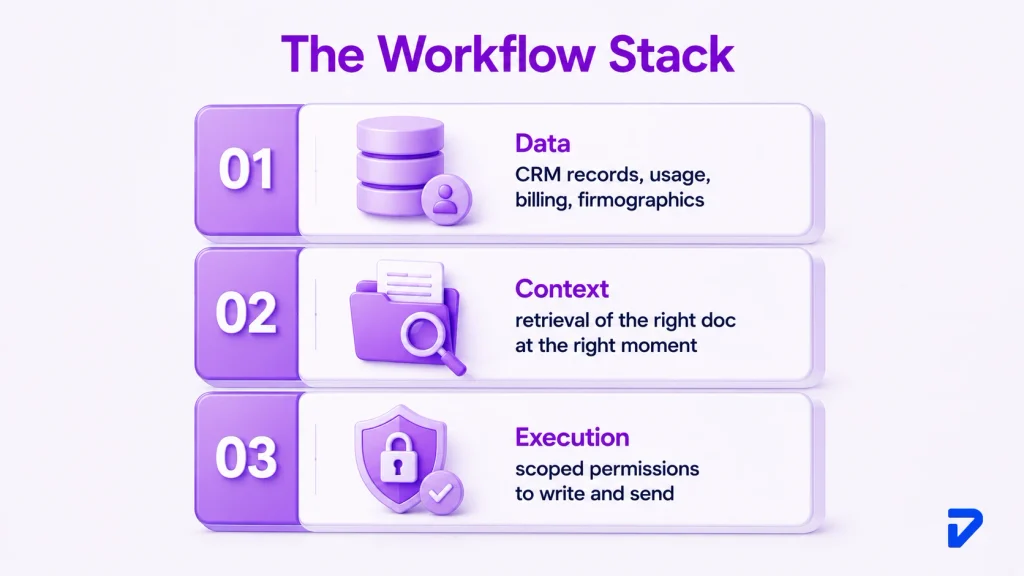
Three layers carry every workflow. Data covers CRM records, product usage, billing history, and third-party firmographics. Context is the retrieval layer that surfaces the right case study or pricing rule at the right moment. Execution is the permission set that lets an agent write to your CRM or send mail. Pinnasys builds all three before any agent goes live.
Model choice rarely decides outcomes, whereas connection quality almost always does. An agent with flawless reasoning and stale contact data still writes to a buyer who left in March. McKinsey reports that fewer than 10% of organizations have scaled AI in any single function, and fragmented data is the usual reason that number stays low.
How Does Agentic AI Sales Work in Practice?
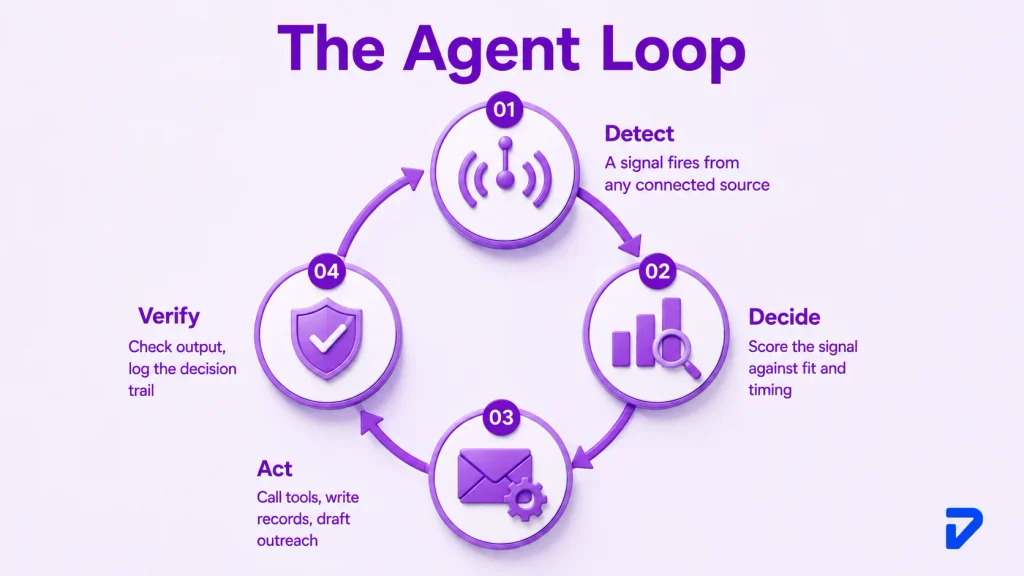
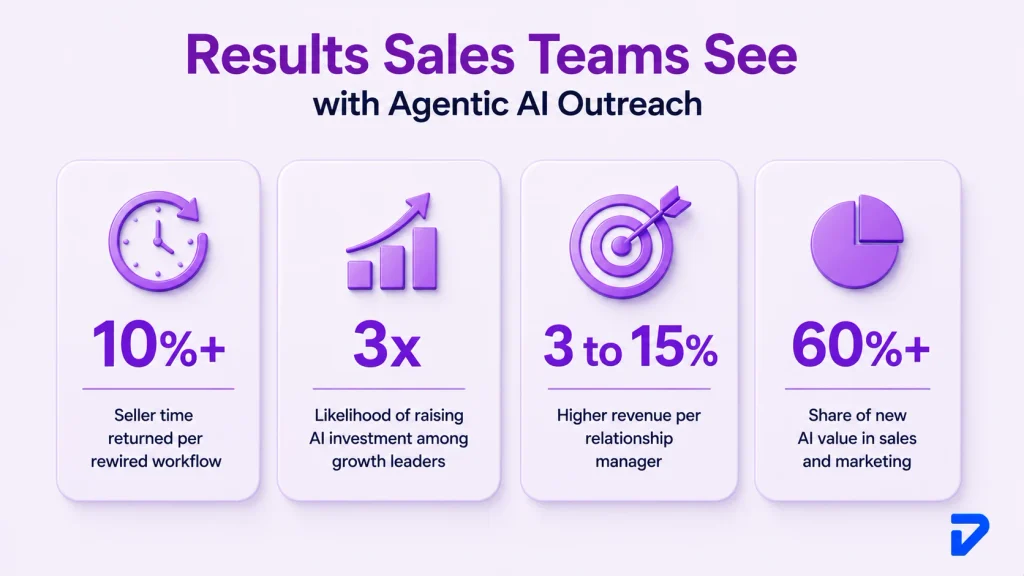
The mechanism is a four-step loop: detect a signal, decide on a play, act through connected tools, then verify and log the result. McKinsey expects agentic systems to drive more than 60% of the added value that AI creates in marketing and sales, so the loop matters well beyond one team.
From Signal Detection to Autonomous Action
Signals arrive constantly: a hiring spike, a funding round, a support ticket naming a competitor, a renewal ninety days out. The agent scores each against fit and timing, then chooses a play instead of filing a notification. A reposted job listing for a warehouse systems lead can trigger enrichment, a battlecard, and a drafted note to the hiring manager.
Where Human-in-the-Loop Approval Still Applies
Human-in-the-loop review means a person approves an action before it reaches a customer. Keep that gate on pricing, contract language, discounting, and any first message to a named executive. Routine confirmations and internal updates can run unattended. The reasoning is practical rather than cautious, since one bad autonomous email to a key account can undo months of trust.
What Autonomous Outreach Actually Looks Like
Autonomous outreach rarely looks dramatic from the outside. It looks like a rep opening a laptop to find several hours of work already finished. The schedule below follows one mid-market account executive through a Tuesday. McKinsey’s field research shows that rewiring even one commercial workflow can free up more than 10% of a seller’s time, which is exactly the gap this day closes.
Account Research and Enrichment Before First Calls
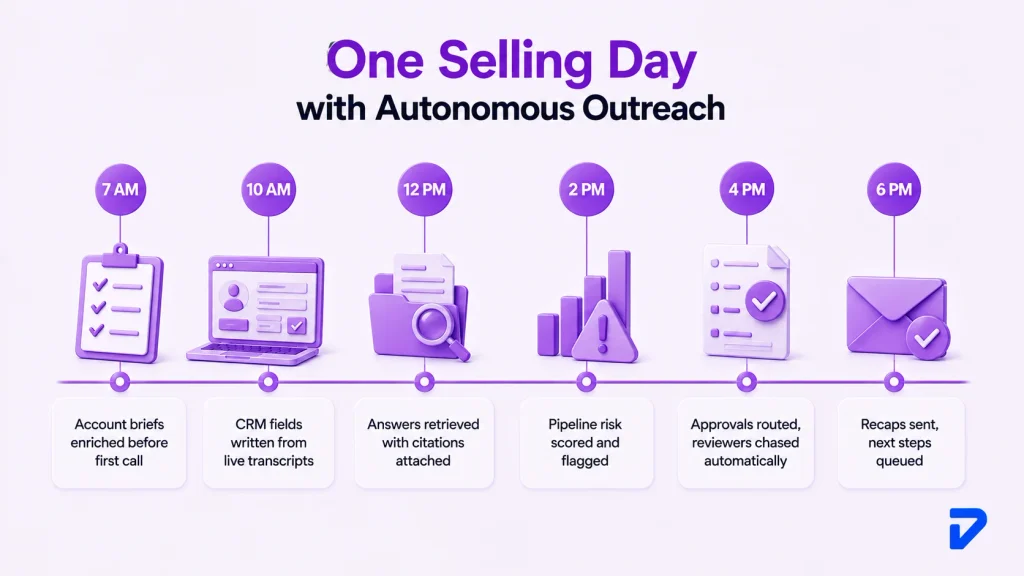
By 7 a.m. every account on the day’s calendar has been enriched: headcount shifts, funding news, product usage trends, and open support tickets. Each brief arrives as a five-line summary in Slack, sourced and timestamped. We built a comparable enrichment layer for Persana AI, which reached 95% accuracy and tripled qualified pipeline.
CRM Hygiene and Opportunity Updates Happening in the Background
While the rep is on calls, the agent transcribes each conversation and writes structured fields back: competitor mentions, stated objections, budget owner, and committed next step. Stage changes then follow the same rules every time, so pipeline reviews stop arguing about data. That kind of background workflow and process automation removes the 5 p.m. logging ritual entirely.
Content Retrieval and Personalization for Active Conversations
A prospect asks how the platform handles multi-warehouse allocation. Rather than pinging three colleagues, the rep gets an answer assembled from the product wiki, two implementation docs, and a matching case study, with citations attached. Retrieval-augmented generation makes this work, and our AI knowledge and enterprise search practice covers the grounding it requires.
Pipeline Health Monitoring and Automated Alerts
Every open opportunity gets scored against historical patterns: days in stage, buying-committee coverage, email reciprocity, and executive engagement. Deals drifting outside normal ranges surface with a recommended intervention rather than a bare red flag. Decision intelligence systems built this way give managers a forecast they can defend in a board meeting.
Cross-Functional Approvals Routed and Chased Automatically
Non-standard terms once sat in legal queues for days while reps sent polite reminders. The agent now files the request with the right context attached, tracks the SLA, and escalates when a reviewer goes quiet. Deal desk, security review, and finance sign-off run in parallel instead of in sequence, which compresses the tail end of every cycle.
Meeting Recaps, Follow-Ups, and Next Steps Queued Automatically
Recaps go out within minutes of each call, summarizing what was agreed and what happens next. Follow-up tasks land in the CRM with owners and dates, while draft emails wait in the rep’s outbox for approval. Because nothing depends on memory, commitments made at 2 p.m. survive a chaotic afternoon.
Ready to give your reps their mornings back?
Pinnasys engineers agentic AI sales systems that run research, CRM writing, and outreach drafting inside the stack your team already uses, so selling time goes up while busywork disappears.
How Does an AI Sales Agent Workflow Handle Prospecting and Outreach Specifically?
An AI sales agent workflow treats prospecting as continuous monitoring rather than a weekly list-building exercise. Speed carries the advantage here. A U.S. Census Bureau working paper on AI diffusion found Sales and Marketing the most common function among AI adopters, at 52%. Continuous prospecting is where that adoption turns a weekly cadence into something close to real time.
Signal-Based Prospecting and Intent Detection
Intent detection means watching for behavior that signals a buying window has opened. Agents track hiring pages, review sites, funding filings, technology installs, and content consumption, then rank accounts by how many signals cluster in the same week. A single trigger means little, whereas three related ones inside ten days usually justify a call.
Win-Back Campaigns for Closed-Lost Opportunities
Closed-lost records are the cheapest pipeline most teams own and the least worked. An agent monitors those accounts for the exact condition that killed the deal, whether that was budget, a competitor contract, or a departed champion. Dormant lead reactivation of 30 to 45% is achievable, as our work with Crystal showed.
Covering Underserved Accounts and Long-Tail Territories
Mid-market teams routinely leave thousands of low-tier accounts untouched because coverage math never works. One rep holding four thousand names works only the top hundred. Agents take that tail directly: outreach, nurture, intent interpretation, and meeting booking, with a clean handoff once a lead warms. Coverage widens without another hire.
What Results Are Sales Teams Actually Seeing?
Results cluster around three metrics revenue leaders already own: seller capacity, conversion, and cycle length. McKinsey’s 2026 B2B Pulse Survey covered nearly 4,000 buyers and sellers. High-growth companies proved three times more likely to have raised AI investment by double digits, at 71% versus 25%.
Time Reclaimed Per Rep
Capacity is where the numbers show up first. Financial services teams that rebuilt prospecting and relationship management with agents saw 3 to 15% higher revenue per relationship manager and lower cost-to-serve. Free four hours a week per rep, and that recovered selling time tends to arrive well before any new headcount does.
Conversion and Reply-Rate Improvements
Conversion moves for a practical reason: better timing and richer context beat higher volume every time. MQL-to-SQL conversion responds first, since qualification now happens while a buyer’s intent is still live rather than a day later. Our engagement with Instantly turned cold email into 3x revenue growth and 10x the deals closed.
Faster Deal Cycles and Cleaner Forecasts
Cycle time shortens because handoffs stop waiting on humans, and forecasts tighten because CRM fields reflect what was actually said on the call. Pipeline velocity improves on both counts at once. When every rep logs the same way, and approvals route themselves, a manager’s forecast finally matches the pipeline underneath it.
How Do Sales Teams Implement and Scale Agentic AI Sales Workflows?
Implementation fails on ambition, rarely on technology. Gartner predicts AI agents will outnumber sellers ten to one by 2028, while fewer than 40% of sellers will say those agents improved their productivity. What separates those two outcomes is sequencing.
The Two-Speed Approach
Two motions run at different speeds. Enterprise-led work rebuilds a named workflow with governed data and audited actions, taking a quarter or two. Employee-led adoption spreads faster and messier, as reps wire up their own prompts for research and recaps. Fund both, but govern the second, since ungoverned tools quietly move customer data into places compliance never approved.
Choosing High-Impact Workflows to Automate First
Pick workflows by frequency multiplied by pain, then check whether the data already exists. Account research, meeting recaps, and CRM writes usually win because every rep does them daily and the inputs are structured. Complex quoting and contract redlining can wait until the foundation holds. One workflow shipped properly beats six pilots stuck at 60% accuracy.
Training Reps for Daily Adoption
Adoption depends on the first two weeks. Show reps exactly where the agent is reliable and where it is not, then let them correct its output rather than rewrite it. Publish the escalation path openly. Teams that name internal champions and share working prompts watch habits form, while broadcast training alone rarely sticks.
Scaling With Governance, Cost Controls, and Iteration
Sales agents touch regulated ground. The FCC confirmed its rules treat AI-generated voices as artificial under the TCPA, while CAN-SPAM, GDPR, and CCPA all bind automated outreach and customer records. Pinnasys builds the audit trails, scoped permissions, token budgets, and review gates through AI integration and governance work, supporting your compliance program rather than certifying it.
The Bottom Line
Autonomous outreach is not a replacement for selling; it is the removal of everything that surrounds selling. Research, logging, retrieval, monitoring, chasing, and recapping all happen without a rep starting them, which is why agentic AI sales returns hours rather than novelty. The teams seeing real numbers picked one workflow, wired the data properly, kept humans on irreversible decisions, and scaled from there.
Capacity returns first, conversion follows, and cycle time tightens last, in that order. Want a grounded view of which workflow to rebuild first and what it will honestly cost? An AI consulting and roadmap engagement is the sensible starting point, and the Pinnasys team will walk you through it.
Key Takeaways
- Agents finish selling actions on their own, while copilots and rule-based tools only assist.
- Data quality and tool permissions decide agent reliability far more than model choice.
- Human review belongs on pricing, contracts, and first contact with named executives.
- Closed-lost accounts and long-tail territories are the cheapest pipeline agents can work.
- One properly wired workflow returns more value than six half-finished agent pilots.
Frequently Asked Questions About Agentic AI Sales and AI Sales Agent Workflows
Is Agentic AI Sales Suitable for Regulated or Complex Enterprise Environments?
Yes, provided every action is scoped and logged. Regulated sellers typically run agents in draft mode for outbound work and full autonomy for internal tasks. Audit trails, role-based permissions, and data residency controls satisfy most SOC 2 and GDPR reviews.
What Sales Data Does an AI Sales Agent Workflow Actually Need?
At minimum: clean account and contact records, opportunity history with win-loss reasons, email and call activity, and product usage or billing signals. Firmographic enrichment helps. Teams below 70% CRM field completeness should fix that before scoping any agent build.
How Should Sales Leaders Measure Impact?
Track four numbers against a baseline: selling hours per rep, lead response time, MQL-to-SQL conversion, and pipeline velocity. Review at thirty and ninety days. CAC payback and win rate move later, roughly one sales cycle after adoption stabilizes.




Prakash C. Saini
Prakash Saini is the Founder & CEO of Pinnasys. With over a decade in digital transformation and building production systems, he grew an engineering team from 2 to 50 people and has led the delivery of 100+ production digital systems. Products built under his leadership have raised millions in funding and generated over $50 million in revenue. He holds an Executive MBA from IIM Kozhikode and today leads the AI engineering team at Pinnasys.