
An AI consultant ranks AI ideas by payback and tests whether your data supports the best one. Then they run a measured pilot, usually within six to twelve weeks.
Most mid-market leaders do not call an AI consultant because they lack ideas. They call because three departments bought three AI tools, a chatbot pilot never left testing, and nobody can say what any of it returned. That pattern is widespread.
McKinsey’s 2026 State of AI survey found just 37% of respondents link any EBIT impact to AI, roughly flat from last year. So what does an AI consultant do about that gap? In practice, the job is to pick the few workflows worth fixing, check the data behind them, and prove one result before budgets scatter. Here is what that work looks like on the ground, what you should receive, and how long each stage honestly takes.
What Is AI Consulting, and What Does an AI Consultant Do?
AI consulting is advisory and hands-on work that connects business goals to AI use cases a company can build, fund, and run. Ask ten firms “what does an AI consultant do?” and you will hear ten answers, because the title covers very different jobs. Some consultants stop at a slide deck, while others stay until a working system is used daily. With AI consulting services explained in plain terms, the useful definition is simple: the consultant owns the decisions, and the build follows.
Adoption among mid-sized firms is rising, yet it remains far from universal. The Census Bureau’s Business Trends and Outlook Survey found 32% of firms with 100 to 249 employees used AI by May 2026. Among firms with 250 or more employees, the share reached 37%, which means most mid-sized companies are still deciding where to start.
| Consultant type | What they deliver | Best fit when |
|---|---|---|
| Strategy adviser | Priorities, roadmap, business case | Leaders agree on AI but not on where to start |
| Implementation partner | A working pilot connected to your systems | The use case is clear and needs building |
| Automation specialist | Workflow automations with AI steps | Repetitive admin work eats team hours |
| Change and enablement lead | Training, usage policy, adoption plan | Licenses are bought but barely used |
| Fractional AI lead | Ongoing ownership a few days a month | You need senior AI judgment without a full-time hire |
The AI Consultant Role
The AI consultant role is closer to an operations architect than a software vendor. A good consultant studies how orders, claims, or tickets really move, then decides where AI removes friction. For example, a distributor may ask for a chatbot, yet discovery shows quote preparation eats twelve hours a week. The consultant points the budget there instead.
Strategy Advisers vs Implementation Partners
Strategy advisers hand over a roadmap, a business case, and a shortlist, then step back. Implementation partners stay to build and measure the first use case on your live systems. Most mid-market firms need a blend, because a plan nobody builds returns nothing. A practical test is simple: ask whether the consultant has ever shipped a model into production.
Where AI Consulting Fits in a Mid-Market Company
In a mid-market company, AI consulting usually sits between the COO and the IT director, translating goals into scoped projects. A typical first engagement targets one painful workflow, such as invoice matching or demand forecasting. Because no in-house AI team exists, the consultant also defines who owns the system after launch, which prevents orphaned pilots.
What Does an AI Consultant Do Day to Day?
Mapping How Work Actually Gets Done
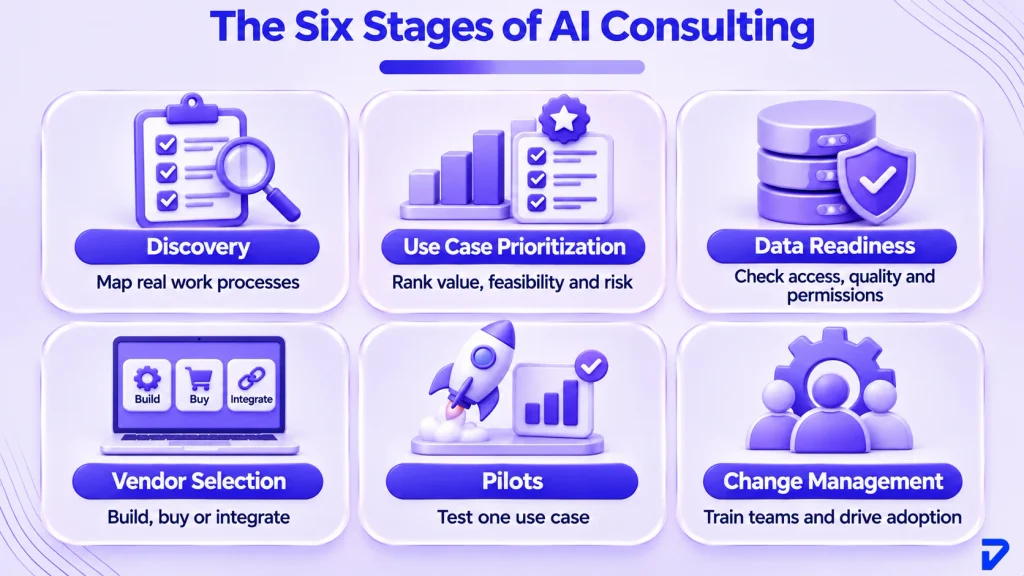
Discovery starts with interviews at three levels: the executive funding the work, the managers running the process, and the frontline staff. Written procedures rarely match reality, so the consultant also shadows the live workflow. For instance, a claims team may document five steps yet perform nine, including two hidden spreadsheet handoffs that AI could remove.
Ranking Ideas by Payback
Use case prioritization turns a long wish list into a short, funded backlog. Each idea is scored on value, feasibility, data availability, and risk, then plotted on a simple grid. A workshop that starts with thirty ideas often ends with three worth funding. The rest are parked with a reason, so leadership stops reopening the same debates.
Data Readiness
Data readiness decides whether a promising use case survives contact with real records. The consultant checks where data lives, who owns it, how clean it is, and whether it can be used legally. Gartner predicts that through 2026, organizations will abandon 60% of AI projects unsupported by AI-ready data, so this check saves real money.
Build, Buy or Integrate
Neutrality matters most in vendor selection, since the cheapest path is often a tool you already own. A consultant compares buying software, connecting a model to existing systems, or building custom, and weighs each by total cost. Architecture choices sit here too, such as whether RAG or fine-tuning suits your documents, where RAG fetches source files before the model answers.
Proving Value on Real Data
Pilots test one use case, with one team and one metric, against a baseline measured before the build starts. The consultant sets a pass mark in advance, such as 95% extraction accuracy on last quarter’s invoices. That discipline matters, since Gartner expected at least 30% of generative AI projects to be abandoned after proof of concept by 2025.
Change Management
Change management decides whether staff adopt the new system or quietly route around it. The consultant plans training, names a business owner, and sets a usage policy before launch, not after complaints. Prosci research finds projects with excellent change management are seven times more likely to meet objectives, which is why adoption deserves real budget.
What Deliverables Should You Expect From an AI Consultant?
Expect written, decision-ready outputs at every phase, not hours of workshops with nothing to show. Deliverables give the clearest answer to “what does an AI consultant do?” because documents and working code outlast meetings. Strong AI consultant deliverables each enable one specific decision, and the table below maps the core set.
Readiness Assessment and Use Case Backlog
The first two AI strategy deliverables usually arrive within three weeks. A readiness assessment names concrete gaps, such as product data split across two order systems, rather than vague maturity scores. A practical AI readiness assessment pairs those gaps with a ranked backlog, showing which use cases are ready and which need groundwork.
The AI Roadmap and Business Case
The roadmap sequences the funded use cases over six to eighteen months, with an owner, budget range, and success metric for each. Its business case separates build cost from monthly running cost, which vendors often blur. A clear plan pays off too: Thomson Reuters found organizations with a visible AI strategy were twice as likely to report AI-driven revenue growth.
Pilot Plan, Evaluation Set and Governance Pack
The pilot plan defines the test set, the pass mark, and the go/no-go rule before any code ships. Alongside it, the governance pack sets usage rules, human review points, and incident steps. Many consultants map this pack to the NIST AI Risk Management Framework, whose four functions are govern, map, measure, and manage.
Not sure which AI idea deserves your budget first?
Pinnasys scores your workflows by payback, checks the data behind them, and hands you a priced roadmap with a ready pilot plan.
How Long Does an AI Consulting Engagement Take?
A focused AI consulting engagement takes four to eight weeks for strategy, then another six to twelve weeks for a production-grade pilot. Timelines also reshape the answer to “what does an AI consultant do?” since the work shifts from listening to building as phases advance. Patience matters here. Deloitte’s State of Generative AI in the Enterprise found roughly two-thirds of organizations had moved 30% or fewer of their experiments fully into production.
Phases often overlap, so discovery and the data audit can run side by side.
| Phase | Typical duration | Key output |
|---|---|---|
| Discovery | 1 to 2 weeks | Current-state map and findings summary |
| Use case workshops | 1 to 2 weeks | Prioritized backlog |
| Data readiness audit | 2 to 3 weeks | Data readiness report |
| Roadmap and business case | 1 to 2 weeks | Sequenced 6- to 18-month plan |
| Pilot build and evaluation | 6 to 12 weeks | Working pilot plus measured results |
| Scale and governance | Ongoing | Production system and operating playbook |
A Realistic 90-Day Path for a Mid-Market Firm
A realistic 90-day path spends three weeks on discovery and data checks, two on the roadmap, and seven on the pilot. Pinnasys typically front-loads the data audit, because one week of checking beats a month of rework. By day 90, you should hold a measured result against your baseline, not a promise.
What Stretches the Timeline
Most delays trace back to access and ownership, not the model itself. The usual culprits are easy to spot early:
- Slow system access, which can stall discovery for two weeks
- Messy data that forces cleanup before any pilot starts
- No named business owner to approve scope and sign off results
- Security reviews that begin only after the build finishes
What Happens After the Pilot
After a successful pilot, the work shifts from proving value to running it reliably. The roadmap’s second use case begins, often workflow automation in an adjacent team. Meanwhile, the first system gets drift monitoring, which catches gradual accuracy loss as data changes. Some firms then keep the consultant on a light monthly retainer for oversight.
When Does a Company Need an AI Consultant?
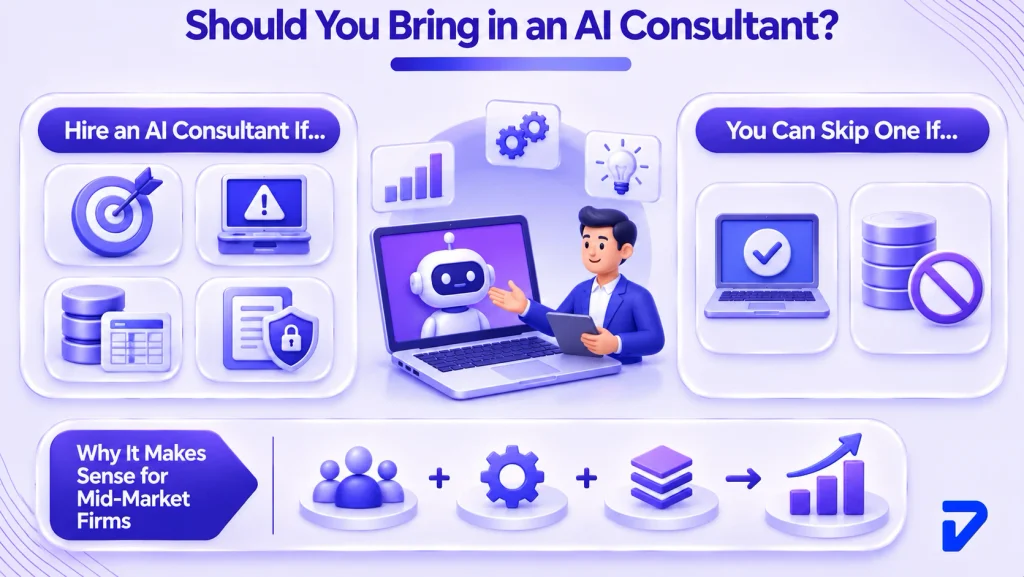
A company needs an AI consultant when the decision is harder than the build: priorities are unclear, data is scattered, or workflows are high-risk. The timing question cuts both ways: hire too early, and you pay for theory; hire too late, and you pay for failed pilots. Many teams ask “what does an AI consultant do?” only after a project stalls, yet the better trigger comes earlier.
Skills are the usual gap. The World Economic Forum’s Future of Jobs Report 2025 found 63% of employers see skills gaps as the biggest barrier to transformation.
Signs You Need One Now
The clearest guide to when to hire an AI consultant is practical. If two or more sound familiar, outside help likely pays back:
- Leadership wants AI but cannot agree where to start
- A pilot stalled without a baseline or pass mark
- Data sits in silos and reports run on spreadsheets
- The workflow touches regulated data or customer decisions
Signs You Can Skip the Consultant
Sometimes the honest answer is that you do not need one yet. If the task is narrow and an off-the-shelf tool already handles it, a capable internal lead can proceed directly. Likewise, skip the fee when there is no budget to act on recommendations, since a roadmap without funding quickly becomes shelfware.
The Mid-Market Case for Outside Help
Mid-market firms feel the skills gap sharply, because one data engineer cannot cover strategy, architecture, and adoption at once. An outside consultant fills that gap for a defined period, then hands over documented systems. For example, a 400-person insurer might borrow senior AI judgment for one quarter instead of recruiting a full-time head of AI.
What Is the Difference Between an AI Consultant and an AI Developer?
An AI consultant decides what to build and why, while an AI developer builds it, integrates it, and keeps it running. Buyers often blur the roles, so “what does an AI consultant do?” gets confused with “who writes the code?”
| Factor | AI consultant | AI developer |
|---|---|---|
| Core question | What should we build, and why? | How do we build it well? |
| Main output | Assessment, roadmap, pilot plan | Working software and integrations |
| When to hire | Before scope is defined | After scope is defined |
| Success measure | A funded, prioritized plan | A system in daily use |
| Typical skills | Process analysis, business cases, governance | Python, APIs, data pipelines, model operations |
In practice, the roles work best in sequence. The consultant writes the brief, and an AI development team builds to it, which prevents a strategy nobody ships.
The split matters most with agents. Gartner expects over 40% of agentic AI projects to be canceled by the end of 2027 over costs, unclear value, or weak risk controls. A consultant first asks whether the task needs an agent at all, meaning software that plans and acts across systems on its own.
When it does, a specialist agentic AI build team handles the planning logic, tool permissions, and human approval steps. Some firms offer both roles under one contract. That can work well, provided the strategy output stands on its own, and you can take it to another builder if needed.
How Do You Know If an AI Consultant Is Worth It?
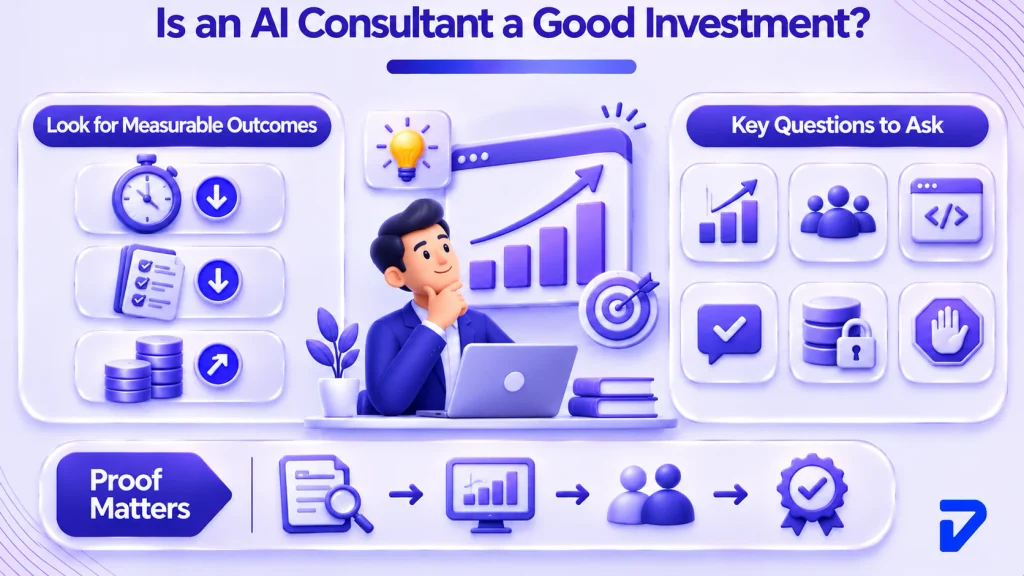
An AI consultant is worth it when the engagement ends with a measured result your team still uses, not a document nobody opens. Judge them the way you would judge any operator: on outcomes such as hours saved, errors reduced, and revenue unlocked.
The bar is real. BCG research found only 26% of companies had built the capabilities to move beyond proofs of concept. Those leaders put about 70% of their resources into people and processes, not algorithms.
So before signing, reframe “what does an AI consultant do?” as “what will we own when they leave?” Ask these questions to test any proposal:
- Which two or three metrics will move, and by how much?
- Who exactly will do the work, and what have they shipped?
- Which past recommendation was to not build something?
- Who owns the code, prompts, and test sets afterward?
- What would make you advise us to stop?
Proof should be specific, too. Credible firms publish AI case studies with real metrics, so ask for before-and-after numbers and call two references from projects older than six months. Equally, walk away from guaranteed ROI before anyone has seen your data.
The Bottom Line
So, what does an AI consultant do when the job is done well? They turn scattered AI interest into a ranked backlog, a checked data foundation, and one pilot that proves value in weeks. The deliverables, timelines, and hiring signals above all point to the same test: whether your team owns something measurable at the end. A thick report alone is advice you cannot use.
If you are weighing AI consulting services, start small with one workflow, one owner, and one metric. Pinnasys can scope that first step with you and outline a priced path forward. Once the pilot proves out, AI integration and governance support keeps it reliable inside your daily operations.
Key Takeaways from the Article
- AI consulting connects business goals to a short list of fundable, measurable use cases.
- Data readiness checks belong before any pilot, since unready data sinks many AI projects.
- Expect written deliverables at each phase, each tied to one clear business decision.
- Strategy work typically takes four to eight weeks, with pilots adding six to twelve.
- Hire a consultant when deciding is harder than building; hire a developer otherwise.
Frequently Asked Questions on AI Consultants
How much does an AI consultant cost?
Fees usually follow scope: a fixed fee for a four-to-eight-week strategy phase, then a separately priced pilot. Ask for monthly running costs too, since about one in five respondents in McKinsey’s 2026 survey said operating costs constrained AI use.
What qualifications should an AI consultant have?
Look for shipped production systems, industry experience, and plain-language explanations over certificates alone. Familiarity with ISO/IEC 42001, the AI management system standard published in December 2023, signals governance depth for regulated mid-market firms.
Can an AI consultant help with AI agents?
Yes, provided they cover retrieval, evaluation, permissions, and human review. Gartner estimates only about 130 of the thousands of agentic AI vendors offer genuine agent capability, so a consultant’s vendor screening can prevent misfires.
Is AI consulting the same as AI integration?
No. AI consulting decides which workflows AI should touch and why, while AI integration connects models to systems such as your ERP or CRM. Integration usually begins once the roadmap and pilot pass mark are approved.
Do small businesses need an AI consultant?
Often not at first. Census Bureau data shows AI use among firms with fewer than 20 employees barely moved in early 2026. Many small teams start with an off-the-shelf tool and a short workshop instead.