
An LLM evaluation framework is a structured process for measuring output quality before deployment. It covers quality criteria, test datasets, automated and human evaluation, and production monitoring, so failures get caught before users do.
McKinsey’s 2024 State of AI report found that 44% of organizations had experienced at least one negative consequence from generative AI, with inaccuracy cited most often. That highlights a critical problem: AI quality cannot be assumed from model performance alone.
Conventional software testing checks whether code behaves deterministically. LLM applications are different. Outputs can vary for the same input, hallucinations can appear convincing, and changes to prompts or retrieval layers can introduce subtle regressions.
That is why teams need a structured LLM evaluation framework to measure output quality. This blog covers evaluation criteria, test datasets, metrics, human review, quality thresholds, and continuous monitoring.
Why LLM Output Quality Needs a Different Evaluation Approach
LLMs require broader evaluation because outputs can vary, hallucinate, or become unsafe. Deloitte’s 2026 research highlights these validation challenges, while IBM distinguishes model evaluation from application evaluation, which also considers prompts, retrieval, integrations, scalability, and security.
The Four Quality Dimensions That Actually Matter
A useful evaluation framework measures four overlapping dimensions:
| Dimension | What it measures | Why it matters in production |
| Correctness | Is the answer factually accurate? | Errors erode user trust and, in regulated contexts, create liability |
| Relevance | Does the response address the actual query? | Off-topic outputs waste latency and budget |
| Faithfulness | Does the response stay grounded in the provided context? | Unfaithful responses are the core symptom of RAG failure |
| Safety | Does the output avoid harmful, toxic, or policy-violating content? | Unfiltered outputs create immediate reputational and legal exposure |
Define What “Good” Looks Like Before You Write a Single Test
Start with the business task, not the model. Define what successful output means and set measurable pass/fail thresholds for each quality dimension. Separate must-have metrics from secondary ones based on the use case.
IBM’s LLM evaluation framework covers metrics including answer relevance, faithfulness, accuracy, F1, context relevance, retrieval precision, and unsuccessful-request rate. Use only the metrics that directly reflect your application’s goals, then turn them into clear scoring criteria.
Build an Evaluation Dataset That Represents Real Usage
A dataset built from happy-path examples will produce optimistic scores that collapse in production. The evaluation dataset needs to represent the full distribution of real inputs: normal queries, difficult ones, edge cases, adversarial prompts, and historical failure cases.
The Three-Way Split: Development, Validation, and Test
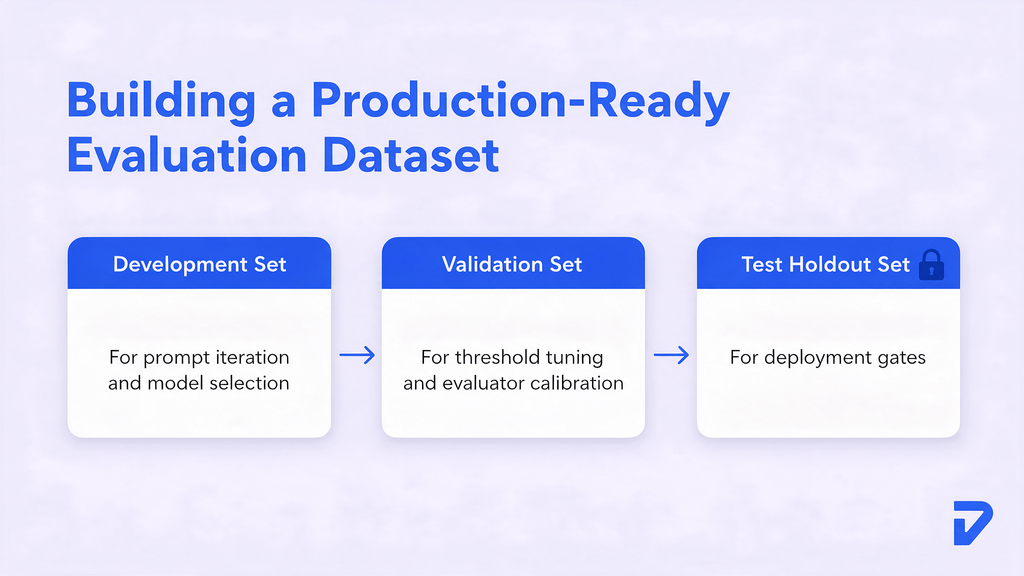
Keep three separate dataset splits with strict discipline about which set gets used when:
- Development set: used during prompt iteration and model selection. The team sees these outputs regularly.
- Validation set: used to tune thresholds and calibrate evaluators. Checked less frequently.
- Test (holdout) set: used only at deployment gates. Never used for tuning.
Contaminating the test set with examples the team has already seen is the most common way to get evaluation scores that don’t reflect production performance.
What a Representative Dataset Includes
A representative dataset should include typical queries, rare and long-tail cases, adversarial prompts, ambiguous requests, and past production failures. Keep it versioned with your prompts and models, and update it as real-world usage changes.
Choose the Right Metrics for Your LLM Application
The best LLM evaluation framework matches its metrics to the task, not to what’s easy to compute.
Objective Metrics for Structured Outputs
For tasks with verifiable ground truth, such as classification, extraction, or structured generation, standard objective metrics work well:
| Metric | Best for |
| Exact match/accuracy | Classification, short factual answers |
| Precision, recall, F1 | Named entity extraction, slot filling |
| ROUGE-L | Summarization quality against reference texts |
| BLEU | Translation and structured generation tasks |
| Perplexity | Measuring model confidence, not output quality directly |
LLM-Specific Metrics for Open-Ended Generation
Open-ended generation tasks require metrics that go beyond surface-level overlap with a reference answer. Per IBM’s evaluation documentation, the most important LLM-specific measures are:
- Faithfulness: does the response stay grounded in the provided context, without introducing external claims?
- Answer relevance: does the response address the actual query?
- Context relevance: does the retrieved context actually contain what’s needed to answer the query?
- Groundedness: can every claim in the response be traced back to a source document?
- Hallucination rate: the proportion of responses containing at least one ungrounded claim.
- Instruction adherence: does the model follow the format, length, and constraint instructions in the prompt?
Choosing open-source versus proprietary LLMs for your evaluation backbone also matters here: some models are better calibrated for self-evaluation tasks than others.
Operational Metrics You Cannot Ignore
Quality metrics measure what the model says. Operational metrics measure whether the system is viable to run:
- Latency (p50, p95, p99)
- Token usage and cost per request
- Failure rate and retry rate
- Successful-completion rate
An LLM evaluation framework that only measures output quality without tracking cost and latency will recommend systems that are correct but impossible to operate within budget.
LLM-as-a-Judge vs. Human Evaluation: When to Use Each
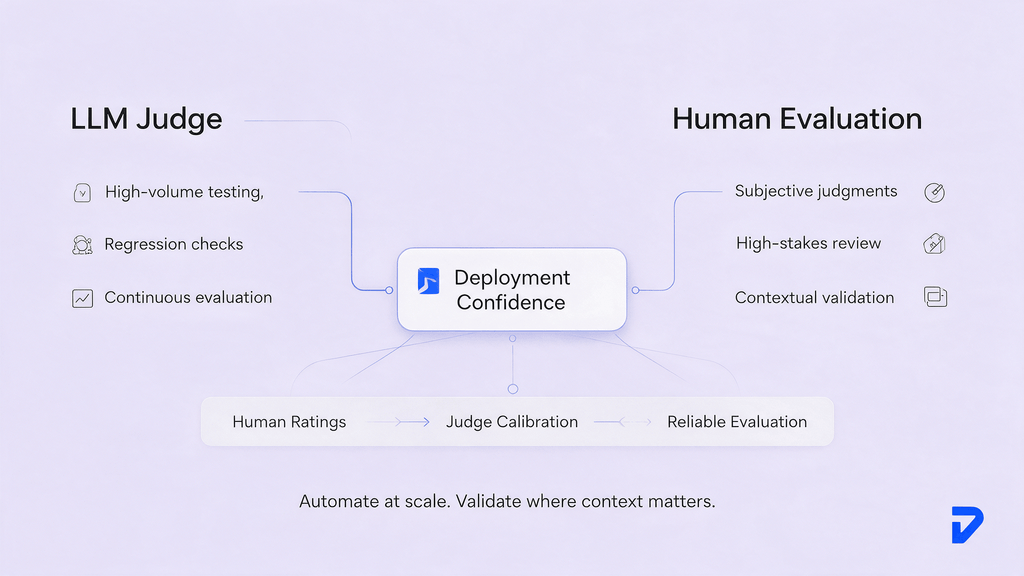
LLM-as-a-judge enables scalable evaluation, while human evaluation provides stronger validation for subjective and high-stakes judgments. The most reliable approach combines both rather than treating either method as sufficient.
Use LLM Judges for Scale
Automated evaluators can score thousands of outputs quickly. They are particularly useful for regression testing, continuous evaluation, and identifying problematic responses that require deeper human review.
Validate Judges Against Human Ratings
A 2025 ACM study reported Pearson correlations of 81.32 for code translation and 68.51 for code generation between automated LLM judges and human evaluations, showing strong but task-dependent alignment.
Build Clear Evaluator Rubrics
Evaluator prompts should define the quality criterion, explain scoring levels, and provide representative examples. Clear rubrics reduce ambiguity and make automated scores easier to interpret, compare, and reproduce.
Keep Humans Involved in High-Stakes Evaluation
Medical, legal, financial, and regulated applications require human oversight. Automated judges can miss contextual errors, nuanced risks, or unacceptable outputs that may not be captured by numerical evaluation scores.
Combine Both for Deployment Decisions
Use automated evaluation for scale and consistency, then apply human review to validate important findings and calibrate the evaluator. This creates a practical evaluation process without treating automated scores as ground truth.
Test RAG, Agents, and Multi-Step LLM Workflows Differently
Single-turn output evaluation is insufficient for retrieval-augmented generation (RAG) systems, AI agents, and multi-agent LLM orchestration workflows. Each adds failure modes that require purpose-built metrics.
Evaluating RAG Systems
A RAG pipeline (the system that fetches relevant documents before the model generates a response) introduces three distinct failure points, each requiring its own metric:
- Context relevance: did retrieval surface the right documents?
- Groundedness/faithfulness: does the generated answer stay within the retrieved documents?
- Answer relevance: does the final response actually address the user’s question?
Gartner recommends an end-to-end testing pipeline for retrieval-augmented generation systems that combines human review, automated LLM judging, and technical retrieval metrics, rather than relying on any single approach. A RAG system can score well on answer relevance while failing badly on groundedness, meaning the model is confidently answering from memory rather than from retrieved documents.
Evaluating AI Agents and Multi-Agent Orchestration
AI agent development introduces a different class of failure modes that require trace-level evaluation, not just output-level scoring. The key metrics are:
- Tool-selection accuracy: did the agent select the right tool for each step?
- Task completion rate: did the agent complete the end-to-end task?
- Planning quality: did the agent’s reasoning chain reflect a valid approach?
- Error recovery: when a tool call fails, does the agent recover gracefully or cascade into failure?
- State consistency: does the agent’s belief state remain accurate across a long session?
- Unauthorized actions: does the agent ever take actions outside its defined permission scope?
For multi-agent LLM orchestration systems, add agent coordination metrics: handoff accuracy (does the right sub-agent receive the right context?), loop detection, and final task completion rate across the full orchestration chain. Our work on Crystal, an agentic fintech product, validated how critical trace-level evaluation is before any agentic system goes live. Catching a planning failure in evaluation is far cheaper than catching it in production.
Ready to evaluate your LLM before deployment?
Pinnasys can help you build a structured evaluation framework and quality gates for production AI.
Build a Pre-Production LLM Evaluation Pipeline: Step by Step
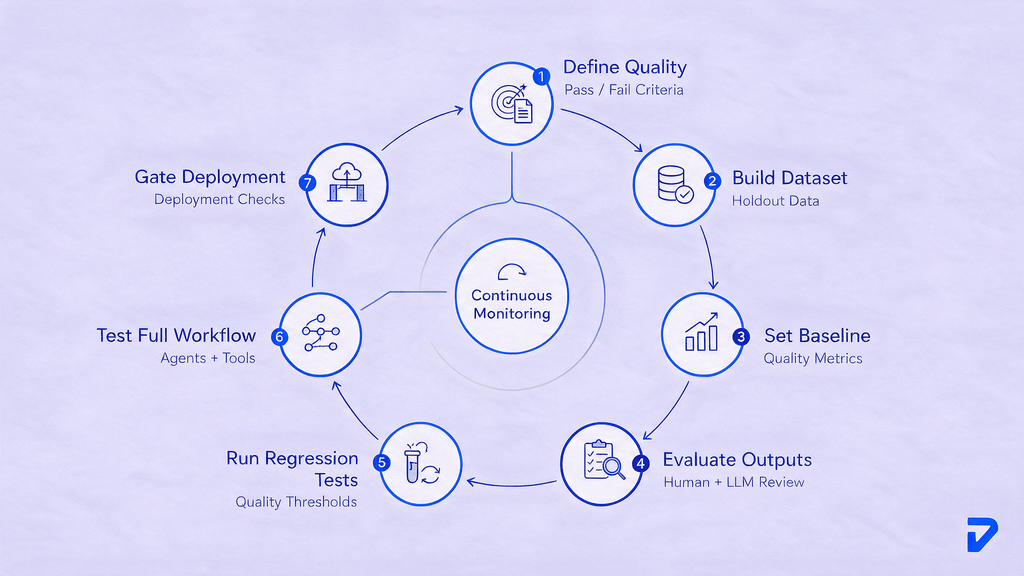
A production-ready LLM evaluation framework should function as a reproducible pipeline rather than a static spreadsheet of test cases. Gartner recommends eval-driven development to identify nondeterministic behavior and potential failures early in the development process.
Step 1: Define the Use Case and Quality Criteria
Start with a clear scope describing what the system should and should not do. Translate this into measurable quality dimensions, such as accuracy, relevance, faithfulness, safety, and instruction adherence, with explicit pass/fail thresholds.
Step 2: Build a Representative Evaluation Dataset
Create development, validation, and holdout datasets covering typical queries, edge cases, ambiguous requests, adversarial inputs, and previous failures. Keep the holdout set separate so it provides an unbiased measure of performance before deployment.
Step 3: Establish a Baseline and Select Metrics
Evaluate the initial model, prompt, and application configuration against the test data. Establish this as your baseline, then select objective, LLM-specific, and operational metrics that directly reflect the application’s quality requirements.
Step 4: Add Automated and Human Evaluation
Use LLM-as-a-judge for scalable scoring where automated evaluation has been validated against human ratings. Add human review for subjective, complex, or high-stakes outputs, using reviewer feedback to continuously calibrate automated evaluators.
Step 5: Set Quality Gates and Run Regression Tests
Define minimum acceptable scores for each quality dimension and block deployments that fall below them. Re-run evaluations whenever prompts, models, retrieval systems, tools, or other critical components change to identify regressions.
Step 6: Evaluate the Complete Application Workflow
Test more than the underlying model. Evaluate retrieval, prompts, tools, business logic, integrations, agent handoffs, and multi-step execution. For AI agents, measure task completion, tool selection, state consistency, error recovery, and end-to-end reliability.
Step 7: Gate Deployment and Monitor Continuously
Only deploy configurations that pass the evaluation pipeline and meet established thresholds. Continue monitoring production outputs, failures, latency, cost, and quality signals so new issues can feed back into the evaluation dataset.
Common LLM Evaluation Mistakes to Avoid
Most evaluation failures are not technical. They are process failures that produce scores disconnected from production quality.
- Testing only happy-path prompts can produce overly optimistic results. Include ambiguous requests, incomplete inputs, adversarial prompts, edge cases, and production failure scenarios in the evaluation dataset.
- Relying entirely on LLM-as-a-judge can create misleading confidence in automated scores. Microsoft’s AAAI 2025 research found variation in how reliably LLM judges align with human evaluations across different tasks and instruction styles. Periodic human review and evaluator calibration remain important.
- Evaluating the model instead of the application can hide important production failures. Test the complete system, including prompts, retrieval, tools, business logic, integrations, and application-specific data.
- Changing prompts without regression testing can improve one scenario while breaking another. Run regression tests against previously validated cases whenever prompts, models, retrieval systems, or other critical components change.
- Using generic benchmarks as shipping criteria does not establish production readiness. Benchmarks such as MMLU, HumanEval, and HELM are useful for standardized comparisons, but application-specific datasets, metrics, and quality thresholds are still required.
How Long Does an LLM Evaluation Framework Take to Implement?
Implementation time depends on dataset readiness, application complexity, number of distinct workflows, and evaluation depth required. Rather than a single timeline, think in maturity stages:
| Evaluation maturity | Typical scope | Approximate investment |
| Basic | Manual test cases, a few core metrics, ad hoc human review | 1 to 2 weeks |
| Production-ready | Automated evaluation pipeline, calibrated LLM judges, quality thresholds, holdout test set | 4 to 8 weeks |
| Advanced | CI/CD integration, regression testing, prompt versioning, offline and online evaluation | 2 to 4 months |
| Agentic and multi-step | Trace-level evaluation, tool-selection scoring, multi-agent coordination metrics, continuous monitoring | 3 to 6 months |
Teams that invest in evaluation infrastructure early recover those costs quickly. A regression caught before deployment costs an hour to fix. The same regression caught in production, by users, costs weeks of incident response, trust repair, and rework.
LLM Evaluation Framework Checklist
Use this as a deployment gate, not a one-time checklist.
Before development
- Define the business objective and intended system scope
- Define measurable quality criteria and pass/fail thresholds for each dimension
- Identify expected failure modes and edge cases
- Establish a baseline using the current model or prompt configuration
Before deployment
- Build a representative evaluation dataset (normal, difficult, edge-case, and adversarial prompts)
- Create development, validation, and holdout test splits; lock the holdout set
- Select and calibrate automated evaluation metrics for the task type
- Run automated evaluations against the holdout set
- Complete human review on a representative sample
- Verify all quality thresholds are met
- Run regression tests against the full test set
- Validate safety, toxicity, and policy-compliance checks
- Version and document the prompt, model, and dataset configuration
After deployment
- Sample and score live production outputs daily
- Alert on quality metric degradation
- Collect user feedback and route flagged outputs to human review
- Update the evaluation dataset when production inputs drift
- Re-run regression tests on every prompt or model change
- Recalibrate LLM judges against fresh human-rated examples quarterly
The Bottom Line
An LLM evaluation framework is not a final QA step. It is the infrastructure that separates a demo from a production system. The sequence is consistent regardless of application type: define quality criteria, build a representative dataset, select appropriate metrics, run automated and human evaluation, set deployment gates, and monitor continuously after launch. Without that infrastructure, every deployment is a guess. With it, quality becomes a measurable, improvable property of the system.
Pinnasys builds AI products with evaluation, quality gating, and AI integration and MLOps governance embedded from the start. If your team is building an LLM application and needs the evaluation infrastructure to match, we can help you design it before you ship.
Key Takeaways from the Article
- An LLM evaluation framework requires application-level evaluation, not just model benchmark scores.
- Quality criteria and pass/fail thresholds must be defined before building any test dataset.
- LLM-as-a-judge evaluation scales well, but requires calibration against human raters.
- RAG systems, AI agents, and multi-agent workflows each require task-specific evaluation metrics.
- Evaluation is a continuous LLMOps process, not a pre-launch checkpoint.
Frequently Asked Questions
What is an LLM evaluation framework?
An LLM evaluation framework is a structured process for measuring language model output quality. It typically includes evaluation criteria, test datasets, metrics, automated testing, human review, regression testing, and production monitoring.
What are the most important metrics for evaluating LLM output quality?
The right metrics depend on the application. Common measures include faithfulness, answer relevance, factuality, precision, recall, F1, instruction adherence, hallucination rate, latency, cost, and failure rate.
How is LLM evaluation different from traditional model evaluation?
LLM outputs can vary even when the same input is provided. Evaluation therefore needs to measure qualities such as factuality, relevance, faithfulness, and consistency rather than relying only on fixed expected outputs.
How does LLM evaluation work for multi-agent LLM orchestration systems?
Multi-agent evaluation examines both individual agents and the complete workflow. Teams measure tool selection, agent handoffs, state consistency, error recovery, loop behavior, and end-to-end task completion across realistic multi-step scenarios.
What is eval-driven development for AI products?
Eval-driven development makes evaluation part of the development process. Teams build evaluation tests early and use them to assess prompt, model, and workflow changes before those changes reach production.
How do you avoid bias in LLM-as-a-judge evaluation?
Calibrate automated judges against human-rated examples and measure their agreement on held-out cases. Use clear scoring rubrics, diverse evaluation data, and periodic human reviews to identify and correct evaluator bias.