


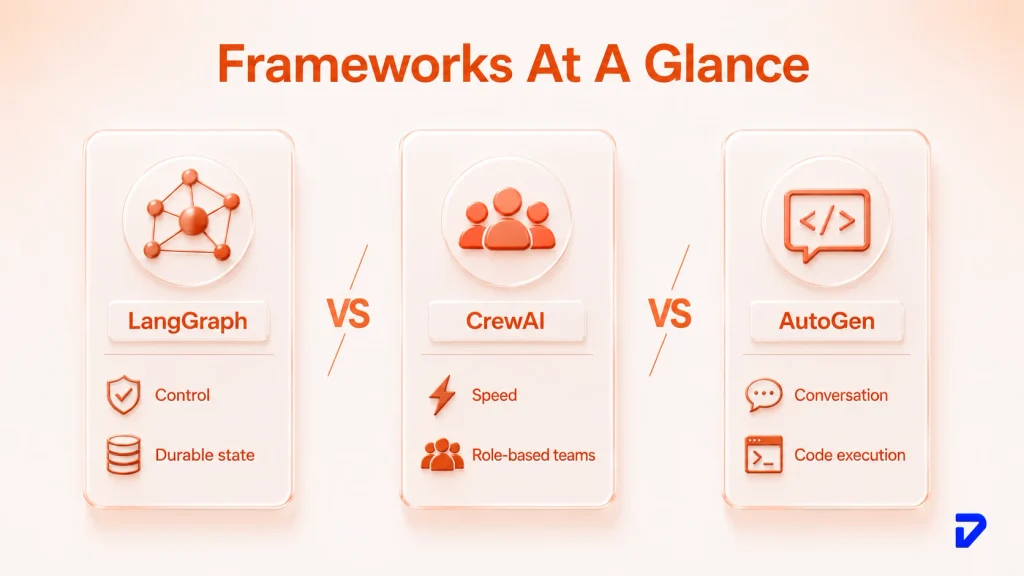
In the LangGraph vs CrewAI vs AutoGen debate, LangGraph wins on control and durable state, CrewAI on speed and team ergonomics, and AutoGen on conversational problem solving. Your workflow shape and support horizon decide the call.
More than half of organizations already run AI agents in production. Mid-sized companies are the most aggressive adopters, with 63% shipping agents to production, according to LangChain’s State of AI Agents survey. That demand makes the LangGraph vs CrewAI vs AutoGen question urgent for lean teams that cannot afford a rebuild.
The choice is hard because all three run the same underlying models, so the real differences hide in control flow, failure modes, and support. LangGraph is an open-source framework that models agent work as a stateful directed graph for precise control. CrewAI organizes agents into role-based crews plus event-driven flows for fast automation. AutoGen is Microsoft’s framework where agents solve tasks by conversing.
LangGraph vs CrewAI vs AutoGen
LangGraph gives you explicit, auditable control and durable state, at the cost of a steeper ramp. CrewAI gets a role-based multi-agent prototype running in an afternoon, and trades some fine-grained control for that speed.
AutoGen pioneered conversation-driven agents and still shines at open-ended, code-heavy problem solving, but Microsoft moved it to maintenance mode, which reshapes any long-term bet. None of the three is a universal winner. The right pick depends on how branchy your workflow is, how fast you need to ship, and how long you plan to run the system.
What Is an AI Agent Framework Comparison, and Why Does It Matter?
AI agent framework comparison is a structured, criteria-by-criteria evaluation of competing agent toolkits, scored against the factors that decide whether a system survives production, not a feature list. It matters because the wrong pick is expensive to unwind. Framework choice shapes your architecture, your debugging story, and your run costs for years, so a clear-eyed AI consulting and framework selection process pays for itself.
The Real Cost of Choosing the Wrong Framework
The downside is not theoretical. Gartner predicts that over 40% of agentic AI projects will be canceled by the end of 2027, citing escalating costs, unclear value, and weak risk controls. A framework that suits a demo but fights you at scale feeds every one of those failure modes. A refactor from role-based prototype to stateful production graph can burn weeks of engineering time, so the first decision carries the most weight.
The Criteria Behind This Comparison
This comparison scores the three frameworks on the criteria that actually flip a production decision: architecture and control, learning curve, memory and state, tooling and ecosystem, human oversight, scalability, and token economics. Each criterion carries a concrete data point rather than vibes. We also weigh long-term support, because a framework’s roadmap is part of its total cost. The aim is a decision you can defend to a CFO, not a popularity contest built on GitHub stars.
What Makes an AI System “Agentic,” and Why It Matters Here
An agentic system does more than answer a prompt. It reasons about a goal, plans steps, calls tools, checks the result, and adjusts, closer to handing someone a project than asking a single question. That loop is exactly what these frameworks manage, and why their design choices matter so much. For a fuller primer, our guide on agentic AI versus traditional AI unpacks the shift.
Single Agent or Agent Team? Knowing the Difference First
A single agent runs one reasoning loop with a set of tools. A multi-agent system splits work across specialists that hand off to each other. CrewAI leans into the team model, with agents that carry a role and a goal. AutoGen coordinates agents through conversation. LangGraph can do either, since any node in its graph can be an agent. Pick the pattern before the framework, because forcing a team metaphor onto a linear task adds cost without adding value.
Why Orchestration Is the Hidden Backbone of Every AI Agent Stack
Orchestration is the layer that decides which agent or tool runs next, how state passes between steps, and what happens when a step fails. It is the part that quietly breaks first under load. LangGraph makes orchestration explicit through typed edges, CrewAI hides it behind crews and flows, and AutoGen routes it through message passing. Done right, this layer separates a reliable system from one that loops forever, which is where workflow and process automation expertise earns its keep.
What LangGraph, CrewAI, and AutoGen Are Built For?
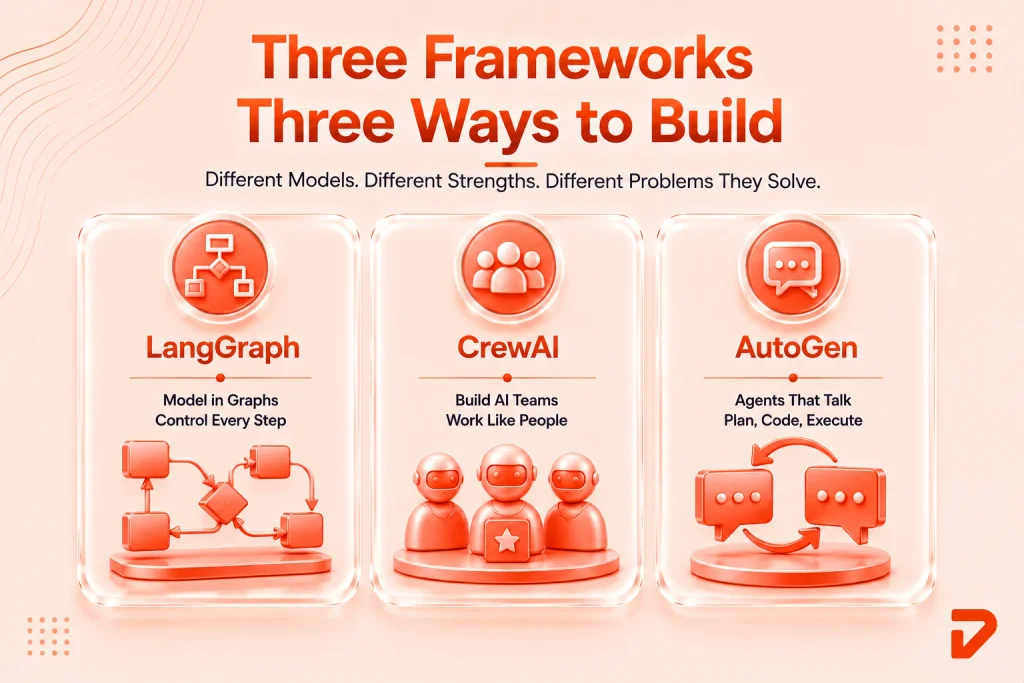
Each framework encodes a different mental model. LangGraph thinks in graphs, CrewAI thinks in teams, and AutoGen thinks in conversations. The match between model and problem is more than half the battle, and it is where custom AI development and engineering work usually begins.
LangGraph: The Flowchart That Actually Runs
LangGraph models an agent as a StateGraph: nodes are functions, edges are transitions, and a checkpointer persists state at every step. You get loops, retries, conditional branches, and the ability to pause for approval. A skeleton looks like this:
python
from langgraph.graph import StateGraph
graph = StateGraph(State)
graph.add_node(“research”, research_fn)
graph.add_conditional_edges(“research”, route_fn)
That explicitness is why Klarna and Uber run mission-critical agents on it. The tradeoff is more upfront wiring than the alternatives.
CrewAI: Building AI Teams That Think Like Employees
CrewAI maps onto how people already picture work: a researcher hands off to a writer, who hands off to an editor. You define agents with a role, a goal, and tools, group them into a Crew, and optionally wrap that in a Flow for deterministic control. CrewAI’s open-source framework added native Model Context Protocol and Agent-to-Agent support, plus checkpointing, so crews can call external tools and replay from a saved step. The abstraction consistently wins time-to-demo tests, which is its whole point.
AutoGen: When Agents Talk Their Way to a Solution
AutoGen built its reputation on the ConversableAgent pattern, where an assistant, a user proxy, and a code executor exchange messages until the task resolves. That conversational loop handles open-ended planning and code generation with unusual grace. The catch is direction: Microsoft retired AutoGen into maintenance mode and now points new work to the Agent Framework. The ideas remain influential, but the roadmap has moved, and that shapes any fresh build.
How Does an AI Agent Framework Comparison Actually Work?
How does AI agent framework comparison work? You fix a shared set of criteria, then score each framework against the same production yardstick, so no tool gets graded on a friendly demo. The seven criteria below each carry a concrete benchmark, and the LangGraph vs CrewAI vs AutoGen verdict shifts row by row rather than landing on one favorite.
Architecture
LangGraph exposes a directed state graph with typed state and checkpointing at every super-step plus durable execution, so a crashed run resumes instead of restarting. CrewAI abstracts that away into crews and flows, trading visibility for speed. AutoGen routes control through message-passing conversations, which flexes well for open-ended tasks but is harder to audit. If you need to prove exactly what an agent did, the graph model wins on inspectability.
Learning Curve
Speed to first prototype is where CrewAI pulls ahead. Teams routinely stand up a role-based crew in a few hours, since the role-and-task syntax reads almost like a job description. AutoGen sits in the middle, though its async-heavy core asks for comfort with Python’s asyncio patterns. LangGraph is the steepest climb, because you define every state transition by hand. For a proof of concept under deadline, CrewAI ships first.
Memory and State
State handling separates a toy from a production system. LangGraph persists a typed state object through a checkpointer backed by Postgres or Redis. That is how Klarna’s assistant cut resolution time 80% while serving 85 million users, holding context across a long task. CrewAI offers built-in short- and long-term memory plus runtime checkpointing. AutoGen leaves memory largely to you, expecting a custom store or a vector database. For long-running, resumable work, LangGraph’s durable state leads, and connecting it to enterprise knowledge and RAG systems extends that reach.
Tooling and Ecosystem
Breadth and standards pull in different directions here, so this one lands close. LangGraph inherits LangChain’s deep catalog of pre-built tools and integrations, the widest of the three. CrewAI ships fewer built-ins but added native MCP and A2A support, so a crew can call any compliant server and delegate to external agents. AutoGen expects more manual tool definition, which buys control at the cost of setup time. Call it a genuine toss-up: pick breadth or pick open protocols.
Human-in-the-Loop
Regulated work needs a human checkpoint, and the frameworks handle it unevenly. LangGraph treats human-in-the-loop as first-class: you can interrupt a graph mid-run, surface state for approval, then resume from that exact node. CrewAI supports human input steps inside a flow but with less granular pausing. AutoGen keeps a human in the conversation through its user-proxy agent, which is natural but coarse. When an approval gate must sit at a precise step, LangGraph’s interrupt model is the cleanest fit.
Scalability
Scale exposes different limits, so the winner depends on the shape of the load. LangGraph’s durable graph handles complex, stateful, long-running workflows and resumes cleanly after a deploy, which is how Uber’s teams saved roughly 21,000 developer hours on agent tooling. CrewAI scales horizontally through a queue-and-worker model, strong for high-volume parallel jobs. AutoGen scales but leans on you for the infrastructure. This is a workload-dependent toss-up: stateful complexity favors LangGraph, raw parallel throughput favors CrewAI.
Token Economics
Token spend tracks how much context each framework stuffs into every call. LangGraph tends to be leanest, since you control exactly what state each node sees. CrewAI’s role and backstory prompts add context to every agent call, which lifts overhead. AutoGen’s back-and-forth conversation loops can multiply calls on hard tasks. Directionally, LangGraph runs the tightest token budget, while CrewAI and AutoGen trade some efficiency for their ergonomics. At ten thousand runs a month, that gap turns into real money.
The Real Difference Between LangGraph, CrewAI, and AutoGen
The difference between LangGraph, CrewAI, and AutoGen comes down to what each one optimizes: control, simplicity, or dialogue. The three are not really rivals, since each was built to make a different pattern easy. The pairwise views below sharpen the tradeoff.
LangGraph vs CrewAI: Structure vs Simplicity
LangGraph asks you to design the whole state machine, then rewards you with precision and auditability. CrewAI asks for a few roles and tasks, then rewards you with a working crew in an afternoon. The practical rule many teams follow: prototype in CrewAI, then migrate the production-critical path to LangGraph once the workflow outgrows role-based simplicity. That migration is real work, so plan for it on day one rather than discovering it later.
LangGraph vs AutoGen: Control vs Conversation
LangGraph gives you deterministic edges and explicit routing; AutoGen gives you emergent behavior from agents talking. For a compliance workflow with fixed steps, determinism wins. For open-ended research or code synthesis, conversation can outperform a rigid graph. The deciding wrinkle is support: LangGraph is actively developed, while AutoGen’s forward path now runs through Microsoft’s Agent Framework, its named successor. New builds should weigh that roadmap carefully.
CrewAI vs AutoGen: Teams vs Dialogue
Both handle multiple agents, but the metaphor differs. CrewAI models a structured team with defined roles and handoffs, which maps cleanly onto business processes. AutoGen models a free-flowing conversation, which suits problems where the path is not known in advance. CrewAI is under active development with an enterprise tier; AutoGen is community-managed in maintenance. For a new multi-agent product with a clear division of labor, CrewAI’s structure is the safer starting point today.
LangGraph vs CrewAI vs AutoGen: The Side-by-Side Scorecard
This scorecard restates the LangGraph vs CrewAI vs AutoGen verdict at a glance. Read down the verdict column: no single framework sweeps, and the right answer shifts with your workload and support horizon.
| Criterion | LangGraph | CrewAI | AutoGen | Verdict |
| Architecture and control | Explicit state graph | Crews and flows | Message-passing chat | LangGraph for control |
| Learning curve | Steepest | Fastest to ship | Moderate, async-heavy | CrewAI ships first |
| Memory and state | Durable checkpointing | Built-in plus checkpoints | Bring your own store | LangGraph for durability |
| Tooling and ecosystem | Widest catalog | Native MCP and A2A | Manual tool wiring | Toss-up, breadth vs protocols |
| Human-in-the-loop | First-class interrupts | Flow input steps | User-proxy in chat | LangGraph for precise gates |
| Conversational and code tasks | Manual setup | Basic | Native strength | AutoGen for open-ended loops |
| Scalability | Stateful, resumable | Parallel via workers | DIY infrastructure | Toss-up, depends on load |
| Token economics | Leanest control | Role-prompt overhead | Conversation overhead | LangGraph runs tightest |
| Long-term support | Active, 1.0 GA | Active, enterprise tier | Maintenance mode | CrewAI and LangGraph active |
Which Framework Wins Your Use Case? Real-World Scenarios
LangGraph in Action: Complex, Branching, Mission-Critical Workflows
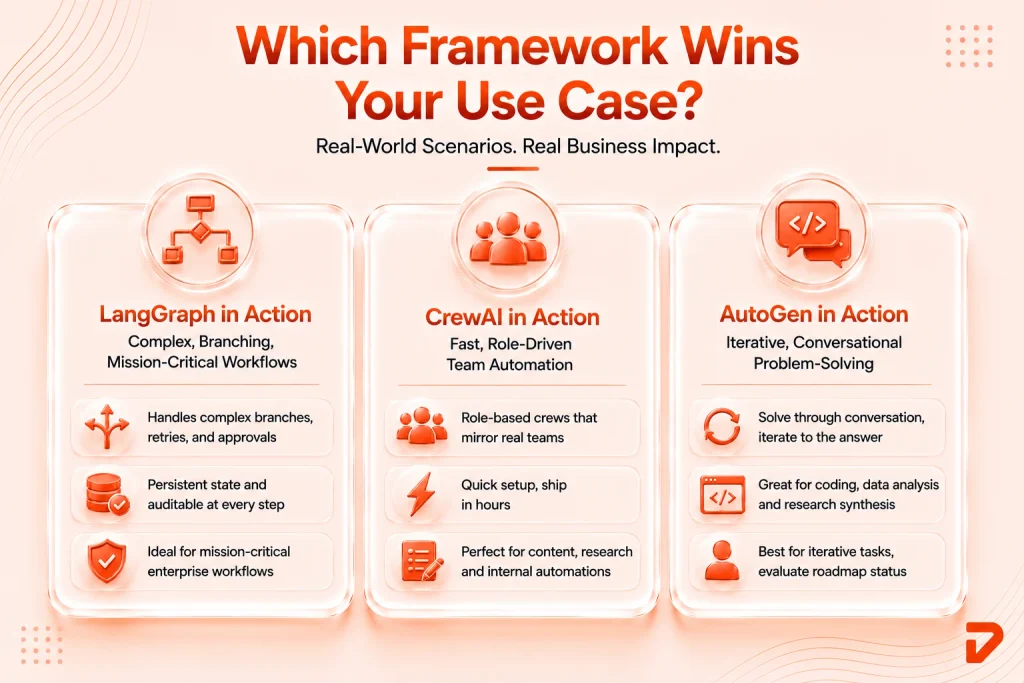
When a workflow has many branches, retry logic, human approvals, and a need to audit every step, LangGraph is the natural home. Think multi-department support escalation, financial reconciliation, or a code-migration pipeline that must resume after failure. The Uber and Klarna deployments share this shape: persistent state, conditional routing, and coordination that linear pipelines cannot hold together reliably. If a single missed step is costly, the graph model repays its steeper setup.
CrewAI in Action: Fast, Role-Driven Team Automation
CrewAI wins where the work divides cleanly into roles and speed matters more than fine-grained control. Content pipelines, research-and-summarize crews, and internal automations that mirror a small team all fit. A marketing crew that researches, drafts, and edits maps onto CrewAI’s abstraction almost one-to-one. Because setup runs in hours, it is also the right tool for validating an idea before you invest in heavier orchestration.
AutoGen in Action: Iterative, Conversational Problem-Solving
AutoGen fits problems where the solution path emerges through back-and-forth, especially code-centric ones. Its executor pattern lets agents write code, run it, read the error, and try again, which is powerful for data analysis, prototyping, and research synthesis. For teams already invested in AutoGen, that iterative loop remains genuinely strong. For new projects, weigh it against actively developed options, given the maintenance-mode status.
5 Mistakes Businesses Make When Picking an AI Agent Framework
Most framework regret traces to a handful of avoidable errors. Watch for these before you commit.
- Demo-first selection: A framework that dazzles in a notebook can buckle under state, retries, and load. Score for production from the start.
- Blind spots on the roadmap: A fresh build on a maintenance-mode framework locks you into a dead-end migration later. Check who funds the project.
- Pattern mismatch: A multi-agent design forced onto a linear task adds token cost and failure surface without adding value. Match the pattern to the problem.
- Undercounted token cost: Role prompts and conversation loops quietly inflate spend at volume. Model the cost at real request counts.
- No observability plan: If you cannot trace why an agent failed, you cannot fix it. Choose for debuggability, not just capability.
What Enterprise-Grade Deployment Needs?
Hosting, Deployment, and Infrastructure Realities
Each framework runs as an API, but the operational lift differs. LangGraph offers a managed platform tier alongside self-hosting. CrewAI provides enterprise hosting through its Agent Management Platform, with SOC 2 and single sign-on. AutoGen leans toward do-it-yourself infrastructure. Whichever you choose, containerization, secrets management, and a queue for concurrency are table stakes, and getting them right is where an experienced integration and MLOps partner removes months of trial and error.
Observability That Actually Helps
Agents fail in ways plain logs cannot explain, which is why observability is a first-order concern, not an afterthought. LangGraph pairs with LangSmith for step-level tracing and time-travel debugging. CrewAI exposes execution logs and integrates with monitoring stacks. AutoGen’s multi-agent conversations are the hardest to trace, since behavior emerges across many messages. Our guide to AI agent observability best practices covers the patterns that keep production honest.
Licensing, Support, and Long-Term Vendor Risk
All three are open source and permissively licensed, so cost lives in compute and support, not license fees. The real risk is roadmap direction. AutoGen’s shift to maintenance mode, with development moving to a separate successor, is the clearest example of vendor risk changing a buying decision. LangGraph and CrewAI both ship active roadmaps and commercial tiers. Weigh the support horizon as seriously as any feature, because it sets your maintenance cost for years.
How Pinnasys Turns the Right Framework Into a Working AI System?
A framework choice is one decision; running it in production is another. Pinnasys builds, ships, and operates agent systems on whichever framework fits your workflow, compliance load, and team, rather than selling a single house favorite. We measure success in hours saved and errors reduced, not demos.
Our engineering and delivery team has shipped production AI since 2016, so the handoff from prototype to live system is a path we have walked many times. The proof is in deployment, not slideware. Across our client case studies, the pattern holds: the framework matters, but the orchestration, observability, and ongoing run decide whether the system earns its keep.
The Bottom Line
The LangGraph vs. CrewAI vs. AutoGen decision is not about which framework is best in the abstract. LangGraph rewards teams that need control, durable state, and auditability. CrewAI rewards teams that need to ship a role-based system fast. AutoGen still serves conversational, code-heavy work, though its maintenance status changes the math for new builds.
Match the tool to your workflow shape and support horizon, and the choice gets clear. Where execution is the hard part, Pinnasys helps you build and run the system on solid AI integration and operations foundations. Start with the workload, and let the criteria settle the rest.
Key Takeaways from the Article
- LangGraph leads on control, durable state, and precise human-in-the-loop gates.
- CrewAI ships a role-based multi-agent prototype fastest, often within a few hours.
- AutoGen excels at conversational, code-execution loops but sits in maintenance mode.
- No framework wins every criterion; workload shape and support horizon decide the pick.
- Production success depends on orchestration and observability, not the framework alone.
Frequently Asked Questions on LangGraph vs. CrewAI vs. AutoGen
What’s the core difference between LangGraph, CrewAI, and AutoGen?
LangGraph uses an explicit state graph for control, CrewAI uses role-based crews for fast team automation, and AutoGen uses agent conversations for open-ended problem solving. All three run the same underlying models, so orchestration style is the real differentiator.
Which framework should enterprises trust for production systems?
LangGraph is the most battle-tested for stateful production work, running at firms like Klarna and Uber. CrewAI is production-viable with a SOC 2 enterprise tier. AutoGen’s maintenance-mode status makes it a weaker long-term bet for fresh regulated deployments.
Can you combine LangGraph, CrewAI, and AutoGen in one system?
Yes, through open interoperability standards. Native Agent-to-Agent protocol support lets agents from different frameworks delegate to each other. Model Context Protocol lets any of them share tools, so a hybrid architecture is realistic today.
Which framework is easiest to learn if you’re just starting out?
CrewAI has the lowest barrier: its role-and-task syntax reads like a job description, and teams typically ship a first crew in a few hours. LangGraph is the steepest, since you define every state transition and edge manually.





Prakash C. Saini
Prakash Saini is the Founder & CEO of Pinnasys. With over a decade in digital transformation and building production systems, he grew an engineering team from 2 to 50 people and has led the delivery of 100+ production digital systems. Products built under his leadership have raised millions in funding and generated over $50 million in revenue. He holds an Executive MBA from IIM Kozhikode and today leads the AI engineering team at Pinnasys.