


The Digital Omnibus resets one enforcement track for the EU AI Act to December 2027, and many teams read that as permission to slow down. The duties that already bite on live agents did not move at all.
The EU AI Act agentic AI rules just gained a new timeline, and the headlines have caused real confusion. On 8 July 2026, the EU signed the Digital Omnibus, which pushes the heaviest high-risk obligations to December 2027. Many teams read that as a full pause. It is not. The rules that already reach a live agentic AI system stayed exactly where they were.
This guide explains what the AI Act delay 2027 moved, why it barely touches agentic systems, and which duties still apply today. You will also get a practical checklist, the real enforcement risk, and a clear view of the agentic AI compliance timeline before the December 2027 deadline lands.
What is The EU AI Act?
What exactly is the EU (European Union) AI Act, and how does it treat agentic AI? The Act is the world’s first comprehensive, legally binding framework for artificial intelligence. It is the EU’s risk-based law for artificial intelligence, sorting systems into unacceptable, high, limited, and minimal risk. It never uses the word agent, yet its definitions fully capture autonomous systems. For agentic AI, obligations follow the risk tier of the use case, not the technology underneath.
What Actually Changed, The Facts, Not The Headlines
So what is the AI Act delay 2027 in concrete terms? It resets deadlines for one enforcement track while leaving the rest running. Commission Executive Vice-President Henna Virkkunen framed the package as a way to let business and citizens “innovate and feel safe” at once. The detail underneath that line matters far more than the slogan.
The New Timeline
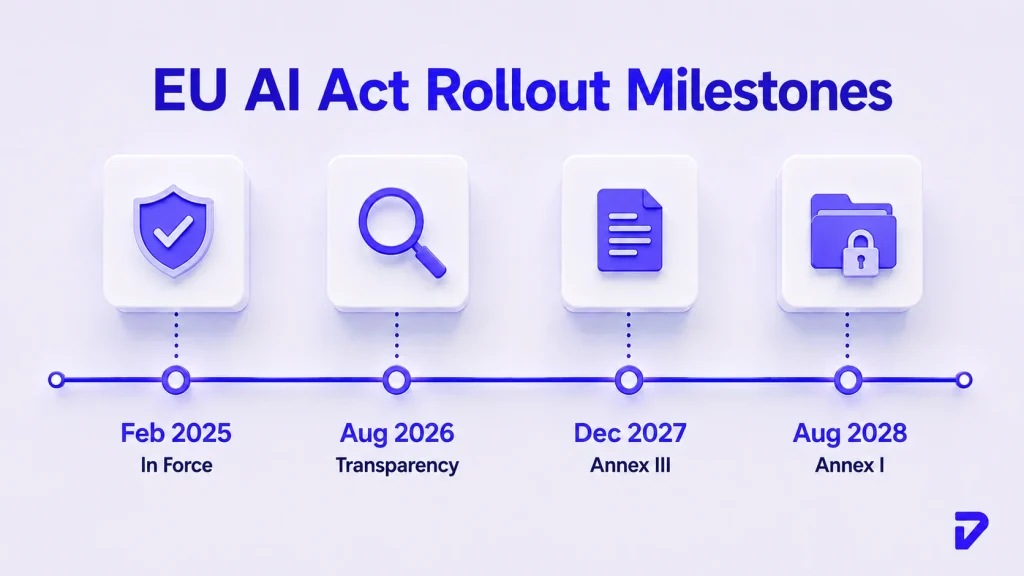
The core dates shifted in a specific, limited way. This is a targeted reset of the agentic AI compliance timeline, not a general amnesty. Standalone Annex III high-risk systems now apply from 2 December 2027, and product-embedded Annex I systems from 2 August 2028. Article 50 transparency and the Article 5 prohibitions, by contrast, keep their earlier dates.
| Milestone | Date | Status |
| Article 5 prohibitions and Article 4 AI literacy | 2 February 2025 | In force |
| Article 50 transparency obligations | 2 August 2026 | On original schedule |
| New prohibited practices and Article 50(2) marking | 2 December 2026 | New |
| High-risk Annex III standalone systems | 2 December 2027 | Postponed |
| High-risk Annex I embedded systems | 2 August 2028 | Postponed |
Political Agreement Vs. Binding Law
For months, the delay was only a political agreement. The Parliament adopted the text on 16 June 2026, the Council approved it on 29 June, and the final act was signed on 8 July 2026. It now awaits publication in the Official Journal, then enters into force three days later. So how does the AI Act delay 2027 work? It binds only after that step.
Why Regulators Pushed It
The delay fixes a practical gap, not a political one. Providers cannot prove conformity without harmonized standards, and the CEN-CENELEC standards were not ready before late 2026. Member States were also slow to name competent authorities and conformity assessment bodies. Without that machinery in place, the original 2 August 2026 date was unworkable, so the reset gives the ecosystem time to catch up.
Why This Matters Specifically for Agentic AI
Here is how the EU AI Act agentic AI rules apply once you look past the deadline. Autonomy changes the engineering, yet it does not change the legal logic. Four points decide whether your agents fall in scope, and each one rewards early attention rather than a wait-and-see stance.
No Carve-Out For Autonomy
The Act gives autonomy no special exemption. An agent that plans, calls tools, and acts still counts as an AI system under the definition. Whether it runs one step or a hundred, the line between agentic and traditional AI does not create a separate rulebook. The EU AI Act agentic AI framework treats a capable agent as an AI system with higher stakes.
Classification Is Use-Case-Based, Not Architecture-Based
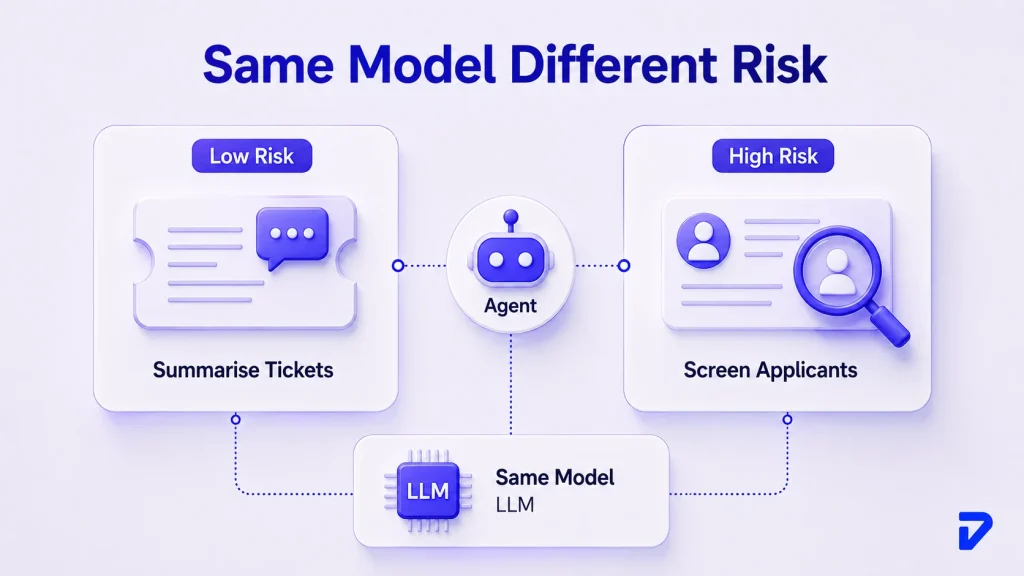
Risk follows the job, not the build. Under the EU AI Act, agentic AI classification tracks the use case, and the EU AI Office confirms Chapter III applies where an agent operates in a high-risk context. A ticket-summarising agent is usually low-risk. The same stack scoring credit or screening candidates is high-risk, whatever model sits beneath it.
Multi-Agent Chains Extend The Compliance Boundary.
One agent rarely works alone, and orchestration widens the perimeter. The Commission’s draft guidelines treat interacting components as a single system when their combined outputs shape a high-risk decision. A narrow helper can therefore inherit high-risk status from the chain it serves. The compliance question is set by the whole workflow, not the individual component.
Logging Is A Distinct Challenge For Agents.
Agentic workflows create a hard traceability problem. A final-output log will not explain which tool call or input triggered a risky action. You need event-level records that reconstruct each decision, which sits closer to agent observability than to standard logging. A retrofit into a live fleet is painful, so design it in from the first sprint.
What The Delay Does NOT Touch? This Is the Real Story
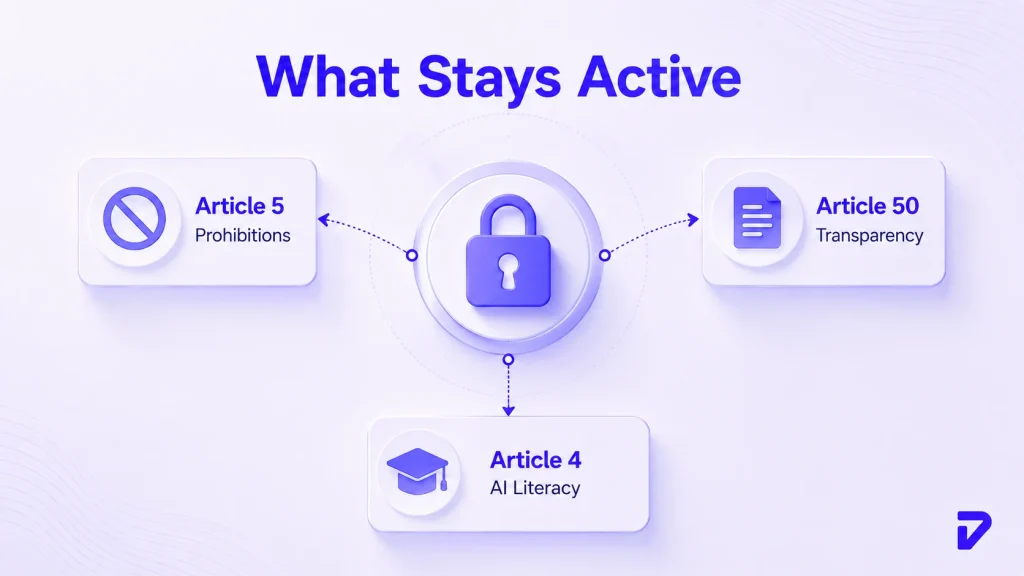
This is the real story. Three obligation sets never moved, and they are the ones most likely to reach a customer-facing agent today. The costly mistake is to read the delay as a full stop, because these duties apply now rather than in 2027.
Article 5 Prohibited Practices
Article 5 bans stay live and even expanded. The prohibitions have applied since 2 February 2025, and the Omnibus adds new bans rather than removing any, including AI-generated intimate imagery from 2 December 2026. Manipulative, exploitative, or social-scoring behavior by an agent is off-limits now, with no grace period and no architecture exemption.
Article 50 Transparency Obligations
Disclosure duties keep their original schedule. Article 50 remains a live 2 August 2026 date, so people must be told when they interact with an AI system or see AI-generated content. A support agent that hides its nature breaches this today. Only the machine-readable marking sub-rule received a short, separate grace period.
Article 4 AI Literacy Duty
Skills are already mandatory. Article 4 has applied since 2 February 2025 and requires providers and deployers to make sure staff operating AI systems are competent to do so. For agent teams, that means documented training on how each agent behaves, where it fails, and when a human must step in. This duty never moved.
Why This Matters For Agent Teams Specifically
Put together, these three duties reach ordinary deployments now. A booking tool or a customer-facing conversational agent can carry transparency and prohibition obligations well before any 2027 milestone. The EU AI Act agentic AI obligations that bite first are behavioral, not paperwork. A plan built around December 2027 alone leaves a live exposure open for eighteen months.
What Agentic AI Teams Should Actually Do Right Now
Start with work that ages well and cannot be reconstructed later. Each control below also makes an agent more trustworthy, independent of the law, so none of it is wasted effort even if the timeline shifts again.
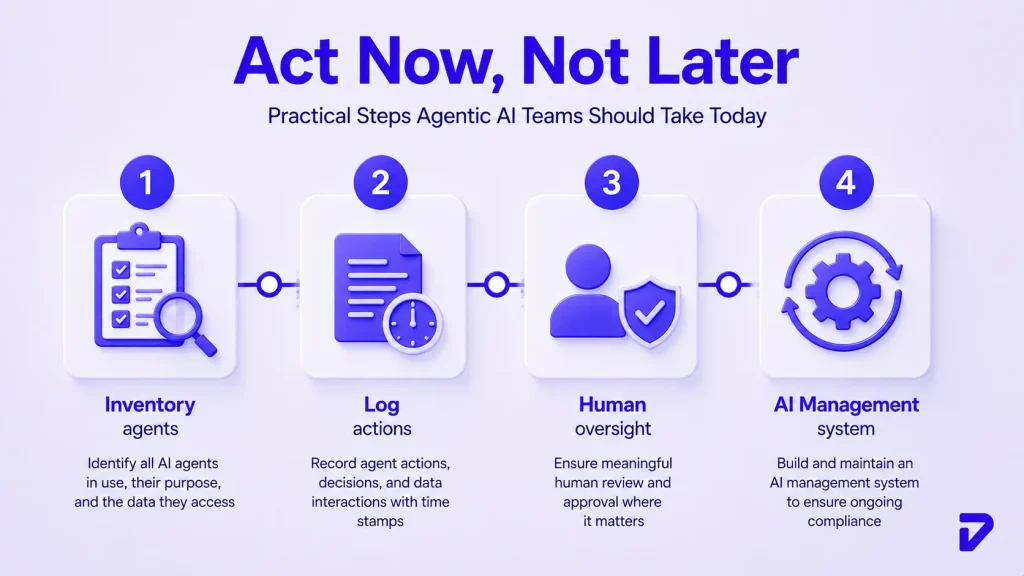
Build An AI Agent Inventory Mapped To Annex III Risk Tiers
Map every agent to a risk tier and record your role for each. A quick AI readiness assessment surfaces the systems in scope. Capture three things per agent:
- The use case and its Annex III category.
- Whether you act as provider or deployer.
- The data the agent touches.
This inventory is the hard part of compliance, and it never gets easier by waiting.
Instrument Agent-Action-Level Logging Now
Turn on granular logging before you scale. High-risk providers must keep automatically generated logs for at least six months, and you cannot backfill history you never captured. Record each tool call, input, and decision with tamper-resistant timestamps. This single step underpins audits, incident reports, and the traceability that EU AI Act agentic AI systems will need.
Build Human Oversight And Stop/Correct Controls.
Design oversight into the workflow, not around it. Article 14 expects meaningful human control, which for agents means a real stop, pause, or correct path. Bake these into your automation and workflow layer so an operator can intervene mid-task. Human oversight costs far more to retrofit into a running fleet than to design in from day one.
Treat ISO 42001 / AIMS As Durable Infrastructure, Not A Compliance Substitute
ISO 42001 builds real governance muscle, yet it is not a shortcut. Certification proves your management system works, while the Act judges each product. As one analysis puts it, certification alone will not make a system compliant. Use the standard as your foundation for an EU AI Act agentic AI program, then layer the Act’s per-system conformity work on top.
What Are The Common Mistakes Teams Are Making With AI Act Delay 2027?
Several teams are drawing the wrong lessons from the delay. Not everyone reads it kindly either. Parliament negotiator Michael McNamara warned the shift could prove “deregulatory rather than simplifying”. For operators, the safe response is to build the controls once and keep them, whatever the politics does next.
Treating The 2027 Date As Settled Law
December 2027 is now signed, but the framework behind it did not change. As Freshfields notes, the timetable was restructured, not the law itself. The risk-based core, the prohibitions, and the GPAI rules all stand. A plan that assumes the whole Act paused until 2027 misreads a deadline shift as a policy retreat.
Pausing Governance Work Broadly Instead Of Narrowly
Only the high-risk paperwork moved. A freeze on your entire governance program wastes the one thing the delay gives you: time. A staged AI roadmap and consulting plan keeps inventory, logging, and oversight moving while the conformity clock is paused. Narrow the pause to what genuinely shifted, and keep the rest running.
Assuming A Lower-Risk Model Choice Exempts An Agent
A smaller or cheaper model does not lower your risk tier. The Act classifies by use, so an agent used for recruitment, monitoring, or credit decisions is high-risk whatever model powers it. A swap to a lighter model changes cost and latency, not legal scope. Classification tracks what the agent does, full stop.
Scoping Governance Programs Too Narrowly
Narrow scoping skips the agents carrying the most exposure. Teams often govern the obvious chatbot and miss the pipeline behind it. High-stakes verticals such as insurance and claims show why the whole agentic chain needs coverage. Scope by decision impact, not by which surface a user happens to see.
The Business Case for Building Now, Not in 2027
Early action is a commercial decision, not just a legal one. In 2026, 76% of enterprises buy AI rather than build it, which puts your governance evidence under a buyer’s microscope. Three forces make early action pay off.
Enforcement Framework And Financial Penalties
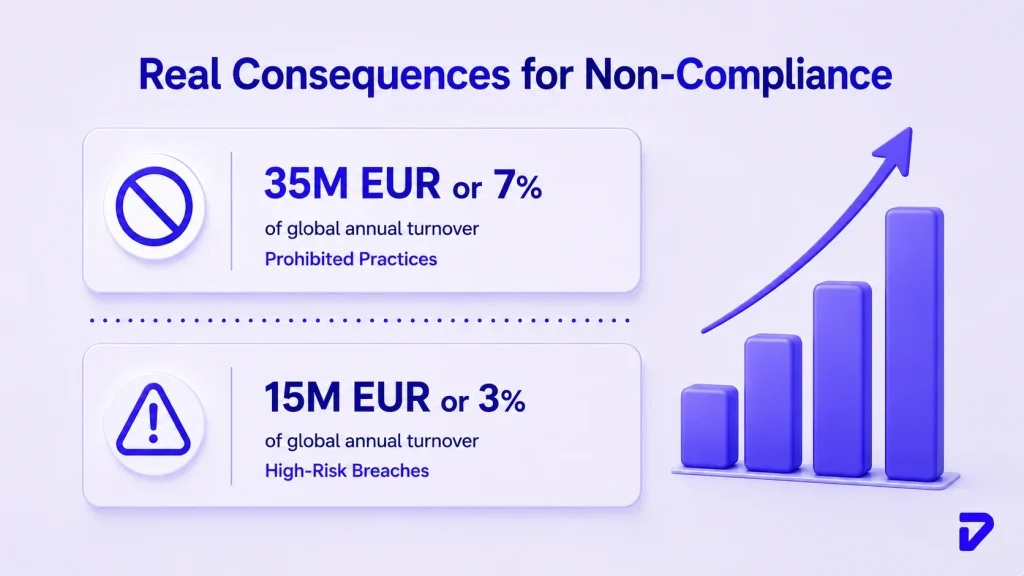
Penalties are not symbolic. Breaches of the Article 5 prohibitions carry fines up to 35 million euros or 7% of global turnover, while high-risk breaches reach 15 million euros or 3%. For larger firms, the higher figure applies. That math turns early classification into a board-level risk decision, not a compliance footnote.
Governance Readiness Is Becoming A Competitive Advantage
Procurement is moving ahead of the law. Regulated buyers now ask vendors to prove agentic governance before they sign, and RFPs in finance and healthcare already include AI governance sections. A documented control set becomes a sales asset well before 2027. Weak governance quietly loses deals you never see.
Avoiding The 2027 Compliance Bottleneck
The queue will not stay short. As the deadline nears, demand for conformity work will spike, and experts advise organizations to integrate governance now to be ready by 2027. Standards and assessment bodies are still maturing, so early movers avoid the bottleneck. Late movers compete for scarce reviewer time under real deadline pressure.
The Bottom Line
The EU AI Act agentic AI delay is a runway, not a reprieve. It defers the high-risk conformity regime, yet it leaves prohibitions, transparency, and AI literacy exactly where they were, and those duties reach live agents first. Teams that pause everything lose the one asset the delay offers: time to build governance without deadline pressure.
Pinnasys reads a development like this correctly and helps operators act on it. The practical next step is to inventory, classify, and instrument, backed by dedicated AI integration and governance support built for mid-market teams. Teams weighing what this means for their roadmap can talk to our team and map the next move.
Key Takeaways
- Only the high-risk conformity regime moved; prohibitions and transparency stay in force.
- Agent risk depends on the use case, never on the underlying model.
- Multi-agent chains can pull a narrow helper agent into high-risk scope.
- Turn on event-level logging now, because history cannot be backfilled later.
- Fines reach 35 million euros or 7% of turnover for prohibited practices.
Frequently Asked Questions on EU AI Act agentic AI
Does the December 2027 delay apply to all AI systems, or just high-risk ones?
No, the AI Act delay 2027 covers only high-risk conformity obligations for Annex III and Annex I systems. Prohibitions, Article 50 transparency, Article 4 literacy, and general-purpose model rules were not postponed and still apply on their own dates.
Is my customer-facing AI agent automatically high-risk under the EU AI Act?
No, a customer-facing role alone does not make an agent high-risk. Classification depends on the use case, such as employment or credit scoring. A support agent is usually limited-risk, though Article 50 transparency duties still apply.
What EU AI Act obligations apply to agentic AI right now, before any delay?
Three sets apply now: Article 5 prohibitions since February 2025, Article 50 transparency, and Article 4 AI literacy. This is how the EU AI Act agentic AI rules already reach live agents, regardless of the December 2027 high-risk delay.
Is the December 2027 date guaranteed, or could it still change?
It is now firm in law. The final act was signed on 8 July 2026 and takes effect after publication in the Official Journal. The high-risk start still depends on harmonized standards, which adds practical conditionality to the agentic AI compliance timeline.
What’s the difference between Annex III and Annex I high-risk systems?
Annex III covers standalone systems defined by use, such as recruitment or credit scoring, due by 2 December 2027. Annex I covers AI embedded in regulated products, like medical devices or machinery, due by 2 August 2028.





Prakash C. Saini
Prakash Saini is the Founder & CEO of Pinnasys. With over a decade in digital transformation and building production systems, he grew an engineering team from 2 to 50 people and has led the delivery of 100+ production digital systems. Products built under his leadership have raised millions in funding and generated over $50 million in revenue. He holds an Executive MBA from IIM Kozhikode and today leads the AI engineering team at Pinnasys.