


Distribution and wholesale businesses are sitting on operational data that AI can act on. Custom AI product development turns that data into faster decisions, lower costs, and workflows that actually fit how distributors operate.
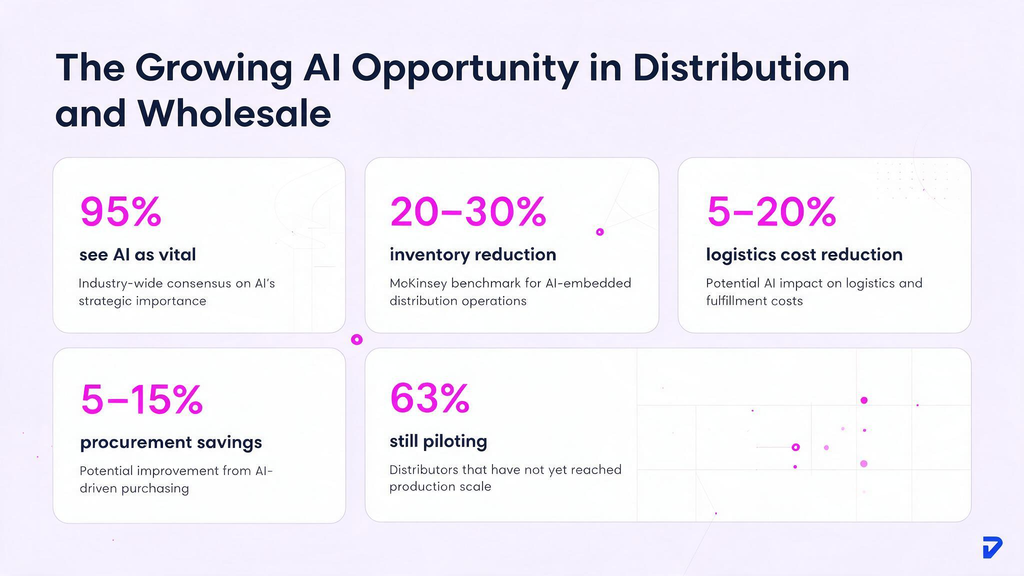
Distribution Strategy Group’s 2026 research found that 63% of distributors are still exploring or piloting AI, while only 27% are implementing it at scale. Distribution Strategy Group research The next step is turning these experiments into custom AI products that work with the ERP, WMS, CRM, and workflows already running the business. These products can support demand forecasting, inventory planning, order processing, sales intelligence, and customer service.
This guide explains which AI products distribution and wholesale companies can build, what they need to work effectively, and how to move from an initial idea to a production-ready product.
The AI Opportunity for Distribution and Wholesale Companies
Distribution and wholesale companies deal with thin margins, large SKU catalogs, changing demand, and labor-intensive workflows. These conditions create clear opportunities for AI products that can improve specific operational processes.
Generic AI tools often fall short because they are not built around how distributors actually work. A demand forecasting tool may not account for customer-specific pricing or supplier lead times. A chatbot may not access live inventory from the WMS, while off-the-shelf software may not integrate with an ERP holding years of transaction data.
Custom AI product development addresses these gaps by combining a distributor’s data, business rules, and existing systems into applications built for specific workflows. That could mean an inventory planning product for demand forecasting, an AI order system for processing transactions, or a sales assistant that gives reps account-level insights.
Distribution Strategy Group research shows that 95% of distributors consider AI vital or important to their success over the next three years. Distribution Strategy Group research The opportunity is to move beyond generic AI tools and build products that fit the way distribution businesses operate.
Where Custom AI Products Fit in Distribution
Nearly 75% of distributor teams have generative AI embedded in their daily work, and about 93% plan to increase their use over the next two years. Distribution Strategy Group 2025 State of AI in Distribution The strongest opportunities are in workflows where distributors manage high volumes of data, repetitive decisions, and time-sensitive operations.
| Distribution Function | What the Custom AI Product Does |
| Demand and inventory planning | Forecasts demand using transaction history, seasonal patterns, and supplier lead times |
| Order and quote management | Automates order processing, pricing, and validation against customer contracts |
| Sales and account intelligence | Scores accounts, identifies opportunities, and gives reps actionable insights |
| Warehouse and fulfillment | Optimizes pick paths, labor planning, and inventory slotting |
| Procurement and supplier management | Predicts lead times, monitors supplier risk, and recommends POs |
| Supply chain monitoring | Detects disruptions, suggests alternatives, and monitors carrier and supplier networks |
| Financial and margin analysis | Analyzes SKU profitability and recommends pricing adjustments |
The strongest starting points are usually high-volume workflows with clear operational costs. Demand planning and order management affect thousands of transactions, so even small improvements in accuracy or processing speed can create meaningful savings.
Connecting AI to the Existing Tech Stack
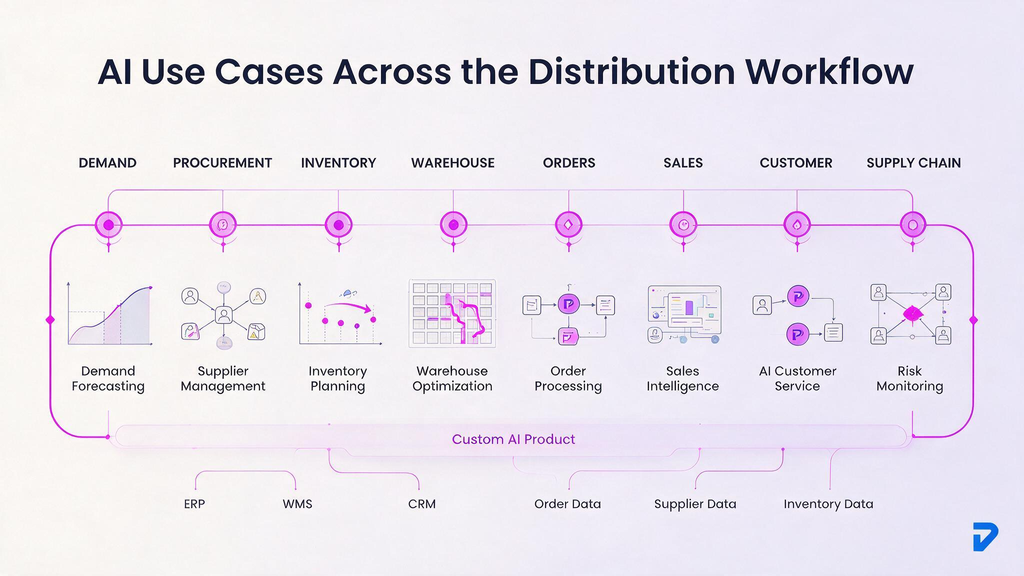
The practical value of a custom AI product depends on how well it connects with the systems already running the business. Distributors often rely on ERP platforms such as SAP, Oracle, or Microsoft Dynamics, WMS platforms such as Blue Yonder or Manhattan Associates, and CRM tools.
A custom AI application can read from and write to these systems through APIs, allowing AI capabilities to work within existing workflows instead of forcing teams to switch between disconnected tools. AI integration services become especially important here because connecting multiple systems, data sources, and business rules is often the most complex part of the implementation.
The Best AI Development Use Cases in Distribution
AI can improve key distribution workflows where speed, accuracy, and efficiency matter most. The strongest use cases span demand forecasting, inventory, order processing, warehousing, procurement, and customer service.
AI for Demand Forecasting and Inventory Planning
Demand forecasting is the highest-value starting point for most distributors. Machine learning models trained on order history, seasonality, and supplier lead times consistently outperform static reorder rules across large SKU catalogs. A building products distributor documented by McKinsey used an AI-enabled supply chain control tower to improve fill rates by 5 to 8 percent, freeing planners from manual reconciliation and allowing them to focus on supplier relationships and strategic purchasing.
AI for Order Processing and Management
High order volumes and complex pricing logic make order management a strong candidate for AI automation. Custom systems can validate orders against customer contracts, apply tiered pricing, flag exceptions, and route approvals automatically. McKinsey’s analysis of AI-powered RFQ tools documented a water technologies distributor that generated $1.8 million in quotes for 45,000 customers within four weeks of deploying a generative AI quoting assistant. The system was built and running in six weeks.
AI for Sales Forecasting and Account Intelligence
Sales AI for distributors goes beyond pipeline forecasting. The more valuable application is surfacing which accounts are at risk, which are ready for an upsell, and which product categories are underrepresented in an account’s current purchasing. AI systems trained on transaction history, visit cadence, and product mix can deliver those signals to sales reps before they walk into a call. Predictive analytics and decision intelligence built on distributor data produces a different quality of insight than a generic CRM report.
AI for Warehouse and Fulfillment Operations
Warehouse AI applications cover pick path optimization, labor scheduling, slotting recommendations, and inbound receiving. These systems use real-time inventory data, order profiles, and historical throughput to make routing and staffing decisions that a planner cannot calculate manually. The output is faster pick cycles, lower labor cost per unit, and fewer fulfillment errors without adding headcount.
AI for Procurement and Supplier Management
Procurement AI monitors supplier performance, flags lead time changes, and predicts when a vendor is likely to miss a delivery window based on historical patterns. Custom systems can also automate PO generation when inventory crosses a threshold, incorporating current pricing, preferred vendor logic, and contract terms. The result is a procurement process that responds to signals before they become stockouts.
AI for Pricing and Margin Optimization
National Association of Wholesaler-Distributors research found that 73% of distributors pursuing AI pricing tools expect margin improvements of 2% or more. For a distributor operating at thin margins, two points of margin recovery is substantial. Pricing AI analyzes transaction history, competitor signals, customer price sensitivity, and contract tiers to surface recommendations that optimize margin without jeopardizing account relationships.
AI for Customer Service and Communication
Generative AI, the category of AI that produces natural-language output, handles inbound order status inquiries, shipping updates, and availability questions without a customer service rep. A RAG pipeline, the system that fetches relevant documents or data before the model responds, grounds answers in live inventory and order records. For distributors managing thousands of accounts, this reduces inbound volume on routine inquiries while keeping response times fast.
Supply Chain AI for Risk and Disruption Management
Supply chain monitoring AI tracks carrier performance, weather events, and supplier health indicators to flag disruption risk before it reaches fulfillment. Gartner projects that 70% of large-scale organizations will adopt AI-based demand forecasting by 2030, driven partly by the compounding cost of disruptions that go undetected. Distributors with AI monitoring can identify alternative routing or sourcing before a supplier delay becomes a stockout.
Why Distribution Companies Need Custom AI Solutions
The structural case for custom AI development in distribution comes down to three factors: workflow variation, system complexity, and business-specific rules.
No two distributors operate identically. A building materials distributor and a food service distributor both need demand forecasting, but the underlying data, supplier structures, customer ordering patterns, and margin logic are entirely different. Generic AI tools cannot accommodate those differences without extensive configuration, and even then, they rarely integrate cleanly with the ERP or WMS systems that hold critical operational data.
Pinnasys builds custom AI for distributors and wholesale businesses, including logistics AI solutions that connect AI applications with production ERP, WMS, and CRM environments. The systems that matter in distribution are not plug-and-play environments, so custom AI development has to account for that complexity from the start.
What a Custom AI Product Looks Like for a Distributor
Custom AI development for distribution typically produces one of a few application types, each designed around a specific operational function.
- AI Sales Assistant: Gives reps a dashboard that surfaces account risk, upsell signals, and product recommendations before each customer interaction. It pulls from order history, CRM data, and product catalog records to give reps useful context without manual research.
- AI Inventory Planning Tool: Replaces static reorder rules with dynamic forecasting models. Planners see recommended order quantities, demand trends by SKU, and alerts when products trend toward stockout or overstock.
- AI Order Management System: Handles validation, pricing, routing, and exception flagging automatically. Standard orders move without human review, while discrepancies are flagged and routed to the right person.
- AI Procurement Assistant: Monitors supplier performance and generates PO recommendations based on lead times, inventory levels, and contract terms. Buyers review and approve recommendations instead of building POs manually.
- AI Warehouse Intelligence Platform: Optimizes pick paths, positions fast-moving SKUs, and forecasts labor requirements by shift using real-time order data and WMS connectivity.
- AI Customer Service Application: Handles routine inquiries about order status, delivery windows, and availability. Complex requests are escalated to a rep, while interactions are logged for account history.
The right application to build first depends on where the biggest bottleneck sits. A distributor losing margin on overstock starts with inventory planning. One managing slow quote cycles starts with order and quoting automation.
Ready to build a custom AI product for distribution?
Pinnasys builds AI applications that connect with your existing business systems.
How to Build a Custom AI Product for Distribution
McKinsey research found that 90% of distributors have AI initiatives, but only 11% have fully adopted the technology. That gap is largely an execution problem, not a technology one. Starting with the right use case matters more than starting fast.
The AI consulting for distribution and wholesale process typically moves from identifying the right opportunity to designing, testing, and deploying a custom AI product.
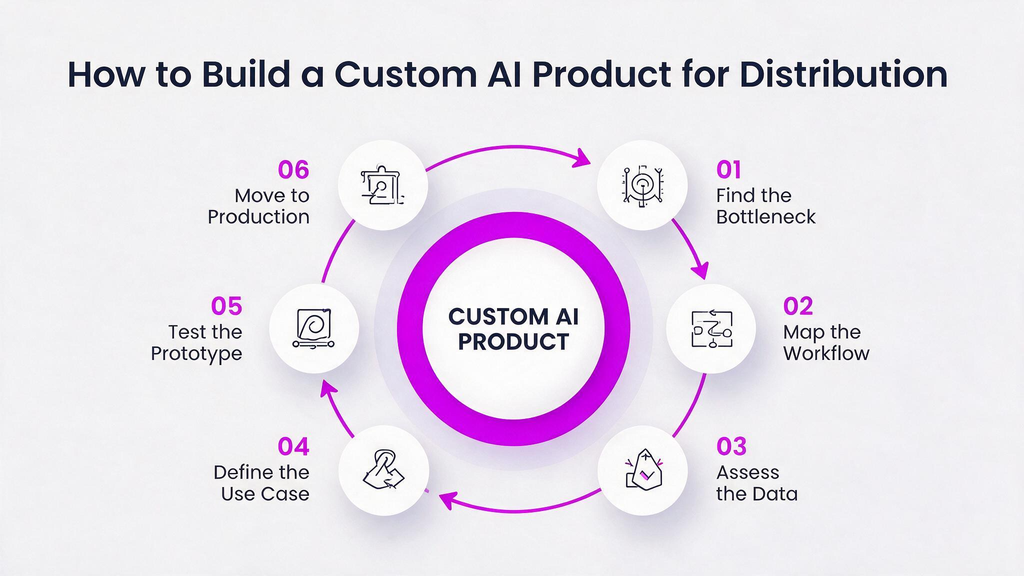
1. Find the Bottleneck
Start with the workflow creating the most manual work, delays, or costly errors. This is often the strongest AI opportunity because improving a high-friction process can create measurable value without requiring the business to automate everything at once.
2. Map the Workflow
Document the process step by step. Identify the systems involved, where data enters, and where it moves next. This reveals integration requirements, manual handoffs, and data gaps before product development begins.
3. Assess the Data
Review the data available for the selected workflow. Clean ERP history can support stronger AI applications, while fragmented information across spreadsheets and email may require additional preparation before development begins.
4. Define the Use Case
Choose one focused use case and define the product roadmap. Set measurable goals such as forecast accuracy, order processing time, inventory turns, or cost per pick. A clear target makes it easier to evaluate the product’s business impact after deployment.
5. Test a Prototype
Build a prototype and test it with real operational data and workflows. This can expose edge cases, integration problems, and usability issues that a simple demonstration may miss. Early testing helps refine the product before full development.
6. Move to Production
Moving beyond a pilot requires more than a working AI model. Distribution Strategy Group’s 2026 research found that 63% of distributors remain in the pilot or exploration stage. A production product needs system integration, monitoring, governance, and change management from the start.
What to Consider Before Building AI for Distribution
Building AI for distribution comes with challenges that need to be addressed early. The biggest ones usually involve data, system integration, and employee adoption.
- Fragmented Operational Data: Order data may sit in the ERP, inventory data in the WMS, and supplier information in spreadsheets. Bringing these sources together should be part of the project from the beginning.
- Legacy ERP and Warehouse Systems: Older platforms may have limited API access, so the AI architecture needs to account for existing system constraints.
- Data Quality: Incomplete or inconsistent data can lead to unreliable AI recommendations. Data assessment should therefore happen before development begins.
- Employee Adoption: Teams are more likely to use AI when they understand how recommendations are generated. Involving employees in testing can also improve trust before deployment.
The Bottom Line
Custom AI products for distribution should solve specific operational problems and fit the workflows your teams already use.
For mid-market distribution and wholesale businesses, Pinnasys builds custom AI applications that connect with ERP, WMS, and CRM platforms. These products can move from strategy to production without requiring teams to replace their existing systems.
The goal is simple: reduce manual work, improve decisions, and create measurable value. A focused AI product can deliver results where generic software falls short.
Key Takeaways
- Custom AI product development delivers the most value when built around specific distribution workflows and existing ERP, WMS, and CRM systems.
- AI can help distributors improve inventory planning, demand forecasting, order processing, and other high-volume operations.
- Custom AI products can connect with existing business systems, while generic tools often lack the integrations and business logic distributors need.
- The biggest challenge in distribution AI is moving from pilot projects to production-ready applications.
- Mid-market distributors can benefit from focused AI products that address specific operational bottlenecks and measurable business goals.
Frequently Asked Questions
How do distribution companies use AI development?
Distribution companies use AI development to build custom applications for demand forecasting, order processing, pricing optimization, warehouse management, and sales intelligence. These products can integrate with ERP, WMS, and CRM platforms to support existing workflows and reduce manual work.
What are the best AI development use cases in distribution?
Strong use cases include demand forecasting, AI-assisted quoting and order management, pricing optimization, inventory planning, warehouse operations, and supply chain monitoring. These applications can help distributors improve accuracy, reduce repetitive work, and make faster operational decisions.
What ROI can distribution companies expect from AI development?
ROI depends on the workflow, data quality, implementation approach, and business goals. A well-designed AI product can reduce operational costs, improve inventory planning, speed up order processing, and support better decisions. Define clear business metrics before development to measure the product’s impact.
Is custom AI product development worth it for a mid-sized distribution business?
Custom AI product development can be worthwhile when it targets a clear operational problem. A focused application for demand forecasting, quoting, inventory planning, or order automation provides a practical starting point. The product can also connect with existing ERP and WMS platforms and expand into additional workflows over time.
How do I get started with AI development for distribution?
Start by identifying the workflow that creates the most operational friction or margin pressure. Map the process, review the available data, and define clear success metrics before development begins. A focused prototype tested with real operational data provides a practical path toward a production-ready product.
What custom AI products can distribution companies build?
Distributors can build custom AI products for sales intelligence, inventory planning, order processing, procurement, warehouse optimization, demand forecasting, and customer service. The right product depends on where operational friction is highest. Each application can be built around company-specific pricing rules, supplier logic, customer data, and ERP structures.




Prakash C. Saini
Prakash Saini is the Founder & CEO of Pinnasys. With over a decade in digital transformation and building production systems, he grew an engineering team from 2 to 50 people and has led the delivery of 100+ production digital systems. Products built under his leadership have raised millions in funding and generated over $50 million in revenue. He holds an Executive MBA from IIM Kozhikode and today leads the AI engineering team at Pinnasys.