
Conversational AI in financial services works best on high-volume tasks like account inquiries, fraud alerts, and payment questions. Guardrails such as grounded answers, step-up authentication, and card-safe call recordings keep it compliant.
The CFPB found that all ten of the largest U.S. commercial banks use chatbots, and 98 million Americans used one in 2022. Most of those bots still answer a balance question well, then stall when a customer types something messy. Picture a member writing at 11 p.m. that a $612 charge posted twice and her debit card feels compromised.
That message needs intent detection, an account lookup, a card freeze, and a clean handoff, all within consumer finance rules. This is precisely where conversational AI in financial services either earns trust or generates complaints. For banks, credit unions, and fintech lenders, the real decision is which jobs to automate first and which controls each one needs.
Where Banking Customer Service Breaks Down Today
Contact Center Volume Grows Faster Than Headcount
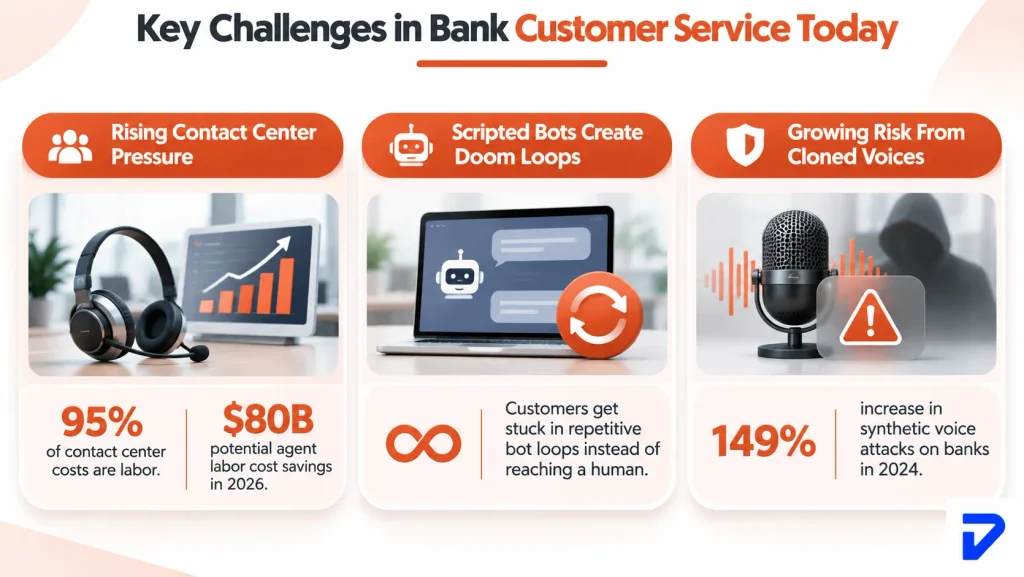
Labor makes up as much as 95% of contact center costs, according to Gartner. The firm also expects conversational AI to trim agent labor spend by $80 billion in 2026. At a typical regional bank, the strain peaks on Monday mornings. Card disputes, payoff requests, and login resets then pile up faster than trained agents can clear them.
Scripted Bots Trap Customers in Doom Loops
Older decision-tree bots recognize only a narrow menu of phrases, so anything off-script sends customers in circles. Complaints filed with the CFPB describe these “doom loops,” where people simply cannot reach a human for help. Looped customers usually call anyway, which means the bot adds cost instead of removing it while also denting trust.
Fraudsters Now Call In With Cloned Voices
Pindrop’s analysis of over 1.2 billion calls found synthetic voice attacks on banks rose 149% in 2024. Consequently, the phone line many customers still prefer has become one of the easiest channels to impersonate. Any voice AI for banks therefore needs fraud signals built into the conversation itself, not bolted on months after launch.
How Is Conversational AI Used in Financial Services?
Most conversational AI in financial services handles four jobs: answering questions, completing routine transactions, flagging fraud, and briefing human agents. Scale is already real, since Bank of America’s Erica averages more than 58 million client interactions a month. Underneath each useful deployment sit three layers, which our AI chatbot development guide covers in build-level detail.
Intent Detection Turns Messy Messages Into Requests
Natural language understanding, or NLU, is the layer that works out what a customer means. It maps messy text to an intent and pulls out amounts, dates, and merchants. For example, “charged twice at the grocery store yesterday” becomes a duplicate-charge intent with both details attached. As a result, the request lands in a dispute flow, not a generic FAQ.
Retrieval Keeps Answers Inside Approved Policy
A financial services chatbot should never improvise fee schedules or dispute rights. Retrieval-augmented generation (RAG) prevents that by fetching approved documents before the model writes a word. That way, the assistant quotes only current, compliance-reviewed content indexed through AI enterprise search. When retrieval finds nothing relevant, the correct behavior is a handoff, never a confident guess about someone’s money.
Scoped Tool Calls Turn Answers Into Actions
Actions such as freezing a card or scheduling a payment run through tool calls, which are narrow API requests the assistant may trigger. Each call carries OAuth scopes (permissions limited to one task and one customer), so a hijacked session cannot drain an account. In addition, these agentic AI workflows write every action to an audit log for later review.
What Can a Banking Chatbot Handle Without a Human?
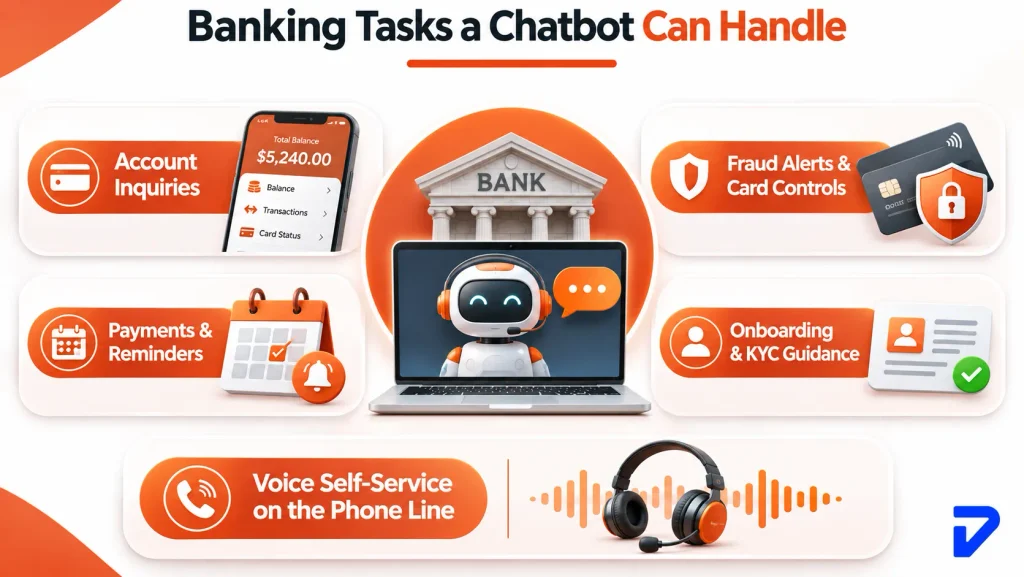
A well-built banking chatbot can fully resolve high-volume, rules-based requests and prepare everything else for a person. The dividing line is consequence: reversible, low-dollar tasks automate well, while credit decisions and contested disputes stay with trained staff. In practice, five use cases cover most of the volume that conversational AI in banking absorbs once it reaches production.
Account Inquiries and Everyday Servicing
Balances, pending transactions, payoff amounts, routing numbers, and card-delivery status make up most routine account inquiries. Inside the authenticated app, an assistant answers them instantly from core banking data. For instance, “why is my balance lower than yesterday?” returns an itemized list of the pending holds behind the gap. No agent needs to touch the conversation.
Fraud Alerts and Card Controls
When a fraud scoring model flags a suspicious charge, the assistant texts or calls the customer to confirm it within seconds; a “no” freezes the card, opens a claim, and orders a replacement in a single reply. Equally important, outbound voice alerts need consent planning, because the FCC ruled AI-generated voices count as “artificial” under the TCPA.
Payments, Reminders, and Hardship Requests
Due-date reminders and payment scheduling suit conversational AI in financial services because the rules are clear and timing matters. A borrower who replies “can I pay Friday instead?” can reschedule without waiting on hold. However, hardship requests route to a person, because forbearance terms carry legal and credit consequences for the borrower.
Onboarding and KYC Guidance
Account opening stalls when applicants hit Know Your Customer (KYC) document errors they do not understand. A conversational guide explains why a license photo failed, what proof of address must show, and how long review takes. Importantly, identity verification itself stays inside the eKYC system, while the assistant simply keeps applicants moving instead of quitting halfway.
Voice Self-Service on the Phone Line
Natural speech in place of press-1 menus lets callers say “I lost my card in Denver” and get a freeze and replacement at once. Latency, interruption handling, and accent coverage decide whether callers trust it, as our guide to AI voice agents in production explains. Escalated calls then reach a human with a summary already written.
Before and After: Conversational Banking in Daily Operations
The clearest way to judge conversational AI in financial services is to compare one workflow before and after deployment, row by row. The table below reflects patterns we typically see at banks and credit unions, each tied to the metric it moves.
| Workflow step | Before (manual) | After (with conversational AI) | Metric moved |
|---|---|---|---|
| Balance and transaction questions | IVR menu, then a hold queue | Instant answer in app or by voice | Containment rate |
| Suspected card fraud | Customer calls, waits, then verifies | Proactive alert with one-tap freeze | Fraud response time |
| Lost or stolen card | Agent call and manual reorder | Freeze and reissue in one chat | Average handle time |
| Dispute intake | Agent types notes from scratch | Assistant captures details and files the claim | Dispute cycle time |
| Loan payoff request | Email ticket with a next-day reply | Quote generated from core data | Time to resolution |
| Escalated call | Customer repeats the whole story | Agent receives an AI-written summary | First contact resolution |
Notice that no row removes people from judgment calls. Instead, each change strips out waiting, retyping, and repetition, which is exactly where cost and frustration were hiding. The same pattern extends into wealth management, as our Jump conversational AI case study shows.
Still routing every card freeze and balance question through a hold queue?
Pinnasys designs conversational AI for banks and fintechs that resolves routine requests safely and hands complex cases to your team with context.
What Results Do Banks See From Conversational AI?
Well-scoped deployments deliver higher self-service rates, faster resolution, and fewer repeat contacts, although results depend heavily on integration depth. Mature AI virtual assistant banking programs show what scale looks like, and the table below pairs each KPI with a published reference point.
| KPI | What it tracks | How conversational AI moves it | Published reference point |
|---|---|---|---|
| Containment rate | Requests resolved without an agent | Resolves routine intents end to end | Bank of America: over 98% of Erica users find what they need |
| Time to resolution | Minutes from first message to fix | Removes hold time and transfers | Klarna: under 2 minutes, down from 11 |
| Repeat contact rate | Customers returning on the same issue | Grounded answers resolve it the first time | Klarna: 25% fewer repeat inquiries |
| Cost per contact | Fully loaded cost of each interaction | Shifts volume off paid agent minutes | CFPB-cited estimate: about $0.70 saved per interaction |
| Internal ticket load | Staff IT and policy questions | Internal assistant answers employees directly | Bank of America: Erica for Employees halved IT desk calls |
Fintech results tend to arrive faster because their stacks are newer. Klarna said its assistant handled two-thirds of customer service chats in its first month, doing the work of 700 full-time agents. A year later, however, its CEO said the cost-first approach produced lower quality, and the company began hiring human agents again. For that reason, measure conversational AI in financial services against a human-only baseline, tracking quality alongside speed.
How Do Banks Keep Conversational AI Compliant?
Banks keep conversational AI compliant by treating every bot reply like a staff statement: grounded, logged, reviewable, and bound by consumer finance law. In its chatbot report, the CFPB says chatbots must follow every applicable federal consumer financial law, including dispute and disclosure rules. UDAAP, the federal ban on unfair, deceptive, or abusive practices, applies to bots exactly as it applies to tellers.
Pinnasys builds these guardrails as enforced policy in code rather than polite instructions inside a prompt. Each intent gets a tier, an authentication level, and logging rules that compliance teams can read and approve before launch. A simplified policy looks like this:
# Simplified intent policy for a banking assistant
intents:
  balance_inquiry:  { tier: automate, auth: app_session }
  card_freeze:      { tier: automate, auth: step_up, log: required }
  dispute_intake:   { tier: assist,   auth: step_up, reg_e_flag: true }
  hardship_request: { tier: escalate, handoff: human_queue }
transcripts:
  redact: [card_number, cvv, ssn]
fallback:
  low_confidence: handoff_with_summary
Examiners treat conversational AI in financial services like any other customer channel. Our AI integration and governance work therefore keeps these policies current as products and rules change. These systems support your compliance program; they never replace your legal review or audit function.
Grounded Answers and Complete Audit Trails
Every reply should trace back to an approved source, and every session should be stored with timestamps, intents, and actions taken. When a customer later disputes what the bot said, compliance can replay the exact exchange. Regulation E also matters here: if a customer describes an unauthorized transfer in chat, that message may start the error-resolution clock.
PCI DSS and Call Recording Without Card Data
The Payment Card Industry Data Security Standard (PCI DSS) bars storing card verification codes after authorization, including inside call recording files and chat transcripts. The PCI Council’s telephone payment guidance favors scope reduction, such as masking keypad tones, over pause-and-resume recording. Consent matters as well, because California requires every party’s consent before recording a confidential call.
Disclosure, Handoff, and Human Review
Customers should know they are chatting with AI, and they should reach a person after one failed attempt rather than five. Human-in-the-loop review, meaning a person approves an output before it takes effect, belongs on credit terms, fee waivers, and complaint responses. That design keeps judgment with staff while conversational AI handles the paperwork.
How Do Banks Authenticate Customers With AI?
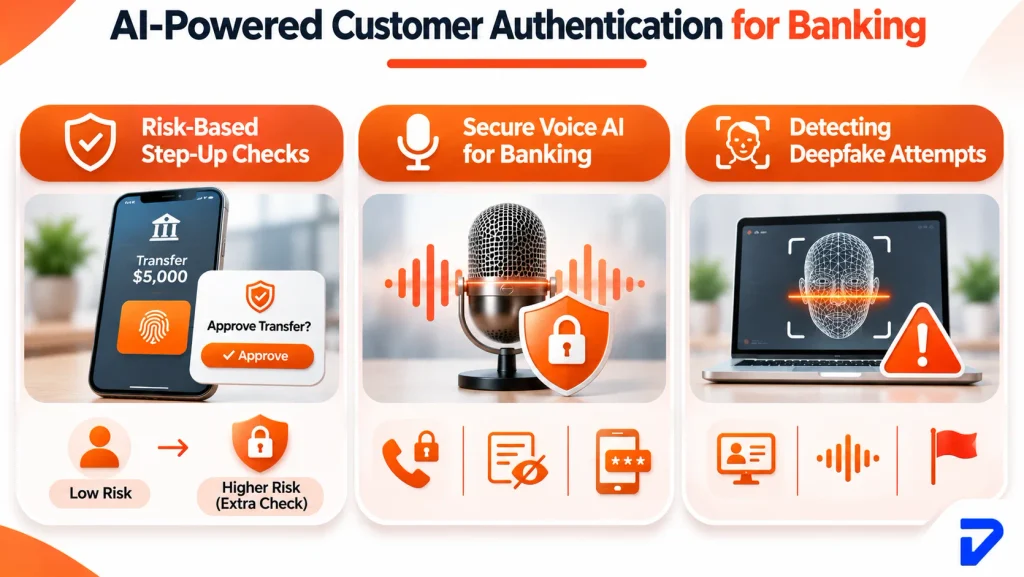
Most institutions now authenticate customers with AI through layered signals, such as device, behavior, and one-time codes, with stricter checks as requests get riskier. The FFIEC’s 2021 authentication guidance backs this layered, risk-based approach over reliance on any single factor. Identity is where conversational AI in financial services carries the most risk, because one weak step exposes real money.
Step-Up Checks Matched to Risk
A balance question inside an already logged-in app session needs no extra friction at all. By contrast, a $5,000 transfer to a new payee is different, so the assistant pauses and triggers a push approval on the registered device. As a result, this risk-matched friction keeps everyday conversational banking fast while making account takeover slow and costly for attackers.
Is Voice AI Secure for Banking?
Voice AI can be secure, but only when the voice itself is never treated as the password. OpenAI’s Sam Altman warned bankers that AI has “fully defeated” voiceprint authentication, since cloned audio is now cheap to produce. Secure designs encrypt calls, redact card details from transcripts, and require a second factor before any money moves.
Deepfake Red Flags Inside the Conversation
FinCEN has flagged a rise in suspicious activity reports involving deepfakes and published red flags for institutions to watch. A well-built assistant scores related signals live, such as mismatched device data, odd audio artifacts, or pressure to move funds urgently. When risk climbs, it routes the caller to a fraud specialist instead of finishing the request.
The Bottom Line
Conversational AI in financial services pays off when it resolves real requests, not when it merely deflects them. Start with high-volume, reversible jobs such as account inquiries, card freezes, and fraud alerts, then expand as the data proves value. Meanwhile, treat every guardrail as part of the product: grounded answers, card-safe recordings, layered authentication, and a fast route to a human.
Banks and fintechs that skip those controls usually rebuild them after the first complaint or audit finding. A short AI consulting and roadmap engagement can rank your intents by volume and risk before any build starts. When you are ready to scope a pilot, talk with the Pinnasys team about which conversations to automate first.
Key Takeaways from the Article
- Reversible, high-volume requests like balance checks and card freezes are the safest starting point.
- Retrieval from approved content keeps chatbot answers inside fee and dispute policy.
- Card verification codes must never land in call recordings or chat transcripts.
- Voiceprints alone no longer prove identity, so layer device signals with step-up checks.
- Track containment, resolution time, and repeat contacts against a human-only baseline.
Frequently Asked Questions on Conversational AI in Financial Services
How long does it take a bank to launch a conversational AI assistant?
A focused pilot covering 10 to 20 intents typically takes 8 to 14 weeks, including integration, testing, and compliance review. Voice channels or more than two core system connections usually extend AI customer service banking timelines by several weeks.
Do fintech startups need the same guardrails as banks?
Yes, and partner banks will usually insist on them. Fintechs working through sponsor banks inherit that bank’s compliance expectations. The FFIEC’s 2021 authentication guidance also applies to third parties acting on an institution’s behalf.
Will conversational AI replace human bank agents?
Not in the near term. Gartner projected that roughly one in ten agent interactions would be automated by 2026. Staff still own complex disputes, hardship cases, and relationship conversations, while bots absorb routine lookups.
How much historical data does a bank need to train a chatbot?
Most banks start with three to six months of chat and call transcripts to map their top intents. Generative models need far less labeled data than older NLU bots, yet every answer still needs compliance-reviewed source content behind it.
Does conversational AI work in Spanish and other languages?
Modern models handle dozens of languages, and Klarna’s fintech assistant launched in more than 35. Banks should still test each language separately, since disclosures, fee terms, and complaint handling must be equally accurate for every customer.