


Agentic AI in 2026 hinges on closed-loop reasoning, not single-shot prompting. Platforms now differentiate through persistent memory graphs, autonomous tool orchestration, and self-correction under failure, the real markers of production-ready autonomy versus scripted demos.
Gartner forecasts that 33% of enterprise software applications will include agentic AI by 2028, up from less than 1% in 2024. That number turned platform selection into a budget conversation. Yet the same analysis expects more than 40% of agentic AI projects to be canceled before the end of 2027, mostly on runaway cost and weak risk controls. The gap between those two figures is where buyers now live.
The best agentic AI platforms get chosen on architecture rather than demo polish, because a pilot usually stalls somewhere between the sandbox and the CRM. Most framework comparisons stop at syntax. The real differences show up in failure recovery, memory persistence, and token burn once agents run at scale. Our agentic AI services cover architecture through live operations.
What is an Agentic AI Platform?
An agentic AI platform is software for building, deploying, and governing AI agents that plan multi-step work, call external tools, and complete tasks without a human driving each step. The distinction matters commercially. A chatbot answers; an agent acts, and an action that goes wrong has consequences a wrong answer does not.
Three capabilities separate a real platform from a wrapper around a model. It must plan a sequence of steps toward a goal rather than respond to one prompt. It must call tools, meaning your APIs, databases, and SaaS systems, under scoped permissions. And it must recover when a step fails, because production systems time out and return malformed data on ordinary Tuesdays.
Adoption is broad but shallow, which is the important context for any buying decision. McKinsey found that 62% of organizations are at least experimenting with AI agents while 23% are scaling them somewhere in the enterprise. In any single business function, no more than 10% report scaling. The technology is therefore proven enough to buy and immature enough to demand care. For a deeper architectural breakdown, our guide on agentic AI versus traditional AI covers the shift in detail.
The Evolution of AI Agents from RPA to Agentic AI
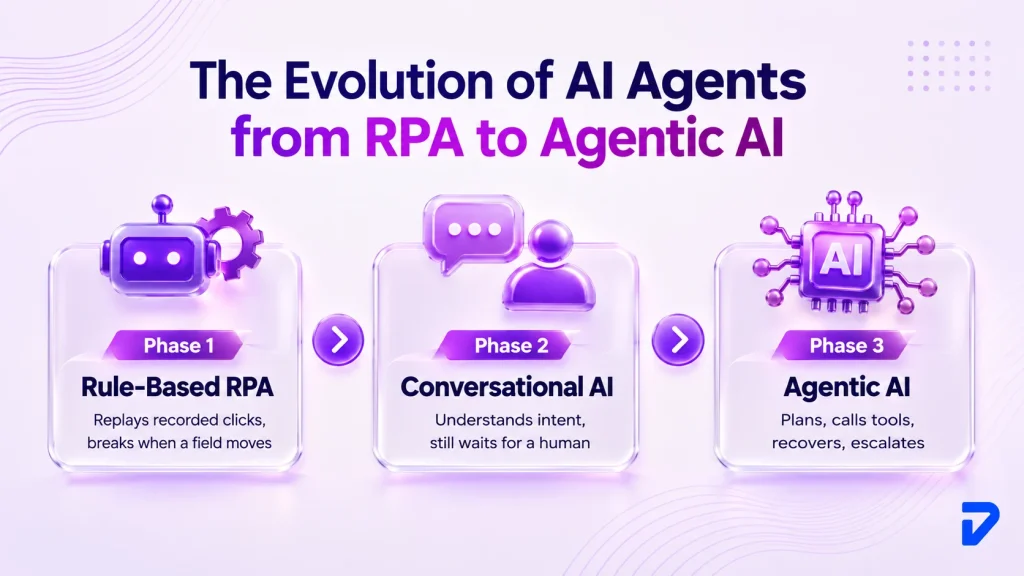
Agentic AI did not arrive from nowhere. It is the third answer to a question operations teams have asked for two decades: how do we get software to finish the work instead of assisting with it? Each earlier answer solved part of the problem and left a specific gap, and that gap explains what the current generation of AI agent platforms is built to close.
Phase 1: Rule-Based RPA and Scripted Bots
Robotic process automation recorded a human clicking through a screen and replayed those clicks at scale. For stable, high-volume, structured work such as invoice keying or system-to-system data transfer, it delivered real savings and still does. The limitation was brittleness. When the vendor moved a field or a PDF arrived in a new layout, the bot broke, and someone rewrote the script. RPA cannot reason about a change it has never seen.
Phase 2: Conversational AI and Copilots
Language models removed the brittleness by handling variation in natural language. Chatbots understood intent, and copilots drafted emails, summarized cases, and answered questions from a knowledge base. Even so, both stayed request-driven. The human still decided what to do next, then did it. Gartner captured the ceiling here: assistive AI improves a task, while 40% of enterprise applications will feature task-specific AI agents by the end of 2026, up from under 5% in 2025.
Phase 3: Agentic AI and Multi-Agent Orchestration
Current platforms close the loop. An agent receives a goal, drafts a plan, calls the tools it needs, checks its own output, and escalates when it hits a policy boundary. Multi-agent orchestration extends that to teams of specialized agents, where one retrieves, one decides, and one commits the transaction. The tradeoff is honest: you gain judgment on variable work and inherit the responsibility of governing something that can take real action.
How Do Agentic AI Platforms Work?
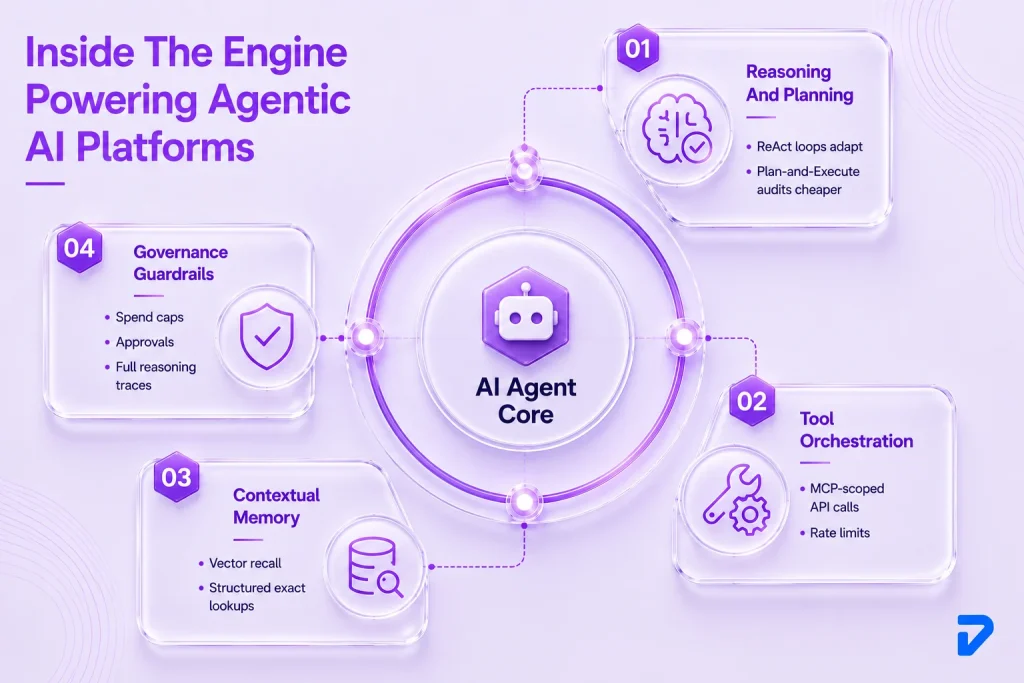
The Reasoning and Planning Engine
The planner decides what the agent does next. Most platforms implement a variant of ReAct, a loop where the model reasons about the situation, takes an action, reads the result, and reasons again. Plan-and-Execute is the alternative, drafting the full sequence upfront and then running it, which is cheaper and easier to audit but less adaptive. Think of ReAct as a driver reacting to traffic and Plan-and-Execute as a printed route. Your workflow decides which one you want, and the platforms that let you choose age better.
Tool Orchestration Layer (MCP Integration)
Tools are how an agent touches your business. Each one is registered with a schema, scoped to an OAuth permission or service account, and rate-limited at the boundary. The Model Context Protocol, an open standard for connecting AI systems to tools and data, has become the default here. Anthropic donated MCP to the Linux Foundation’s Agentic AI Foundation in December 2025, with more than 10,000 published servers and AWS, Google, Microsoft, and OpenAI backing the effort. That matters commercially. In practice, AI integration and governance work decides the timeline on these projects far more often than model choice does.
Contextual Enterprise Memory
Agents need continuity, and short-term memory holds the current task state. Long-term memory stores preferences and facts across sessions, usually split between a vector database for semantic recall and structured storage for exact lookups like account IDs or transaction history. Underneath sits a RAG pipeline: the system that fetches the right documents before the model answers, and chunking strategy affects accuracy almost as much as the embedding model itself. When teams complain that their agent hallucinated, the cause is usually retrieval quality, stale embeddings, poor chunk boundaries, or an index nobody refreshed recently.
The Governance and Security Guardrail
Guardrails define what the agent cannot do, no matter what its planner concludes. In practice, that means spend caps, blocked actions, role-based permission scoping, and human-in-the-loop approval above a defined risk threshold. A policy engine checks each action against rules before execution, while rate limiting and PII redaction handle runaway loops and data exposure. Every decision needs a full reasoning trace, not just a final output, or incidents become impossible to debug. Skip this layer, and you have a liability rather than a system, which is why AI agent observability practices belong in the build, not the retrofit.
What Are The Types of Agentic AI Platforms?
Developer-First Frameworks
These are code libraries that give engineers full control of the planning loop, state, and tool calls. LangGraph and CrewAI lead here. You get no ceiling on what you can build and no guardrails you did not write yourself. They suit teams with Python depth and a workflow too specific for a packaged product.
No-Code Platforms
Visual builders let operations staff assemble agents without writing code, dragging triggers and actions onto a canvas instead of touching an IDE. Microsoft Copilot Studio and IBM watsonx Orchestrate sit here, both aimed at business users rather than engineers. Time to first agent is measured in hours, not sprints, but complex branching logic eventually hits the wall of the visual canvas and needs custom code to escape it.
Automation-First Platforms
These began as workflow engines and grew agentic nodes. n8n is the clearest example. The mental model is a flow with an AI step inside it, not an agent that happens to run a flow. For deterministic processes with a judgment call in the middle, that framing is an advantage rather than a compromise. It maps closely to how workflow automation services get scoped in the mid-market.
AI-Native Operational Platforms
Purpose-built products own a single business outcome end-to-end rather than offering a general-purpose framework. Sierra and NiCE Cognigy own customer service; Salesforce Agentforce owns CRM-adjacent work, each baked with domain logic specific to that function. You trade flexibility for speed, prebuilt integrations, and a vendor accountable for the result, which suits teams that want an outcome, not an architecture to maintain.
AI Agent Platforms vs Frameworks vs Builders
Buyers use these three words interchangeably, and vendors are happy to let them. The categories carry different costs, different risks, and different failure modes.
| Dimension | Frameworks | Builders | Platforms |
| What you get | Code libraries | Visual canvas | Full managed stack |
| Who uses it | Python engineers | Ops and IT staff | Mixed teams |
| Control | Total | Limited by the canvas | Configurable, not open |
| Time to first agent | Days to weeks | Hours | Weeks, sales-led |
| Governance | You build it | Basic, built in | Audit-grade, built in |
| Hosting | Yours | Vendor cloud | Vendor or hybrid |
| Cost shape | LLM tokens only | Per credit or execution | Seats, usage, or outcomes |
| Fails when | Nobody owns upkeep | Logic outgrows the canvas | Your process is unusual |
The practical read is simple. Frameworks are cheapest at the license line and most expensive in engineering time. Builders are fastest to a demo and slowest to a complex production system. Platforms cost the most upfront and carry the least operational risk.
Top 8 AI Agent Platforms for Growing Businesses in 2026
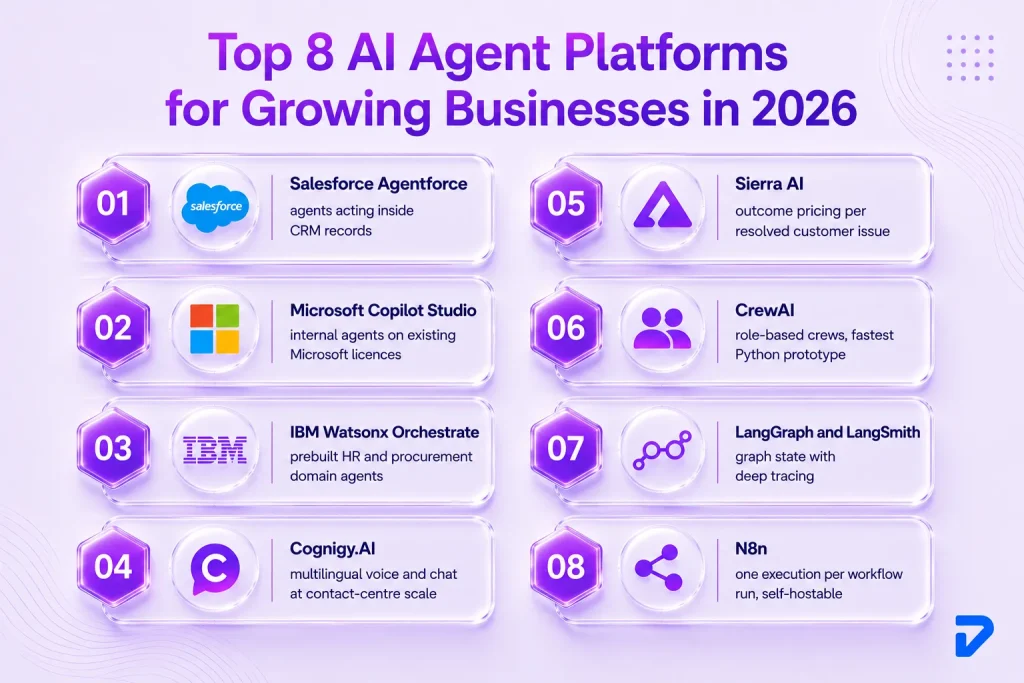
The eight AI agent platforms below cover all the categories above. Every price comes from each vendor’s own published materials from 2026 and often changes, so treat it as a shape rather than a quote.
Salesforce Agentforce
Agentforce embeds agents directly into CRM records, so an agent can update a case, retrieve an order, and finalize a reservation within the system of record. For Salesforce-native businesses, that proximity to clean data is the entire argument.
Pros
- Agents act on live CRM data with no integration project.
- Agent Builder and Prompt Builder are usable by admins, not just engineers.
- Digital Wallet gives real-time visibility into consumption.
- Voice, chat, and employee-facing agents share one credit pool.
Cons
- Serious grounding needs Data Cloud, which frequently exceeds the agent spend itself.
- Requires Enterprise Edition or above on the underlying platform.
- Consumption billing rewards low volume and punishes scale.
- Value collapses outside the Salesforce ecosystem.
Best For
Mid-market and enterprise teams already running Salesforce as their operational core.
Pricing
Salesforce prices Flex Credits at $500 per 100,000 credits, with a standard action costing 20 credits or roughly $0.10. A fixed $2 per conversation model remains available, and a free Foundations tier exists for testing.
Microsoft Copilot Studio
Copilot Studio is the natural first stop for any organization standing on Microsoft 365. Internal agents built for licensed Copilot users consume no additional credits, which makes the first deployment unusually cheap.
Pros
- Internal agents ride existing Microsoft 365 Copilot licenses at no additional cost.
- Native reach into Teams, SharePoint, and the Graph.
- Pay-as-you-go removes any upfront commitment.
- Bring-your-own-model support through Azure.
Cons
- Credit burn depends on agent design, ranging from 1 to well over 100 per response.
- External-facing agents always require standalone licensing.
- Azure compute and token costs land on a separate invoice.
- Cost forecasting is genuinely difficult before you measure.
Best For
Microsoft-first organizations automating internal helpdesk, HR, and IT workflows.
Pricing
Microsoft sells capacity packs of 25,000 Copilot Credits at $200 per month, or pay-as-you-go through Azure. Credits are consumed per action, not per message.
IBM Watsonx Orchestrate
Orchestrate is built for multi-agent work across enterprise systems rather than single-purpose bots. Its strength is the prebuilt domain library for HR, procurement, and sales, plus deployment on IBM Cloud, AWS, or on-premises.
Pros
- Prebuilt domain agents significantly shorten HR and procurement timelines.
- Deep connectors into SAP, Workday, ServiceNow, and Salesforce.
- Model choice across Granite, Llama, Mistral, and external gateways.
- On-premises deployment satisfies strict data residency rules.
Cons
- Entry pricing is high relative to comparable builders.
- Monthly active user billing makes successful adoption expensive.
- Advanced multi-agent configuration carries a real learning curve.
- Traction concentrates among existing IBM customers.
Best For
Regulated enterprises orchestrating agents across many back-office systems.
Pricing
IBM lists a free trial, then an Essentials tier starting around $500 per month with Standard priced on request. Usage is metered in monthly active users.
Cognigy.AI (NiCE Cognigy)
Cognigy is a contact-center-grade conversational and agentic AI platform with a long track record in enterprise with Lufthansa, Mercedes-Benz, and Bosch. Its position changed materially in 2025.
Pros
- Voice, chat, and messaging handled across more than 100 languages.
- Battle-tested in high-volume enterprise contact centers.
- Available standalone or inside the NiCE CXone Mpower platform.
- Balances fully agentic behavior with process-driven flows.
Cons
- The roadmap now sits within a larger CX suite strategy.
- Pricing is sales-led with nothing published.
- Scope is customer service, not general business automation.
- Partner relationships with rival CCaaS vendors add uncertainty.
Best For
Enterprise contact centers automating multilingual voice and digital service at scale.
Pricing
Not published. Note the ownership change: NiCE closed its $955 million acquisition of Cognigy in September 2025, and Cognigy continues to be sold as a standalone product.
Sierra AI
Sierra is the clearest expression of where agent economics are heading. It sells resolved customer issues rather than software, and it has grown quickly on that promise.
Pros
- Outcome-based pricing aligns vendor incentives with your results.
- Published resolution rates cluster around 65%-77% in real deployments.
- Voice, chat, email, SMS, and WhatsApp under one agent.
- High-touch implementation with dedicated support.
Cons
- Sales-led onboarding lasts four to ten weeks and includes no self-serve path.
- Third-party estimates put year-one budgets well into six figures.
- Customization often requires the vendor rather than your team.
- Resolution volume is hard to forecast, so bills move.
Best For
Large consumer brands with high support volume and a mandate to cut cost per contact.
Pricing
Outcome-based and unpublished. Co-founder Bret Taylor describes the model plainly: if the agent resolves the case with no human intervention, there is a pre-negotiated rate, and escalations are free.
CrewAI
CrewAI models agents as a crew with explicit roles, goals, and tools. A Researcher hands it to a Writer, who hands it to an Editor. The abstraction is the most readable in the Python ecosystem, which is why prototypes come together fast.
Pros
- Fastest time to a working multi-agent prototype.
- Open-source core runs on your infrastructure with no license cost.
- Role-based design is legible to non-specialists reviewing the logic.
- AMP adds a visual editor, tracing, and guardrails when you need them.
Cons
- Python only, which rules out many engineering teams.
- Every agent handoff burns tokens, so costs climb with crew size.
- Compliance certifications sit behind custom enterprise contracts.
- Managed tiers jump sharply between free and enterprise.
Best For
Python teams prototyping multi-agent workflows before committing to a managed platform.
Pricing
The framework is free and self-hostable. The managed AMP platform runs execution-based tiers with custom enterprise pricing, and CrewAI reports use by 63% of the Fortune 500. Your LLM tokens are billed either way separately.
LangGraph + LangSmith
LangGraph gives engineers explicit control of agent state as a graph, and LangSmith provides the tracing and evaluation layer around it. Together they are the closest thing to an engineering discipline for agents.
Pros
- Graph-based state handles loops, branches, and human approval cleanly.
- LangSmith tracing is the deepest debugging surface in the category.
- Evaluation datasets let you test an agent’s quality like you would software.
- The framework itself is open source and free.
Cons
- Trace-based billing scales with agent chattiness, not business value.
- Per-seat costs start before you log a single trace.
- Steepest learning curve of the eight.
- Self-hosted observability requires an enterprise contract.
Best For
Engineering teams building complex, stateful agents that must be debugged and evaluated rigorously.
Pricing
LangSmith offers a free Developer plan with 5,000 traces and a Plus plan at $39 per seat per month with 10,000 traces included. Overages and deployment runs are metered separately.
N8n
n8n comes at agents from the automation side. One execution is a single complete workflow run, regardless of step count, which makes it dramatically cheaper than step-billed alternatives for complex flows.
Pros
- Execution-based billing is far cheaper than per-step models at depth.
- The Community Edition is genuinely free and self-hostable with no execution cap.
- Over 400 integrations plus inline JavaScript and Python.
- AI agent nodes count as ordinary executions with no separate AI tier.
Cons
- Cloud plans stop workflows when the execution cap is reached.
- Polling workflows consume allowances far faster than teams expect.
- SSO, Git version control, and audit logs sit behind higher tiers.
- The interface assumes technical comfort.
Best For
Technical teams automating deterministic processes that need a judgment step in the middle.
Pricing
n8n prices cloud plans from a Starter tier with 2,500 monthly executions up to Business at 40,000, with unlimited users and workflows on every plan. The self-hosted Community Edition is free.
How to Choose the Best AI Agent Platform?
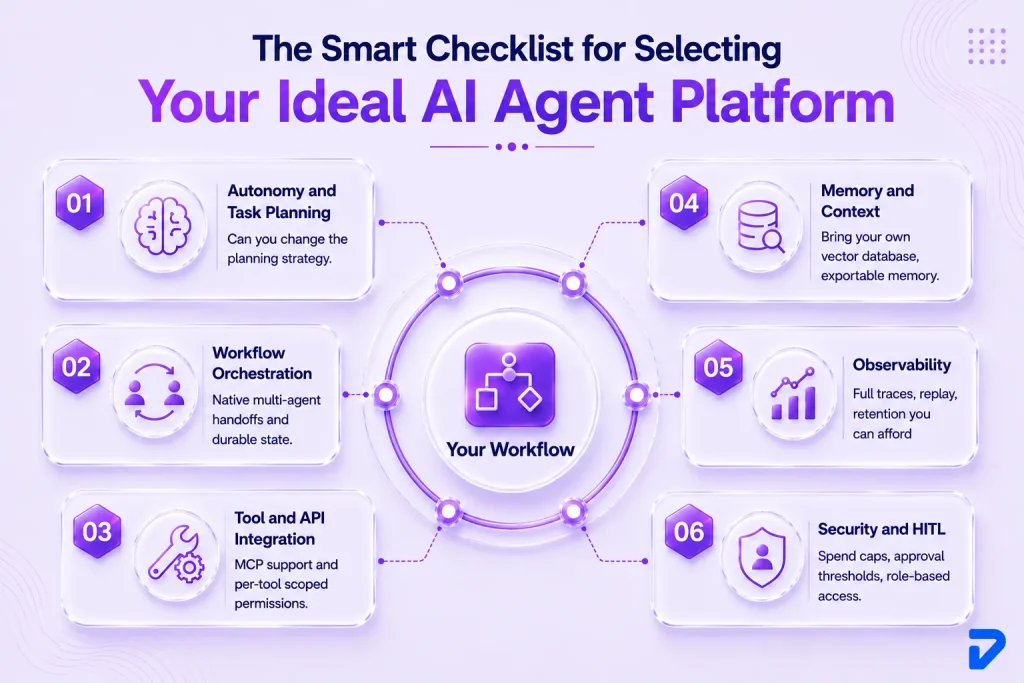
Autonomy & Task Planning
Ask how the planner works and whether you can change it. ReAct loops adapt to surprises and cost more tokens. Plan-and-Execute is cheaper and easier to audit. A platform that hides the planning strategy entirely is fine for packaged outcomes and risky for anything bespoke. Test it on your messiest workflow, not the clean one from the demo script.
Workflow Orchestration and Multi-Agent Support
Single agents handle single jobs. Real operations need handoffs, parallel branches, and a supervisor that decides who acts next. Check whether multi-agent support is native or bolted on, and whether state survives a restart. This is where developer-first frameworks pull ahead of visual builders, and where visual builders quietly hit their ceiling.
Tool & API Integration
The agent is only as capable as the systems it can reach. Count the prebuilt connectors to your actual stack, then ask about MCP support, because that determines whether your integrations are portable. Confirm that permissions are scoped per tool rather than granted wholesale. An agent with blanket write access to your ERP is a governance incident waiting for a date.
Memory & Context Handling
Check whether the platform separates short-term task state from long-term knowledge, and whether you control the retrieval layer. Bring-your-own vector database matters more than most buyers realize, since retrieval quality drives answer quality. Ask what happens to context across sessions, and whether stored memory is exportable if you leave.
Observability and Traceability
You cannot debug what you cannot see. Insist on full reasoning traces, tool-call logs with arguments and results, token and latency metrics, and replay. Then check the retention window and its cost, because trace pricing scales with how chatty your agent is rather than with how much value it delivers. Cheap observability that expires in 14 days is not observability.
Security, Governance & Human-in-the-Loop (HITL)
Define the approval thresholds before you build. Every serious platform should offer spend caps, blocked actions, role-based access, and a human checkpoint above a risk line you set. McKinsey found that high performers are far more likely to have defined human validation processes, at 65% compared with 23% for everyone else. Our AI consulting and roadmap work usually starts here, because governance decisions are cheapest to make before any code exists.
AI Agent Platform by Use Cases
Match the category to the job rather than the brand name. These pairings reflect where each type of platform earns its cost in practice:
- Customer service at volume: AI-native operational platforms such as Sierra or NiCE Cognigy, priced against resolution rates rather than seats.
- Internal helpdesk and HR: No-code builders such as Copilot Studio, where existing licenses already cover employee-facing agents.
- CRM-adjacent sales and service: Salesforce Agentforce, when your clean data already lives in the system of record.
- Back-office orchestration across SAP or Workday: IBM watsonx Orchestrate, for its prebuilt domain agents and connectors.
- Document extraction and quoting: Automation-first platforms such as n8n, where the flow is deterministic, and one step needs judgment.
- Research and analysis pipelines: CrewAI, because role-based crews map naturally onto how analysts divide work.
- Complex stateful workflows needing audit: LangGraph with LangSmith, where every branch and approval must be traceable.
- Regulated approvals with a human gate: Any platform with native human-in-the-loop, evaluated on its guardrails before its features.
What Industries Can Benefit from Enterprise AI Agentic Platforms?
Agentic AI pays back fastest where work is multi-step, data-rich, and currently done by people copying between systems. Five sectors fit that description particularly well, and they are the ones where our own client case studies focus.
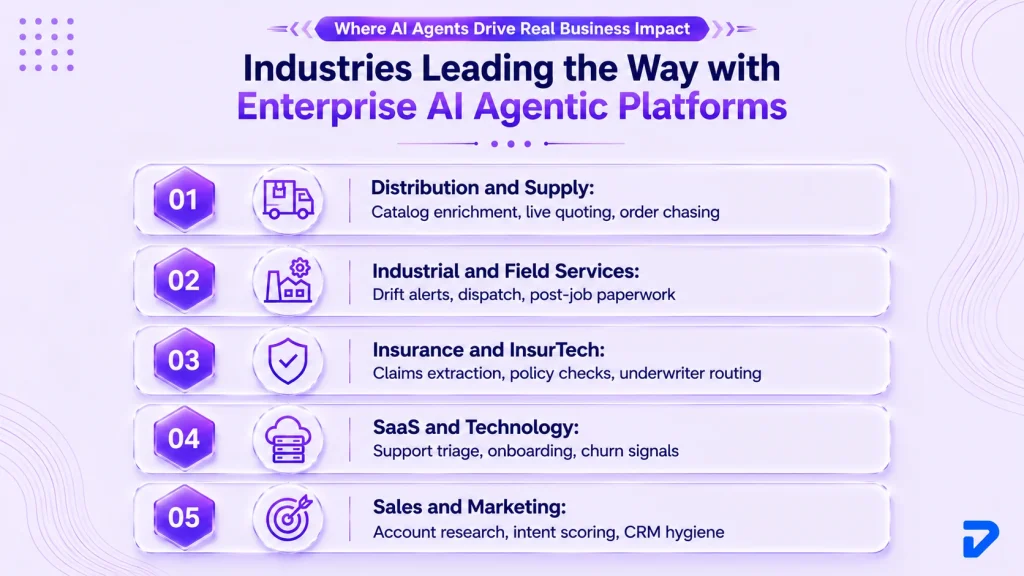
Distribution & Supply
Distributors run on catalogs, quotes, and exceptions. Agents enrich messy product data, generate quotes from a live price file, and chase order confirmations across supplier portals. The payback is measurable in quote turnaround and margin leakage. As the work is variable rather than scripted, RPA never fully solved it, which is exactly the gap agents fill.
Industrial & Field Services
Field operations lose hours to scheduling, parts lookups, and post-job paperwork. Agents read sensor data, flag equipment drift, book the right engineer with the right part, and file the report. Downtime avoided is the metric that matters here. Human-in-the-loop stays mandatory, since a wrong dispatch costs a truck roll and a customer relationship.
Insurance & InsurTech
Claims and underwriting are document-heavy, rules-bound, and full of judgment calls. Agents extract data from submissions, check policy conditions, price risk against guidelines, and route anything unusual to a human underwriter. Cycle time drops sharply. Regulatory exposure makes traceability non-negotiable, so observability and audit trails belong in the first sprint rather than the second phase.
SaaS & Technology
Software teams deploy agents against their own operations first. Support triage, onboarding, churn signals, and internal knowledge retrieval all reward agents that act rather than answer. Technical staff also considerably shorten the build cycle. The risk is the opposite of most sectors: teams over-engineer agents for workflows a simple rule engine would have handled cheaply.
Sales & Marketing
Pipeline work is repetitive at the top and judgment-heavy at the close. Agents research accounts, score intent across data sources, personalize outreach, and keep CRM records up to date without a rep touching a form. Reply rates and lead-to-contact time move first. Guardrails matter because an agent emailing your market at scale can quickly damage a brand.
The Bottom Line
The best agentic AI platforms in 2026 are the ones that survive your workflow, not the ones that win a demo. Frameworks give control and hand you the upkeep. Builders give speed and hit a ceiling. Operational platforms give outcomes and cost the most upfront. There is no universal winner, only a right answer for a specific process, a specific stack, and a specific tolerance for risk. Score candidates on planning, orchestration, integration, memory, observability, and governance before you look at the price sheet.
Pinnasys measures success in hours saved and errors reduced, not demos. Our agentic AI development services cover architecture, guardrails, and live operations. Bring us your hardest workflow, and we will tell you honestly whether an agent is the right tool for it. Book a 30-minute free consultation with the industry’s top AI experts.
Key Takeaways from the Article
- Gartner expects a third of enterprise software to include agentic AI by 2028.
- Frameworks cost less in licenses and far more in engineering time.
- MCP support decides whether your integrations stay portable across vendors.
- Trace and credit billing scales with agent chattiness, not delivered business value.
- Governance and human-in-the-loop belong in the build, never the retrofit.
Frequently Asked Questions
Can AI agents from different platforms work together?
Yes, through open protocols. MCP standardizes tool access, and Agent2Agent handles inter-agent messaging. Cross-vendor coordination works in practice, though error handling and shared state across vendor boundaries remain the hardest parts to get right.
How long does a typical agentic AI deployment take?
No-code builders produce a working internal agent in hours. Production deployments with real integrations, guardrails, and testing typically run six to twelve weeks. Sales-led enterprise platforms often quote four to ten weeks for onboarding alone.
Do agentic AI platforms require a data warehouse first?
Not always, but retrieval quality decides agent quality. Agents can read directly from APIs and documents. Fragmented or duplicated source data produces unreliable output regardless of which platform or model you select.
What team do you need to run agents in production?
Plan for an owner accountable for outcomes, an engineer for integrations, and a reviewer handling escalations. Without a named owner after launch, agents drift silently, and quality degrades before anyone notices.
Are open-source agent frameworks safe for regulated industries?
They can be, but compliance is your responsibility. Self-hosted frameworks keep data in your environment, which helps. You must build the audit logging, access controls, and certifications that commercial platforms include by default.





Prakash C. Saini
Prakash Saini is the Founder & CEO of Pinnasys. With over a decade in digital transformation and building production systems, he grew an engineering team from 2 to 50 people and has led the delivery of 100+ production digital systems. Products built under his leadership have raised millions in funding and generated over $50 million in revenue. He holds an Executive MBA from IIM Kozhikode and today leads the AI engineering team at Pinnasys.