



Distribution teams lose nearly a full workday every week hunting product specs, certifications, and supplier data across disconnected systems. AI knowledge search for distribution fixes that by connecting every document into one intelligent, searchable layer.
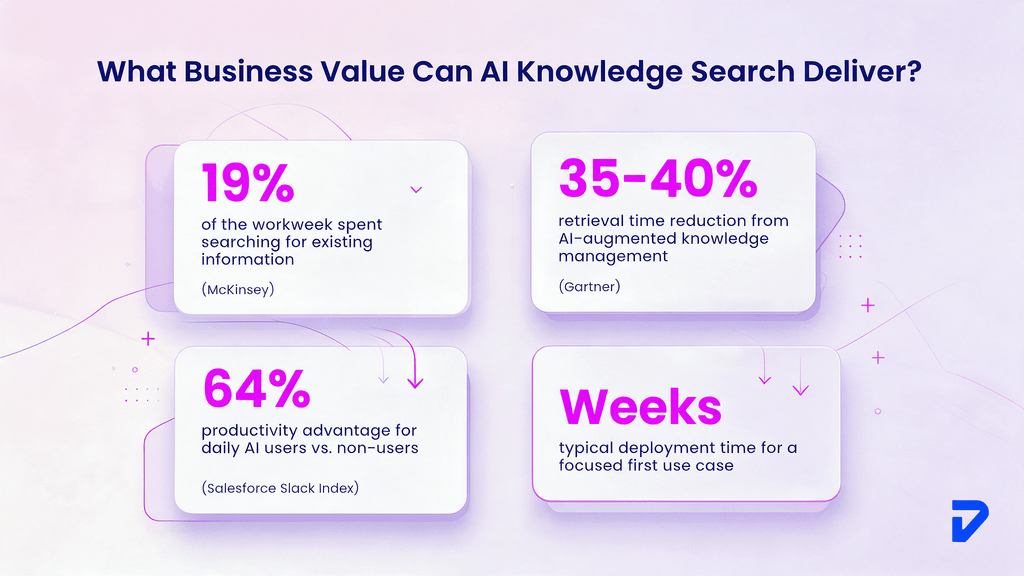
McKinsey research found that employees spend 19% of the workweek, roughly 7.5 hours per person, searching for and gathering information that already exists somewhere inside their organization. For distribution companies, that number lands harder than average. Product catalogs run to tens of thousands of SKUs. Compliance certifications expire and get replaced. Supplier documentation spreads across email threads, shared drives, and legacy ERP attachments.
The result is a daily information problem that costs real hours and slows the decisions that keep customers and auditors satisfied. AI knowledge search for distribution is the architecture that changes this, and this guide explains how it works, where it creates the most value, and how to start.
Why Distribution Companies Have a Harder Information Problem Than Most Industries
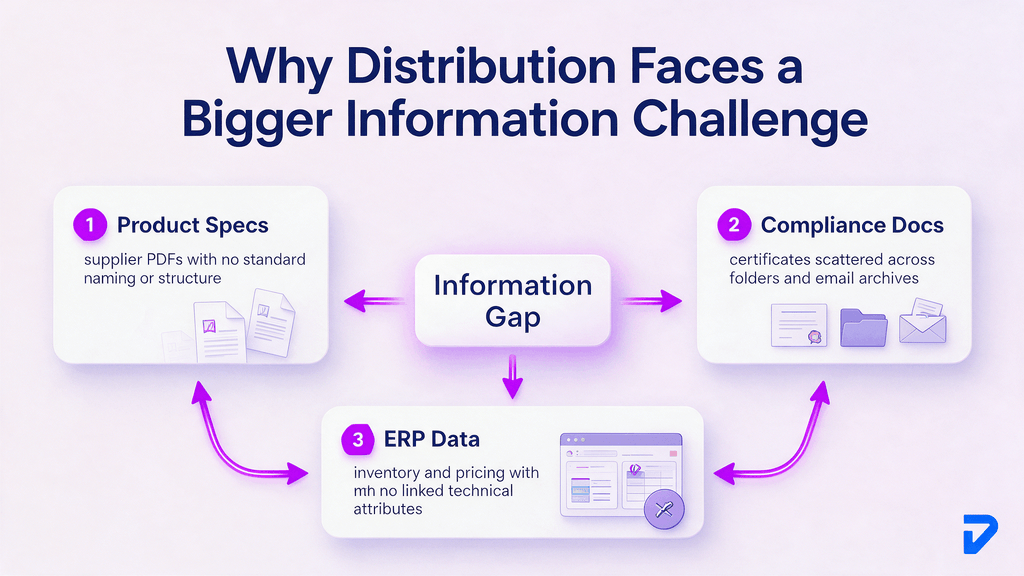
The information challenge in distribution is not about volume alone. It is about structure, or the lack of it. A manufacturer maintains product data in one system. A retailer manages a relatively stable SKU catalog. A distributor sits between dozens of suppliers and thousands of customers, ingesting documentation from every direction in formats that were never designed to talk to each other.
The Three Sources of Information Fragmentation
Product specification sheets arrive as supplier PDFs with no standardized naming convention. Compliance documents, including Safety Data Sheets, CE certificates, and UL listings, live in certification management folders that only a few people know how to navigate. ERP systems hold pricing and inventory data but rarely surface the technical attributes a sales rep needs to answer a customer’s spec question on a call.
When those three layers stay separate, every product question becomes a scavenger hunt. A customer asks whether a particular valve meets a specific pressure rating, and the rep searches three drives, messages a product manager, and waits. Salesforce’s Slack Workforce Index found that workers who access information efficiently through AI tools report 64% higher productivity than colleagues who do not. The inverse of that finding is the cost distribution companies absorb every day their search stays broken.
Why Traditional Enterprise Search Falls Short
Keyword-based enterprise search was built for document retrieval, not knowledge retrieval. It finds files that contain your search term. It does not understand that “max operating pressure” and “pressure rating” describe the same attribute, or that a search for “RoHS compliance” should surface the certificate, the declaration of conformity, and the engineering note that lists exemptions. Semantic search, the ability to understand intent rather than match strings, is what separates AI-powered retrieval from a file index with a search bar.
What AI Knowledge Search for Distribution Actually Does
AI knowledge search is an enterprise retrieval system that combines semantic understanding, knowledge graph structure, and permission-aware access to let any authorized user find the right information in natural language, regardless of where that information lives or what format it takes.
Semantic Search vs. Keyword Search: The Practical Difference
Semantic search (the system that understands the meaning of a query, not just its words) closes the gap between how people ask questions and how documents are written. A buyer asks, “What is the maximum ambient temperature for this controller?” The keyword search returns every document containing “temperature.” The semantic search reads the product datasheet, finds the relevant specification, and surfaces the exact value with a source citation. For a distribution team handling thousands of spec queries per month, that difference compounds into hours.
The Role of a Knowledge Graph in Product Data
A knowledge graph connects entities: a product, its attributes, the supplier that makes it, the certifications it carries, and the customer verticals it serves. When that graph underlies your search layer, a query about one entity automatically surfaces related knowledge. Searching for a product brings up its current compliance status without a separate search. The graph makes the implicit relationships in your data explicit and navigable.
| Traditional Enterprise Search | AI Enterprise Search |
| Keyword matching | Semantic intent understanding |
| Returns documents | Returns answers with source citations |
| Searches indexed text only | Ingests PDFs, ERP data, emails, wikis |
| No relationship mapping | Knowledge graph connects related entities |
| No permission logic | Permission-aware retrieval by role and team |
| Static index | Continuously updated as documents change |
How Permission-Aware Retrieval Protects Sensitive Data
Not every search result should reach every employee. Sales reps do not need cost-of-goods data. Customer service agents should not access supplier negotiation files. Permission-aware search enforces existing access controls at the retrieval layer, so the system returns only results the querying user is authorized to see. This is particularly important for compliance documents that carry regulatory sensitivity and for supplier contracts that affect commercial relationships.
How AI Enterprise Search Works in a Distribution Environment
The architecture behind enterprise AI search for distribution involves five connected layers, each solving a specific part of the information problem.
Document Ingestion and Knowledge Indexing
The first step is connecting data sources: product information management (PIM) systems, ERP platforms, shared drives, supplier portals, email archives, and any legacy document store the team depends on. Modern connectors handle common formats (PDF, Excel, Word, CSV) without manual re-entry. Documents are chunked into retrievable segments, which means the system does not return a 40-page catalog; it surfaces the two paragraphs relevant to the query.
Embeddings, Vector Search, and RAG Pipelines
After ingestion, each document chunk is converted into a vector embedding (a numerical representation of its semantic meaning) and stored in a vector database. At query time, the user’s question is also embedded and compared against stored vectors to find the closest semantic matches. A RAG pipeline (retrieval-augmented generation: the system that fetches the right documents before the model answers) then passes those matched chunks to a language model, which synthesizes a grounded, cited response. The answer comes from your actual documents, not from a model’s general training data.
Keeping the Knowledge Layer Current
Static indexes go stale. A compliance certificate expires. A supplier updates a datasheet. New SKUs arrive weekly. Production-grade AI knowledge search runs continuous or scheduled re-indexing so the retrieval layer reflects current documentation, and surfaces version metadata so users know when a document was last updated.
Need faster access to product and compliance information?
Pinnasys builds AI knowledge search across your core business systems.
Enterprise AI Search Use Cases in Distribution
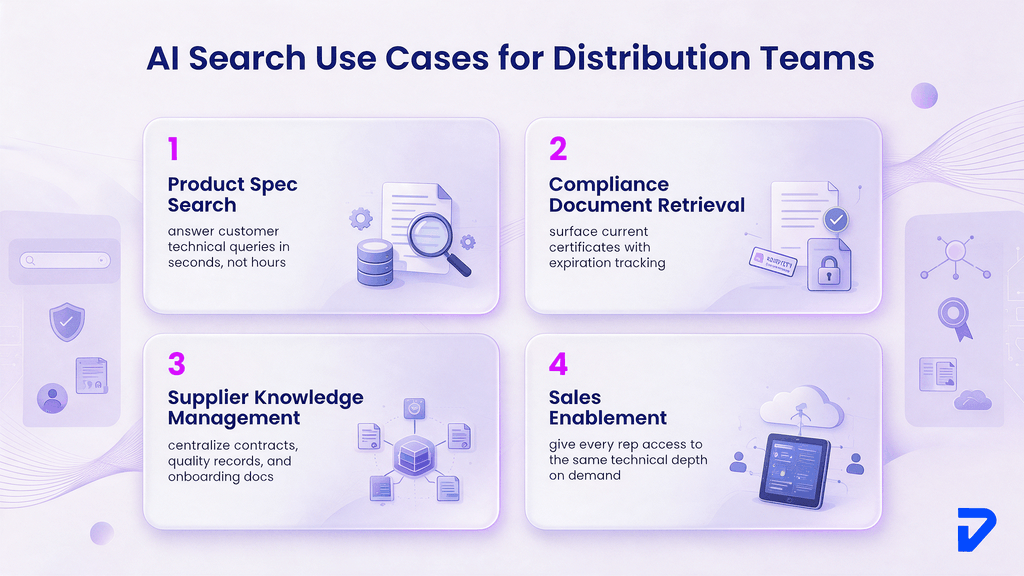
The value of AI enterprise search concentrates in six specific workflows where information fragmentation causes the most daily friction.
Product Specification Search
A rep on a customer call cannot wait three hours for a product manager to confirm a pressure rating. With a searchable knowledge layer, that query resolves in seconds: the rep types the product name and the attribute in question, and the system returns the value with a citation to the source datasheet. When a distribution business carries 50,000 SKUs across hundreds of suppliers, this use case alone justifies the build.
For B2B distributors specifically, spec search extends to product comparison. A buyer asks which of three similar products meets a given IP rating and operating temperature range. The AI search layer runs that comparison across the relevant datasheets and returns a structured answer, rather than forcing the rep to open three PDFs and read them side by side.
Compliance and Certification Document Search
Compliance document retrieval is arguably the highest-stakes search use case in distribution. An expired certificate during an audit is not just an embarrassing gap; it is a liability. AI knowledge search solves two problems here. First, it makes current certificates findable by product, supplier, standard, and expiration date, without anyone maintaining a manual tracker. Second, it surfaces version history so teams can show auditors exactly which certificate was current at a given date. For distributors handling hazardous materials, food-grade products, or electrical components, this capability is not optional.
Supplier and Vendor Knowledge Retrieval
Every supplier relationship generates a body of knowledge: contracts, lead time commitments, quality records, onboarding documentation, and correspondence about exceptions and substitutions. That knowledge usually lives in the inbox of whoever manages the relationship. When that person leaves or is unavailable, the institutional knowledge goes with them. A shared, searchable supplier knowledge base means any authorized team member can retrieve the relevant context for a negotiation, an escalation, or a new supplier evaluation.
Technical Documentation and Sales Enablement
Sales engineers at distribution companies spend a disproportionate share of their time answering technical questions that are already answered somewhere in the document library. AI-powered enterprise search reduces that load by giving the full sales team access to the same technical depth, surfaced on demand. The result is faster customer responses, more confident reps, and less dependency on specialists for routine queries.
How to Get Started With AI Knowledge Search for Distribution
Most distribution companies that succeed with AI enterprise search start narrower than they think they should. A company-wide rollout of a knowledge platform touches every department, every document type, and every data source at once. That scope is manageable eventually, but it is not how you build something that gets used.
Identify the Highest-Pain Search Problem First
The right starting point is the search failure that costs the most time or the most risk. For many distributors, that is product spec lookup, where every unanswered customer query is a potential lost sale. For others, it is compliance documentation, where a missed certificate is a regulatory exposure. Pick one problem, map the documents that answer it, and build the retrieval layer around those sources first.
Audit Your Knowledge Sources Before You Index Anything
A search layer is only as good as the documents behind it. Before building, audit the sources you plan to connect: How current are the datasheets in your shared drive? Are compliance certificates stored consistently, or scattered across three folders and an email archive? Which ERP fields actually contain useful product attributes versus legacy codes no one decodes anymore? A pre-build audit typically surfaces both the gaps and the quick wins.
The Implementation Sequence That Works
Start with a focused use case, connect the right data, and test the system with one team. Measure the results before expanding to new sources, users, and workflows. The phases below outline this implementation sequence.
| Phase | Focus | Outcome |
| 1. Discovery | Map document sources, identify the primary use case, audit data quality | Clear scope, no surprises |
| 2. Ingestion | Connect sources, ingest and chunk documents, configure permissions | Indexed, searchable knowledge base |
| 3. Pilot | Deploy to one team (inside sales, product management, or compliance) | Real usage data, early ROI signal |
| 4. Measure | Track query volume, time-to-answer, and user satisfaction | Evidence base for expansion |
| 5. Expand | Add document sources, user groups, and use cases in waves | Controlled growth, sustained adoption |
This phased approach connects directly to the broader question of AI integration for distribution, particularly how search layers fit alongside ERP connectors, WMS data feeds, and existing workflow automation.
What ROI Can Distribution Companies Expect From AI Knowledge Search?
Gartner projects that by 2026, AI-augmented enterprise knowledge management will reduce average information retrieval time by 35 to 40% compared with traditional search. For distribution teams, this can translate into measurable productivity gains
The ROI case for mid-market distributors rests on four measurable outcomes:
- Faster customer responses: Reps can find product specifications and answers within seconds instead of hours. Faster responses can help shorten sales cycles and improve customer service
- Reduced compliance risk: Centralized search makes current certificates, specifications, and regulatory documents easier to find. This reduces the risk of using outdated or incorrect information
- Recovered productive time: Faster information retrieval reduces the time employees spend searching across disconnected systems. The recovered time can be redirected toward sales, operations, and customer work
- Lower dependency on specialists: Employees can find technical and compliance information without relying on a small group of specialists. This helps distribute knowledge across sales, product, and operations teams
Choosing an AI Search Solution for Distribution
Not every AI search platform is designed for the information environment a distributor operates in. The right solution needs to work with distribution-specific data, return reliable answers, and fit existing security and governance requirements.
Integration With Distribution-Specific Data Sources
A general-purpose search tool that indexes SharePoint files may not be enough. Product data could live in a WMS, compliance certificates in supplier portals, and technical specifications across supplier PDFs and PIM exports. The right solution connects these sources through native connectors or APIs, keeping the search index current without manual re-entry.
Accuracy, Source Citations, and Hallucination Controls
A wrong product specification can create more than a search problem. It can lead to an incorrect recommendation, failed installation, or damaged customer relationship. AI search should return answers grounded in source documents, with citations that let users verify the information before acting on it. This makes the system more useful for technical and customer-facing teams.
Security, Governance, and Scalability
The AI governance and integration layer surrounding a knowledge platform matters as much as search quality. Access controls should follow existing permissions rather than creating another system to manage. Audit logs should capture searches and retrieved information for monitoring. The platform should also handle growing document volumes without compromising retrieval quality.
The Bottom Line
Pinnasys builds AI knowledge search for distribution, connecting product catalogs, compliance libraries, supplier documentation, and ERP data in one permission-aware retrieval layer. Teams spend less time searching and more time responding to customers, selling, and making informed decisions.
For mid-sized distributors, the starting point is not a company-wide search platform. Identify the information failure that costs the most time or creates the most risk, build around that workflow, measure the results, and expand from there.
When you are ready to define that first layer, Pinnasys starts with your actual document environment through its AI consulting services.
Key Takeaways from the Article
- Employees spend 19% of the workweek searching for information that already exists inside their organization.
- Semantic search understands query intent; keyword search only matches strings in documents.
- A RAG pipeline grounds every answer in your actual documents and provides verifiable source citations.
- Starting with one high-pain search problem, such as product spec lookup or compliance retrieval, is faster and more effective than a company-wide rollout.
- AI knowledge search creates value through faster customer responses, lower compliance risk, and recovered productive time.
FAQs About AI Search for Distribution
How do distribution companies use enterprise AI search?
Distribution companies use enterprise AI search for product specification lookup, compliance certificate retrieval, and supplier knowledge management. A searchable knowledge layer helps authorized team members find the right information quickly without relying on specialists for routine technical or documentation queries.
What are the best enterprise AI search use cases in distribution?
Key use cases include product specification search, compliance document retrieval, and supplier knowledge management. These applications help teams find technical information, verify documentation, and access supplier records without searching across disconnected systems and folders.
How do I get started with AI knowledge search for my distribution business?
Start by identifying the search problem that consumes the most time or creates the greatest operational risk. For AI knowledge search for distribution, audit the documents and systems involved, connect relevant sources to a semantic search layer, and pilot the solution with one team. Measure time-to-answer and expand once the workflow works reliably.
What ROI can distribution companies expect from enterprise AI search?
ROI can come from faster customer responses, less time spent searching for information, reduced reliance on subject-matter specialists, and easier access to compliance and supplier documentation. The actual return depends on the search volume, document environment, user adoption, and processes included in the implementation.
Is enterprise AI search worth it for a mid-sized distribution business?
It can be, particularly when the starting scope is focused. Instead of attempting to create a company-wide knowledge platform immediately, a distributor can begin with one document type or workflow, such as product datasheets or compliance certificates. This makes it easier to validate the search experience and measure its operational value before expanding.
Which enterprise AI search vendors work with distribution companies?
Vendor capabilities vary in their support for distribution-specific data sources such as PIM systems, ERP platforms, document repositories, and supplier portals. Evaluate solutions based on their ability to connect to your existing environment, respect permission structures, retrieve relevant information, and provide source citations with answers.





Prakash C. Saini
Prakash Saini is the Founder & CEO of Pinnasys. With over a decade in digital transformation and building production systems, he grew an engineering team from 2 to 50 people and has led the delivery of 100+ production digital systems. Products built under his leadership have raised millions in funding and generated over $50 million in revenue. He holds an Executive MBA from IIM Kozhikode and today leads the AI engineering team at Pinnasys.