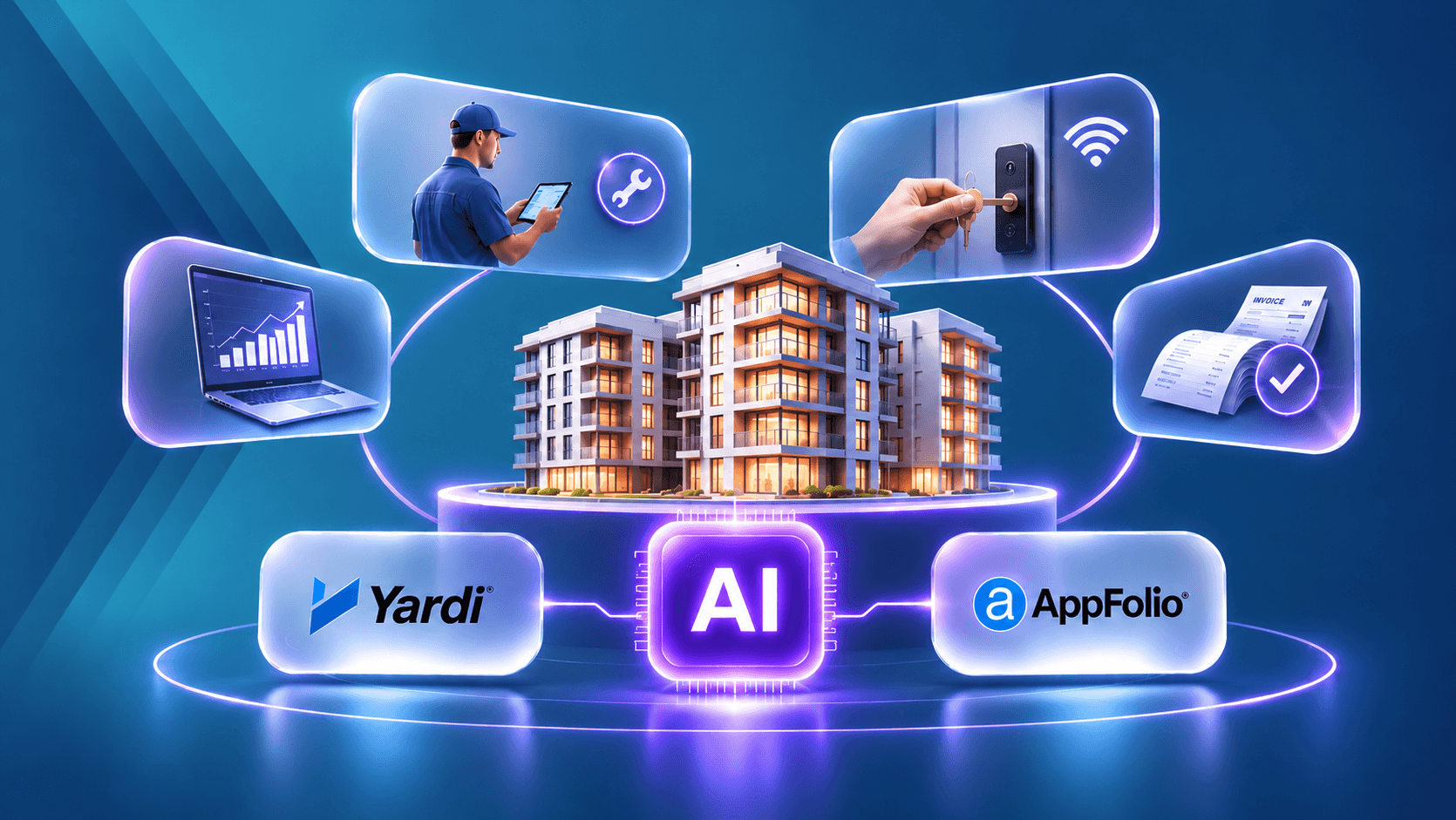
AI for property management works best when it reads from and writes back to Yardi or AppFolio. Lead replies, maintenance triage, resident messaging, and owner reporting deliver the most value, with humans approving exceptions.
AI use among property managers jumped from 21% to 34% in a single year, according to AppFolio’s 2025 Property Management Benchmark Report. Even so, much of that use still happens in a browser tab beside the system of record. A leasing agent drafts a reply in ChatGPT, then retypes the tour time into Yardi.
Meanwhile, a coordinator reads a resident’s late-night text and rebuilds it as an AppFolio work order the next morning. That copy-and-paste gap decides whether AI for property management saves hours or simply moves them around. The use cases below work because they read live data and write results back. That is also why AI for real estate operators should start with the integration, not the chatbot.
Why Property Management Teams Feel the Squeeze
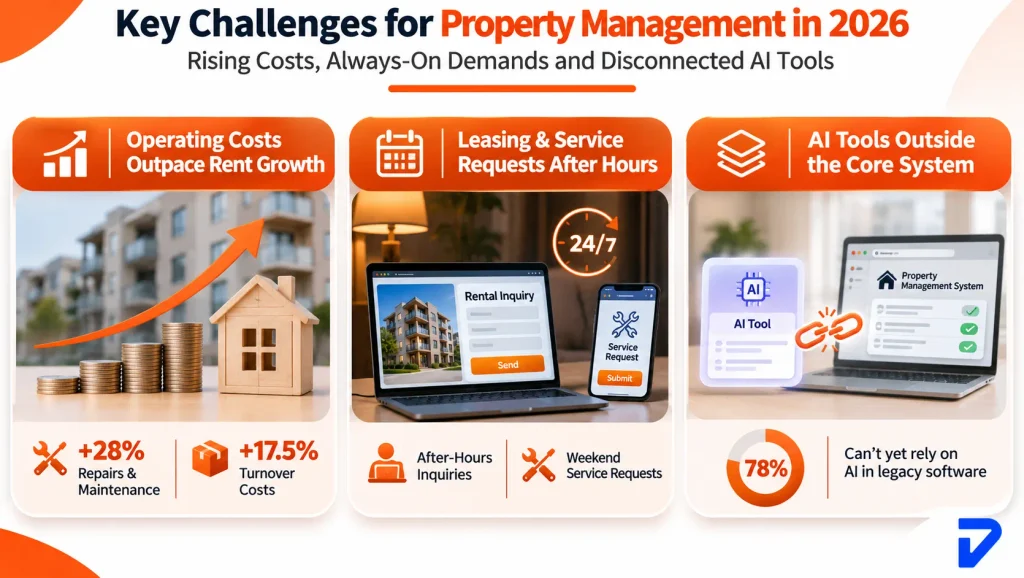
Most operators already use some AI, yet very few run it across the whole business. NAA’s industry pulse research on AI found 57% of companies were adopting AI, while only 6% used it across multiple functions. In other words, AI for property management has stayed in pockets, mostly because three pressures pull teams in different directions at once.
Operating Costs Are Rising Faster Than Rents
Expense growth keeps outrunning rent growth across multifamily portfolios. NAA’s Dollar of Rent analysis shows repairs and maintenance costs rose nearly 28% since 2021, and turnover costs jumped 17.5% in 2024. As a result, every avoidable truck roll and lost renewal now hits net operating income harder. One preventable move-out can erase a year of vendor savings.
Leasing and Service Requests Arrive After the Office Closes
Prospects and residents keep their own hours, not the leasing office’s. Renters browse listings after dinner, and pipes tend to burst on weekends. Consequently, a Saturday-night inquiry often waits in a shared inbox until Monday, when the prospect has already toured elsewhere. Voicemail rarely rescues the lead, because many callers simply hang up and try the next community.
AI Tools That Sit Outside the System of Record
Plenty of property management AI arrives as a separate login holding a stale copy of your data. In AppFolio’s 2026 survey of 1,617 professionals, 78% said they cannot yet rely on AI in legacy software. As a result, staff end up double-keying answers while the bot confidently quotes yesterday’s availability. Trust erodes once a prospect is promised a unit that is already leased.
What Property Management Tasks Can AI Automate Today?
Leasing Inquiries, Tour Booking, and Follow-Up
The leasing desk is usually the first win because inquiry volume is high and most answers repeat. An AI agent checks live availability, books the tour, and logs the guest card without staff involvement. Pet, parking, and deposit questions are answered from your policy documents through AI knowledge search, not guesswork. Your team then focuses on tours and serious applicants.
Can AI Handle Maintenance Requests End to End?
For routine issues, yes, and residents largely agree. HappyCo’s resident research found 53% are comfortable using AI for routine maintenance, yet 82% want a human first for urgent problems. Well-built AI maintenance requests therefore ask follow-up questions, collect a photo, and open a prioritized work order. Emergencies escalate to on-call staff through workflow automation instead of waiting.
AI Tenant Communication for Rent, Renewals, and Notices
Residents ask the same monthly questions about balances, late fees, and lease end dates. AI tenant communication answers these from the live ledger and sends rent collection reminders before the due date. It also drafts renewal outreach in each resident’s language. A conversational AI layer logs every exchange to the resident record for the next staff member.
Reporting and Owner Updates From Live Data
Month-end owner packets often cost an accountant several days of exports and commentary. Instead, AI pulls the rent roll, delinquency, and work order spend, then drafts variance notes. Operators who want forward-looking signals, such as renewal risk or expense trends, usually extend this into decision intelligence and analytics. In every case, a person approves each report before owners see it.
Does AI Work With Yardi and AppFolio?
Yes, AI works with both platforms through three routes: native features, certified partner integrations, and custom connections built on partner APIs. The right route for AI for property management depends on how much of the workflow you need to control. Custom AI agents built for your workflows make sense once native tools stop short of your actual process.
| Route | Yardi | AppFolio | Best fit |
|---|---|---|---|
| Native AI | Virtuoso agents, Chat IQ, Smart AP | Realm-X, Realm-X Flows, Realm-X Performers | Standard workflows and a fast start |
| Certified partner integrations | Standard Interface Partnership Program | AppFolio Stack marketplace | Point tools for maintenance, screening, or payments |
| Custom AI on partner APIs | Licensed interfaces per data type | Stack API through approved partners | Multi-system workflows and custom rules |
How Native Yardi AI Works Today
Yardi AI now runs through Virtuoso, its agent platform for real estate operations. Per Yardi’s June 2026 announcement, multifamily agents cover leasing, resident services, maintenance, and accounting. Chat IQ handles lead nurturing, tour scheduling, and payment reminders, while inspection agents review walkthrough videos to flag repairs. Because these agents run on Yardi data, setup is mostly configuration, not integration.
How Native AppFolio AI Works Today
AppFolio AI centers on Realm-X, with Flows for defined processes and Performers for leasing, maintenance, and accounting work. In June 2026, AppFolio also connected Realm-X to Anthropic’s Claude through an agent-to-agent connector. Managers can now trigger reporting, reconciliation, or listing updates from Claude, while every action still follows AppFolio permissions. That design keeps the system of record firmly in charge.
Connecting Custom AI Through Yardi Interfaces
When native agents cannot follow your process, custom AI connects through Yardi’s partner program instead. Under Yardi’s interface partner requirements, each interface type needs its own data exchange agreement and an annual license fee. That makes scoping the exact records the AI reads and writes, such as work orders or guest cards, the first step of any build.
Connecting Custom AI Through AppFolio Stack
AppFolio routes third-party connections through AppFolio Stack, its certified integrations marketplace. AppFolio’s Stack partner program notes that the platform serves over 20,000 customers and more than 8 million units. Partners gain API access only after review, which keeps integrations consistent. For custom AI, confirm early which endpoints support write-back on your plan, since that sets how far automation goes.
Still retyping AI answers into Yardi or AppFolio by hand?
Pinnasys builds AI integrations that read and write inside your property management system, so leasing, maintenance, and resident work closes the loop automatically.
Before and After AI for Property Management Workflows
The clearest way to judge any AI project is to compare the same workflow side by side. Here is how five daily tasks change once AI reads from and writes back to your property management system.
| Workflow | Before AI | After integrated AI | Metric moved |
|---|---|---|---|
| After-hours leasing inquiry | Voicemail, reply next business day | Instant answer, tour booked in the PMS | Speed to lead, tour rate |
| Maintenance request | Vague ticket, phone tag for details | Guided intake with photos and priority | Work order cycle time |
| Balance question | Staff pull the ledger, reply manually | AI answers from the live ledger | Staff hours, delinquency rate |
| Vendor invoice | Keyed by hand, coded later | OCR captures and codes it for approval | Invoice processing time |
| Owner report | Spreadsheet exports, written notes | Drafted from live data, human-reviewed | Days to close the month |
Notice that every “after” column depends on clean, connected data. If unit records, vendor lists, or charge codes are inconsistent, the AI simply repeats those errors faster. Experienced teams therefore treat AI data pipelines as part of the build rather than a cleanup project for later.
How Do Residents Respond to AI?
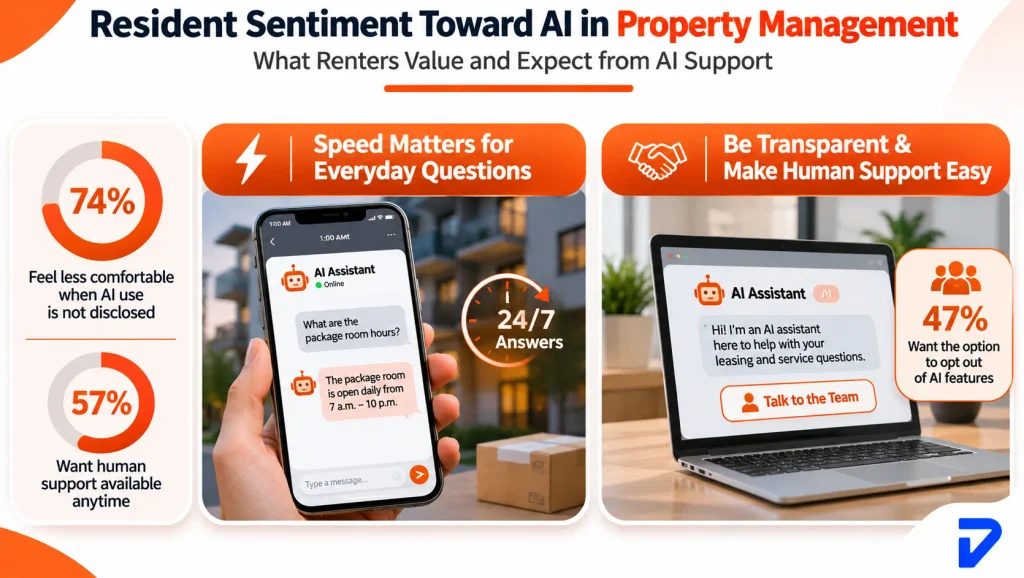
Residents respond well to AI that is fast, honest, and easy to bypass, and poorly to AI that hides or traps them. The Rently 2025 Report on AI in Leasing found 74% of renters feel less comfortable when AI use is not disclosed. The same survey found 57% want human support available anytime.
Speed Wins for Routine Questions
On everyday questions, residents care more about getting a correct answer than about who provides it. A 1 a.m. reply about package room hours or a current balance beats a next-day callback. That said, the answer must come from live data. One wrong balance damages the resident experience more than a slow human reply ever would.
Disclosure and an Easy Human Handoff
Label the assistant as AI in its first message, and offer a human option in every thread. Rently’s survey also showed that 47% of renters want to opt out of AI features. A simple “talk to the team” button preserves that trust without routing every question to staff. Residents who value speed will keep using the assistant anyway.
Which Property Management KPIs Does AI Actually Move?
Results from AI for property management should be judged on the same KPIs your owners already read. On the leasing side, AppFolio’s Bluestone Leasing Performer case study offers a useful benchmark from a 3,000-unit Pacific Northwest portfolio. Measure your own baseline first, then track each number monthly.
| KPI | How AI Moves It | Evidence or Benchmark |
|---|---|---|
| Speed to lead | Replies in seconds, day or night | Under 9 seconds across 9,865 Bluestone leads, 55% after hours |
| Lead-to-application conversion | Consistent follow-up on every guest card | 30%+ lead-to-applicant conversion at Bluestone |
| Invoice processing time | OCR capture and automatic coding | 86% less processing time at KETTLER with Yardi Smart AP, per Yardi’s release |
| Renewal rate | Faster answers, with humans kept reachable | 11-point higher renewal intent where human support stays available, per HappyCo |
| Work order cycle time | Complete intake and the right vendor on first dispatch | Baseline your own, then track first-time fix rate |
| Delinquency rate | Earlier, personalized rent reminders | Baseline your own, then compare reminder cohorts |
Where a row has no public benchmark, run a 60-day test on one property before scaling. A similar control site, measured alongside the pilot, keeps seasonality from distorting the results.
Building AI Around Fair Housing, Screening, and Owner Rules
Property management carries real legal exposure, so AI for property management must ship with guardrails from day one. Pinnasys designs AI systems that support compliance through permissions, audit trails, and human review. However, it does not certify compliance, because your counsel and written policies still set the rules.
Fair Housing and Tenant Screening
The Fair Housing Act applies whether a person or an algorithm answers a prospect. Consequently, AI leasing replies should draw only from approved policy text, so every prospect hears the same terms. Tenant screening carries separate risk under the Fair Credit Reporting Act. The FTC’s $2.25 million RentGrow settlement shows how duplicate screening records become federal liability.
Consent, Disclosure, and Payment Data
Automated texts to residents and prospects fall under the Telephone Consumer Protection Act, which requires proper consent. Accordingly, AI messaging should check opt-in status before every send and honor STOP replies immediately. Payment data deserves the same discipline. An assistant can confirm a balance, but card numbers should stay inside the payment portal and never pass through a chat transcript.
Permissions, Write-Back Limits, and Audit Trails
Every agent needs explicit limits on what it may read and change in Yardi or AppFolio. A short policy file makes those limits reviewable by operations leaders and counsel alike:
agent: maintenance_intake
reads: [units, residents, open_work_orders, vendors]
writes: [work_orders.create, work_orders.add_note]
never_writes: [ledger, lease_terms, screening_results]
human_approval_required:
  - priority: emergency
  - estimated_cost_over: 750
log: [prompt, records_read, action, approver]
Each action is then logged with its inputs, outcome, and approver, following an AI governance framework that owners and auditors can review.
Where Should a Property Manager Start With AI?
Pick One Workflow and Baseline It
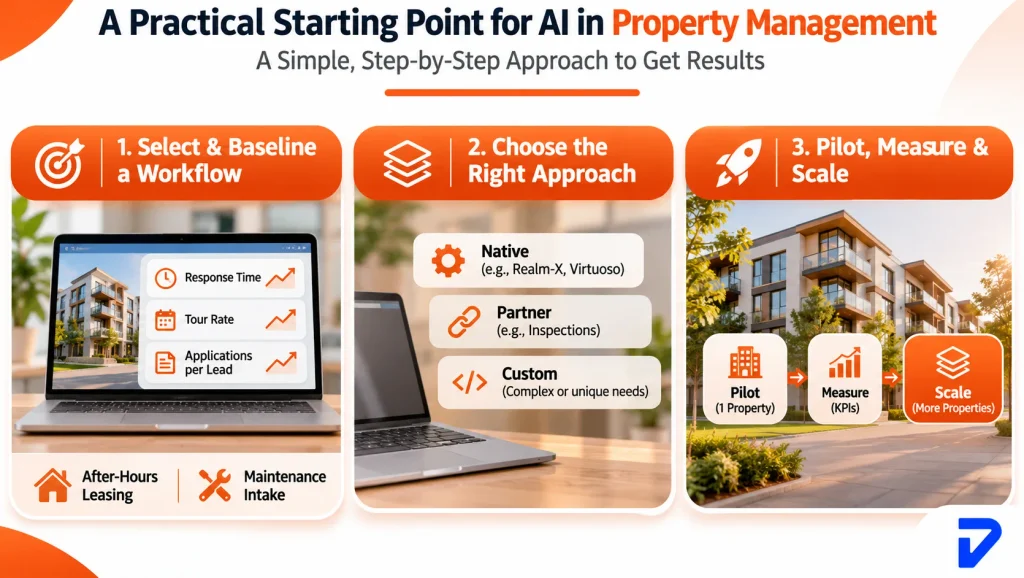
Before choosing any tool, pull 90 days of data for the workflow you plan to automate. For leasing, that means first-response time, tour rate, and applications per lead. For maintenance, track intake time, repeat visits, and days to completion. Without that baseline, you cannot prove the AI worked, and owners will rightly question the spend.
Choose Native, Partner, or Custom
Match the route to the gap you found. If Realm-X or Virtuoso already covers the workflow, switch it on and configure it carefully. A certified partner tool suits single-purpose needs such as inspections. A custom build earns its cost when the workflow spans several systems, follows unusual owner rules, or needs logic no vendor offers.
Pilot on One Property, Then Scale
Launch on a single property with a named owner who reviews AI conversations daily for the first two weeks. During that window, tune escalation rules, fix data gaps, and tighten approved answers. Once the KPI moves and error rates stay low for a full month, roll the setup out to similar properties in planned waves.
The Bottom Line
AI for property management delivers when it works inside the systems your team already trusts. Native Yardi and AppFolio features cover standard workflows, while custom integrations handle the processes that make your portfolio different. Either way, the gains come from clean data, clear write-back limits, and residents who can always reach a person. The technology matters less than the discipline around it.
When you decide where to begin, Pinnasys helps property operators map workflows, connect data, and ship AI that stays in production. A focused AI consulting engagement can identify your first use case and its expected payback. From there, pilot one property, measure the KPIs your owners already track, and expand only when the numbers hold.
Key Takeaways from the Article
- AI pays off when it reads from and writes back to Yardi or AppFolio.
- Fast lead response and maintenance intake are the quickest, most measurable first use cases.
- Residents accept AI for routine questions but still expect a human for emergencies.
- Native tools fit standard workflows, while custom integrations handle portfolio-specific processes and rules.
- Fair housing, screening accuracy, and messaging consent need guardrails built in from launch.
Frequently Asked Questions on AI for Property Management
How can AI help property management teams with limited staff?
It absorbs repetitive leasing, messaging, and intake work, so existing staff can manage more doors. AppFolio’s 2026 survey found firms with broad AI adoption expected 31% portfolio growth, compared with 12% for firms without AI.
Will AI replace leasing agents and property managers?
Current data points the other way. AppFolio found 34% of AI adopters plan to add headcount, compared with 25% of non-users. For property managers, AI mainly shifts staff time toward tours, renewals, and resident relationships.
Should AI handle emergency maintenance calls?
Automation can capture details quickly, but a person should own the response. HappyCo found that only 30% of residents are comfortable reporting emergencies to AI, and 51% of the issues they reported qualified as emergencies.
How long does it take to connect AI to Yardi or AppFolio?
Native features can launch in weeks because no integration is required. Custom proptech connections take longer, since Yardi needs a data exchange agreement per interface type and AppFolio reviews Stack partners before granting access.
What data does AI property management software need to work well?
At minimum, it needs accurate unit, lease, ledger, work order, and vendor records. Duplicate units or outdated charge codes cause incorrect results, so clean those five record types before enabling any automation.