



AI B2B pricing reads cost, demand, and deal signals in real time, then sets or recommends a price per customer and SKU inside guardrails your team defines. Gains land in basis points.
A single point of price improvement lifts operating profit by 8.7 percent on average, assuming volume holds steady. That math explains why AI B2B pricing moved from research project to board agenda item in under two years. Most mid-market sellers, though, still price the way they did a decade ago: a spreadsheet, a cost-plus rule, and a rep’s discretion at the moment of quote.
The combination quietly leaks margin, and it loses deals outright when a quote lands days after the buyer chose someone else. Pricing is, at heart, a decision intelligence problem, and real-time systems attack both halves of it at once. The mechanics are less exotic than the marketing suggests, and the failure modes are well documented.
What is B2B Pricing?
B2B pricing is the discipline of setting what one business charges another, delivered through negotiated contracts, volume tiers, and account-specific price lists rather than a single public number. Complexity is the defining trait. A distributor running 50,000 SKUs across 5,000 accounts is not managing one price; it manages millions of price points that shift with cost, contract, region, and order size. The stakes are proportional to that complexity. McKinsey reports that well-run pricing transformations produce two to seven percentage points of sustained margin improvement, with initial benefits arriving in three to six months. The base is enormous, because every dollar of revenue passes through a price.
When to Use It?
Structured pricing earns its keep once unique price points outgrow what a person can hold in working memory. A practical threshold: if your ERP carries more than 100,000 distinct price records, spreadsheet management has already failed, whether or not anyone admits it. Three other triggers matter. Discount discretion sits with reps, and nobody audits it. Input costs move faster than your quarterly list refresh. Quote turnaround has stretched past a week. Any one of those is enough to justify the work.
How AI Translates to Real-World B2B Efficiency?
Efficiency shows up in two places, and the second surprises people. The first is speed: quotes that took days return in minutes, because the system assembles cost, contract, and competitive inputs without a human chasing them. The second is consistency, which is where the money sits. Two similar accounts stop receiving prices that differ by eleven points for no defensible reason. One $15 billion distributor replaced manual pricing across 1.5 million SKUs. McKinsey reports it captured more than 200 basis points of margin improvement, then added roughly 50 more with agentic tooling on top.
How AI in B2B Pricing Works
Five stages run in sequence, and each one fails in its own way. The pipeline is not conceptually hard. It is operationally unforgiving, because a bad input at stage one becomes a wrong price at stage four.
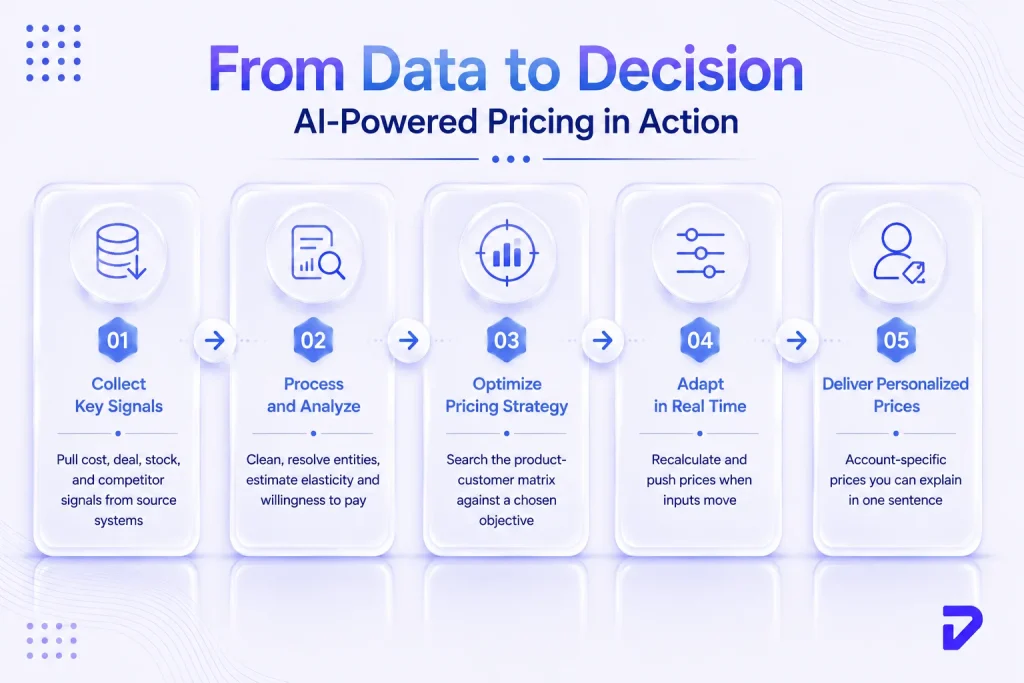
Data Collection
Everything starts with signals pulled from systems that were never designed to talk to each other. Transaction history and cost sit in the ERP, account terms and open opportunities in the CRM. Stock positions live in the WMS, competitor list prices on public sites, and freight and commodity indexes arrive from third-party feeds. Most mid-market sellers discover here that their product data is a mess. That discovery is normal, and it is the real first project.
Data Processing & Analysis
Raw signals become features a model can use. Cleanup, deduplication, and entity resolution come first, so that “GRN-4400” and “Grainger 4400” resolve to one product. Then the system estimates price elasticity, which measures how much volume you lose per point of price you take. It also builds willingness-to-pay estimates by segment. Generative AI has made this stage dramatically cheaper: one B2B materials distributor unified fragmented product data in roughly a fifth of the time it previously took.
Price Optimization
Optimization is where a target function gets chosen, and that choice is a business decision, not a technical one. Maximize margin, defend share, or protect a strategic account; each produces a different price. The model then searches the product-customer-context matrix for the price that best serves the objective at acceptable risk. Guardrails constrain the output: floor prices, contract ceilings, and approved discount bands. Without them, a well-trained model will happily recommend something commercially indefensible.
Real-Time Adjustments
Adjustment earns the phrase “real time.” When a cost input moves, a competitor drops a price, or inventory ages past a threshold, the system recalculates affected prices and pushes them where they are consumed. Cadence varies by category. Commodity-linked SKUs may reprice daily, while contract items hold for a quarter and only flag exceptions. As a result, the operator question is never how fast it can go. It is how fast a category should move without spooking buyers.
Personalized Pricing
Personalization in B2B means account-specific, not person-specific, and that distinction is doing heavy legal work. A price reflecting contracted volume, payment terms, service level, and cost-to-serve is standard commercial practice. A price reflecting surveillance of individual behavior is a different animal. Regulators have noticed. US state lawmakers introduced more than 40 algorithmic pricing bills across at least 24 states in 2026 alone, and nearly all target consumer pricing. Even so, a distributor should be able to explain every price it charges, in one sentence, to the account paying it.
What Are The Benefits of Using AI in B2B Pricing?
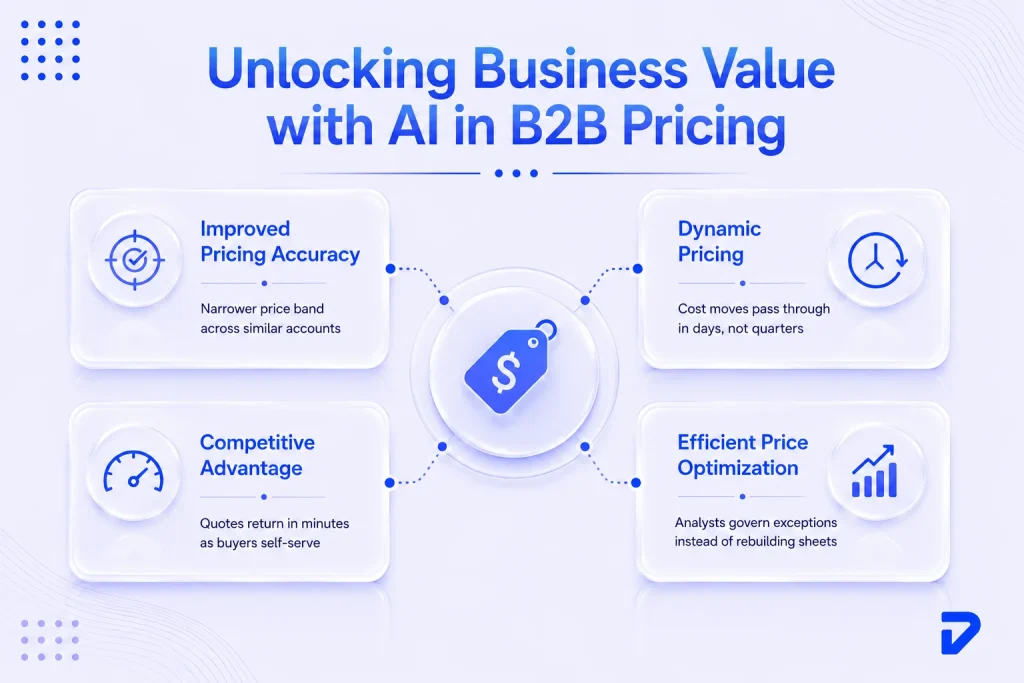
Benefits cluster into four areas, and pricing leaders now expect commercial lift rather than headcount savings alone. McKinsey surveyed 419 pricing executives in November 2025. Cost and productivity gains ranked top three for 66 percent, but 59 percent named price uplift and 50 percent named a better win rate.
Improved Pricing Accuracy
Accuracy here means the price matches what the deal is actually worth, not what a stale rule says. Manual pricing drifts because costs move and list files do not. Machine learning closes that gap by re-estimating value continuously against real transaction outcomes. The measurable effect is a narrower price band across similar accounts, which finance sees as reduced variance and sales sees as fewer arguments.
Dynamic Pricing
Dynamic pricing AI adjusts levels as conditions change instead of waiting for the next review cycle. In distribution, that usually means passing through a copper or freight movement in days rather than a quarter. The benefit is not clever repricing. It is the elimination of the window where you sell at last quarter’s cost and absorb the difference yourself.
Competitive Advantage
Advantage comes from speed and defensibility together. Buyers have already moved: Gartner found 67 percent of B2B buyers prefer a rep-free experience, and 45 percent used AI tools during a recent purchase. When a buyer compares five suppliers in an afternoon, a five-day quote is not a quote. It is a decline.
Efficient Price Optimization
Efficiency means your pricing team stops assembling inputs and starts governing outcomes. Analysts who spent Mondays rebuilding a competitor sheet instead review exceptions, tune guardrails, and investigate the deals the model flagged. That shift matters more than the hours saved, because judgment gets applied where it changes the number.
Wondering how much margin your current pricing process is quietly losing?
Pinnasys maps your data and guardrails to find the one category most worth fixing first for your business now.
How AI-Powered B2B Pricing is Different From Manual B2B Pricing?
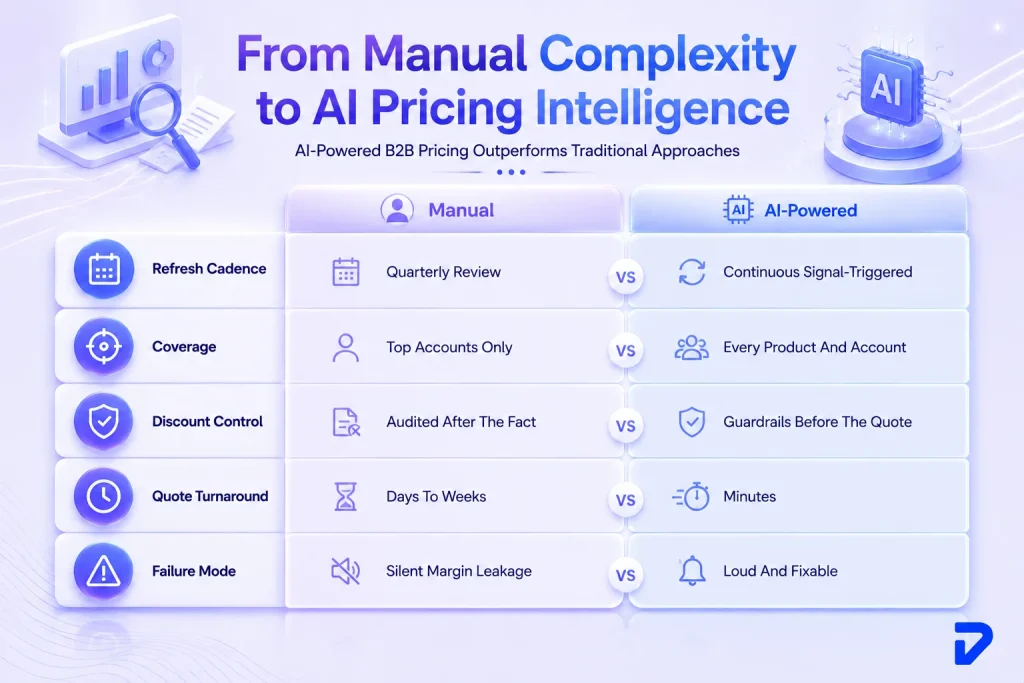
The honest difference is not intelligence. It is refresh rate, coverage, and auditability. A skilled pricing manager makes excellent decisions on the forty accounts they know well, then applies a blunt rule to the other 4,960.
| Dimension | Manual B2B Pricing | AI-Powered B2B Pricing |
| Refresh cadence | Quarterly or annual list review | Continuous, triggered by cost and demand signals |
| Coverage | Top accounts priced well, long tail priced by rule | Every product and account priced individually |
| Cost pass-through | Lags input moves by weeks | Days, with exception routing |
| Discount control | Rep discretion, audited after the fact | Guardrails applied before the quote leaves |
| Quote turnaround | Days to weeks | Minutes for standard configurations |
| Explainability | Tribal knowledge, rarely documented | Logged inputs and recommendation reasons |
| Failure mode | Silent margin leakage | Bad data producing confident wrong prices |
| Typical impact | Baseline | 200 to 250 basis points on a mature deployment |
Note the last row of the failure column. Manual pricing fails quietly and slowly, which is why it survives so long. AI pricing fails loudly and fast, which feels worse and is, in practice, far easier to fix.
What are The Best AI Tools for B2B Price Optimization?
No single tool sets a price. A working stack borrows from six categories, and most mid-market sellers already own three of them without connecting the pieces.
| Tool category | What it contributes | Pricing decision it improves |
| Predictive analytics | Elasticity and win-probability models | How much price this deal can carry |
| Inventory management | Live stock, aging, and cover data | When to move price to clear or protect stock |
| AI-powered CRMs | Deal context, history, account health | Whether a discount buys anything |
| Dynamic pricing engines | Rules, guardrails, repricing logic | The number itself, and its bounds |
| Supply chain optimization | Landed cost and lead-time signals | Cost floors that hold under volatility |
| Personalized marketing | Segment behavior and offer response | Which offer to attach to which account |
Predictive Analytics
Predictive models answer the two questions a rep guesses at: what will this account pay, and how likely is the deal to close at that number? Trained on your own won and lost transactions, they replace instinct with a probability. Their value depends on loss data, which most sellers record badly.
Inventory Management
Stock position belongs in the price. Slow-moving inventory carrying cost every week is worth less than the list says, and constrained inventory is worth more. Systems that read live stock let price reflect that reality, not an assumption from a planning meeting six weeks ago.
AI-Powered CRMs
The CRM supplies context: contract terms, service history, share of wallet, and open pipeline. A discount to an account already buying 90 percent of its category from you is a gift, not a strategy. Modern CRM AI surfaces that distinction before approval, not during the post-mortem.
Dynamic Pricing
Dynamic pricing engines hold the rules, the floors, and the repricing triggers. Buy or build is a real decision here, and it usually turns on how unusual your price architecture is. Standard tiering suits a package; complex bundled and index-linked structures often need custom logic wired into your stack through AI integration work.
Supply Chain Optimization
Landed cost, not invoice cost, sets the floor. Freight, duty, currency, and lead-time risk move independently, and a pricing model blind to them will confidently price below break-even on a bad tariff week. Supply chain signals close that hole.
Personalized Marketing
Offer and price travel together. Segment-response models identify which accounts price move and which move on availability or terms. That prevents discounting to a buyer who was never price-sensitive.
How Do B2B Companies Use AI for Dynamic Pricing Strategy?
Value-Based & Customer-Specific Pricing
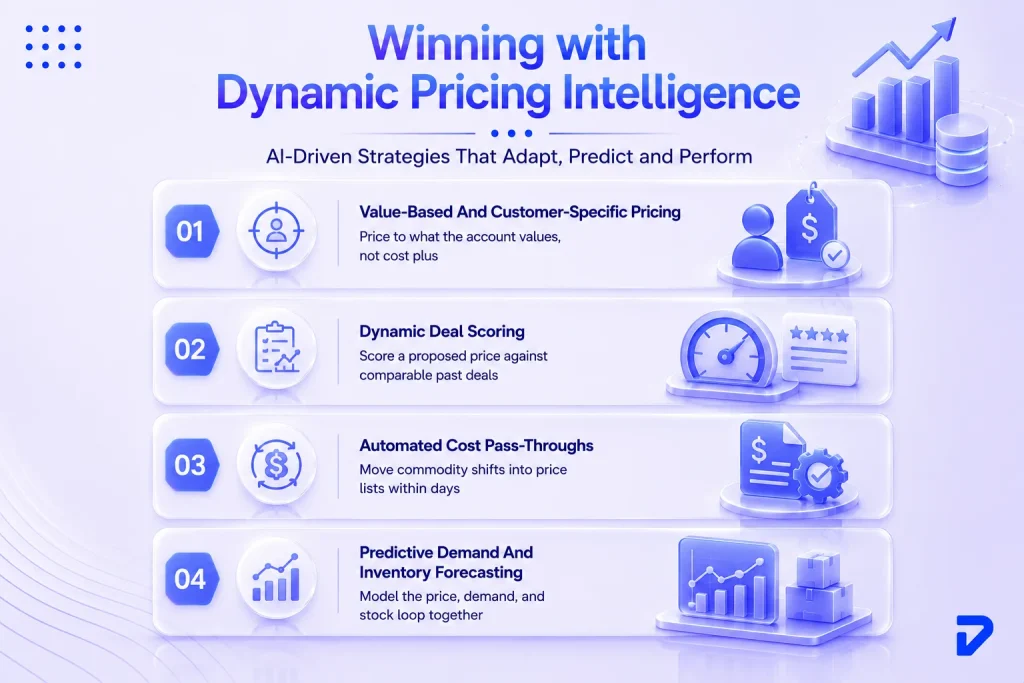
The system prices based on what the account values rather than cost plus a fixed percentage. Two customers buying the same valve, one needing next-day availability and one buying on an annual schedule, are not buying the same thing. Willingness-to-pay models make that difference visible and priceable, which is where most B2B price uplift originates.
Dynamic Deal Scoring
Deal scoring rates a proposed price against comparable past transactions and returns a score plus a reason. This is where agentic AI systems earn their place, routing exceptions instead of merely reporting them. Below threshold, the deal routes for approval. Above it, the rep proceeds. McKinsey’s survey found 62 percent of respondents rank discount approval and governance among the biggest impact opportunities, while only 22 percent rank it a top investment priority. That gap is the clearest arbitrage in pricing right now.
Automated Cost Pass-Throughs
Cost pass-through is the least glamorous use case and often the fastest payback. Agents monitor cost inputs continuously and update affected prices within governance rules, so a commodity move reaches the price list in days. Most of this is workflow automation with a model attached, not frontier AI, and it is usually where a first pilot should land.
Predictive Demand & Inventory Forecasting
Forecasts close the loop. Price influences demand, demand draws down stock, and stock position feeds back into price. Systems that model the loop rather than one leg of it avoid the classic error: discounting to move inventory that was about to sell at full price anyway.
How to Choose the Right Pricing Software for B2B Strategies?
Define Core Pricing Goals
Name the outcome in a number before anyone books a demo. Margin points on the long tail, quote turnaround under an hour, or discount variance halved are all valid goals; “better pricing” is not. Whether you sell fasteners or field services, the goal determines the target function, and the target function determines which tool fits.
Identify Your Pricing Model
Cost-plus, value-based, index-linked, tiered, and contract-driven models each stress software differently. Index-linked pricing needs external feed handling. Contract-heavy books need version control and compliance checking. A tool built for one and sold for the other will be discovered in month five, not month one.
Analyze Integration Depth
Integration is where budgets die. Ask exactly how the tool reads cost from your ERP, writes prices back, and handles a schema change. Ask whether pricing runs synchronously inside quoting or as a nightly batch, since only one of those supports a real-time promise. Sub-second calculation is achievable, but only when the plumbing is real.
Assess Data Refresh Rates and Decision Logic
Refresh rate and explainability decide whether the system survives contact with your sales team. A recommendation nobody can justify to a customer gets overridden, and an overridden model is an expensive report. Demand the reason string alongside the number. The distinction between agentic and traditional AI matters here, because autonomy without auditability is the pattern to avoid.
Top B2B Platforms Leveraging AI in Pricing
Platform choice sets the ceiling on pricing sophistication, because the storefront and the price engine have to agree. Five dominate mid-market conversations.
| Platform | Pricing strength | Best fit |
| Amazon Business | Marketplace scale, AI-driven analytics | Sellers competing for catalog spend |
| Salesforce B2B Commerce | Entitlement pricing inside CRM data | Existing Salesforce estates |
| BigCommerce | Customer groups, price lists, quoting | $1M to $50M B2B revenue, fast launch |
| Shopify Plus | B2B catalogs and per-company price lists | Moderate complexity, speed to live |
| SAP Commerce Cloud | Deep ERP coupling, contract price books | Large catalogs, thousands of price lists |
Amazon Business
Amazon Business now serves over eight million organizations and drives more than $35 billion in annualized gross sales, including 97 of the Fortune 100. It is the benchmark your buyers compare you against, whether you sell there or not.
Salesforce B2B Commerce
Prices are tied to CRM entitlements, and Salesforce has pushed agents hard into that layer. It reported over $1.2 billion in Data Cloud and AI annual recurring revenue in Q2 FY26. The trade-off is cost concentration inside one vendor.
BigCommerce
BigCommerce ships B2B Edition with customer groups, price lists, and quote workflows natively. It covers moderate complexity and launches in months, not quarters.
Shopify Plus
Shopify Plus handles per-company catalogs and price lists cleanly. Beyond that, teams externalize pricing logic to a dedicated engine and call it by API.
SAP Commerce Cloud
SAP Commerce Cloud carries the most complete native contract-pricing model of the five. It also carries the longest implementation, commonly six to eighteen months, so fit is a question of scale, not features.
What Are The Common Implementation Challenges & How to Handle Them?
Data Quality Issues
Product data is dirty, and pricing exposes it. Duplicate SKUs, missing attributes, and cost fields updated by three teams produce confident wrong prices at scale. The naive fix is a data cleanup project that runs for a year and delivers nothing. The production-grade approach is narrower: fix data for one category, ship pricing on that category, then expand. McKinsey found more than 60 percent of early-stage adopters struggle with incomplete or siloed data, which is precisely why a scoped AI readiness assessment beats a blanket remediation program.
Integration Complexity
An ERP read is easy. The write-back path is not, because prices must land safely, under load, without breaking quoting. Budget for it honestly, insist on a rollback path, and use canary releases so a bad model version touches one region before it touches all of them.
Cost Concerns
The license is rarely the expensive part. Integration, data work, and model maintenance carry the real spend, and maintenance outlasts the build. Pick a first use case with a clear ROI case and measurable impact inside three to six months, then fund the foundations from that win rather than from a slide.
Employee Resistance
Reps override what they cannot explain. That is not obstruction; it is professional self-preservation in front of a customer. The fix is to ship the reason with the price and to keep human approval on exceptions. Notably, security and compliance concerns climb as adoption scales, from 25 percent of respondents at the experimenting stage to 59 percent among those who have scaled. Governance gets harder as you succeed, not easier.
How Does Pinnasys Help Businesses Implement AI Pricing Optimization?
Pinnasys starts where the money is, not where the demo is. In practice, that means one category, one price architecture, and a measurable target agreed before a line of code is written. We map the pricing decision first, then wire the pipeline: cost and deal signals in, elasticity and guardrails applied, recommendation plus reasoning out, human approval on exceptions.
Governance is designed in from day one, with logged inputs, drift monitoring, and a rollback path, because a pricing model nobody can audit will not survive its first disputed invoice. Our AI engineers have shipped production systems since 2016, and the pattern across our client work holds: narrow scope, honest metrics, and a system that still runs after the consultants leave.
The Bottom Line
AI B2B pricing is not a bet on the model. It is a bet on your data, your guardrails, and your willingness to let a system price the long tail that no human has time to price well. The returns are real and bounded: 200 to 250 basis points on a mature deployment, arriving in basis points rather than miracles.
The failures are equally predictable, and almost all of them trace back to dirty data or an unexplainable recommendation. Start narrow, measure honestly, keep a human on exceptions. At Pinnasys, we build pricing systems pairing predictive models with real-time monitoring, compliant with GDPR and SOC 2. Talk to our team about scoping your highest-ROI category first.
Key Takeaways from the Article
- A one percent price improvement lifts operating profit by roughly 8.7 percent on average.
- Mature AI pricing deployments deliver 200 to 250 basis points of margin improvement.
- Dirty product data, not model quality, causes most B2B pricing implementation failures.
- Reps override any price recommendation they cannot explain to a customer.
- Discount governance ranks high on impact and low on investment, creating clear arbitrage.
Frequently Asked Questions on B2B Pricing
Is AI pricing legal in B2B contracts?
Yes, in most jurisdictions. Account-specific pricing based on volume, terms, and cost-to-serve is standard commercial practice. Current US algorithmic pricing legislation targets consumer surveillance pricing, though price-fixing rules still apply to any shared algorithm.
How long does an AI pricing implementation take?
A scoped pilot on one category typically reaches production in three to six months. Full rollout across a large catalog usually runs twelve to twenty-four months, with data readiness rather than model development setting the pace.
Who should own AI pricing inside a mid-market company?
Ownership works best with a small pricing team reporting to finance or commercial leadership, supported by IT for integration. Sales owns exceptions. Ownership split between IT and sales alone reliably stalls adoption.
Can AI pricing work without replacing our ERP?
Yes. Most deployments read cost and transaction data from the existing ERP through APIs and write approved prices back. Replacement is rarely necessary and often introduces risk unrelated to pricing.
What happens when the model recommends a price a customer rejects?
The rep escalates, the exception routes through approval, and the outcome feeds back as training data. Rejected recommendations are a valuable signal, so systems without a loss-capture loop degrade over time.





Prakash C. Saini
Prakash Saini is the Founder & CEO of Pinnasys. With over a decade in digital transformation and building production systems, he grew an engineering team from 2 to 50 people and has led the delivery of 100+ production digital systems. Products built under his leadership have raised millions in funding and generated over $50 million in revenue. He holds an Executive MBA from IIM Kozhikode and today leads the AI engineering team at Pinnasys.